A Publisher Guide to Designing Clear Author and Reviewer Bylines

What Are the Best Practices for Distinguishing Authors and Expert Reviewers on Articles?
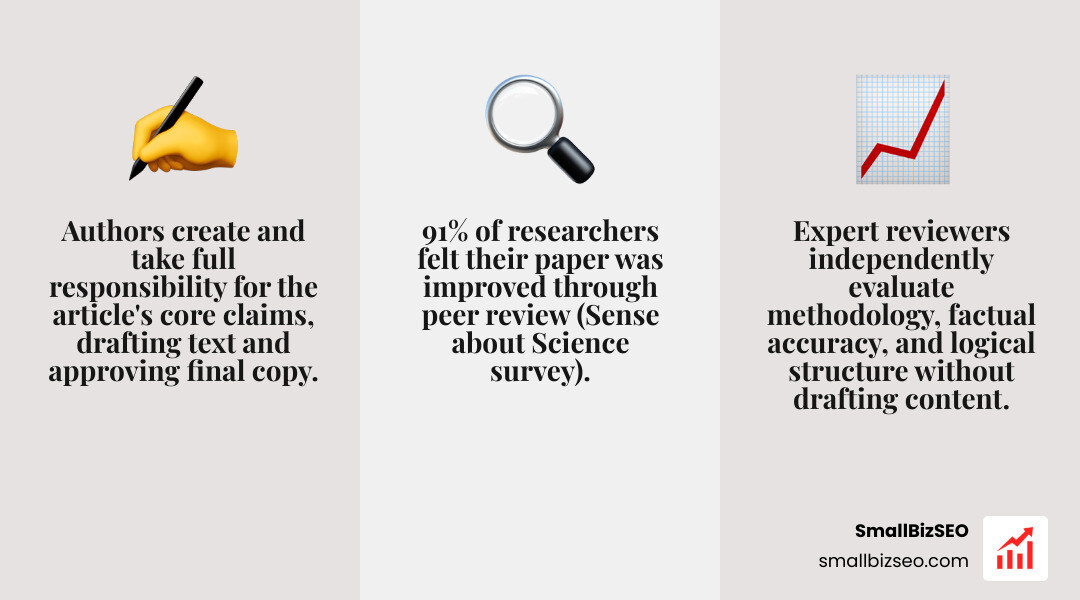
Authors create and take full responsibility for the article's core claims, while expert reviewers independently evaluate the methodology, factual accuracy, and logical structure. To keep these roles transparent, publishers must label each contributor separately in the page layout and detail their exact contributions.
When readers land on a technical, medical, or data-intensive guide, they need immediate clarity on who originated the ideas and who verified them. Blurring these lines erodes editorial integrity and weakens search engine trust. Implementing structured role demarcation ensures your publication aligns with recognized standards like the ICMJE guidelines and NISO peer review terminology. This is the practical foundation for how to distinguish authors and expert reviewers in articles without confusing your audience.
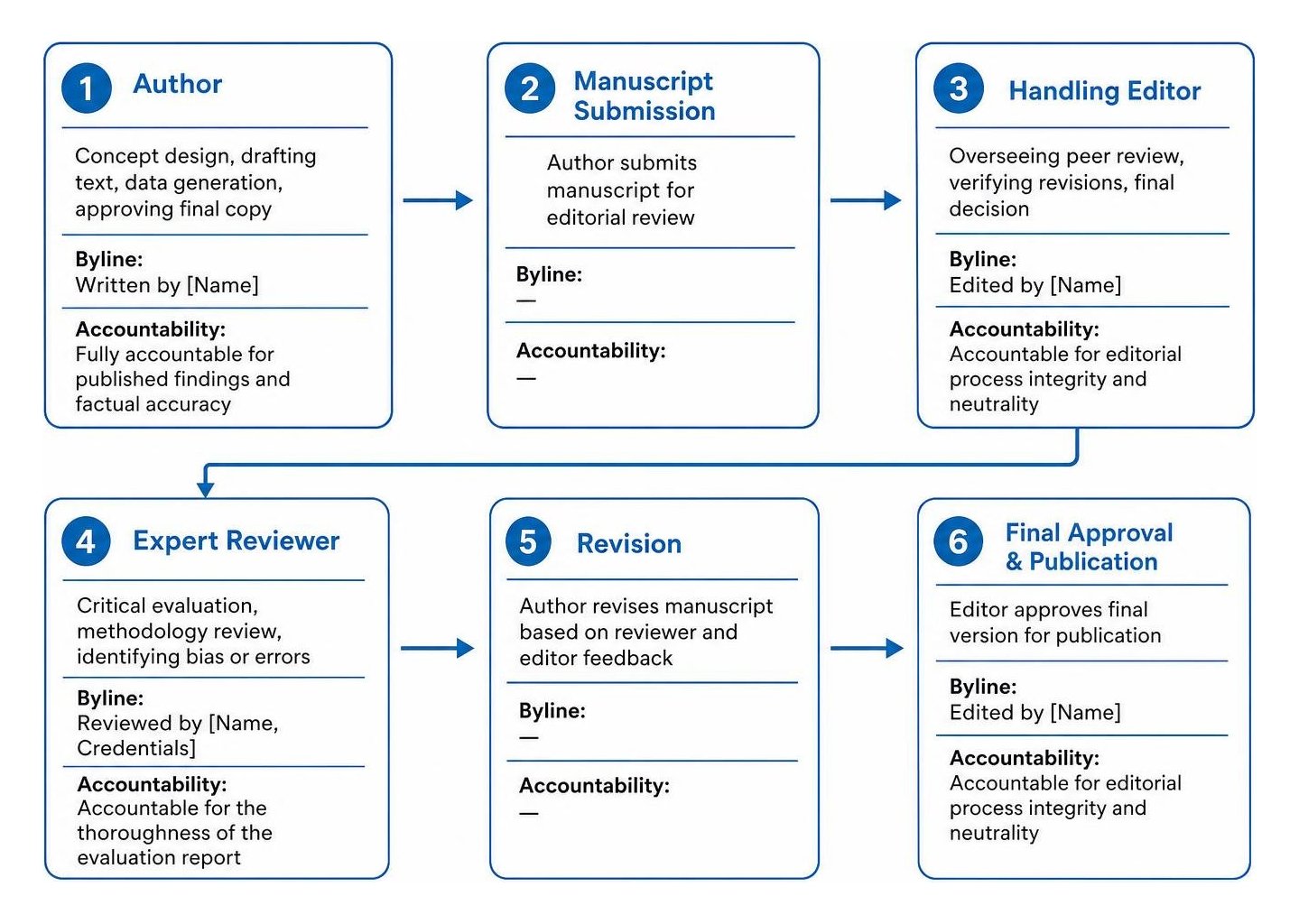
| Contributor Role | Primary Responsibilities | Byline Labeling | Accountability & Governance |
|---|---|---|---|
| Author | Concept design, drafting text, data generation, approving final copy | "Written by [Name]" | Fully accountable for published findings and factual accuracy |
| Expert Reviewer | Critical evaluation, methodology review, identifying bias or errors | "Reviewed by [Name, Credentials]" | Accountable for the thoroughness of the evaluation report |
| Handling Editor | Overseeing peer review, verifying revisions, final decision | "Edited by [Name]" | Accountable for editorial process integrity and neutrality |
What Are the Key Criteria for Distinguishing Authors and Expert Reviewers in Articles?
A contributor earns authorship only by making a substantial intellectual contribution to conceiving, designing, drafting, or revising the manuscript. In contrast, an expert reviewer functions as an objective critic who assesses the submission against industry standards without drafting the underlying content.
Scholarly bodies establish clear criteria for who belongs in the byline. Standard guidelines on authorship and contributorship mandate that authors approve the final version and accept public accountability for the work. Peer review, however, is a quality-control partnership. A Sense about Science peer review survey revealed that 91% of respondents felt their paper was improved through peer review, while a Taylor & Francis study showed that most researchers rated peer review's contribution to their work as 8 or higher out of 10.
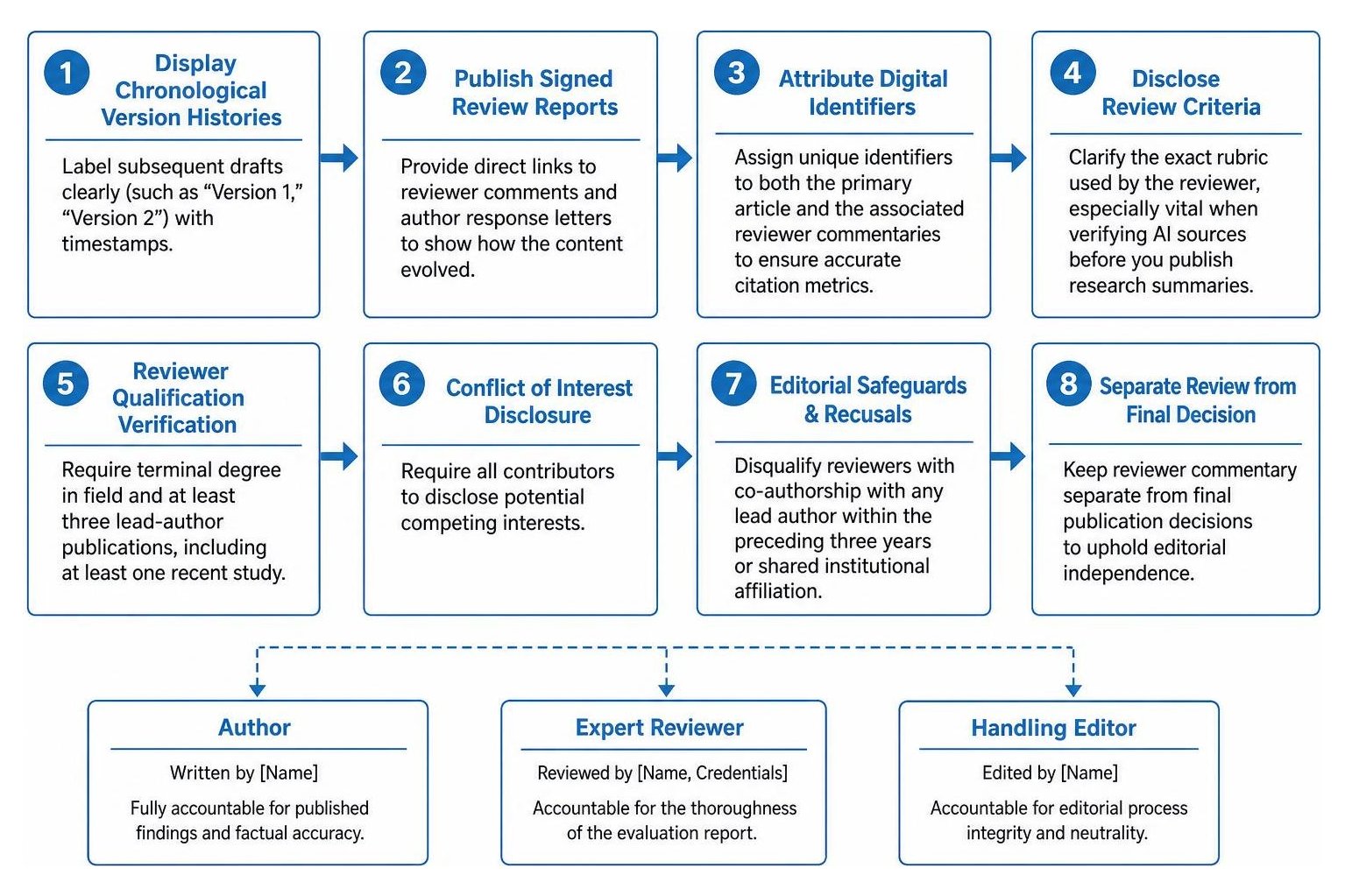
To maintain high standards, benchmark reviewer qualifications rigorously. For instance, leading open-research platforms require expert reviewers to hold a terminal degree in their field and have authored at least three lead-author publications, including at least one recent study. Clearly stating these qualifications on the page reinforces digital authority and helps search engines evaluate your site's EEAT signals.
How Can Publishers Use Open Peer Review Data to Distinguish Authors and Expert Reviewers?
Publishers can distinguish roles by publishing signed reviewer reports, providing permanent version histories, and displaying dedicated verification badges alongside digital object identifiers (DOIs).
In transparent publishing ecosystems, readers do not have to guess who reviewed a piece. Open-access platforms make the entire evaluation trail public. Following a recognized framework for peer review and quality assurance allows you to display reviewer names, their institutional affiliations, and their dated feedback reports directly beneath the article text or within an expandable review panel.
When implementing open peer review data on your site, follow this verification workflow:
- Display Chronological Version Histories: When authors update an article based on feedback, label subsequent drafts clearly (such as "Version 1," "Version 2") with timestamps.
- Publish Signed Review Reports: Provide direct links to reviewer comments and author response letters to show how the content evolved.
- Attribute Digital Identifiers: Assign unique identifiers to both the primary article and the associated reviewer commentaries to ensure accurate citation metrics.
- Disclose Review Criteria: Clarify the exact rubric used by the reviewer, which is especially vital when verifying AI sources before you publish research summaries.
How Should Publishers Handle Conflicts of Interest and Editorial Safeguards?
Publishers must require all contributors to disclose potential competing interests, enforce strict editor recusals when personal or financial ties exist, and separate reviewer commentary from final publication decisions.
Upholding editorial independence requires robust safeguards aligned with Committee on Publication Ethics (COPE) standards. Reviewers must be disqualified if they have co-authored research with any lead author within the preceding three years or share an institutional affiliation. Publishers should consult established resources, such as a scholarly journal publishing guide on types of review, to determine whether single-anonymous, double-anonymous, or open models best prevent evaluation bias.
Maintaining blind reviews has become increasingly complex. Deep learning studies show that text attribution models can crack double-anonymous reviews with over 73% accuracy by analyzing distinctive phrasing and reference lists. This makes automated and human conflict-of-interest checks indispensable. Furthermore, handling editors must retain final authority; data from Frontiers indicates that editors follow reviewer recommendations in 90% of cases, yet human editorial oversight remains necessary to catch coercive citation requests and determine whether AI can edit without human oversight.
How Can Publishers Design E-E-A-T-Compliant Author and Reviewer Metadata for Search Engines?
Publishers must pair human-readable bylines with structured JSON-LD schema markup that differentiates the author property from the reviewedBy entity. This ensures both website visitors and search engine crawlers can verify contributor credentials.
Search engines evaluate author expertise and editorial oversight when assessing content quality. If an article covers high-stakes topics such as financial guidance, legal processes, or healthcare advice, demonstrating independent verification is critical. Displaying an expert reviewer's name visually on the page is step one; feeding that entity data directly into the search graph via structured markup is what cements your topical authority.
How Can Publishers Implement Schema Markup and Visible Bylines for Maximum Trust?
To maximize credibility, embed explicit schema properties for every contributor and pair that markup with interactive, visible author and reviewer cards on the front end.
Follow these direct technical steps to implement dual-attribution schema markup:
- Define Author Entities: Use the standard
authorproperty within yourArticleorTechArticleschema, specifying the creator's full name, job title, and authoritative profile links (such as their personal website or LinkedIn profile). - Nest the Reviewer Entity: Add the
reviewedByproperty containing aPersonschema object. Include their relevant academic or professional credentials, organization affiliation, and direct links to their published works. - Synchronize Visible UI with Markup: Ensure all details in your author structured data match the visible page text. Discrepancies between markup and visual bylines can trigger algorithmic trust penalties.
- Integrate Credential Popups: Design your site's front-end byline with clickable profile cards. When a reader clicks "Reviewed by," an overlay should display their subject-matter expertise, years of experience, and verification date.
Clear bylines not only build immediate reader trust, but they also serve as a foundational metric when measuring if your brand is actually authoritative. At SmallBizSEO, we engineer this visual trust architecture into our data-driven Velocity framework, helping businesses achieve rapid organic growth while upholding search quality standards.
Master Editorial Transparency on Every Page
Distinguishing between content creators and expert evaluators transforms standard articles into authoritative, high-trust assets. By implementing clear visible bylines, enforcing strict conflict-of-interest rules, and structuring your schema markup, you protect your readers and provide search engines with unambiguous quality signals.
If you are ready to modernize your publication's digital authority, explore our specialized solutions or upgrade your site layout with our custom author box design services to showcase your team's expertise seamlessly.