Descriptive Anchors: A Practical Field Guide to Writing Natural Links

How do you write descriptive anchors that sound natural?
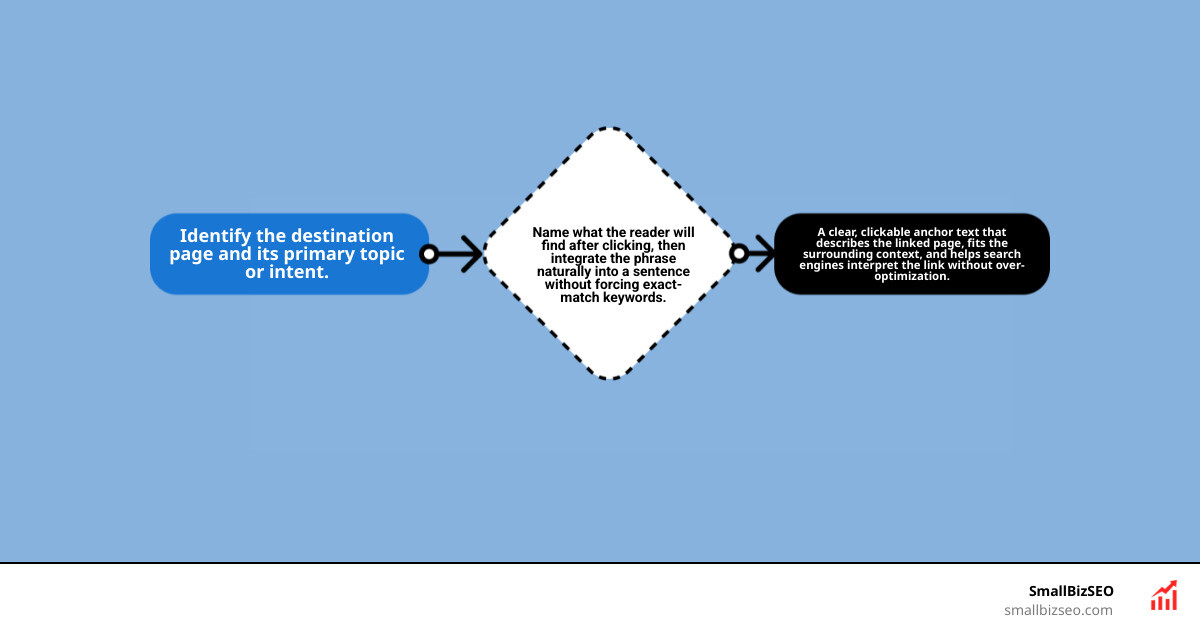
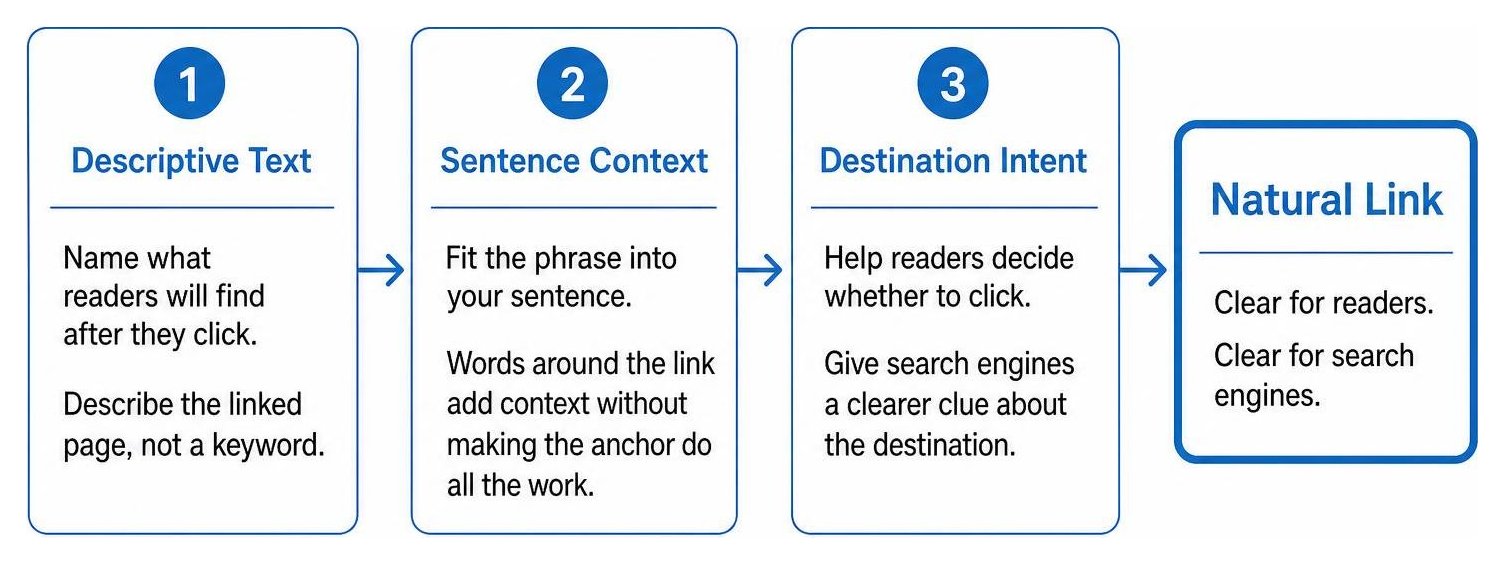
To write descriptive anchors without forcing exact-match keywords, name what readers will find after they click. If a link leads to a pricing page, use “compare pricing plans” instead of “click here.” Fit the phrase into your sentence, and use a keyword only when it sounds natural. The words around the link can add context without making the anchor do all the work.
A good anchor helps readers decide whether to click and gives search engines a clearer clue about the destination. It should describe the linked page, not repeat a keyword just because you want to rank for it.
I’m Clayton Johnson, founder of SmallBizSEO. I help small businesses learn how to write descriptive anchors without forcing exact match keywords through my work in SEO, content strategy, and link building.
How to Write Descriptive Anchors Without Forcing Exact Match Keywords
Writing effective anchors means focusing on clarity, search intent, and readability rather than stuffing mechanical search queries into your copy. When search engines crawl your content, they use natural language processing and modern semantic understanding to evaluate how pages connect. Modern search algorithms do not need robotic keyword matches to figure out where a link leads.
Instead, creating SEO-friendly links requires writing clickable text that accurately summarizes the destination while reading naturally within your sentence. As Search Engine Land explains in their guide on how to optimize your anchor text, search engines evaluate the entire semantic context surrounding a hyperlink rather than isolating the clickable words alone.
Why are exact-match anchors risky compared to descriptive link text?
Direct Answer: Overusing exact-match anchors exposes your website to algorithmic link spam filters, triggers over-optimization penalties, and creates a confusing experience for human readers.
When webmasters force identical, keyword-dense phrases into their links, search engines flag the pattern as manipulative. Understanding what exact match anchor text is helps clarify why this happens: repeating identical commercial search terms looks unnatural because genuine human writers rarely link out using identical commercial queries. For instance, in one documented industry case study, a law firm built roughly 120 backlinks where 72% used the identical exact-match phrase "personal injury lawyer NYC." Following an algorithmic spam update, their organic search traffic plummeted by 80%.
Beyond spam detection, forcing exact matches hurts real users and accessibility. According to Siteimprove's breakdown on how descriptive anchor text helps search engines and AI interpret links, vague links like "click here" or awkward keyword-stuffed strings fail Web Content Accessibility Guidelines (WCAG). Screen reader users often pull up lists of links on a page to navigate efficiently; hearing repetitive keywords or empty calls-to-action makes navigation impossible.
| Anchor Type | Example Phrasing | SEO Risk Level | User & Accessibility Impact |
|---|---|---|---|
| Exact-Match | "affordable plumbing services" | High when repeated | Confusing, robotic flow |
| Generic | "click here" / "read more" | Low risk, zero topical value | Forces users to hunt for context |
| Descriptive / Partial | "schedule a plumbing inspection" | Safe and natural | Clear destination intent and accessible |
What is the step-by-step process for how to write descriptive anchors without forcing exact match keywords?
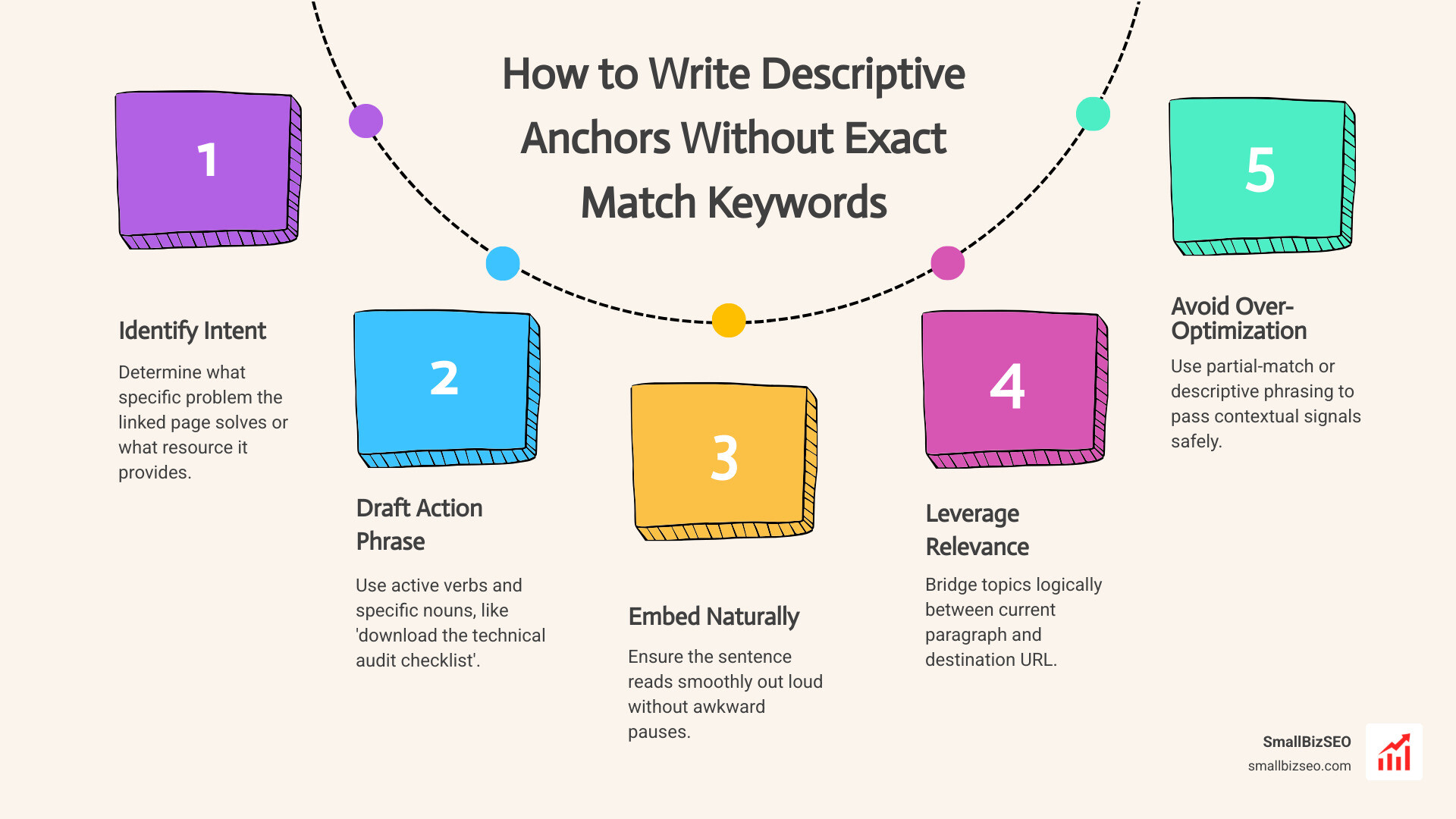
Direct Answer: To craft a descriptive anchor, identify the primary purpose of the destination page, choose an action-driven 3- to 4-word phrase that reflects that purpose, and integrate it seamlessly into your sentence.
Research shows that the average natural anchor across the web is 3 to 4 words long. In fact, case studies demonstrate that switching from lazy, generic anchors to thoughtful, relevant descriptions increased page views by 88%.
Follow this four-step sequence whenever you add links:
- Identify the destination's primary intent: Determine what specific problem the linked page solves or what resource it provides.
- Draft a natural action phrase: Use active verbs and specific nouns (e.g., "download the technical audit checklist" rather "audit checklist").
- Embed the phrase into the sentence flow: Ensure the sentence reads smoothly out loud without awkward pauses.
- Leverage topical relevance: Use the practical link builders guide to topical relevance to ensure the link logically bridges the topic of your current paragraph with the topic of the destination URL.
How do you balance keyword relevance with natural context and sentence flow?
Direct Answer: Balance keyword relevance by using co-occurrence—placing your target topic words in the surrounding sentence while keeping the clickable text focused on a concise, descriptive action.
Modern search engines and AI retrieval models evaluate surrounding text alongside the anchor itself. You do not need to cram your main topic directly into the clickable anchor. Placing a natural editorial link inside a topically rich sentence passes strong contextual signals without triggering over-optimization filters.
Consider this practical comparison:
- Forced: "We offer the best [emergency roof repair Atlanta] for homeowners."
- Natural with Co-Occurrence: "If storm damage causes a sudden ceiling leak, you can [request emergency roof repairs] from our local team."
In the second example, the context words ("storm damage," "ceiling leak," "local team") provide rich semantic clues, allowing the anchor to remain smooth, clear, and perfectly readable.
How should your internal and external link strategies differ in practice?
Direct Answer: Internal links can be more direct and topic-specific because you control your site architecture, whereas external backlinks must reflect natural, diverse third-party attribution dominated by brand names.
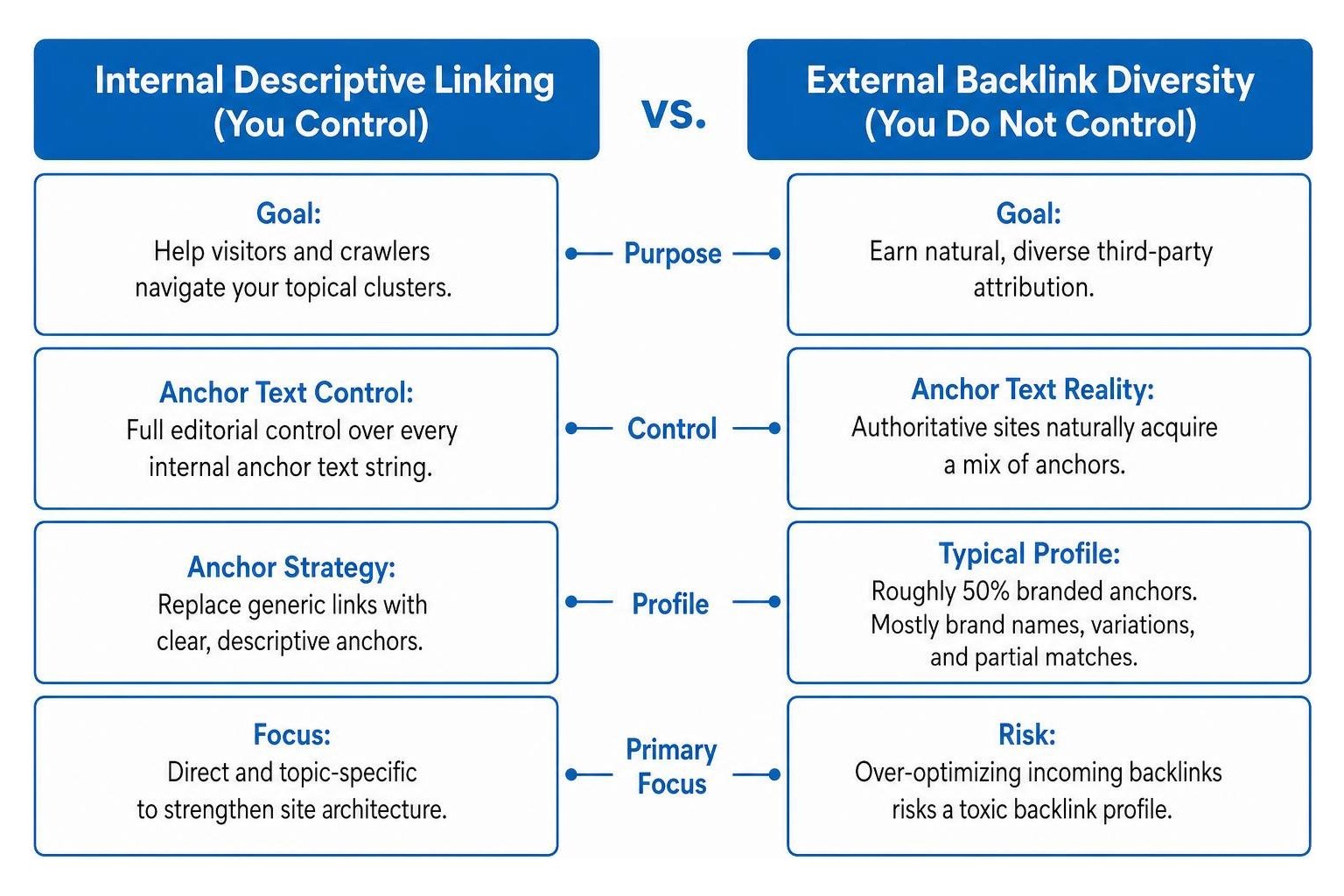
When linking internally, your goal is to help visitors and crawlers navigate your topical clusters. You have full editorial control over every internal anchor text string, meaning you can systematically replace generic links with clear descriptions.
External link profiles behave differently. Authoritative websites like Ahrefs naturally accumulate roughly 50% of their referring domains via branded anchors. A natural profile consists primarily of brand names, variations, and partial matches, while keeping exact matches to a tiny fraction. Over-optimizing incoming backlinks risks acquiring a toxic backlink profile that signals artificial link building to search engines.
How to Audit and Fix Problematic Links Across Your Website
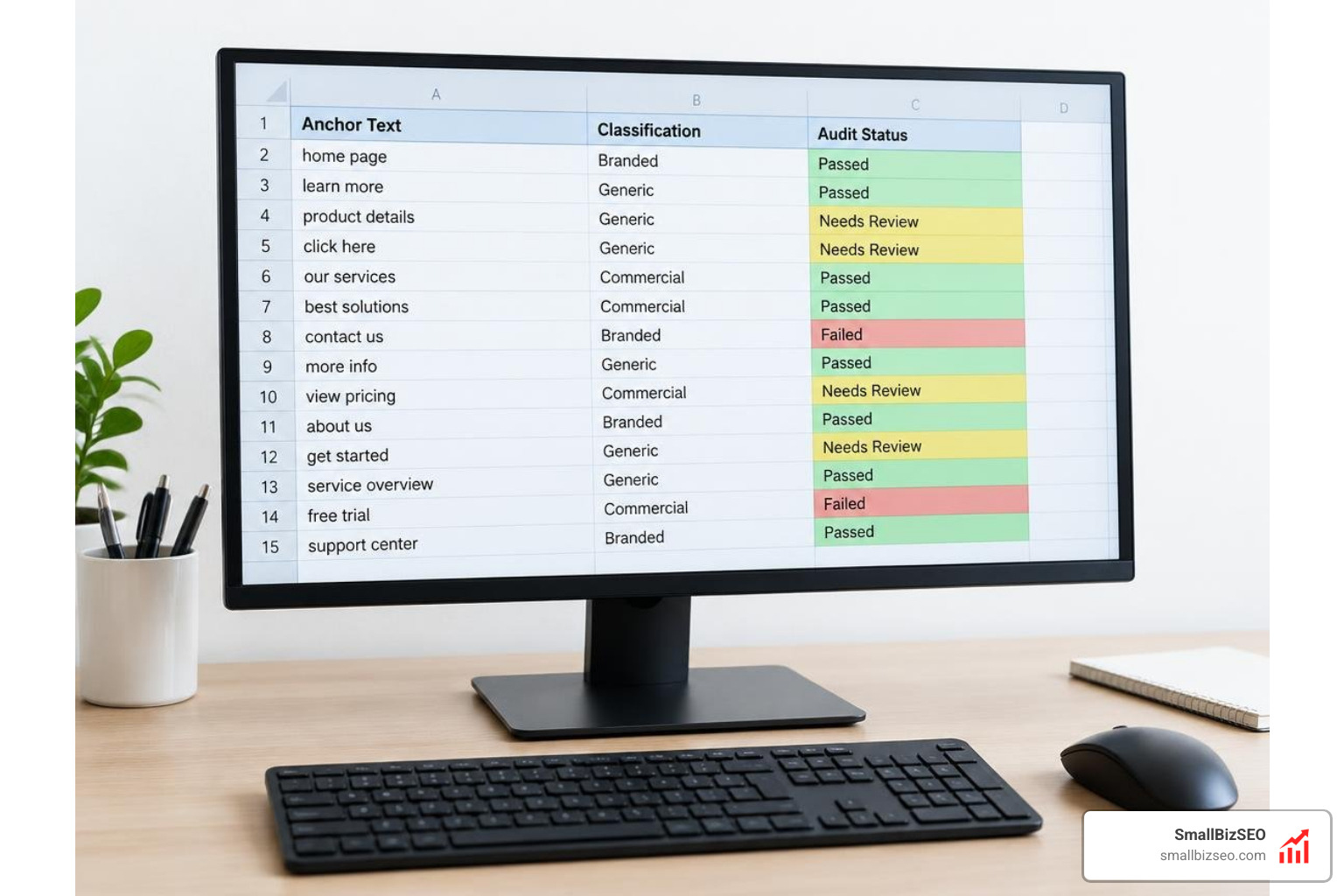
Direct Answer: Audit your anchor profile by crawling your site, classifying link text into categories (branded, descriptive, generic, exact-match), and rewriting any repetitive or ambiguous phrases.
Many site owners fall into the trap of obsessing over rigid anchor percentages. However, as detailed in this analysis of why anchor text ratios are a myth, search engines do not grade websites against a universal mathematical formula. Instead, algorithms look for unnatural patterns and repetitive commercial clusters. Implementing modern link auditing to build a risk-free anchor profile without strict percentages ensures your site maintains editorial integrity without getting bogged down by arbitrary rules.
How to write descriptive anchors without forcing exact match keywords during a link audit?
Direct Answer: Use link extraction tools to isolate all internal and inbound anchors, group them by destination URL in a spreadsheet, and replace repetitive keywords with varied, intent-focused descriptions.
Follow this audit workflow to clean up your links:
- Export link data: Pull your internal and external link records using website crawling tools or Google Search Console.
- Review your anchor inventory: Examine your current anchor text profile by creating a pivot table that groups anchors by destination page.
- Flag repetitive anchors: Look for commercial landing pages where the exact same keyword appears repeatedly across multiple internal pages.
- Rewrite generic and forced links: Replace instances of "read more" or forced keywords with varied phrases describing the unique value of the linked resource.
At SmallBizSEO, we help businesses implement safe, scalable linking frameworks through our data-driven Velocity framework. If you want to strengthen your site architecture, improve crawlability, and build lasting organic visibility, explore our data-driven link-building services to get started.
Action Steps for Cleaner, Smarter Linking
Improving your link profile does not require complex technical overhauls. Start small by auditing your top ten most visited landing pages. Identify any vague links or repetitive exact-match phrases, and rewrite them into natural, 3- to 4-word descriptive summaries. By focusing on destination intent and sentence readability, you will provide a superior user experience, improve web accessibility, and build sustainable search engine authority.