Detailed Guide to Local SEO for Law Firms

How Can Local SEO Help Your Law Firm Get Found?
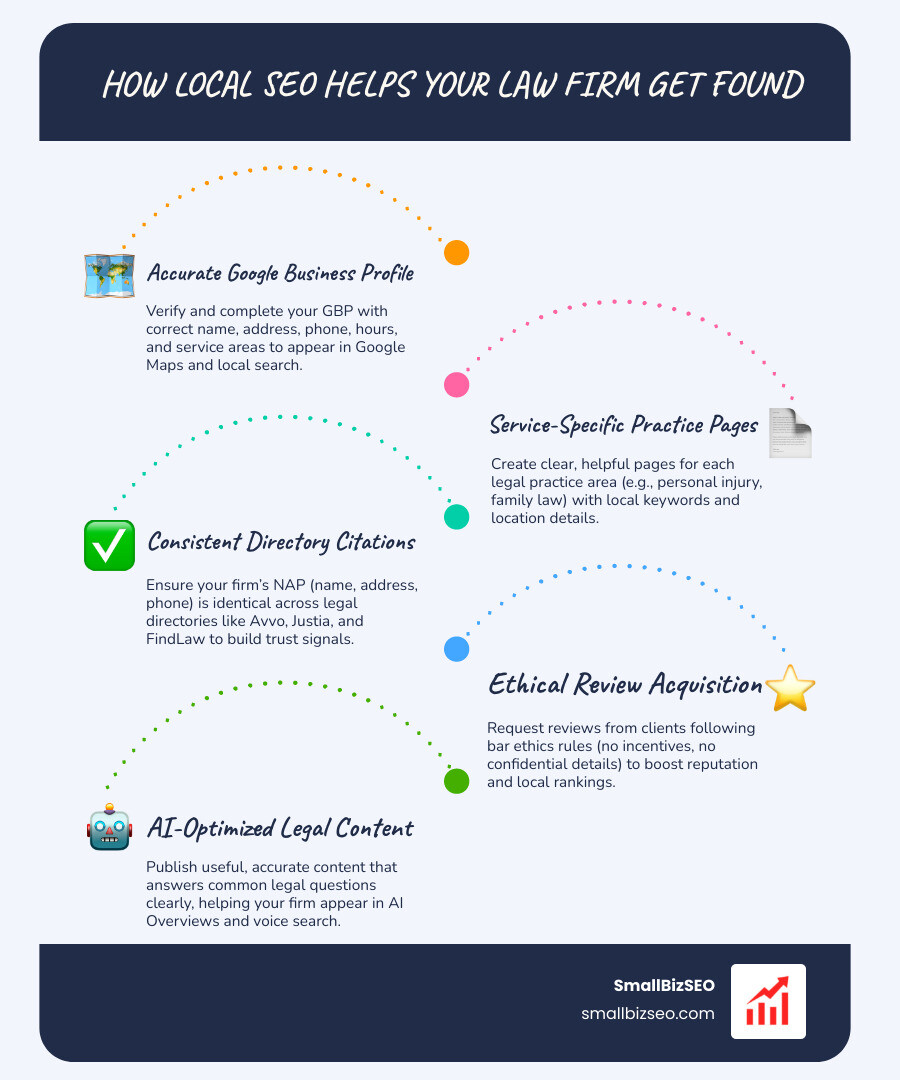
Local SEO for law firms helps nearby people find your practice in Google Maps and search results when they need legal help. Start with an accurate Google Business Profile, clear pages for the services you offer, consistent contact details across legal directories, and a simple, ethical way to request client reviews.
People may also encounter your firm in AI-generated answers. The same foundation matters there: useful legal content, accurate business information, and a reputation people can check.
I'm Clayton Johnson. My work in SEO and digital PR focuses on building the search visibility and online authority that support local SEO for law firms, including how businesses are discovered across search and AI tools.
Local SEO for law firms terms at a glance:
- enterprise local SEO
- local SEO map
- search engine optimization for law firms
Why Does Local SEO Matter for Law Firms?
Local SEO connects law firms directly with prospective clients searching for legal representation nearby, capturing high-intent inquiries across local map listings, standard search results, and AI-generated search summaries.
When legal issues arise, people search with high urgency. Data shows that 46% of all Google searches carry local intent, and over 70% of legal queries include geographic terms or "near me" modifiers. These searches generate immediate actions: 76% of people conducting a local mobile search reach out to a business within 24 hours. Furthermore, over 91% of consumers research legal practices online before making contact.
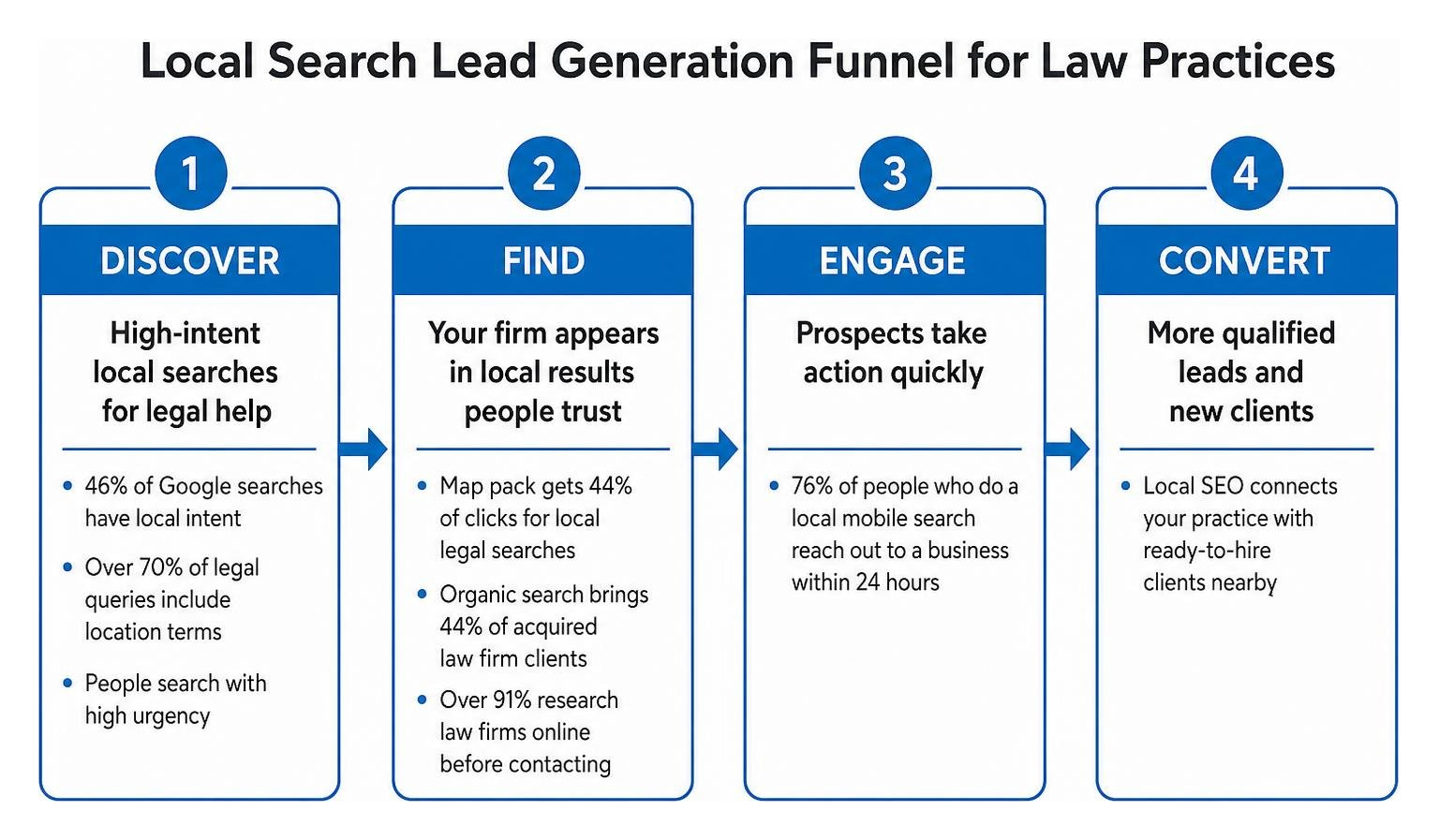
The local map pack captures roughly 44% of all clicks for local-intent legal searches. Securing a spot in these top three map spots often delivers more qualified calls than ranking in the standard organic blue links. For practices looking to master these positions, following a practical guide to local SEO map visibility ensures every technical signal aligns with search engine expectations. Organic search channels account for nearly 44% of all acquired law firm clients, outperforming traditional media, social platforms, and standard referrals combined.
How Does Google Rank Law Firm Websites Locally?
Google determines local law firm rankings using three core signals: relevance, distance, and prominence.
- Relevance: How closely your firm's profile and on-page content match the exact legal problem searched.
- Distance: The proximity between your verified office location and the user conducting the search.
- Prominence: Your firm's overall digital reputation, measured by review volume, citation consistency, directory authority, and authoritative legal backlinks.
Because legal queries directly affect a consumer's safety and finances, Google applies strict Your Money or Your Life (YMYL) content standards. To demonstrate Experience, Expertise, Authoritativeness, and Trustworthiness (E-E-A-T), law firm websites must showcase credentialed attorney authors, factual statutory references, and clear legal guidance. Following the ultimate guide to attorney website SEO strategies helps practices build these trust signals across all landing pages.
How Are AI Overviews Changing Legal Search?
AI Overviews now appear on roughly 78% of legal search queries—the highest rate of any commercial search category. Modern search engines extract direct answers from trusted web entities, presenting summarized legal overviews above traditional results.
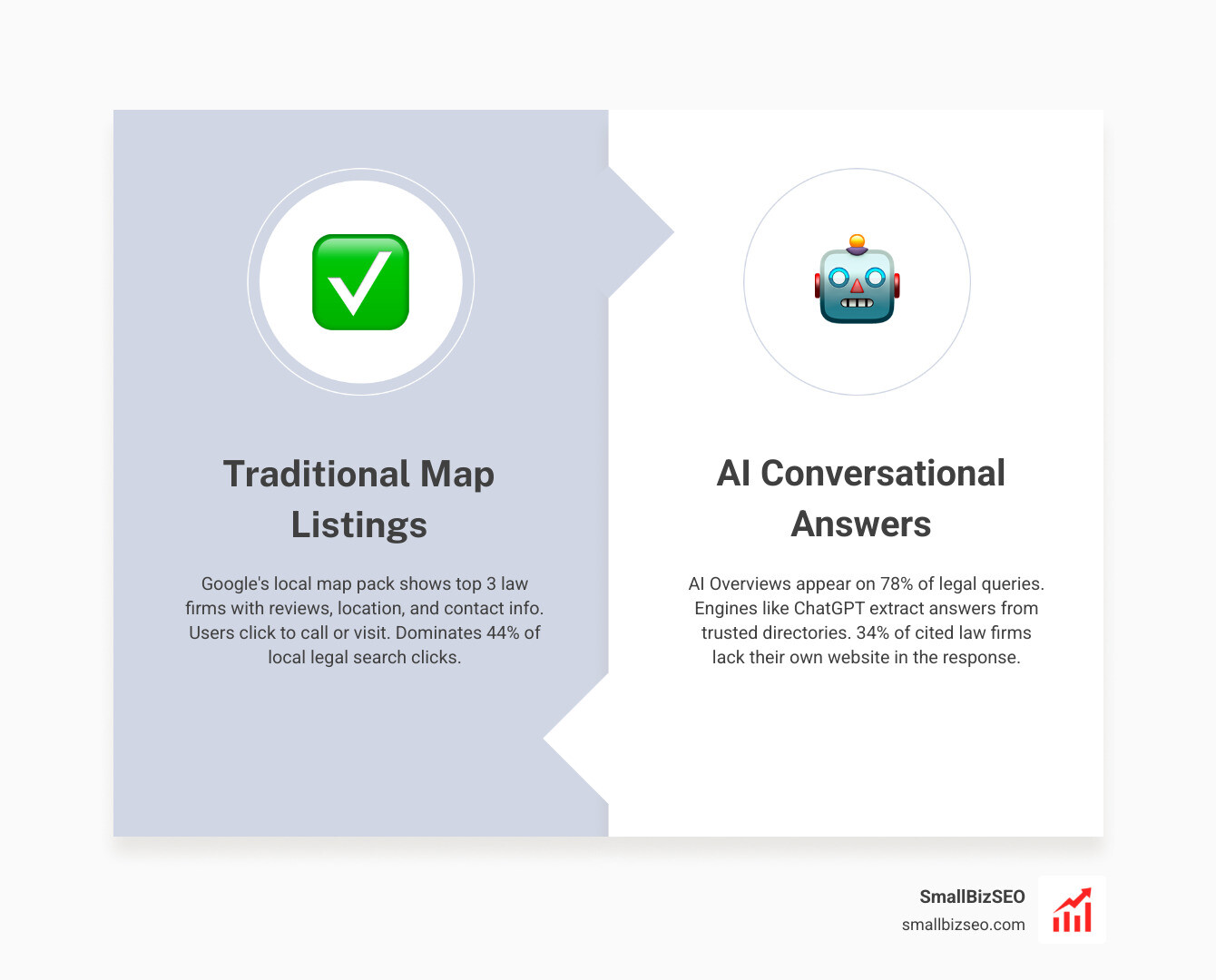
Generative Engine Optimization (GEO) focuses on positioning your practice within these AI answers. Legal directories serve as primary data sources, accounting for over 51% of all citations in legal AI summaries, with a directory being the first-cited source in nearly 78% of responses. In fact, research shows that over 34% of law firms mentioned by name in AI answers lack an individually cited website page; the AI engine recognizes them purely through their directory authority. Developing structured, plain-language legal answers ensures your practice gets cited in conversational search engines like ChatGPT and Perplexity.
What Are the Core Foundations of Local Search Visibility for Attorneys?
Strong local visibility requires an optimized Google Business Profile, consistent name, address, and phone number (NAP) data across legal directories, and an ethical client review acquisition process.

Law firms that establish these core signals gain compound visibility across desktop, mobile, and voice search. Starting with a beginner's guide to law firm local SEO allows solo practitioners and growing partnerships to systematically claim these fundamental assets.
How Can Law Firms Optimize Their Google Business Profile?
A Google Business Profile (GBP) accounts for roughly 32% of all local map pack ranking signals, making it your most valuable local search asset.
- Select Precise Categories: Choose your primary category carefully (e.g., "Personal Injury Attorney," "Divorce Lawyer," or "Criminal Defense Attorney"). Add 3 to 5 supporting categories that match your active practice areas.
- Standardize Business Naming: Use your firm's real, registered business name. Avoid stuffing extra keywords or city names into your business title, as this violates platform guidelines and invites suspensions.
- Complete Practice Information: Fill out your business description, operating hours, consult booking links, and service menus.
- Publish Visuals and Updates: Upload high-resolution photos of your actual office space, conference rooms, and attorney headshots. Publish regular updates linking to informative practice resources. Uncover additional Google local map pack secrets to maintain top positions.
How Can Law Firms Keep Legal Directory Citations Accurate?
NAP consistency across third-party directories verifies your firm's legitimacy for both search engine algorithms and generative AI models.
When directories list conflicting phone numbers, old suite numbers, or mismatched firm names, search engines lose confidence in your location data. Review our NAP consistency guide to audit and align your details across major platforms including Avvo, Justia, FindLaw, Martindale-Hubbell, and Yelp. Maintaining a consistent data footprint across the web protects your map pack placements and reinforces entity trust.
How Can Law Firms Request Reviews While Following Bar Ethics Rules?
Client reviews serve as a primary prominence signal, but attorneys must gather them within state professional conduct rules.
To solicit reviews ethically, implement a standardized post-case workflow. Send a simple email or text invite after resolving a matter, asking clients for candid feedback on their experience. Never offer gifts, discounts, or financial incentives in exchange for reviews, as this violates platform policies and professional conduct rules.
When replying to public reviews, always safeguard client confidentiality. Even if a reviewer shares specific case details, respond professionally without confirming representation or discussing case outcomes. For deeper insights on how reputation signals drive local rankings, explore how reviews influence local SEO.
How Should Law Firms Structure Local SEO Content and Schema?
Structure your website with dedicated practice-area hubs and distinct location pages, supported by nested schema markup that clarifies your legal expertise to search engines.
A clean site architecture prevents duplicate content issues while ensuring search bots index your primary practice topics efficiently.
How Should Law Firms Structure Practice Area Pages and Location Hubs?
Build dedicated practice pages for each legal service you provide rather than combining everything onto a single generic page.
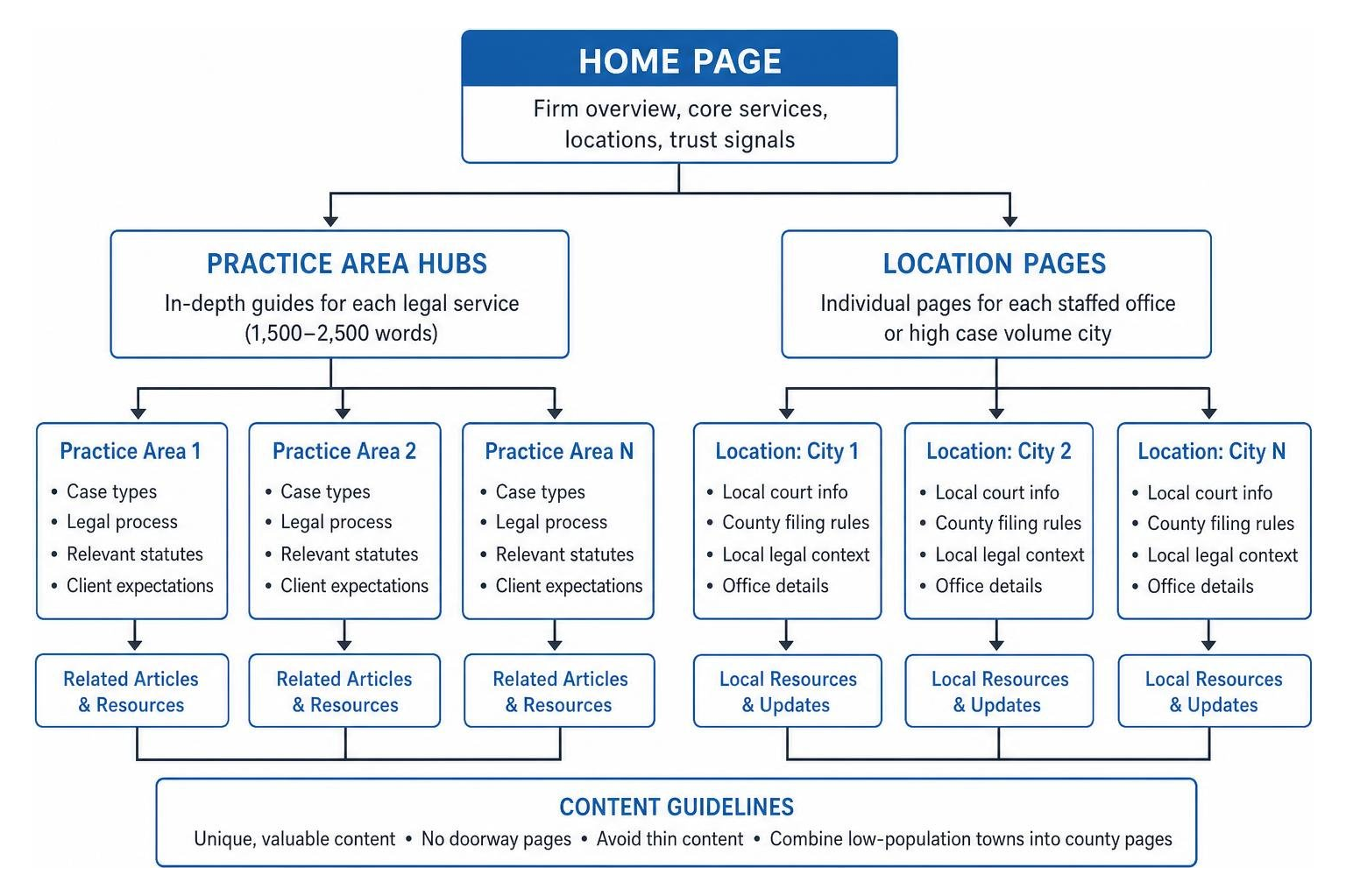
To establish topical depth, follow these structural guidelines:
- Practice Area Hubs: Create in-depth guides (1,500 to 2,500 words) covering specific case types, legal procedures, relevant statutes, and client expectations.
- Location Pages: Develop individual location pages only for cities where you maintain a staffed physical office or handle substantial case volume.
- Avoid Doorway Pages: Ensure every location page contains at least 60% unique content, highlighting local court procedures, county filing rules, and local legal context. Combine low-population towns into county-level overview pages to avoid thin content penalties. Mastering modern search engine optimization for law firms ensures your pages establish true topical authority.
How Can LegalService Schema and Interactive Legal Assets Support SEO?
Structured data provides search engines with explicit information about your firm's attorneys, practice areas, physical addresses, and editorial credentials.
Implementing LegalService and Attorney JSON-LD schema allows search engines to connect your website with your Google Business Profile and authoritative directory profiles via sameAs entity links. Pair this markup with interactive assets like fee estimators or timeline calculators. Interactive tools keep users engaged longer, reducing bounce rates and generating qualified inquiries. Our blueprint to law firm SEO services provides practical frameworks for deploying technical assets that support long-term practice expansion.
How Can Law Firms Plan, Execute, and Measure Local SEO?
Track meaningful commercial outcomes—such as signed cases, qualified phone inquiries, and cost per lead—rather than focusing solely on vanity keyword rankings.

A data-driven tracking setup attributes signed clients directly to specific landing pages and map listings, ensuring transparency across marketing investments.
How Much Should Law Firms Budget for Local SEO, and What Timelines Should They Expect?
Local SEO delivers compounding returns over time, trending toward an effective cost per lead (CPL) of $10 to $40 for mature campaigns, delivering a lower long-term cost than many other marketing channels.
| Investment Tier | Typical Monthly Cost | Primary Activities | Expected Milestones |
|---|---|---|---|
| DIY / Starter | Minimal software fees | Basic GBP setup, directory claims, manual review requests | Initial local map impressions within 60–90 days |
| Boutique Agency | $1,500 – $3,000 | Custom content creation, technical fixes, citation audits, review workflows | First-page rankings and regular inquiries within 4–6 months |
| Competitive Metro | $3,000 – $8,000+ | Comprehensive practice hubs, digital PR, interactive assets, advanced GEO | Top 3 map pack placement and steady case acquisition within 9–12 months |
Solo and small firms that establish complete profiles, earn 50+ reviews with strong ratings, and clean up their directory citations routinely achieve top map pack visibility within 6 to 9 months.
Should a Law Firm Manage Local SEO In-House or Hire an Agency?
Solo practitioners in lower-competition markets can successfully handle early local foundations internally by dedicating roughly 10 hours per month to profile maintenance and content drafting.
However, as a practice scales, the opportunity cost of handling technical schema, content creation, and citation audits internally often outweighs agency retainers. Retaining specialized legal SEO support allows attorneys to focus on casework while experienced professionals scale search visibility. Reviewing top lawyer SEO services for competitive practices helps managing partners select marketing partners with proven track records.
What Common Mistakes Should Attorneys Avoid in Local SEO?
Avoiding common technical and strategic pitfalls protects your practice from algorithm penalties and wasted budgets:
- Using Virtual Offices: Registering unstaffed virtual addresses or P.O. boxes violates Google guidelines and leads to sudden profile suspensions.
- Publishing Thin Content: Mass-producing generic city pages with identical text harms your organic visibility; review why your new law firm struggles to rank for remediation steps.
- Neglecting Profile Updates: Treating your business listing as a static phonebook entry limits your rankings. Identify other local SEO mistakes killing visibility to keep your profile active.
- Unattributed AI Content: Publishing auto-generated legal advice without attorney review violates YMYL standards and risks bar advertising compliance issues.
Frequently Asked Questions About Local SEO for Attorneys
How Long Does It Take for a Law Firm to Rank in Google's Map Pack?
Most law practices observe measurable ranking improvements within 4 to 8 weeks after optimizing their business profile and correcting directory citations. Securing a competitive top-three map pack position typically requires 6 to 9 months of consistent review generation and localized content publication.
Can Attorneys Claim Specialist or Certified Status in SEO Content?
Attorneys must comply with professional conduct rules (such as Rule 7.4), which restrict describing a lawyer as a "specialist" or "expert" unless formally certified by an accredited certifying organization and clearly disclosed in the content. Always describe legal practice areas factually.
How Should Law Firms Assess Local SEO Cost per Lead?
Calculate cost per lead by dividing total monthly local SEO expenses by the number of qualified inquiries (phone calls, form submissions, and chat leads) generated from local search channels. Mature local SEO programs typically deliver leads at a fraction of paid advertising costs.
Partner with SmallBizSEO for Sustainable Practice Growth
Dominating local search requires technical precision, authoritative legal content, and ongoing profile management. At SmallBizSEO, our data-driven Velocity framework helps law firms secure top local map rankings and capture qualified client inquiries through transparent, ethical search marketing.
Schedule a strategic search audit for your law practice today to discover how our tailored local search strategies can grow your firm's case pipeline.