Are Companies Actually Preparing Their Workers for the AI Era?

Are Companies Actually Preparing Their Workers for the AI Era?
How Are Businesses Preparing Employees for Artificial Intelligence?
Most organizations are prioritizing workforce AI training, but actual employee access to formal programs still lags behind daily tool adoption. While nearly two-thirds of organizations deliver some form of AI education, a substantial gap persists between corporate investment and the practical enablement workers need for their everyday tasks. These AI training statistics show how businesses are preparing employees for artificial intelligence, and the picture is uneven.
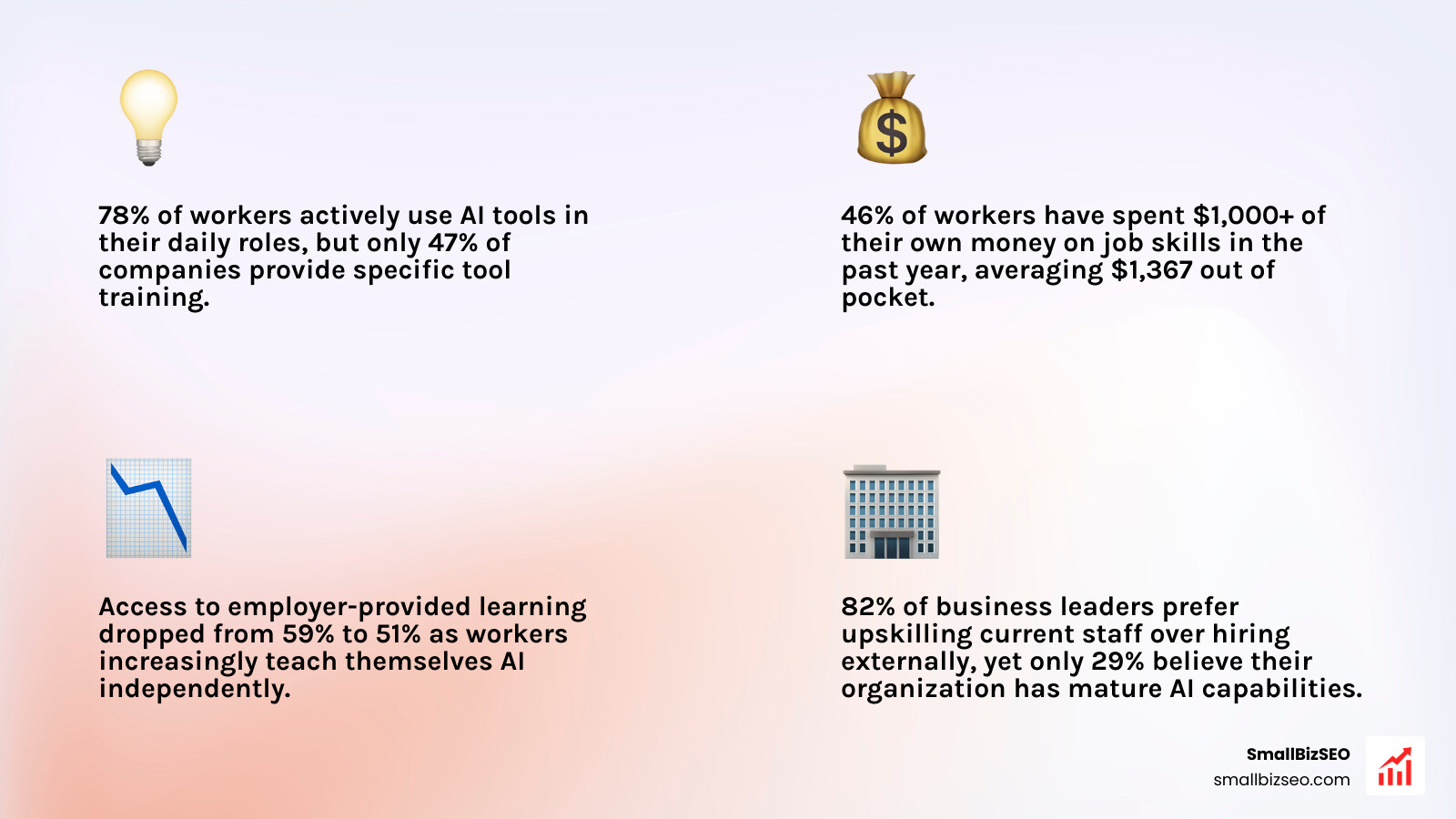
According to Gallagher's global AI adoption report, 62% of businesses have delivered AI training, and 86% report that artificial intelligence has directly boosted employee productivity. However, tool-specific enablement sits at just 47%, even as 78% of workers actively use artificial intelligence tools in their daily roles.
| Metric / Focus Area | Percentage of Organizations / Workers | Primary Business Impact |
|---|---|---|
| Organizations delivering AI training | 62% | Broad awareness and strategic alignment |
| Companies providing specific tool training | 47% | Practical workflow execution |
| Workers actively using AI in their roles | 78% | Grassroots productivity gains |
| Workers using AI agents regularly | 50% | Autonomous task assistance |
| Employees teaching themselves AI tools | 49% | Unstructured, shadow-AI adoption |
| Workers receiving formal company training | 16% | Verified compliance and proficiency |
How Big Is the Gap Between Leadership Intent and Upskilling?
Leadership enthusiasm for artificial intelligence does not always translate into mature training programs. A significant 82% of decision-makers say they prefer upskilling current staff over hiring external talent, and 83% prioritize AI skills across their organizations. Yet only 29% of business leaders believe their organizations have built mature AI capabilities.
Findings highlighted in the State of Data and AI Literacy Study show that while 69% of leaders now view AI literacy as essential, mature upskilling frameworks have only expanded to 43% of companies. Furthermore, executive mandate strength and deep outcome measurement account for the vast majority of what separates AI transformation leaders from laggards, proving that passive leadership interest is not enough.
Are Employees Paying to Learn AI on Their Own?
Because formal enterprise programs take time to materialize, workers are taking skill acquisition into their own hands. Roughly 78% of workers have started learning AI tools independently without any mandate from their employer.
This self-directed learning carries a tangible personal cost: 46% of workers have spent $1,000 or more of their own money on job skills over the past year, averaging $1,367 out of pocket. At the same time, the proportion of workers who feel they have adequate access to employer-provided learning and development dropped from 59% to 51%. Understanding these skill deficits is critical when evaluating workplace productivity and ROI metrics, as informal experimentation can introduce inconsistencies across teams.
Which AI Training Methods and Program Formats Work Best?
The most effective AI training programs focus on role-specific workflows and measurable proficiency rather than generic tool overviews or course completion rates. Practical application within an employee's daily responsibilities produces higher retention and measurable output gains.

Evaluating training success requires looking past baseline metrics. When evaluating corporate adoption and spending benchmarks, companies see far higher returns when learning programs mirror actual departmental deliverables.
Is Role-Specific AI Training More Useful Than General Tool Literacy?
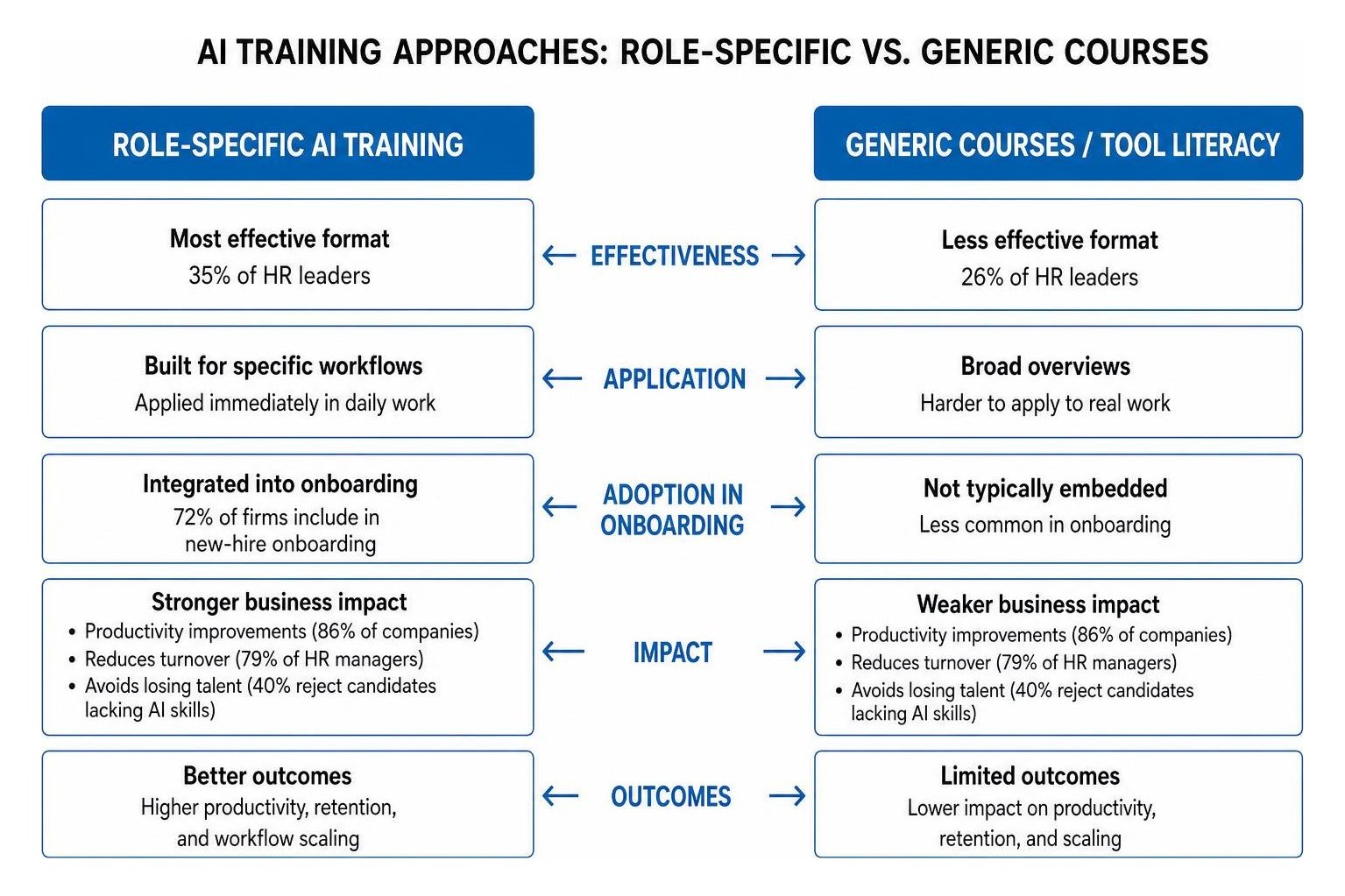
Role-specific instruction consistently outperforms broad, theoretical overviews. According to small business AI talent analysis, 35% of HR leaders rank role-specific training as their most effective format, compared to 26% who favor general tool training and 18% who rely on unstructured on-the-job experimentation.
When training is customized to specific departmental workflows—such as prompt engineering for customer support, automated data modeling for finance, or dynamic content ideation for marketing—employees integrate tools immediately. In fact, 72% of forward-thinking smaller firms now build dedicated AI modules directly into their new-hire onboarding paths.
How Does AI Training Affect Productivity and Retention?
Structured AI training directly influences employee retention, job satisfaction, and operational speed:
- Substantial Productivity Gains: About 86% of companies report productivity improvements after deploying AI, with task gains jumping from 45% for simple tasks to 90% when workers apply AI across seven or more task types.
- Talent Retention: Roughly 79% of HR managers agree that higher-quality skill development significantly reduces staff turnover.
- Hiring and Recruitment Advantages: Around 40% of small and mid-sized businesses have rejected otherwise qualified candidates due to a lack of AI competency, making internal training essential for preserving talent.
- Workflow Scaling: Upskilling staff enables businesses to streamline complex operations while scaling internal AI workflows without sacrificing work quality.
What Makes AI Training Hard to Implement and Measure?
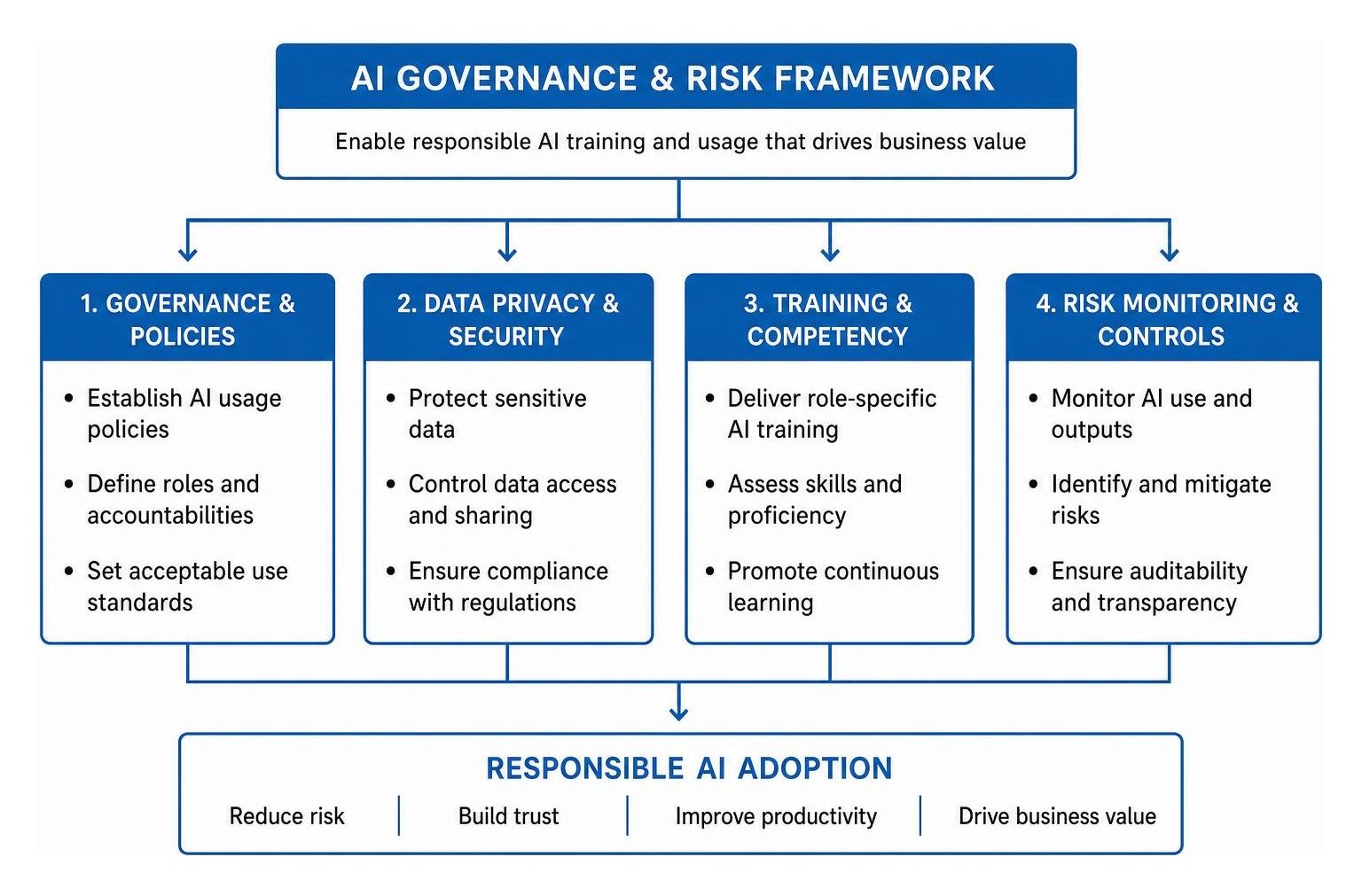
AI training programs struggle primarily due to inadequate risk-management frameworks, data privacy anxieties, and outdated methods for measuring learning ROI. Without clear usage policies and granular competency tracking, organizations hesitate to scale their educational initiatives.
A major hurdle involves resource allocation. Balancing software subscriptions against educational initiatives can be challenging, as detailed in recent software pricing benchmarks. When tool budgets overshadow learning budgets, implementation naturally stalls.
What Risk Frameworks and Governance Are Companies Missing?
Governance gaps represent a significant roadblock to widespread workplace training:
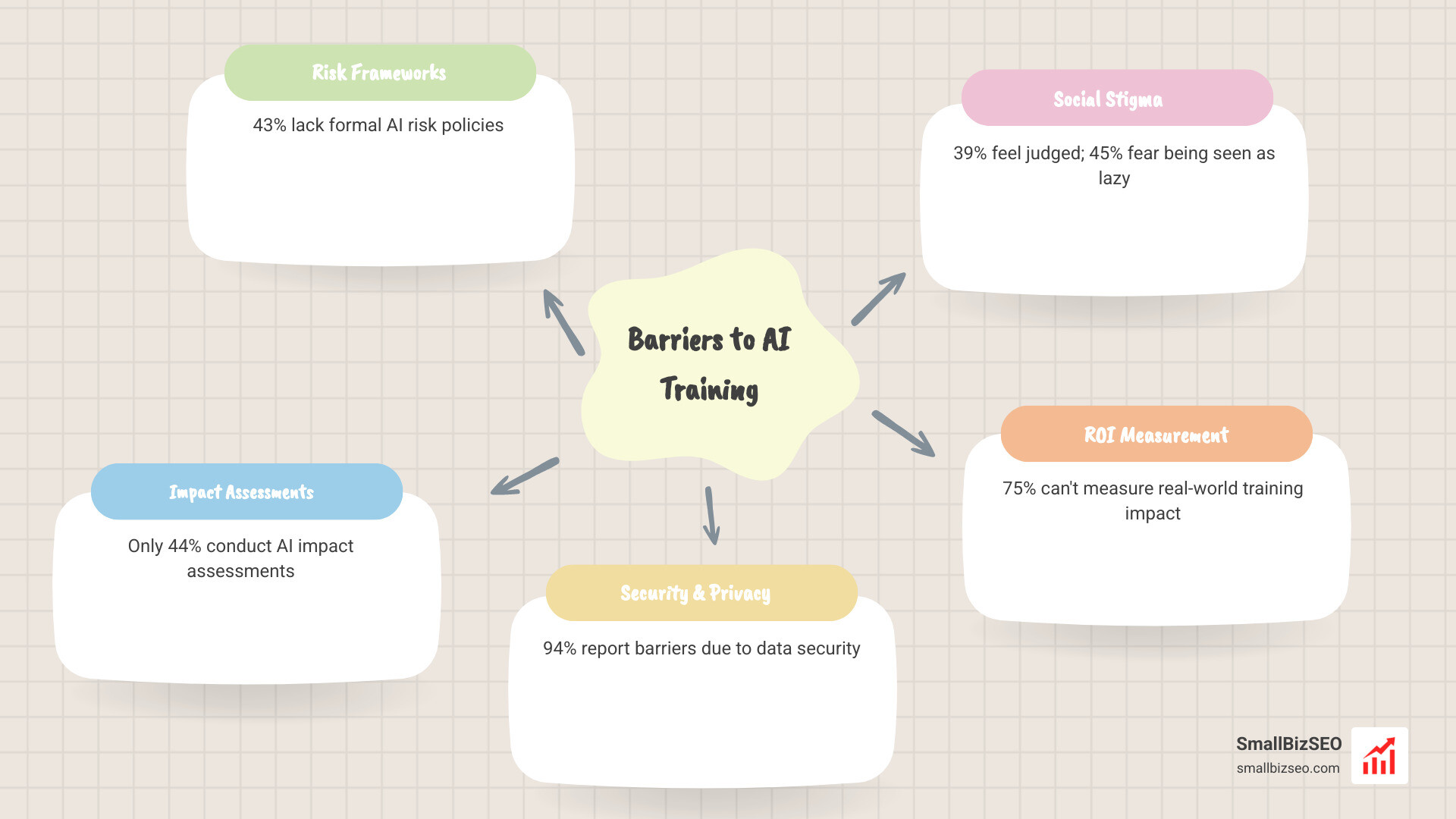
- Missing Risk Frameworks: An estimated 43% of organizations have yet to introduce formal AI risk-management policies.
- Limited Impact Assessments: Only 44% of businesses conduct structured AI impact assessments before rolling out new systems.
- Security and Privacy Hurdles: A striking 94% of workers report encountering barriers when using workplace AI, with data security and compliance cited as their primary concerns.
- Social Friction and Stigma: Roughly 39% of employees report feeling judged by peers when utilizing AI tools, and 45% worry that tool usage may be perceived as lazy or untrustworthy without explicit corporate policy backing.
Why Do Companies Struggle to Measure Training ROI?
Traditional learning management systems rely heavily on course completion rates, which average around 30% across digital learning platforms. However, completion does not equal workplace competence.
Approximately 75% of businesses admit they cannot reliably measure the real-world impact of their AI qualification programs. Leading organizations overcome this by abandoning passive attendance tracking in favor of skill-based benchmarking, workflow speed improvements, and output quality assessments.
How Do AI Training Opportunities Differ by Region and Company Size?
Large enterprises lead in formal program budgets, but agile small businesses are rapidly closing the gap by using role-specific training as an aggressive recruiting and retention strategy. Geographic location and organizational scale heavily influence how resources are distributed.
How Do AI Training Rates Differ Across Regions?
AI training adoption shows clear variations across different international business markets:
- Germany: According to a Bitkom workforce study, 61% of employees want AI training, but only 5% of companies train their entire staff, while 48% provide no training at all.
- Rapid Two-Year Growth: Separate TÜV-Verband AI training research revealed that the share of German companies offering AI training more than doubled from 12% to 27%, even as 56% of companies use generative AI daily.
- Global Leaders: Markets such as Singapore and Japan lead global benchmarks for organizations with more than a quarter of their workforce formally trained in artificial intelligence.
How Does AI Training Differ Between Enterprises and Small Businesses?
Enterprise organizations (250+ employees) report training rates near 49%, leveraging dedicated learning departments and enterprise software licenses. In contrast, smaller businesses (20–49 employees) average training rates around 21% due to tighter discretionary budgets.
However, small and medium businesses adapt quickly. About 64% of SMBs are actively upskilling their current teams, and 81% note that enterprise layoffs made it easier to recruit high-performing talent. By integrating training stipends and flexible experimentation into daily work, smaller teams effectively compete for top-tier performers.
What Do Employees and Employers Want to Know About Workplace AI Training?
What Percentage of Companies Currently Offer AI Training to Employees?
Globally, 62% of businesses have delivered some form of AI training over the past year. However, mature, organization-wide programs exist in only 43% of enterprises, and specific tool instruction is provided by just 47% of employers.
How Much Money Do Employees Spend Learning AI Independently?
Among workers pursuing self-directed learning, 46% spend $1,000 or more annually on courses, certifications, and software subscriptions. The overall average out-of-pocket expenditure stands at $1,367 per year.
Why Are Role-Specific AI Training Programs More Effective Than Generic Tool Workshops?
Role-specific programs ground technology in concrete, day-to-day responsibilities. Instead of teaching generic prompt writing, role-based instruction demonstrates how to solve departmental problems, verify model outputs, and automate recurring bottlenecks, yielding immediate workflow efficiency.
Practical Steps to Build an AI-Ready Team
A sustainable AI workforce strategy requires combining leadership mandates, clear safety guardrails, and role-based learning paths. Rather than treating artificial intelligence as an isolated IT initiative, organizations succeed when they treat upskilling as an ongoing operational practice.
To create an effective corporate AI learning roadmap:
- Establish a Transparent Usage Policy: Eliminate workplace stigma and compliance confusion by establishing clear guidelines on data security, privacy, and approved tool applications.
- Prioritize Workflow Integration Over Theory: Replace generic seminars with targeted, hands-on workshops tailored to the daily responsibilities of individual departments.
- Allocate Dedicated Learning Time: Provide employees with structured time during the workweek to test automation scripts and explore emerging tools without sacrificing project deadlines.
- Track Practical Skill Outcomes: Measure business impact through real-world process improvements, time saved, and deliverable quality rather than course completion statistics.
As generative tools continue to reshape the modern business landscape, leaders who invest early in their teams will capture the highest productivity gains. For a deeper look at industry benchmarks, review our comprehensive breakdown of 50 generative AI statistics every business owner should know to refine your operational strategy.