Get Meaningful Quotes Faster with a Structured SME Interview Content Brief

How do you brief a subject matter expert for an interview?
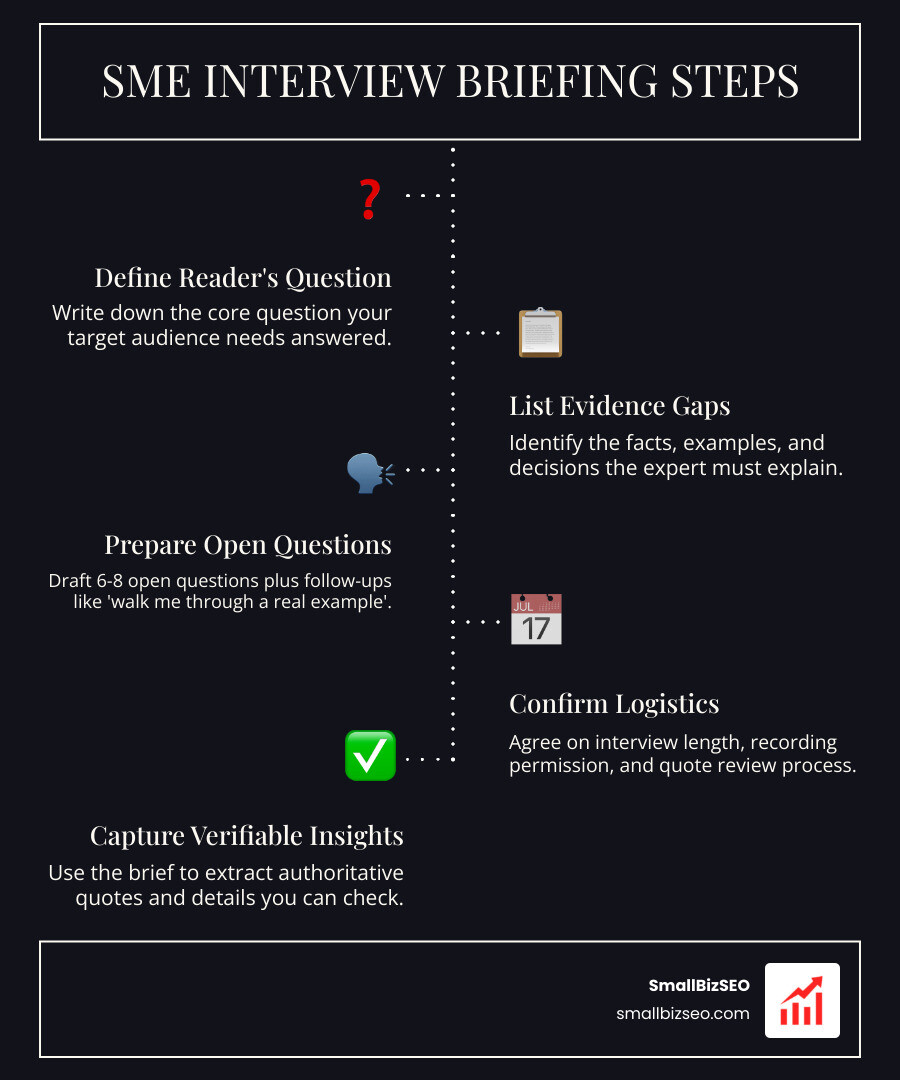
A content brief template for interviewing a subject matter expert should tell the expert what the reader needs to know and what evidence the article is missing. Before the call:
- Write down the reader’s question and the article’s main point.
- List the facts, examples, and decisions you need the expert to explain.
- Prepare six to eight open questions, plus follow-ups such as “Can you walk me through a real example?”
- Confirm the interview length, recording permission, and how quotes will be reviewed.
An SME interview is a focused conversation that brings first-hand experience into your content. The brief helps you get beyond general advice and capture details you can check and use.
I’m Clayton Johnson, founder of SmallBizSEO, where I develop content strategies that turn business expertise into useful resources. My approach to a content brief template for interviewing a subject matter expert starts with the reader’s question and the evidence needed to answer it.
Why Should You Use a Content Brief Template for Interviewing a Subject Matter Expert?
A structured interview brief gives your conversation a clear goal, lets the specialist prepare specific numbers or case details ahead of time, and makes extracting verifiable quotes straightforward. Without a prepared plan, the average expert interview transcript runs about 60% redundant information or irrelevant side trips. When you supply a clear brief, you eliminate filler and capture authoritative insights that readers and search engines reward.

What Is a Content Brief Template for Interviewing a Subject Matter Expert and Why Is It Vital?
A content brief template for interviewing a subject matter expert is a planning document that outlines the specific evidence gaps, core thesis, and targeted questions needed to create authoritative content. Instead of treating the interview as a casual chat, it treats the session as an editorial research tool focused on aligning content with search intent.
Generic content cannot compete in modern search. Research shows that adding relevant quotations, statistics, and source citations can raise a page's visibility in generative engine answers by up to 40%. Furthermore, the overlap between AI citations and top organic results is only 12% for standalone AI models, meaning generative search engines look for unique, attributed proof that standard summaries lack.
Following established video interview briefing guidelines ensures your subject matter expert understands their specific role in supporting the article's core thesis.
| Feature | Unguided SME Conversation | Structured Brief-Led Interview |
|---|---|---|
| Preparation | No advance context or general topic list | 1-page brief with evidence goals sent 2–3 days ahead |
| Question Style | High-level, theoretical questions | Neutral, decision-focused, and scenario-based |
| Transcript Yield | Up to 60% conversational filler | Dense, usable quotes, metrics, and case studies |
| Search Engine Value | Commodity summaries easily replicated | High-value, proprietary insights that earn citations |
| Editorial Turnaround | Hours spent sifting through vague answers | Fast extraction mapped directly to brief sections |
What Should a Content Brief Template for Interviewing a Subject Matter Expert Include?
A comprehensive interview brief must fit on a single page to keep both the interviewer and the specialist focused. It bridges your high-level SEO content brief with the live conversation.
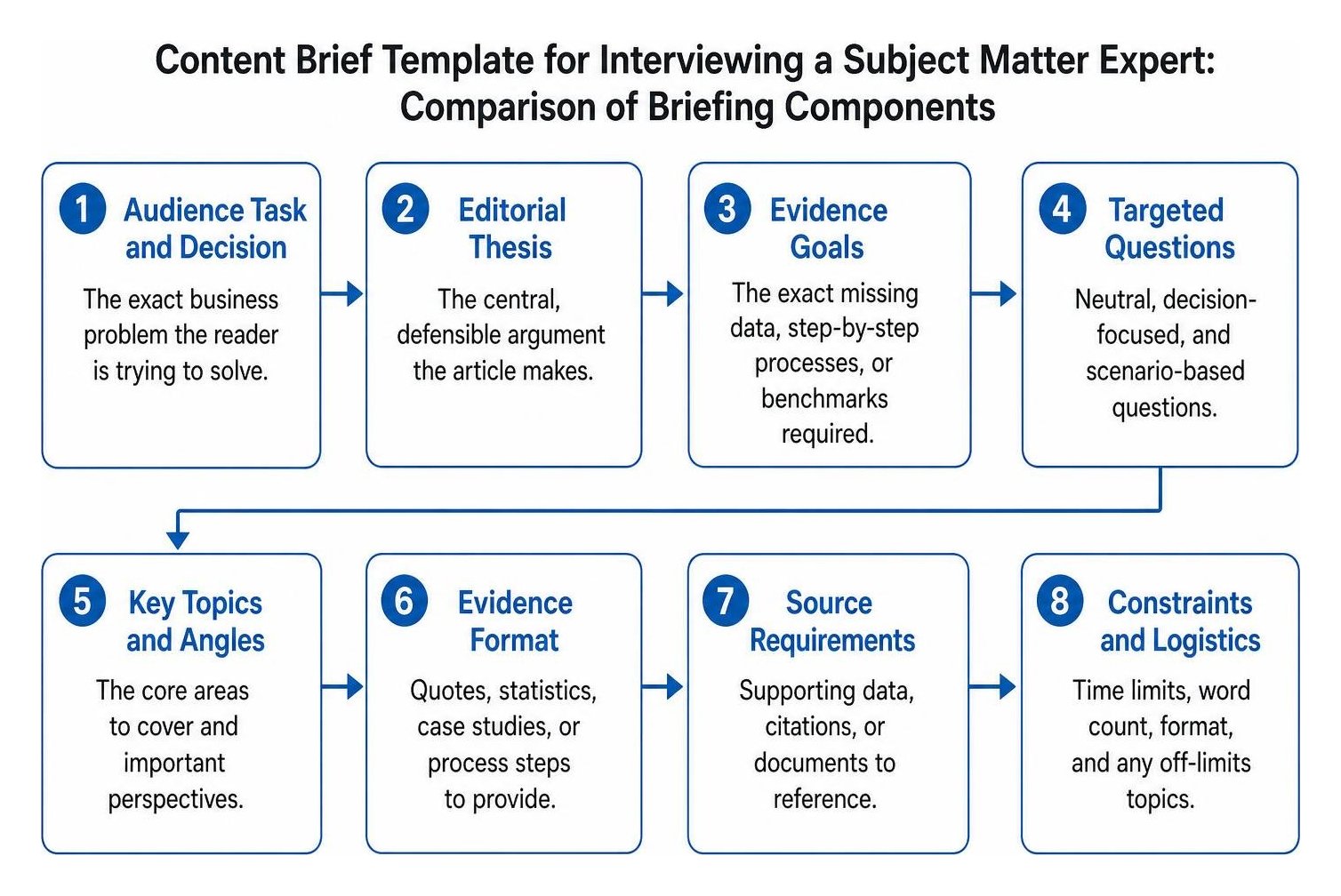
Every interview brief should contain these foundational fields:
- Audience Task and Decision: The exact business problem the reader is trying to solve.
- Editorial Thesis: The central, defensible argument the article makes.
- Evidence Goals: The exact missing data, step-by-step processes, or benchmarks required.
- Expert Role: Why this specialist was chosen and the specific perspective they provide.
- Anchor Questions: Six to eight prioritized, neutral questions with follow-up prompts.
- Do-Not-Soften Constraints: Technical truths, limitations, or industry trade-offs that must not be edited down into vague marketing speak.
- Logistics and Rights: Session duration, recording platform, and quote-attribution terms.
How Do You Structure the Five Interview Phases and Ask Neutral Questions?
Structuring your session into five distinct phases keeps the conversation on track and surfaces genuine expertise.

- Opening and Context (3–5 Minutes): Confirm permissions, state the editorial thesis, and build rapport. Ask: "How would you describe your day-to-day focus on this topic?"
- Core Knowledge Extraction (15–20 Minutes): Walk step-by-step through specific workflows. Ask: "Walk me through how you approach this process from start to finish. Where do you start, and how do you know you are done?"
- Challenges, Errors, and Edge Cases (10 Minutes): Uncover the failure modes that build reader trust. Ask: "Walk me through the last time a standard approach failed. What happened, and how did you resolve it?"
- Nuance and Expert Judgment (5–10 Minutes): Explore trade-offs and differences in opinion. Ask: "What is something non-experts believe about this topic that is completely wrong?" Highlighting authentic nuance demonstrates authentic subject matter expertise across your content.
- Closing and Future-Facing (3–5 Minutes): Capture forward-looking insights. Always close with: "What did I not ask that I should have?"
During every phase, use the pause technique: wait three to five seconds after the expert stops speaking. Specialists often fill that brief silence with their most practical, unfiltered insights.
How Do You Execute the SME Interview Workflow to Build High-Ranking Content?
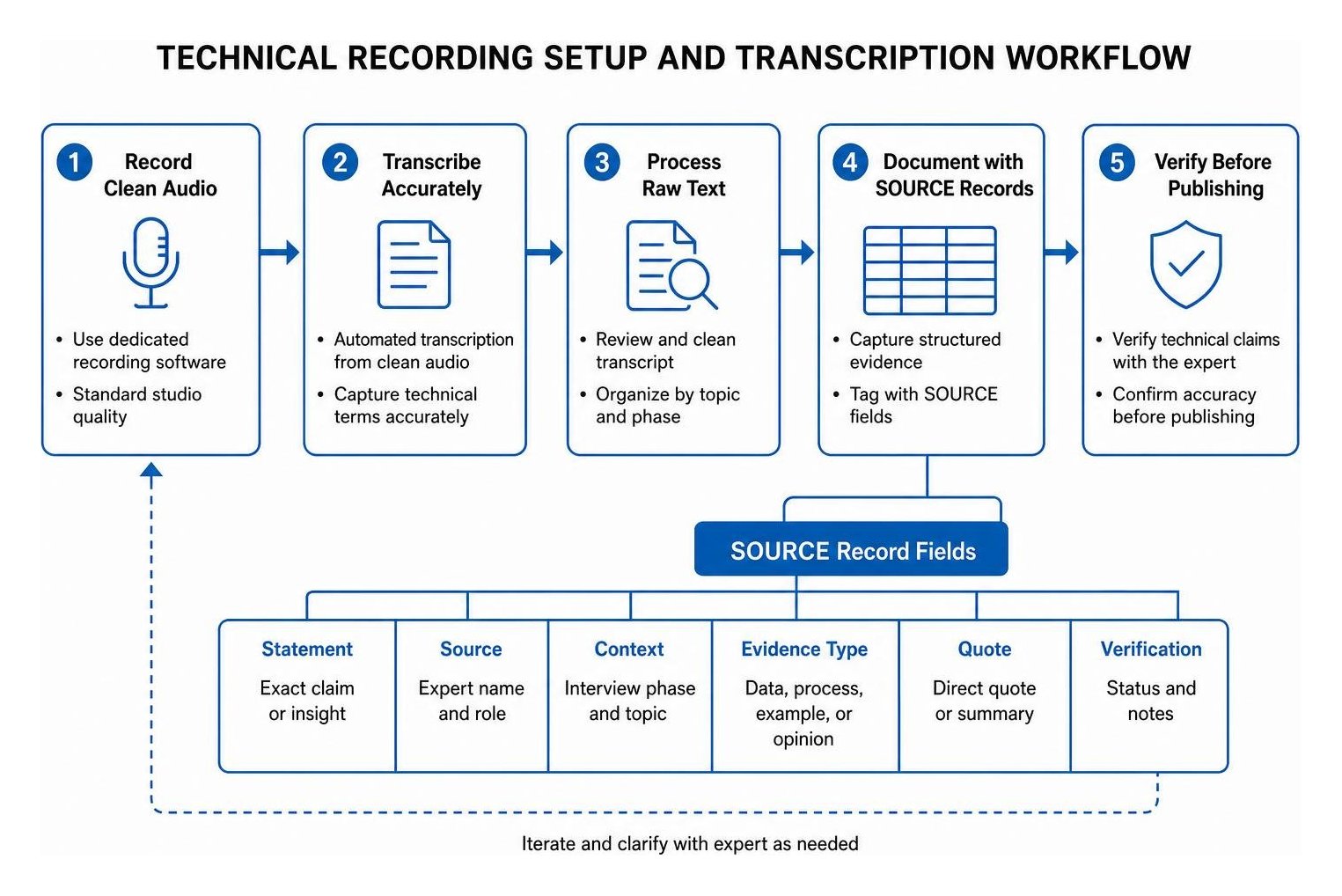
To turn an interview into high-ranking content, record clean audio, transcribe the discussion accurately, tag evidence using a structured source model, and verify all technical claims with the expert prior to publishing.
How Do You Record, Transcribe, and Document Evidence with SOURCE Records?
High-fidelity audio recording is essential for clean automated transcription. Use dedicated recording software set to standard studio quality so technical terms are accurately captured.
Once transcribed, process the raw text through a structured framework rather than copying raw quotes. The expert interview engine framework recommends documenting statements through a structured record:
- S – Situation: The specific scenario, client problem, or environment discussed.
- O – Observation: What the specialist directly observed, measured, or experienced.
- U – Underlying Artifact: The data report, code sample, log file, or dashboard backing the claim.
- R – Rights & Attribution: Approved quote format, byline agreement, or background attribution status.
- C – Confidence Level: Whether the statement is an established standard, an educated hypothesis, or a single test result.
- E – Exceptions: The boundary conditions where this advice does not apply.
Classifying claims this way prevents misattribution and gives your writers clean, verified source material.
How Do You Turn Transcripts into Citations, Repurposed Assets, and Approvals?
One 30-to-45-minute structured session can easily supply source material for an entire topic cluster. To meet rigorous E-E-A-T search guidelines, map every section of your draft to specific timestamps and quotes from your SOURCE records.
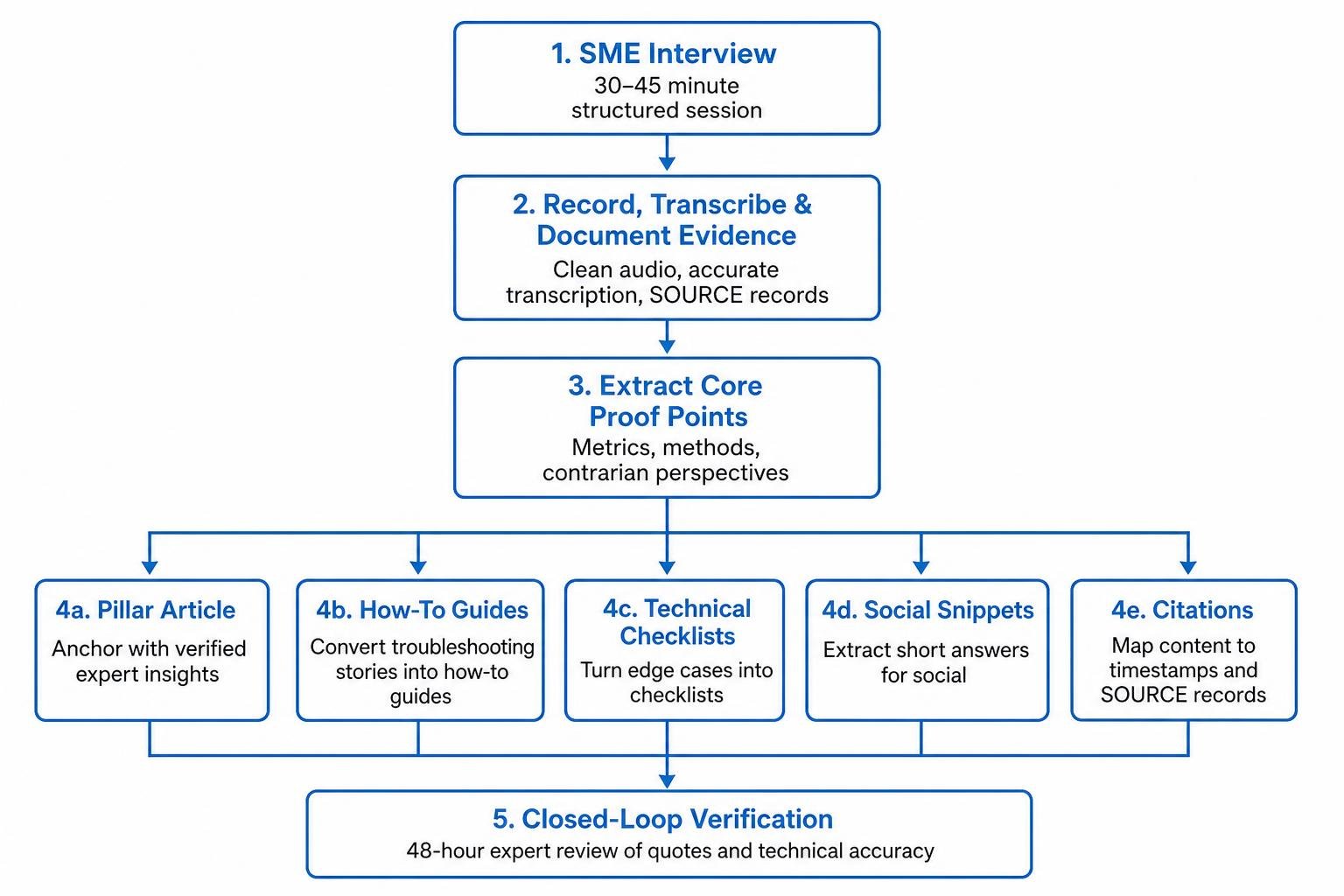
Transform the raw interview material into high-impact assets through this repeatable workflow:
- Extract Core Proof Points: Isolate proprietary metrics, step-by-step methodologies, and contrarian perspectives to anchor your main pillar article.
- Build Derivative Assets: Convert troubleshooting stories into targeted how-to guides, turn edge-case discussions into technical checklists, and extract short answers for social snippets.
- Run a Closed-Loop Verification: Send the specialist a concise verification packet containing only their direct quotes and technical context. Give them a 48-hour window to review technical accuracy without opening the broader editorial style to committee debate.
Close the loop by notifying the contributor when the content goes live. Supplying pre-written social snippets and direct links makes it effortless for them to share the article with their own professional network.
Accelerate Your Organic Authority with Expert Content
Conducting focused interviews separates generic web copy from high-performing, authoritative resources. At SmallBizSEO, our data-driven Velocity framework pairs strategic technical execution with deep subject-matter research to capture competitive search visibility and AI citations.
Explore our custom content brief services to streamline your production, capture compelling quotes, and build search visibility that drives business growth.