Align Your Content Strategy with Search Quality Standards to Win Organic Traffic

Align Your Content Strategy with Search Quality Standards to Win Organic Traffic
How Do You Put E-E-A-T Into Practice for SEO?
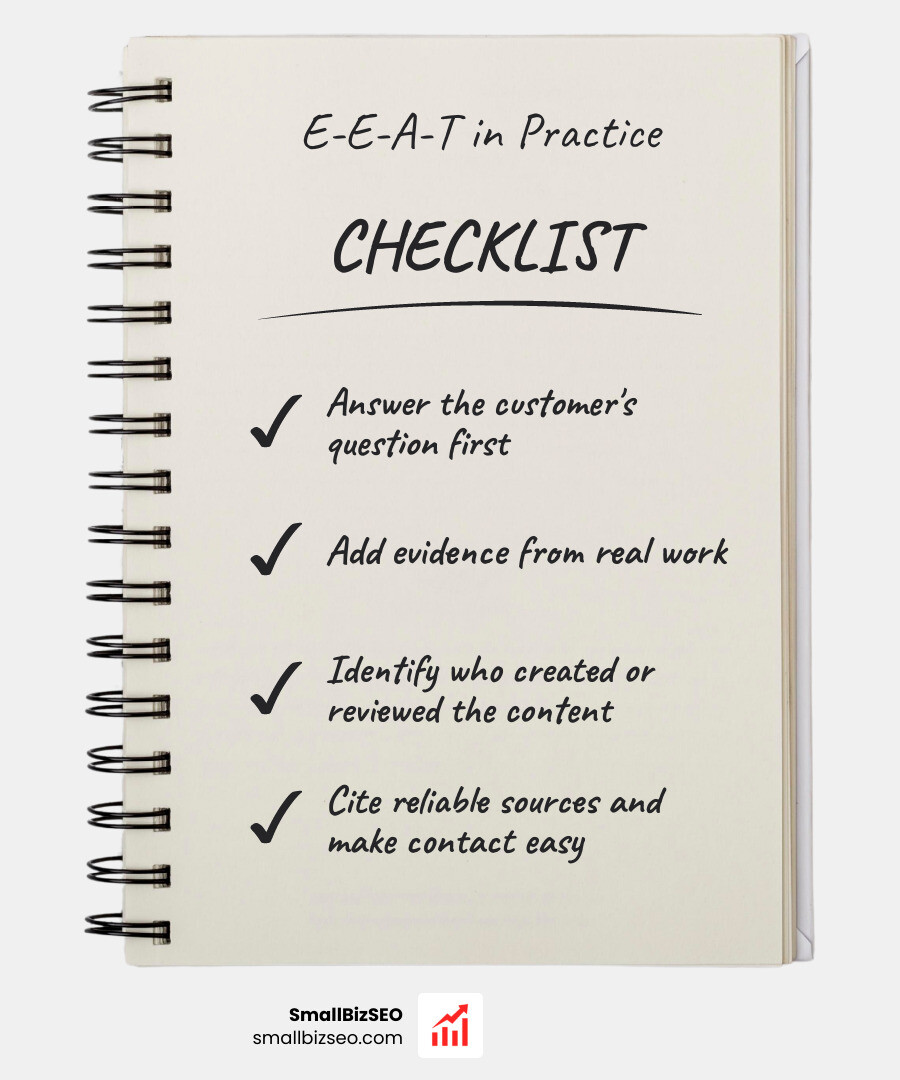
To put Google's E-E-A-T guidance into practice, start with your most important pages. Answer the customer's question, add evidence from real work, identify who created or reviewed the content, cite reliable sources, and make your business easy to contact.
E-E-A-T stands for Experience, Expertise, Authoritativeness, and Trustworthiness. Google added Experience to the earlier E-A-T framework to better reward first-hand knowledge. Quality raters use these ideas to assess search results, but there is no E-E-A-T score or single ranking factor to optimize. The goal is content people can use and trust.
I'm Clayton Johnson, founder of SmallBizSEO. My work connects SEO, content, and digital PR, and I use that experience to help small businesses approach E-E-A-T SEO compliance as a practical way to earn trust, not a box to check.
E-E-A-T SEO compliance vocabulary:
Introduction to E-E-A-T SEO Compliance and Modern Ranking Systems
Google assesses web quality by training search algorithms on human feedback. An army of approximately 10,000 independent Quality Raters worldwide evaluates search results using a 172-page manual called the Search Quality Rater Guidelines.
These human raters do not directly penalize or boost your individual web pages. Instead, their qualitative evaluations serve as a benchmark to train machine learning systems. When Google updates its ranking algorithms, it relies on this feedback to reward people-first content that directly satisfies search intent and maintains resilience against major core algorithm updates.
What Are the Core Pillars of E-E-A-T SEO Compliance?
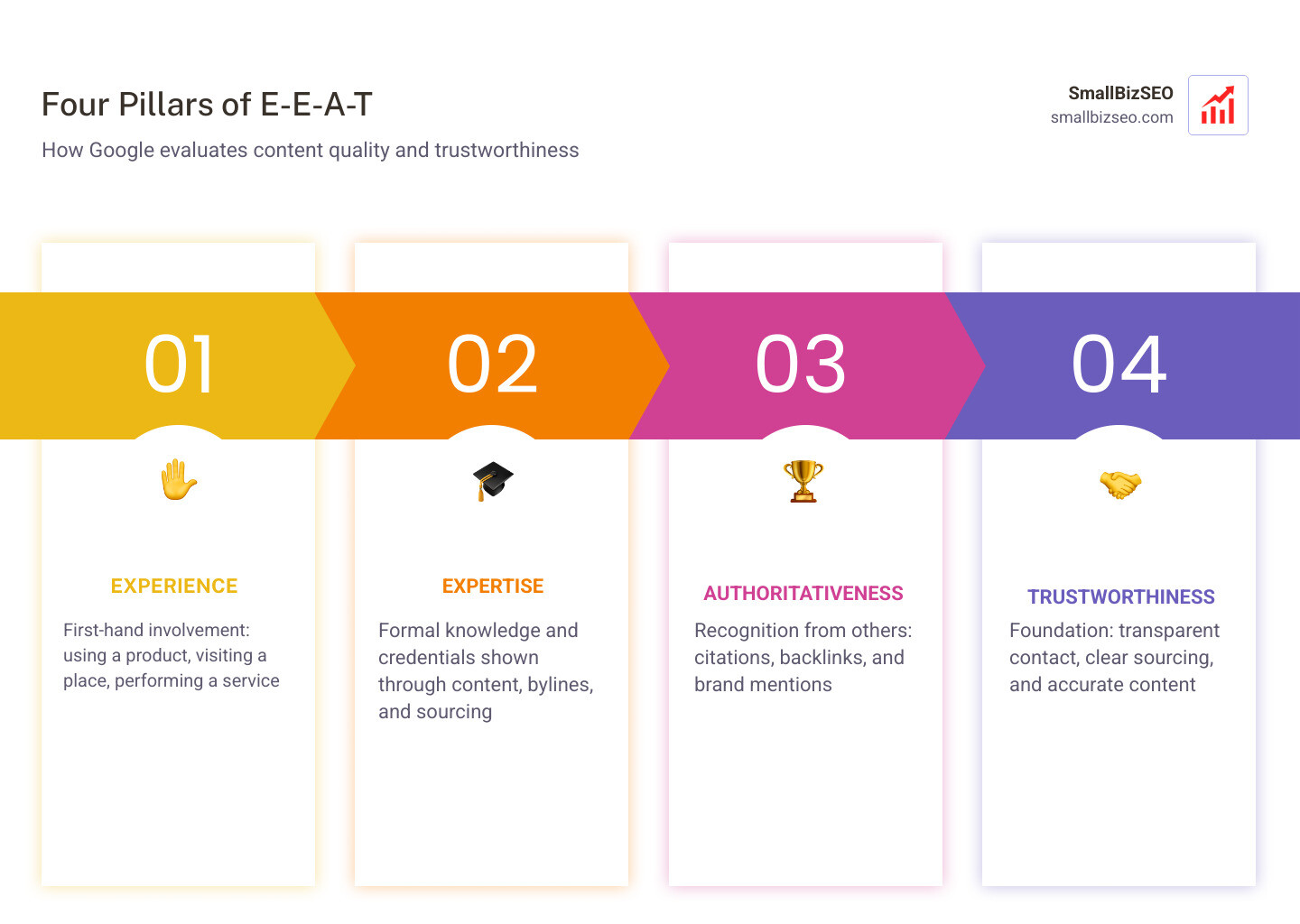
The four pillars evaluate content creators, publishers, and the pages themselves:
- Experience: First-hand, practical involvement with the subject matter (e.g., using a product, visiting a location, or performing a service).
- Expertise: Formal education, specialized skill sets, or deep subject-matter knowledge.
- Authoritativeness: Industry reputation, peer recognition, and citations as a go-to source in your niche.
- Trustworthiness: The foundational core pillar assessing page transparency, accuracy, security, and honest business practices.
| Component | Focus Area | Primary Content Signals |
|---|---|---|
| First-Hand Experience | Practical application | Original photography, personal case studies, testing notes, process videos |
| Formal Expertise | Credentialed skill | Professional degrees, industry certifications, technical accuracy, expert citations |
| Authoritativeness | Market standing | External backlinks, brand mentions, thought-leadership features, peer recognition |
| Trustworthiness | User safety & accuracy | Secure checkout/HTTPS, transparent contact details, cited sources, clear policies |
Google emphasizes that Trust is the central pillar supporting the entire framework. Experience, Expertise, and Authoritativeness act as supporting evidence that builds that core user trust. By aligning your site with Google's helpful content guidelines and optimizing content for search trust, you protect your organic visibility against quality volatility.
Why Do YMYL Topics Demand Higher Standards?
Your Money or Your Life (YMYL) topics include healthcare, financial investments, legal counsel, and critical safety information. Google holds these topics to much stricter quality thresholds because incorrect or misleading information can cause direct physical, emotional, or financial harm.
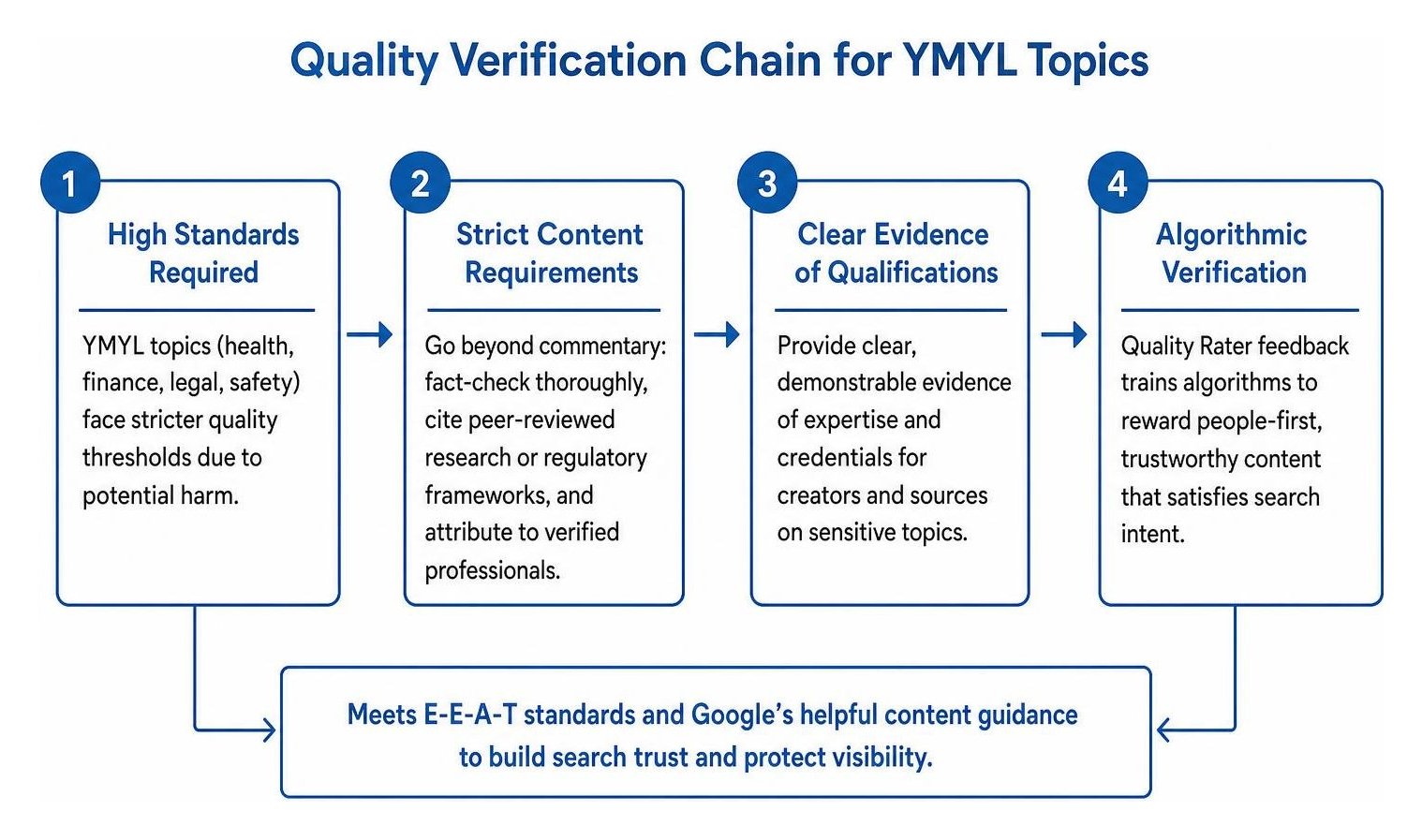
For YMYL content, surface-level commentary is never sufficient. Articles must undergo strict fact-checking, cite peer-reviewed research or regulatory frameworks, and carry attribution to verified professionals. Exploring established Search Quality Rater insights shows that Google requires clear, demonstrable evidence of qualifications on these sensitive topics. Take proactive steps to optimize E-E-A-T signals today across your critical business pages.
Step-by-Step Implementation: How to Achieve Search Trust and Authority

Building real authority requires embedding transparency into your publishing routine. Rather than relying on generic content, we recommend establishing verifiable assets:
- Publish proprietary survey data, client studies, and original industry statistics.
- Use precise practitioner terminology instead of generic high-level summaries.
- Link out to reputable, authoritative primary sources to substantiate factual claims.
- Execute targeted digital PR campaigns to earn high-authority editorial backlinks and brand mentions.
- Implement structured JSON-LD schema markup for authors and organizations.
How Can You Demonstrate Real Experience and Expertise in Content?
Demonstrating lived experience means showing users that you have actually handled the products or delivered the services you write about.
- Include Original Media: Add original photos, video demonstrations, and step-by-step unboxing or service workflows instead of generic stock photos.
- Share Testing Notes: Detail specific challenges, real numbers, edge cases, and practical takeaways gained during implementation.
- Provide Credentialed Bylines: Give every piece of content a clear byline that links to a detailed biography page highlighting the author's background and achievements.
- Publish Editorial Policies: Clearly state your fact-checking workflows, review processes, and correction policies to meet technical EEAT web standards.
- Maintain Clear Dates: Display visible publication and modification timestamps when meaningful updates occur.
How Do You Build Verifiable Publisher and Site-Wide Trust?
Site-wide trust signals assure visitors and automated crawlers that your business is legitimate, safe, and transparent.
- Security Infrastructure: Secure every page with valid HTTPS encryption.
- Comprehensive About Us Page: Detail company history, business leadership, physical team members, and professional affiliations.
- Accessible Contact Channels: Provide functional phone numbers, support emails, physical operating addresses, and support desk links.
- Clear Commercial Policies: Display transparent terms of service, return policies, shipping specifics, and privacy disclosures.
- Structured Schema Data: Embed
Personschema for content writers andOrganizationschema linking to established social profiles and external entity directories viasameAsproperties.
Auditing and Maintaining Long-Term Search Visibility
Search quality standards evolve continuously. Maintaining high visibility requires continuous content maintenance, regular updates of aging information, and active pruning of thin or outdated material.
How Do You Conduct an E-E-A-T SEO Compliance Audit?
Follow this systematic checklist to identify and resolve trust gaps across your site:
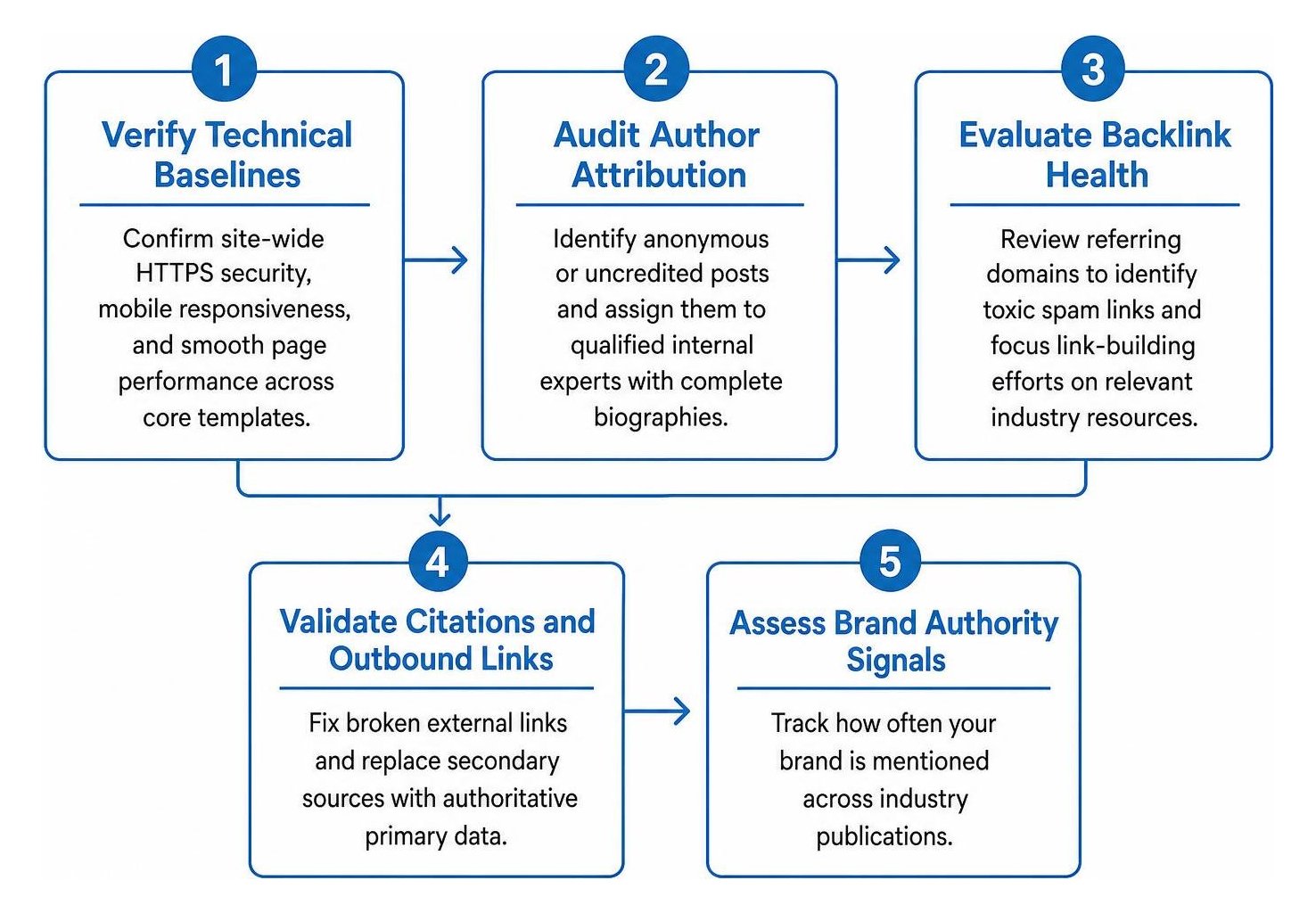
- Verify Technical Baselines: Confirm site-wide HTTPS security, mobile responsiveness, and smooth page performance across core templates.
- Audit Author Attribution: Identify anonymous or uncredited posts and assign them to qualified internal experts with complete biographies.
- Evaluate Backlink Health: Review referring domains to identify toxic spam links and focus link-building efforts on relevant industry resources.
- Validate Citations and Outbound Links: Fix broken external links and replace secondary sources with authoritative primary data.
- Assess Brand Authority Signals: Track how often your brand is mentioned across industry publications when measuring brand authority.
To establish an accurate baseline for your site's current standing, execute a comprehensive SEO visibility audit across all indexable URLs.
How Does E-E-A-T Impact AI-Generated Content and Search Visibility?
With the rapid adoption of large language models and Answer Engine Optimization (AEO), AI engines seek the most trustworthy sources to cite in generated overviews.
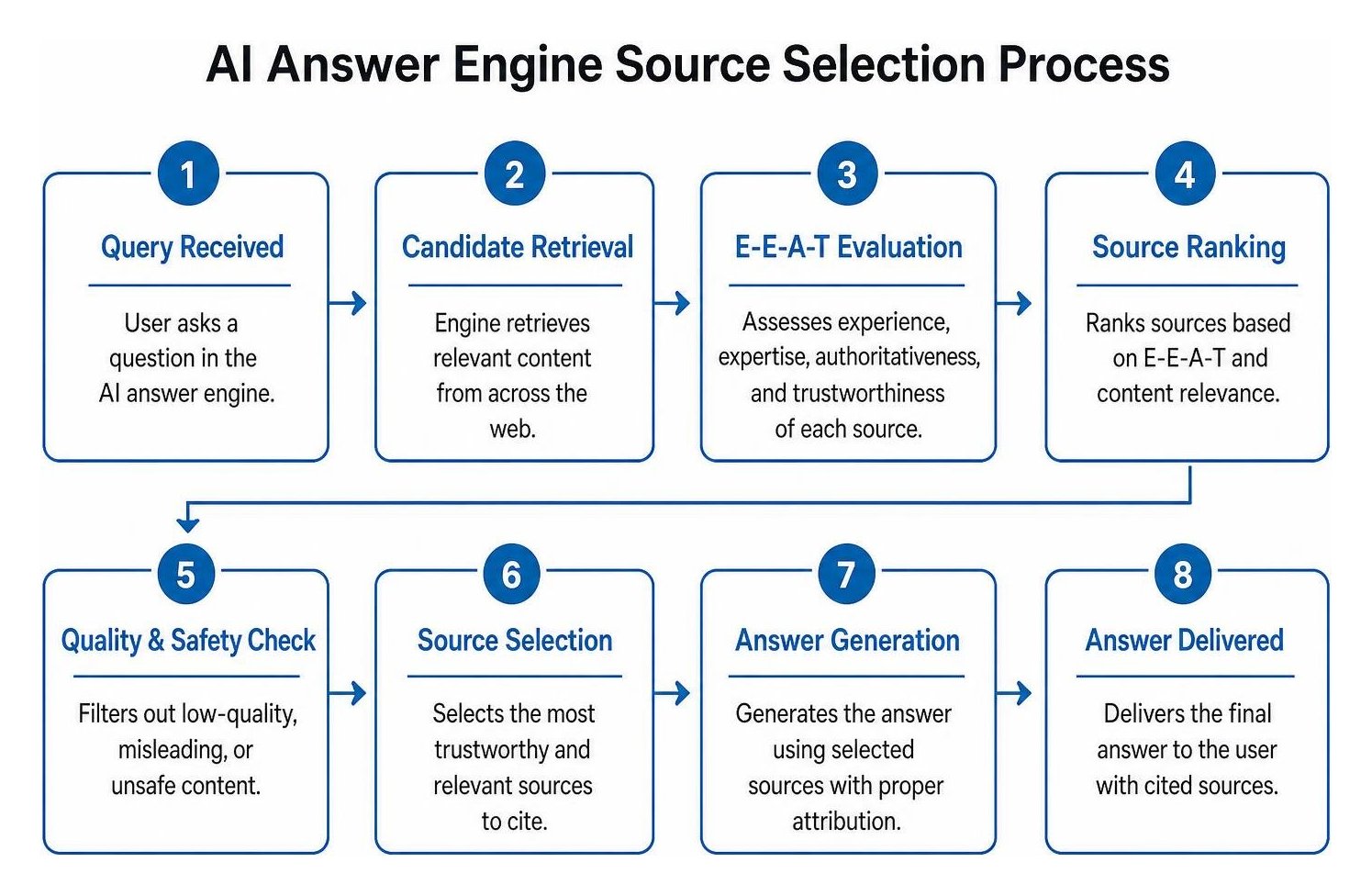
Mass-producing unedited AI text creates significant quality risks. While search engines do not mandate labels on AI-generated text, they prioritize helpful, human-centered content. AI systems cannot fabricate genuine first-hand human experience. This makes your lived case studies, unique testing notes, and professional insights an enduring competitive advantage.
When utilizing AI tools, mandate human editorial review, ensure factual verification, and adopt standard IPTC image metadata for synthetic visuals. To monitor how AI engines evaluate your assets, apply proven AI SEO audit techniques.
Elevating Your Brand Authority and Search Performance
Building sustainable search visibility requires transforming your web presence into an undeniable mark of trust. At SmallBizSEO, our data-driven Velocity framework pairs technical precision with genuine authority development to help growing businesses capture market share and protect organic traffic.
Ready to uncover and fix your site's quality gaps? Request a SmallBizSEO professional SEO visibility audit today to build lasting search authority.