How Smart SEO Helps Flexible Office Operators Reach Maximum Capacity
How can SEO help flexible offices fill more space?
SEO for executive suite & coworking operators starts with the searches that lead to bookings. Create a useful page for each location, with clear details on offices, desks, prices, amenities, and how to book a tour. Keep your business listings accurate, add real photos, and make it easy to call or schedule from a phone. Then track tours and sign-ups, not just website visits.
I’m Clayton Johnson, founder of SmallBizSEO, where I work on technical SEO, content strategy, and link building to help small businesses attract qualified leads. My approach to SEO for executive suite & coworking operators is to connect what people search for with the workspace details they need to make a booking decision.
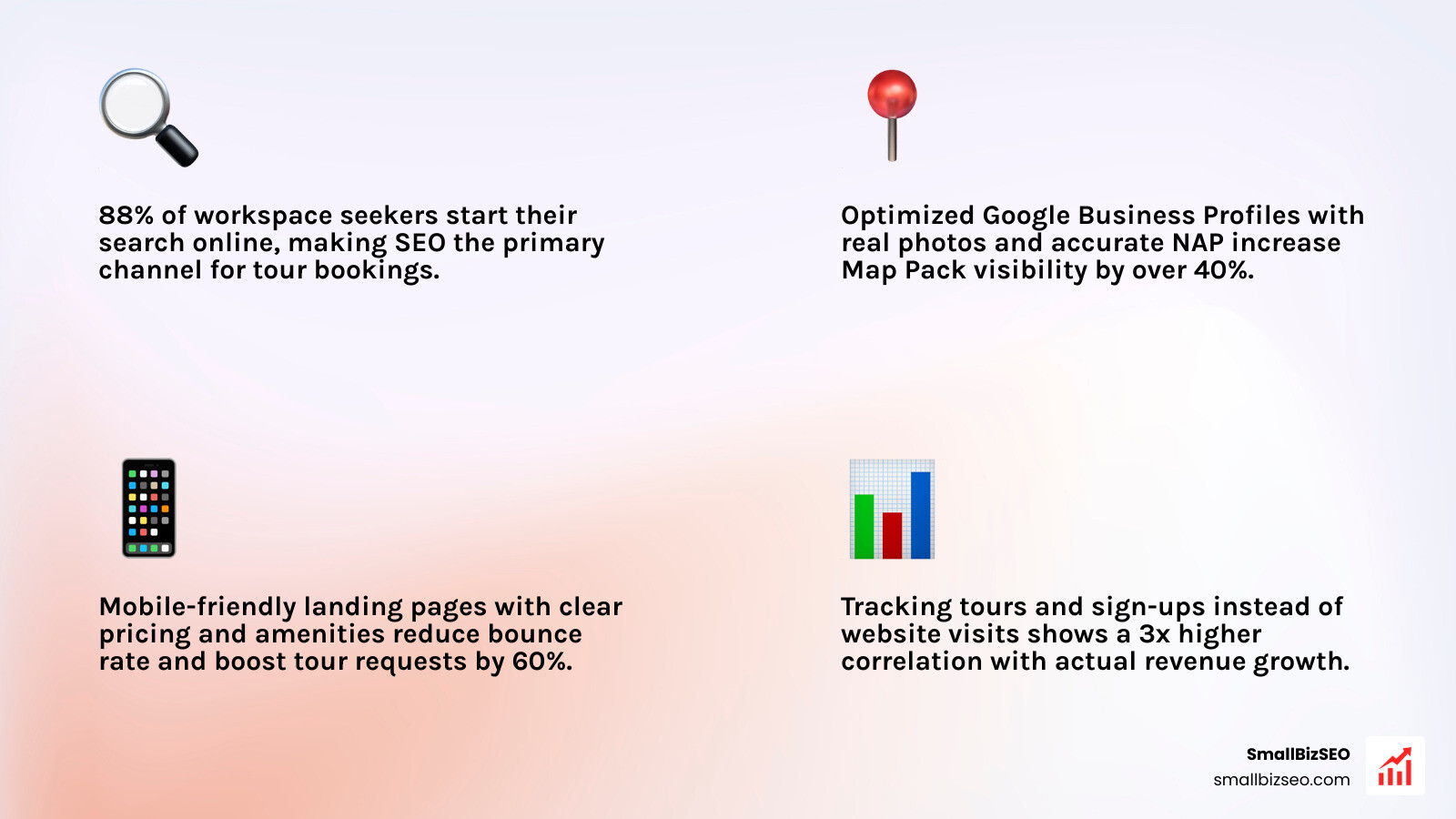
Basic SEO for executive suite & coworking operators vocab:
Local and Commercial SEO for Executive Suite & Coworking Operators
Commercial tenants search online before ever stepping foot into a building. Research shows that 88% of potential tenants start their search for commercial real estate online, and 40% sign leases for spaces they discovered independently. For flexible workspace operators, visibility during these high-intent searches directly dictates occupancy rates.
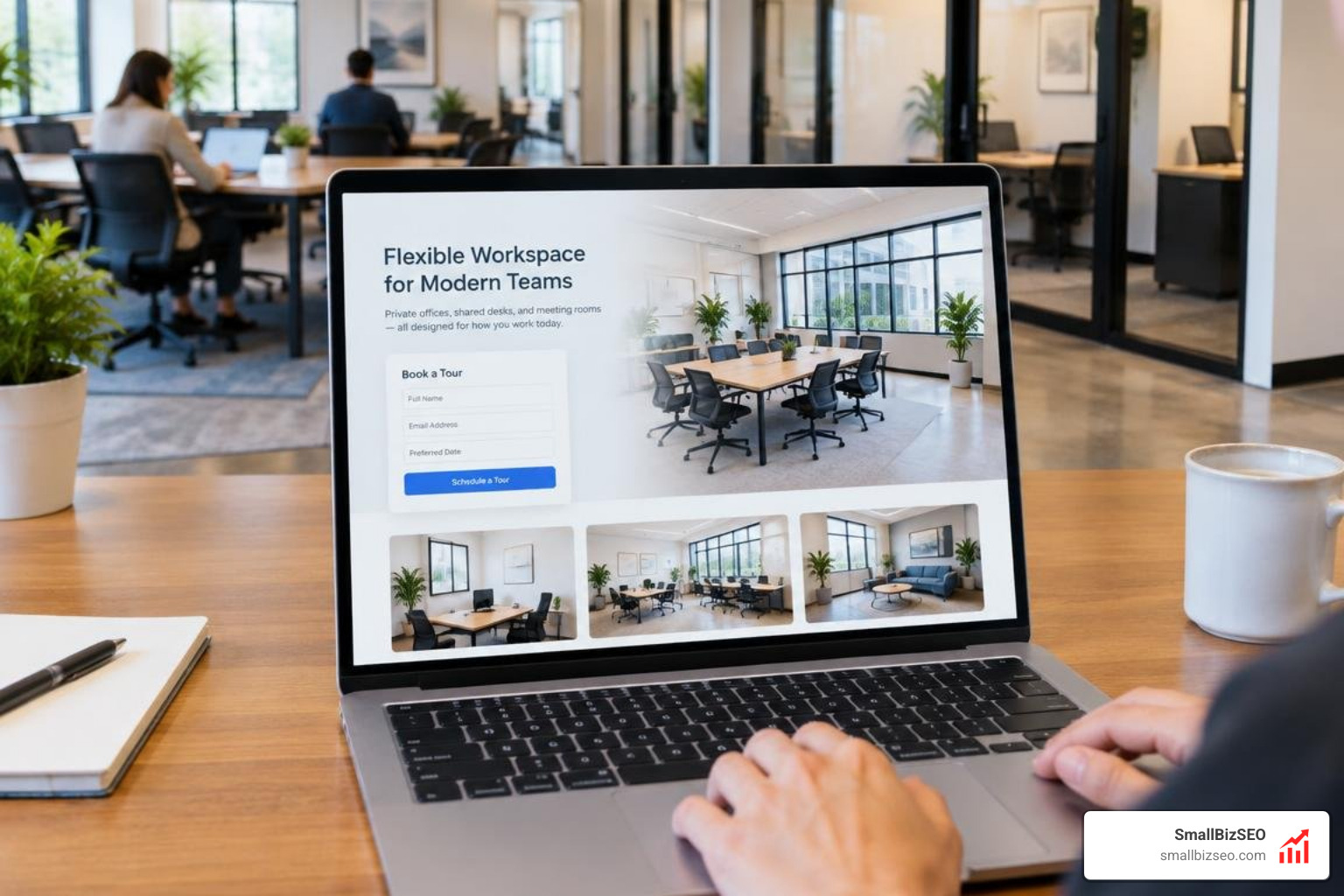
Capturing qualified demand requires optimizing for bottom-funnel commercial terms rather than general vanity traffic. A search for "private office rental" or "flexible workspace with meeting rooms" comes from an operator ready to tour. By aligning landing pages to match these submarket searches, flexible offices achieve higher conversion rates from smaller, more qualified visitor pools. Following an actionable local SEO guide ensures your location signals, metadata, and service descriptions align with search engine expectations. You can also explore how to properly add business details to Google to solidify your presence across platforms.
How Does SEO for Executive Suite and Coworking Operators Differ by Workspace Type?
Workspace models serve distinctly different professional audiences. While the physical products (desks, conference rooms, high-speed internet) share similar traits, the commercial positioning and search queries diverge significantly.
An attorney or financial planner typically searches for "executive suites" or "serviced offices" expecting formal receptionist support, privacy, and traditional Class A decor. In contrast, startup founders, creative agencies, and remote workers query terms like "coworking space" or "hot desk rentals." Positioning a luxury corporate office solely under coworking terms alienates high-budget corporate tenants, while labeling a vibrant startup hub as an executive suite creates friction for remote professionals. Operators managing diverse real estate assets can also review specialized property management SEO services to understand how broader commercial portfolios structure their offerings.
| Workspace Model | Primary Search Intent | Target Demographics | Core Value Proposition |
|---|---|---|---|
| Executive Suite | Formal, quiet, turn-key private office space | Attorneys, accountants, corporate consultants | Prestige, administrative support, sound privacy |
| Serviced Office | Scalable, fully furnished private team suites | Regional corporate branch teams, established firms | All-inclusive utility billing, turnkey infrastructure |
| Coworking Space | Flexible desks, shared amenities, networking | Startups, freelancers, remote tech workers | Flexible commitments, open community, modern aesthetic |
How Do Operators Optimize Google Business Profile for Local Map Pack Visibility?
Securing top rankings in Google's local Map Pack is essential for capturing nearby workspace demand. Because flexible workspaces rely heavily on proximity, business listings must provide complete, accurate, and engaging information.
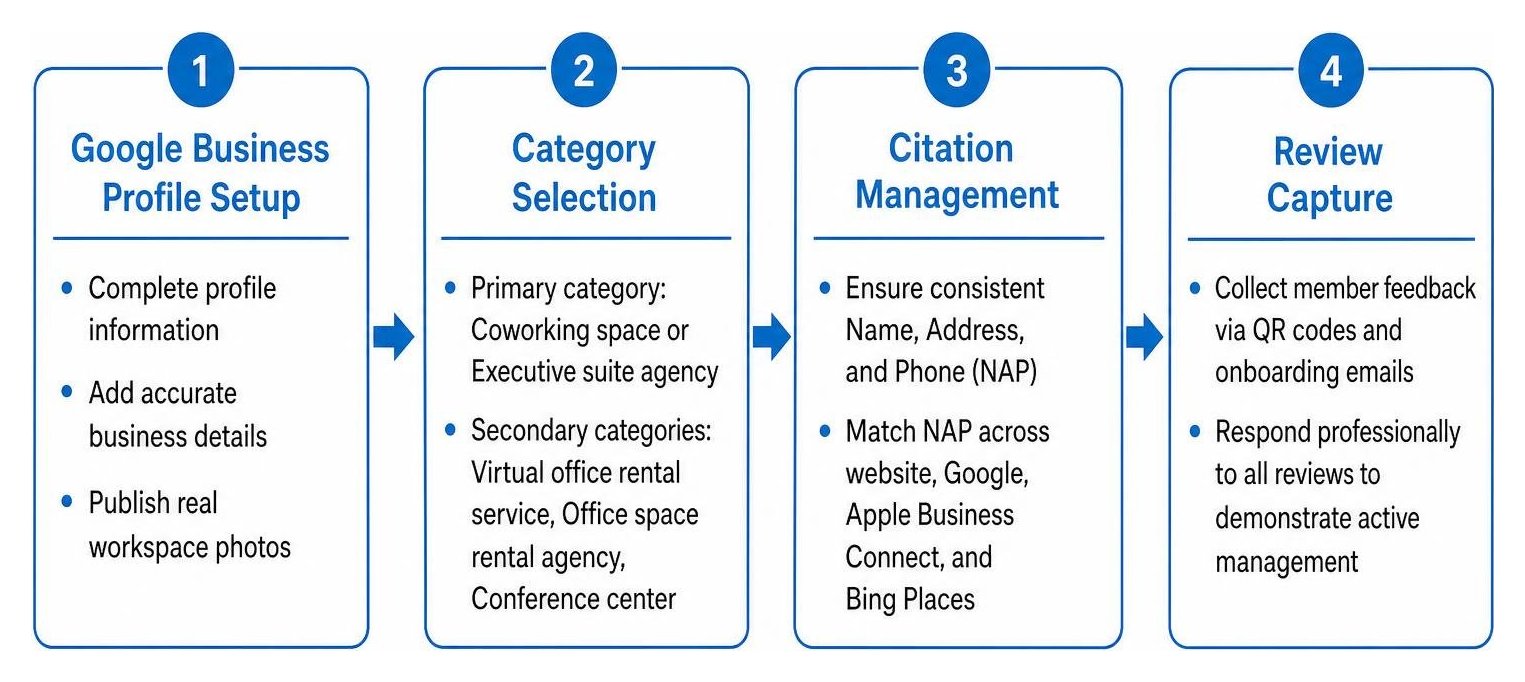
- Select the Proper Primary and Secondary Categories: Choose your most valuable offering as your primary category (e.g., "Coworking space" or "Executive suite agency"). Add secondary categories such as "Virtual office rental service," "Office space rental agency," and "Conference center" to capture overlapping search terms.
- Maintain Strict NAP Consistency: Ensure your Name, Address, and Phone number are identical across your website, Google, Apple Business Connect, and Bing Places.
- Publish Real Workspace Photography: Upload high-resolution photos of private offices, open seating, phone booths, boardrooms, and reception desks. Authentic images outperform generic stock photos and build immediate trust.
- Implement an Active Review System: Gather member feedback through front-desk QR codes and automated onboarding emails. Respond professionally to all reviews to demonstrate active management.
Operators can refine their strategy by optimizing your Google Business Profile and reviewing our practical guide to local SEO map visibility to maintain consistent local dominance.
How to Implement On-Page SEO for Executive Suite & Coworking Operators to Convert Tours
On-page architecture must guide prospects smoothly from organic discovery to physical tour bookings. A proven approach is the Root-Seed-Node structure, where the primary location page acts as the root, product categories (private offices, dedicated desks, day passes) serve as the seeds, and individual feature pages (meeting room equipment, podcast studios) act as supporting nodes.
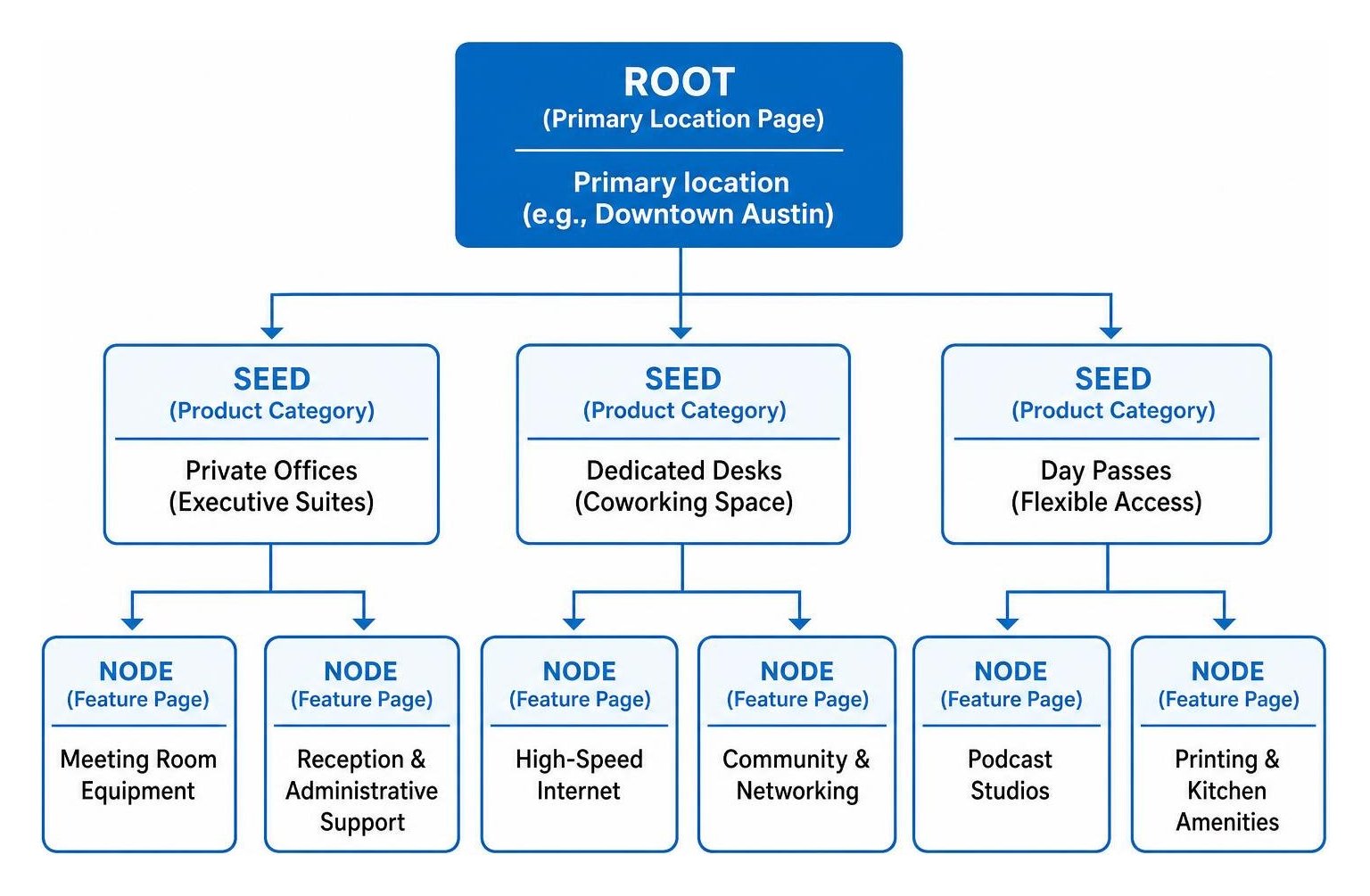
To maximize conversion rates:
- Display Transparent Pricing: Clearly outline monthly rates, deposit requirements, and included amenities. Clear pricing qualifies leads and increases tour submission rates.
- Detail Functional Amenities: Highlight fiber-optic internet bandwidth, parking access, printing allowances, and kitchen amenities directly within the page copy.
- Implement Structured Data: Add schema markup using
LocalBusiness,CoworkingSpace, orEventformats. This helps search crawlers interpret operating hours, address details, and available services.
Applying the principles from our B2B SEO playbook for qualified traffic allows operators to target decision-makers efficiently. Real-world results bear this out: optimizing commercial search intent rather than pursuing generic search volume increases closed contract value significantly.
Technical Optimization, Revenue Growth, and Campaign ROI
A flexible office website must function quickly and securely. Technical SEO ensures search engines can crawl your property layouts while delivering a friction-free experience for prospective members exploring floor plans or scheduling tours on mobile devices.

Key technical priorities include:
- Core Web Vitals: Keep Largest Contentful Paint (LCP) under 2.5 seconds and eliminate Cumulative Layout Shift (CLS) so interactive floor plans load smoothly.
- Mobile Usability: Ensure tour reservation forms and tap-to-call buttons work seamlessly on smartphones.
- HTTPS Security: Maintain SSL encryption across all booking portals and member payment pathways.
- Backlink Acquisition: Secure local backlinks by partnering with local business associations, sponsoring startup pitch competitions, and listing spaces on flex office aggregators.
Operators evaluating technical redesigns can look to structural site improvements to see how modern site architecture expands search visibility.
How Can Operators Scale Virtual Office Revenue While Managing Google Verification Risks?
Virtual office and digital mail plans offer uncapped capacity and predictable recurring revenue. Because these services do not depend on physical desk limits, they can provide substantial cash flow.
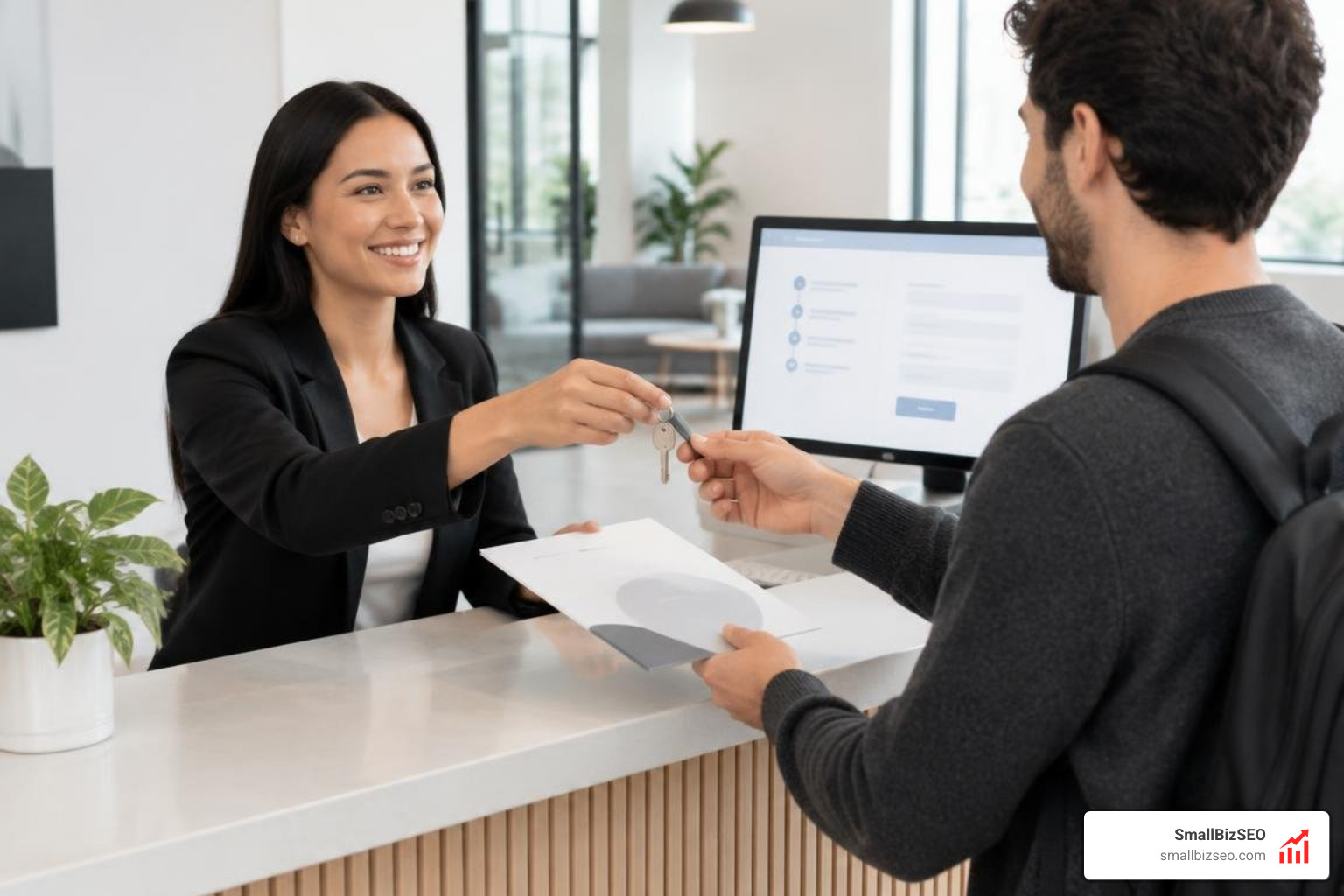
However, offering business addresses for Google Business Profile verification carries specific risks. Google requires verified listings to represent physical locations with permanent signage and dedicated staffing during stated business hours. Allowing dozens of remote businesses to register identical suite numbers can trigger duplicate address flags or map suspensions.
Best practices for virtual office management include:
- Assigning unique suite or unit numbers (e.g., Suite 300-A1) to each member.
- Requiring an upgraded membership tier or physical desk add-on for members using the address on Google Maps.
- Inspecting incoming verification postcards to confirm accurate sub-suite formatting before member delivery.
What Metrics, Timelines, and Agency Costs Drive Measurable Growth?
Measuring SEO success for executive suites and coworking spaces goes beyond tracking search engine rankings. Operators should focus on direct commercial actions: booked tours, phone inquiries, direction requests, and completed membership agreements.
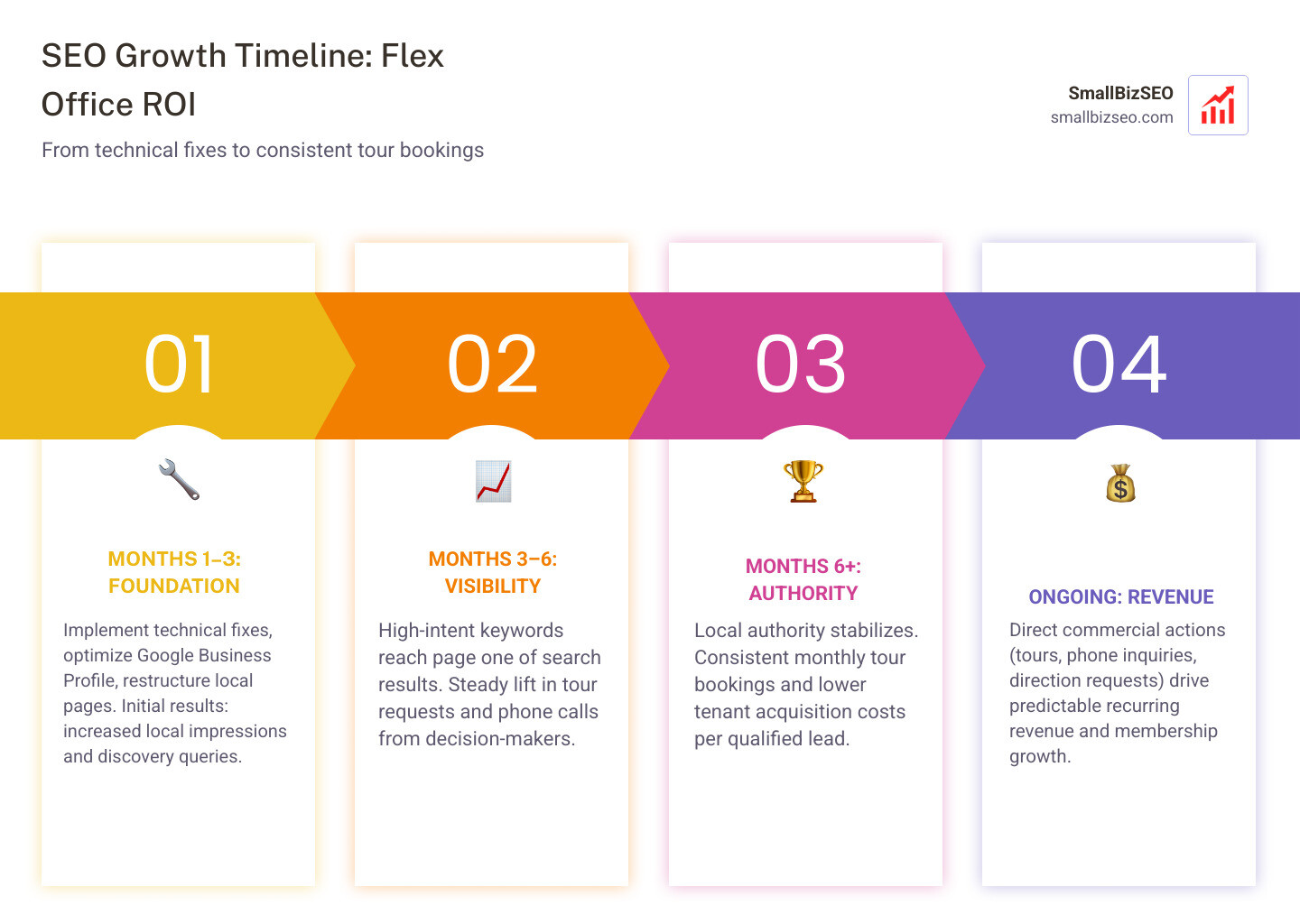
A standard SEO campaign follows clear developmental phases:
- Months 1 to 3: Technical fixes, Google Business Profile optimization, and local page restructuring take root. Initial increases appear in local impressions and discovery queries.
- Months 3 to 6: Keyword rankings for high-intent terms move onto the first page of search results, driving a steady lift in tour requests and phone calls.
- Months 6 and Beyond: Local authority stabilizes, producing consistent monthly tour bookings and lower tenant acquisition costs.
Professional SEO services for flexible workspaces typically range from $1,500 to $5,000 per month depending on market density and portfolio size. Exploring specialized commercial SEO packages helps operators select an approach that aligns with their growth targets.
Ready to Fill Your Flexible Office and Executive Suites?
Attracting reliable members and achieving maximum occupancy requires connecting high-intent local searchers with transparent, well-structured workspace information. By combining rigorous local listing management, transparent on-page pricing, clean technical performance, and compliant virtual office services, independent operators can outrank larger competitors and maintain steady waitlists.
At SmallBizSEO, we use our data-driven Velocity framework to build search visibility that translates directly into booked tours, signed agreements, and sustained revenue growth. Reach out to our team today to build an acquisition strategy tailored to your space.