How to Run AI Search Competitor Analysis in 5 Steps
How Do You Analyze Competitors in AI Search?
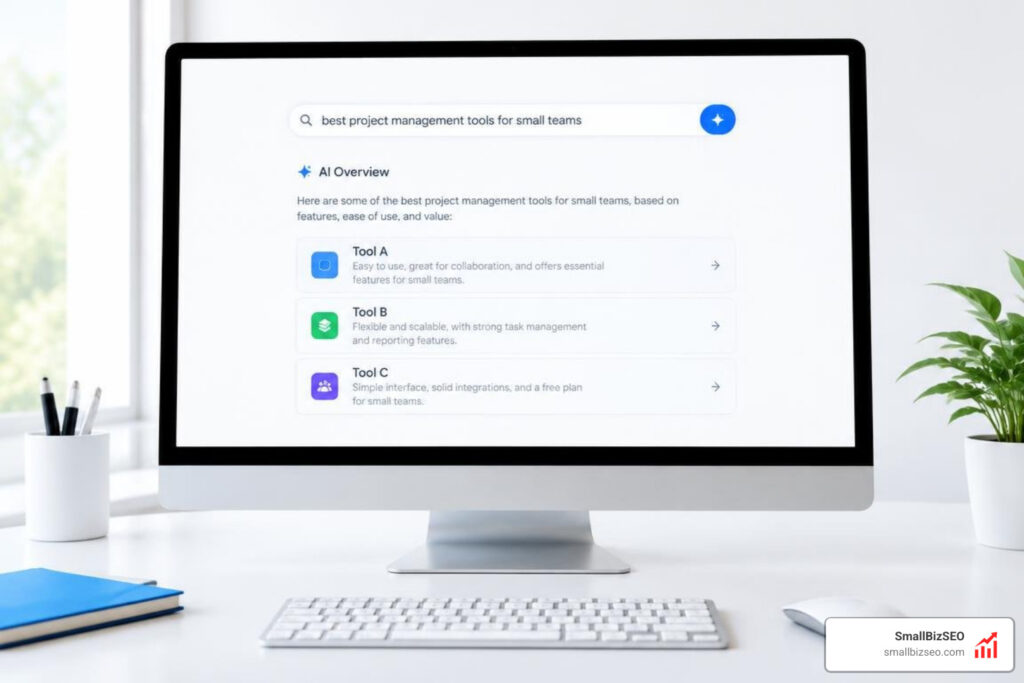
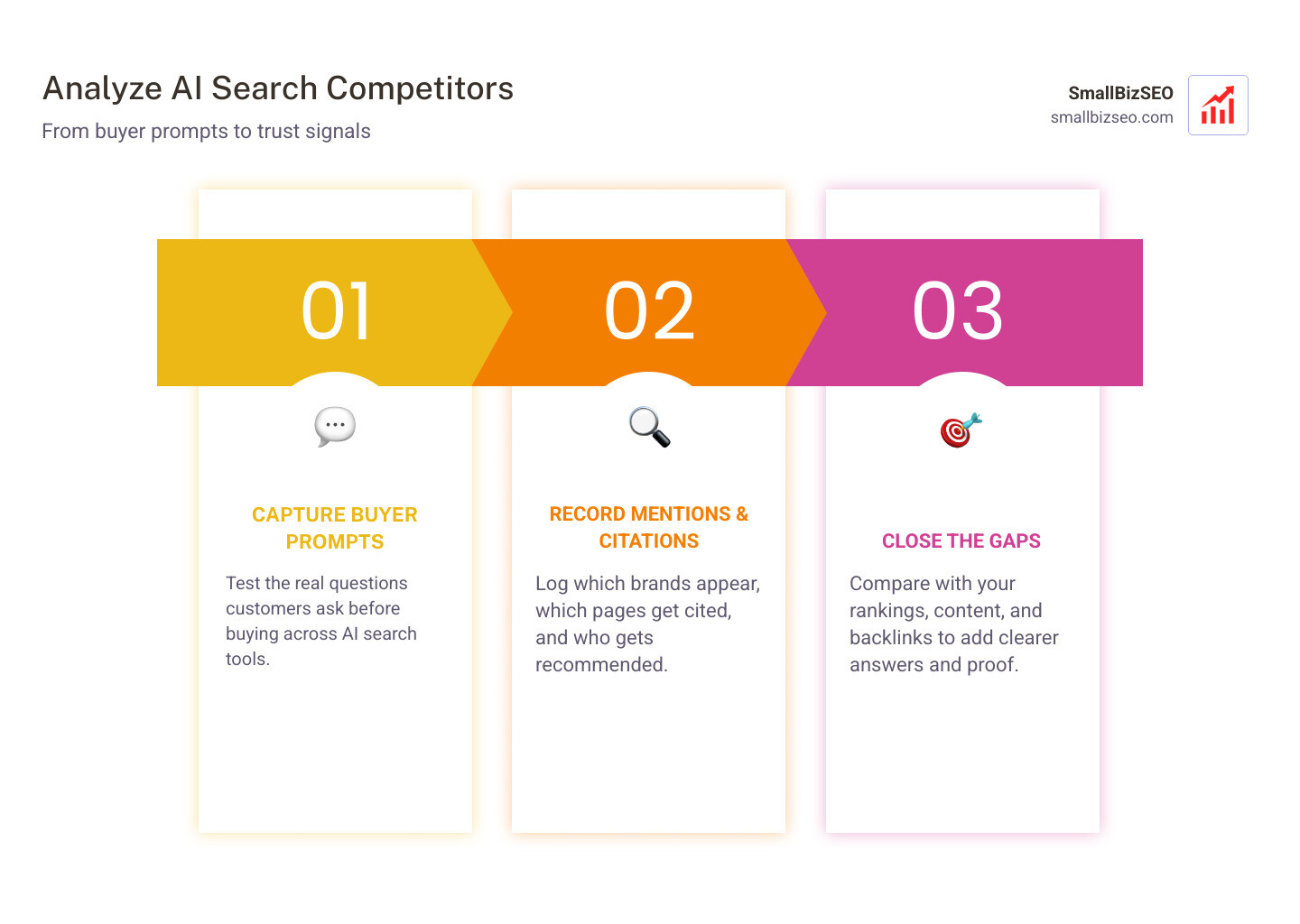
Start an AI search competitor analysis with the questions your customers ask before buying. Test those questions across AI search tools, then record which brands appear, which pages are cited, and whether the answer recommends a competitor. Compare those findings with your own search rankings, content, and backlinks. This shows where you need a clearer answer, stronger proof, or a more useful page.
A brand mention is not the same as a recommendation. Track both so you can see not just who gets noticed, but who earns a buyer's trust.
I'm Clayton Johnson, founder of SmallBizSEO. My work in SEO, content, and digital PR shapes how I approach AI search competitor analysis: start with buyer questions, check the evidence, and turn the gaps into practical improvements.
AI search competitor analysis definitions:
Core Differences in AI Search Competitor Analysis vs. Traditional SEO
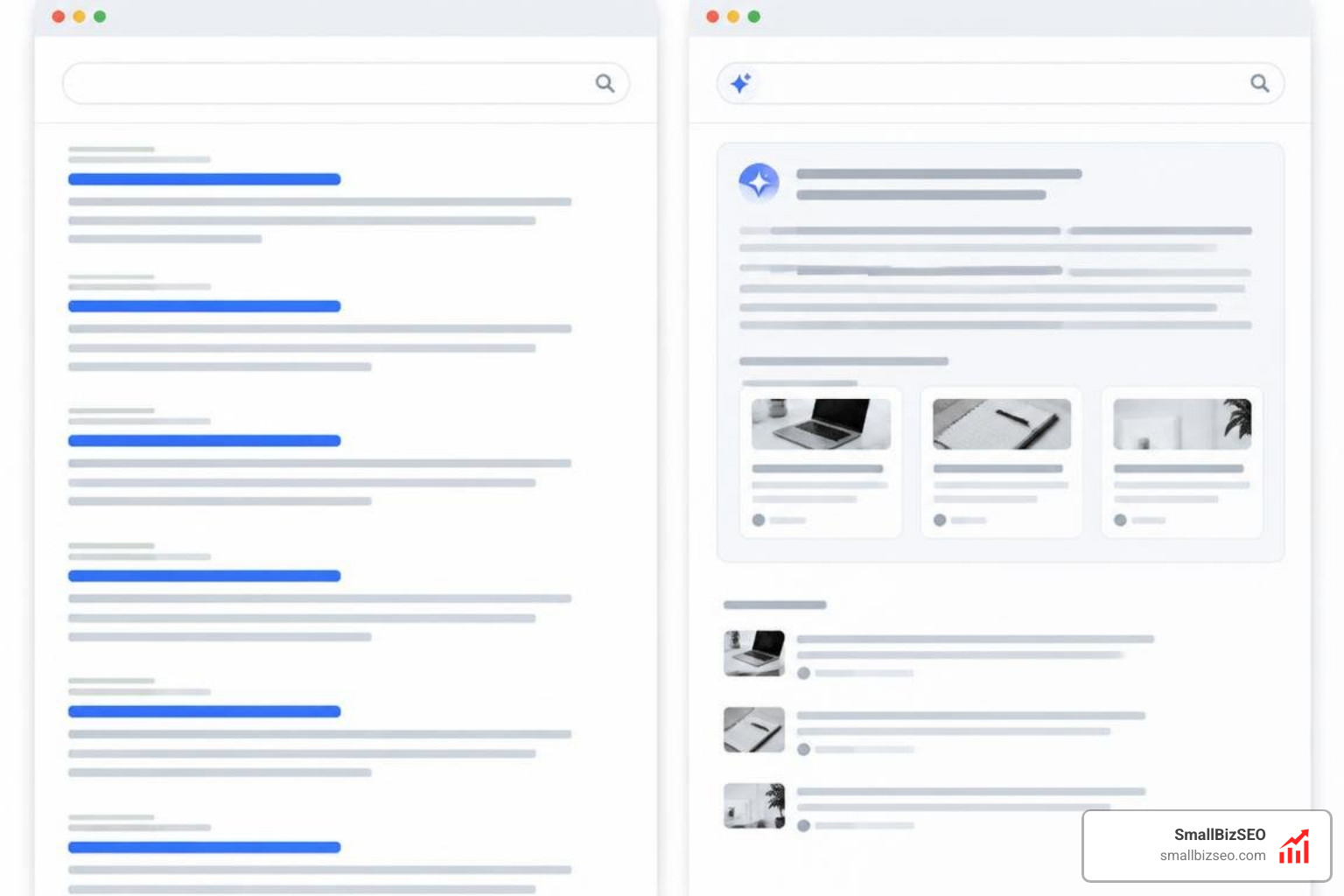
Traditional SEO competitor analysis tracks where URLs rank on a static results page, whereas AI search competitor analysis evaluates how generative engines synthesize, cite, and recommend brands. In classic search, winning meant securing a top spot on a list of blue links. In generative discovery, large language models (LLMs) use retrieval-augmented generation (RAG) to scan multiple sources, extract relevant facts, and construct a single comprehensive response.
Because organic search accounts for 53% of website traffic, tracking your market rivals remains critical. However, research into demystifying AI search ranking factors shows that standard keyword volume no longer tells the whole story. An engine might pull data from three distinct websites to answer a complex prompt, completely bypassing traditional position-one click-through advantages.
| Evaluation Area | Traditional SEO Competitor Analysis | AI Search Competitor Benchmarking |
|---|---|---|
| Primary Metric | Keyword rankings and URL positions (1-10) | Citation frequency, source links, and Share of Voice |
| Data Extraction | Page-level metadata and keyword density | Semantic facts, entities, and structured data tables |
| Search Surface | Ten blue links and standard search features | Conversational answer overviews and multi-modal responses |
| Competitor Scope | Direct business rivals in your niche | Informational hubs, community threads, and business sites |
| End Goal | Earning a direct click to a landing page | Securing a direct brand recommendation and cited source |
According to independent academic research on Source Coverage and Citation Bias in LLM-based vs. Traditional Search Engines, generative engines select citation sources based on semantic relevance, domain credibility, and content structure rather than traditional backlink volume alone. When we monitor the competitive landscape, we must look beyond keyword positions to see how models extract, evaluate, and present our business information against alternative options.
What Is the Difference Between AI Visibility and AI Recommendations?
AI visibility means your brand name appears within an AI-generated answer, while an AI recommendation occurs when the model actively advises the user that your brand is the best solution for their specific problem.
Visibility is purely informational. For example, if a user asks for a list of project management tools, an AI engine might list your product alongside ten competitors. You have achieved visibility. However, when a prospect enters a prompt like "What is the best project management software for a team of five remote designers on a tight budget?", the model evaluates proof points, pricing clarity, and sentiment. If it selects your company as the top recommendation and justifies why, your conversion potential skyrockets.
Understanding the conversion power of AI referral traffic highlights why recommendations matter. Traffic coming from conversational recommendations converts at higher rates because the user has already received an objective, third-party validation from the engine.
To turn passive mentions into active endorsements, your content requires specific conversion copywriting elements:
- Hard data and verifiable return-on-investment statistics.
- Clear feature-to-benefit comparisons.
- Transparent pricing and explicit use-case definitions.
- Third-party trust proof from industry publications and review hubs.
How to Identify True SEO Competitors vs. Direct Business Rivals
Your true SEO competitors are the domains that consistently win citations and organic visibility for your target buyer questions, regardless of whether they sell a competing product.
Many businesses make the mistake of tracking only their direct commercial rivals. If you run an email marketing software platform, your direct business competitors are other software vendors. However, when your prospects ask an engine how to improve newsletter open rates, the AI might cite marketing blogs, niche publishers, or independent educators. Those cited websites are your true SEO competitors because they control the real estate and shape the answers your prospective clients read.
Industry experts studying Competitor Analysis & Benchmarking with AI emphasize that identifying these audience-comparison sources reveals where AI engines pull their foundational knowledge. By categorizing your search rivals into direct business peers, authority publishers, and niche educational hubs, we can see exactly what source content we must outperform to capture valuable citation share.
How to Execute an Actionable AI Search Competitor Audit

An actionable AI search competitor audit requires testing targeted buyer prompts across multiple engines, cataloging cited sources, and mapping content gaps into an operational roadmap. Using automated tools alongside manual prompt sampling accelerates data collection. AI-driven competitor screening operates up to 10.5x faster than legacy manual audits while delivering over 110% more relevant contextual insights.
When conducting an AI SEO audit, we look at how different engines process language. Because models rely on distinct data partnerships, real-time browsing mechanisms, and retrieval indexes, benchmarking across multiple platforms provides a balanced picture of your brand's true digital standing.
How to Conduct an AI Search Competitor Analysis Using Strategic Prompts
You can perform an in-depth strengths and weaknesses analysis by feeding structured, comparative prompts into AI engines to evaluate market perception.
To audit how AI perceives your brand versus competitors, use objective prompts that ask the engine to extract factual comparisons without leading the answer. Run prompts such as:
"Act as a procurement consultant. Compare [Your Brand] and [Competitor A, Competitor B] for an enterprise buyer. Create a table detailing their core features, pricing structures, perceived strengths, and notable limitations based on verified web sources."
Analyze the generated output for:
- Framing and Sentiment: Does the engine frame your company as an affordable entry-level tool or an advanced enterprise solution?
- Missing Proof Points: Did the model cite a competitor's specific case study while noting a lack of data for your product?
- Source Attribution: Which third-party websites did the engine cite to validate its claims?
Tracking these outputs gives you a clear baseline for understanding AI citation rates and reveals where your website lacks explicit facts that engines need to recommend your business.
How to Predict Prospect Prompts for an AI Search Competitor Analysis
Predict future buyer prompts by analyzing the pain points, comparison queries, and decision criteria your customers express during the buying journey.
Prospects rarely type short, two-word keywords into conversational search engines. Instead, they provide detailed background context, specify technical constraints, and ask complex follow-up questions. As discussed in The Google Exec Reinventing Search in the AI Era, modern discovery tools are built to handle multi-step, contextual user journeys.
To uncover these long-tail queries, ask your sales team about common objections and review support tickets. You can also prompt an AI model directly:
"List 20 detailed, multi-sentence prompts that a small business owner would ask when searching for [your service category]. Include constraints related to budget, implementation speed, and technical skill."
Testing these exact scenarios shows you which competitors currently own the conversation for high-intent, bottom-of-the-funnel questions.
What Is the 4-Step Framework to Audit Keywords, Content, and Backlinks?
Our four-step framework combines competitor identification, keyword gap analysis, content quality scoring, and backlink replication into a unified action plan.
- Step 1: Identify Your True Search Competitors. Search your core problem-based queries across traditional engines and generative tools. Record the top five commercial brands and top five informational domains cited most frequently.
- Step 2: Uncover Question and Keyword Gaps. Run a keyword gap analysis to find conversational queries where competitors earn visibility but your site is missing. Focus on question-based phrases, because AI models lean heavily on clear question-and-answer pairs when assembling summaries.
- Step 3: Evaluate Content Quality with a Scorecard. Audit top-performing competitor URLs against clarity, structure, and depth. Studies show that comprehensive long-form resources over 3,000 words earn 3x more traffic, but in AI search, that depth must be paired with structured data, summary bullets, and direct definitions. This structure is central to building E-E-A-T signals for AI search.
- Step 4: Execute Authority and Backlink Replication. Top-ranking pages have 3.8x more backlinks than lower positions, yet only 2.2% of online content earns more than one unique backlink. Analyze where your competitors earn their best industry citations. Because 54% of businesses build links through competitor targeting, finding sites that link to multiple rivals—but not to you—gives you an immediate outreach roadmap.
What Mistakes Derail Competitor Analysis in AI Search?
The most damaging mistakes in AI search competitor analysis are relying on a single engine, assuming AI answers are static, and failing to verify cited sources.
Avoid these common pitfalls when running your audits:
- Single-Engine Tunnel Vision: Tracking visibility only on one platform misses how different models process authority. Always test across several major generative interfaces.
- Overlooking Citation Gaps: Seeing your brand mentioned is not enough; if competitors have links to their source pages while your mention is unlinked, you lose referral traffic.
- Ignoring Data Decay: Approximately 66% of backlinks decay or break over time, and AI models frequently refresh their retrieval indices. Perform audits on a quarterly schedule to catch shifts early.
- Failing to Take Action: Audits provide zero value without implementation. Prioritize opportunities based on business impact and required effort so your team can publish updates immediately.
Winning the Shift to Conversational Search Discovery
Analyzing your competitive landscape in generative search is not about chasing algorithmic tricks; it is about building the most accurate, structured, and authoritative answers in your industry. When you systematically identify your true citation rivals, close critical keyword gaps, and provide verified proof points, AI engines naturally choose your business as the definitive answer for prospective buyers.
If you are ready to turn competitive insights into measurable organic growth and sustainable AI visibility, explore our data-driven AI search services to build an authoritative, Answer-Ready search strategy today.