In Depth Guide to Grok Brand Monitoring
What Is Grok Brand Monitoring?
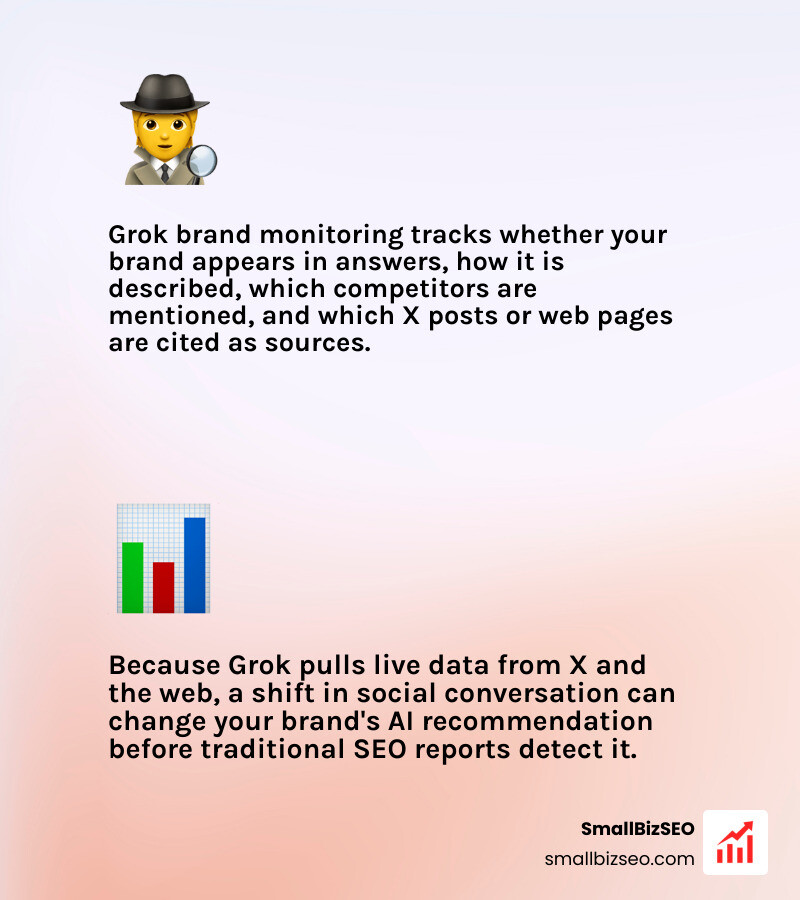
Grok Brand Monitoring means checking how Grok mentions, describes, and recommends your business in its answers. To start, test the same buyer questions each week. Record whether your brand appears, how it is framed, which competitors appear, and what web pages or X posts Grok cites. Compare the results over time so you can spot changes worth investigating.
This matters because Grok can use current information from X alongside web sources. A shift in public conversation may show up in an answer before your usual SEO reports reveal a problem. One answer is not enough to establish a trend, so keep your prompts and testing conditions consistent.
I’m Clayton Johnson, founder of SmallBizSEO. My work in SEO, digital PR, and AI search visibility informs this guide to Grok Brand Monitoring and its focus on clear answers, credible sources, and useful follow-up.
Grok Brand Monitoring terms made easy:
How Does Grok Find and Describe Your Business?
Grok searches the live web and real-time social conversations to summarize what people say about your company, determine your market standing, and formulate direct answers for prospective buyers.
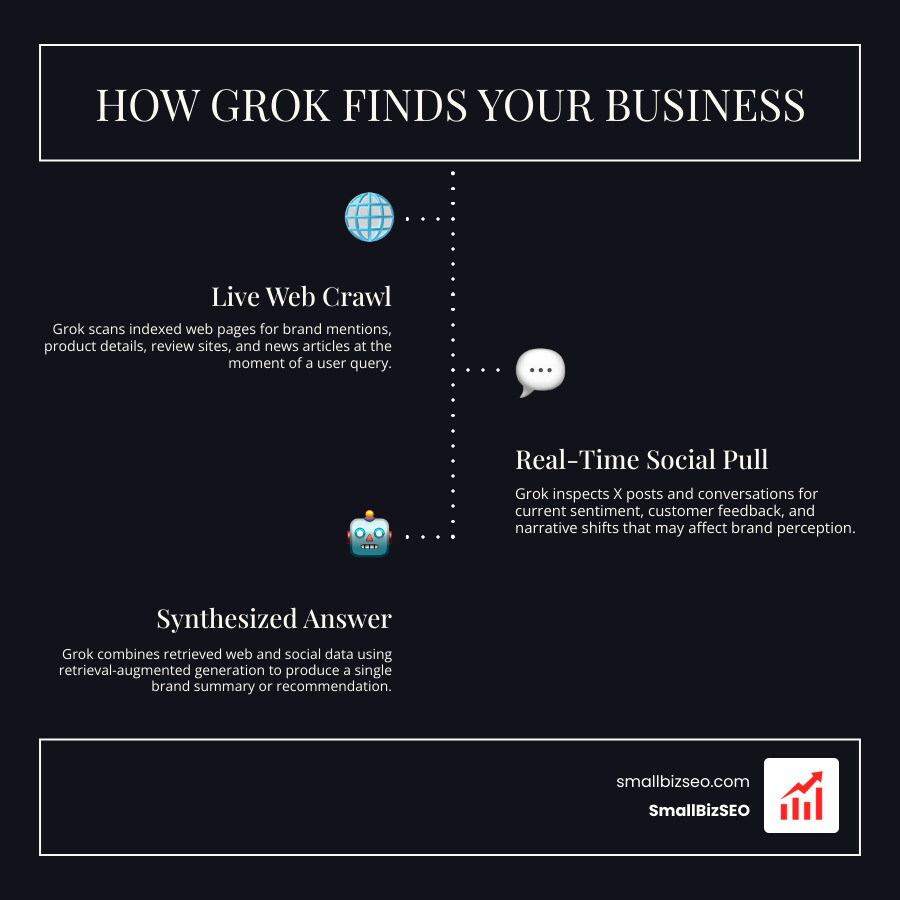
When prospective buyers use conversational search engines, they bypass traditional blue links in favor of synthesized answers. Grok uses retrieval-augmented generation (RAG) to generate these summaries. Rather than relying solely on frozen database training sets, it scans live digital sources at the moment a user submits a prompt.
Understanding this dual retrieval pipeline is vital for modern brand authority. If a sudden narrative shift occurs online—such as a product update, a pricing dispute, or customer feedback—Grok can reflect that sentiment within hours. By monitoring these answers, we can see whether AI systems perceive our client businesses as market leaders, budget options, or unreliable alternatives.
Why Do Live Social Signals and Query Fan-Outs Matter for Grok Brand Monitoring?
Testing related queries reveals whether Grok bases its answers on social media momentum or traditional web indexing, helping you pinpoint the root source of brand visibility shifts.
The underlying xAI platform architecture relies on two distinct server-side information retrieval mechanisms:
- The web_search tool: Scans indexable online publications, official business sites, comparison blogs, and press releases.
- The x_search tool: Scans public posts, creator threads, and real-time commentary across X.
When Grok processes a query, it performs "query fan-outs." A query fan-out occurs when the engine splits a primary user prompt into multiple secondary sub-queries. For example, if a user asks, "What is the best CRM software for real estate agencies?", Grok may run sub-searches across web reviews while simultaneously searching recent user sentiment threads on social channels.
These fan-outs determine whether conversational momentum or structured domain citations shape your brand profile. Maintaining an authoritative digital brand entity and improving cross-channel AI visibility ensures that both retrieval tools pull verified, positive facts about your company.
How Does Grok Compare to ChatGPT, Gemini, and Claude for AI Brand Tracking?
Grok reacts directly to real-time public conversations and news events, whereas models like ChatGPT, Gemini, and Claude place greater weight on static knowledge bases and traditional search engine indexes.
In news and financial queries, roughly 20% of Grok's responses touch current events. This creates high conversational volatility compared to models restricted by static training snapshots. Tracking your comparative AI share of voice and measuring your generative AI citation rate requires recognizing how each assistant sources data:
| Feature | xAI Grok | OpenAI ChatGPT | Google Gemini | Anthropic Claude |
|---|---|---|---|---|
| Primary Live Data Layer | Live X posts and DeepSearch web crawls | Bing Search integration and web browsing | Google Search Index and Workspace | Web search tool integration |
| Data Refresh Latency | Minutes to hours (real-time social sync) | Daily to weekly web crawl indexing | Constant search index synchronization | Periodic knowledge base refreshes |
| Sentiment Volatility | High (sensitive to breaking viral threads) | Moderate (favors high-authority review sites) | Low to Moderate (favors established brands) | Low (analytical, cautious tone) |
| Core Citation Types | Social posts, creator threads, web URLs | Top-ranking editorial reviews and websites | Google-indexed sources and official docs | Authoritative technical and policy documents |
| Tracking Method | Daily prompt checks and social narrative audits | Weekly category prompts and SERP citation checks | Search Console and branded query audits | Document-level prompt testing |
How Can You Build an Actionable Grok Brand Monitoring Workflow?
Building an effective workflow requires scheduling consistent prompt testing, cataloging citation sources, and setting up rapid responses for emerging narrative risks.

Ad-hoc, one-off searches inside a consumer chat app do not provide reliable data. Because AI models produce natural output variations, we must build structured, repeatable testing cadences to spot genuine business trends.
Which Metrics Should You Track for Grok Brand Monitoring and AI Visibility?
Track mention inclusion, recommendation positioning, sentiment scores, and citation sources across standardized prompt groups.
To turn qualitative AI responses into measurable data, monitor these core brand visibility metrics:
- Mention Frequency and Positioning: Does Grok name your brand first, list you among competitors, or omit you entirely?
- Sentiment Tone Scoring (0 to 100): Is your brand framed with positive descriptors (such as "reliable" or "industry standard") or burdened by negative associations (such as "pricier than competitors" or "frequent bugs")?
- Competitive Share of Voice: In benchmark tests across sample prompt sets, visibility often splits unevenly—such as one tool capturing a 38% share while a competitor holds 31%. Tracking these ratios reveals shifts in market share of voice.
- Citation Provenance: Are your citations coming from your own domain, independent product review sites, or social media threads?
- Multi-Market Consistency: Track regional differences. Testing prompts across international markets and local languages ensures global brand messaging remains accurate.
How Can You Build an Automated Pipeline Using the xAI API and Monitoring Tools?
An automated pipeline runs scheduled prompts through the xAI API, extracts mention data, and flags major sentiment drops for team review.
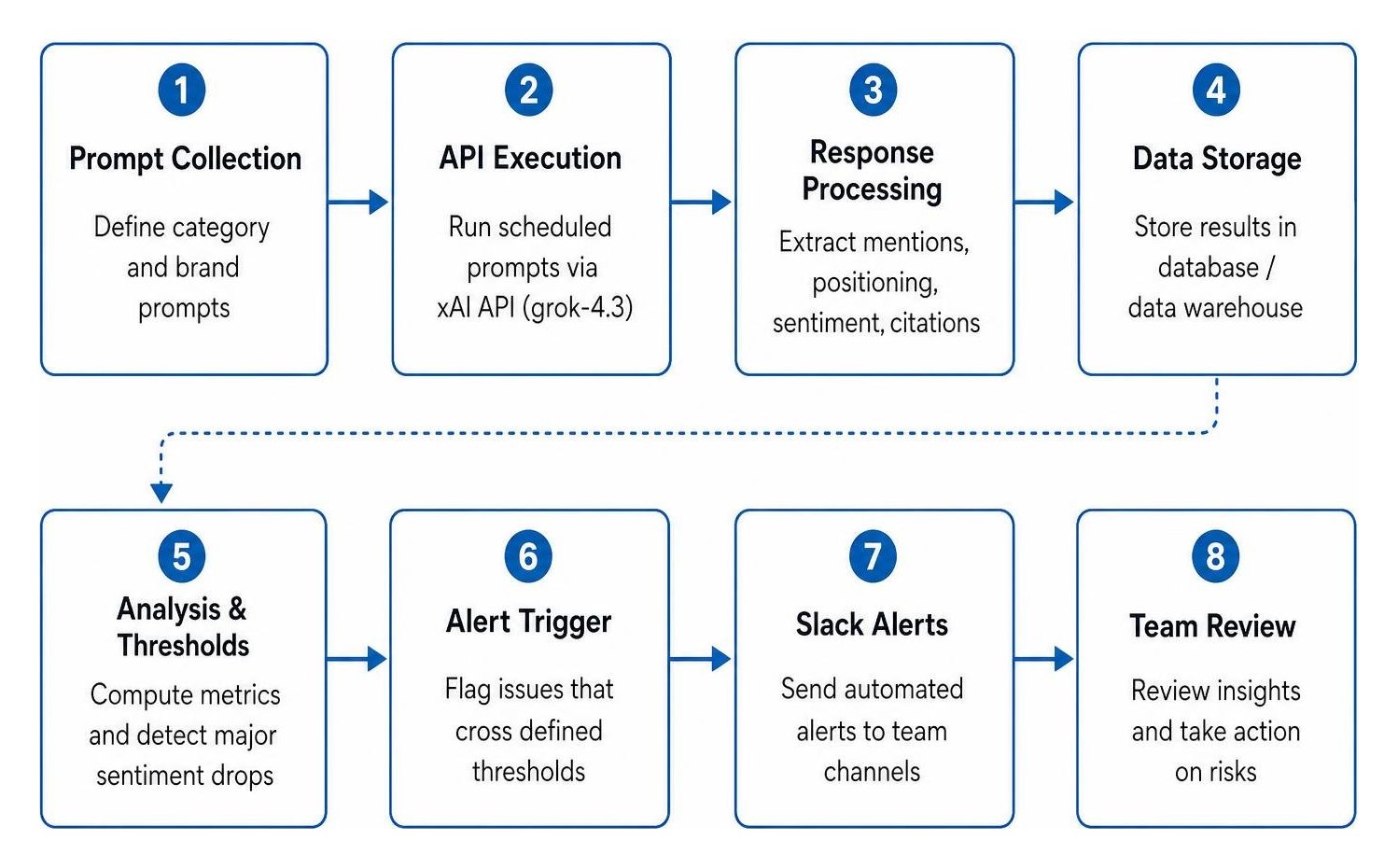
Teams can manage brand tracking manually using shared workspaces (available through Grok Business at $30 per user monthly) or deploy custom data pipelines using the xAI developer API. For developer implementations, the grok-4.3 model costs $1.25 per 1M input tokens, $0.20 per 1M cached input tokens, and $2.50 per 1M output tokens. Under standard enterprise data terms, inputs and outputs are automatically purged within 30 days.
Follow these technical steps to build an automated monitoring pipeline:
- Define category and brand prompts: Assemble a fixed library of branded, comparative, and unbranded buyer queries.
- Configure API credentials securely: Store tokens in a dedicated secrets manager and apply read-only permissions.
- Ingest and score responses: Run daily batch queries through the API, extracting named entities, tone scores, and cited links.
- Apply noise reduction filters: Isolate high-impact buying queries to filter out noisy brand references and maintain clear reporting.
- Establish alert thresholds: Set automatic notifications (via Slack or email) when negative sentiment increases by more than twice your baseline.
How Can Businesses Protect Their Reputation and Recover Lost AI Recommendations?
Protect your presence by auditing the exact sources feeding negative summaries, publishing clear corrective content on authoritative channels, and tracking recovery trends over time.
When an AI engine drops your company from its recommendations or adopts negative framing, review the data before overhauling your strategy. Analyze your AI brand recommendation data to isolate whether the issue stems from an outdated third-party review or an unresolved customer support thread.
Next, publish clear, factual resources—such as comparison pages, updated pricing sheets, or detailed technical documentation—that search crawlers can index easily. Track web analytics for referral traffic originating from grok.com to see if user visits correlate with your updated citations. At SmallBizSEO, our data-driven Velocity framework combines technical SEO, digital PR, and content optimization to secure authoritative citations across both traditional and AI search surfaces. Businesses seeking hands-on support can partner with us for dedicated brand mention tracking and optimization services.
Mastering Your Brand Narrative in AI Search
Tracking your presence in Grok bridges the gap between fast-moving public conversations and digital search visibility. By testing consistent prompt sets, evaluating web and social citations, and acting on sentiment shifts early, businesses can protect their digital authority. Monitor your AI footprint continuously, verify what the engine tells your buyers, and ensure your business remains the recommended choice across modern answer engines.