Thin Content Examples: How to Review Low-Value Pages
What Are Thin Content Examples, and How Can You Spot Them?
Thin content examples can include copied product descriptions, location pages that only swap place names, affiliate pages with no original review, and articles that repeat advice without helping the reader complete a task. A short page is not automatically thin: a concise answer, contact page, or product page can be useful when it serves its purpose.
Assess the page’s original contribution, accuracy, reader task, supporting evidence, and relationship to nearby pages before deciding what to do.
Thin content resources:
Common Thin Content Examples and Better Alternatives
Low value comes from a page’s lack of useful, original help—not a universal word count. A page may need work when it duplicates other pages, offers no meaningful answer beyond a template, has outdated or unsupported claims, or does not match the reader task.
| Page pattern | Why it may be low value | Better next step |
|---|---|---|
| Location template with only a name swap | Gives visitors little local usefulness | Add real local information where it is warranted, or consolidate overlapping pages |
| Copied product description | Repeats information available elsewhere | Add accurate, original decision support such as fit, use cases, limitations, or service details |
| Affiliate or comparison page without evidence | Does not explain how conclusions were reached | Add transparent criteria and supported, useful analysis—or do not publish the page |
| Empty archive or tag page | May provide no navigational value | Improve its purpose, remove internal links to it, or use an appropriate technical treatment after review |
Google’s people-first content guidance emphasizes useful, reliable content for readers. It does not set a required word count or say that every short page needs expansion. Keep pages that serve customers, support, legal, transactional, or other valid business purposes even when they are not meant to attract organic traffic.
How Should You Review and Improve Potentially Thin Pages?
Use a page-by-page review that considers purpose, original contribution, search and user signals, internal links, conversions or support value, and any legal or operational role. Metrics can point to a page for review, but no single traffic, word-count, duplication, or engagement threshold proves that a page is thin.
What Checklist Should You Follow When Reviewing Pages?
- Confirm the page’s intended reader task and business or support purpose.
- Check whether it contains accurate, original, useful information beyond template text.
- Compare it with genuinely overlapping pages before treating it as duplicate coverage.
- Review measurement and indexing status before interpreting low traffic.
- Check useful internal and external links, conversion paths, and required legal or customer-support value.
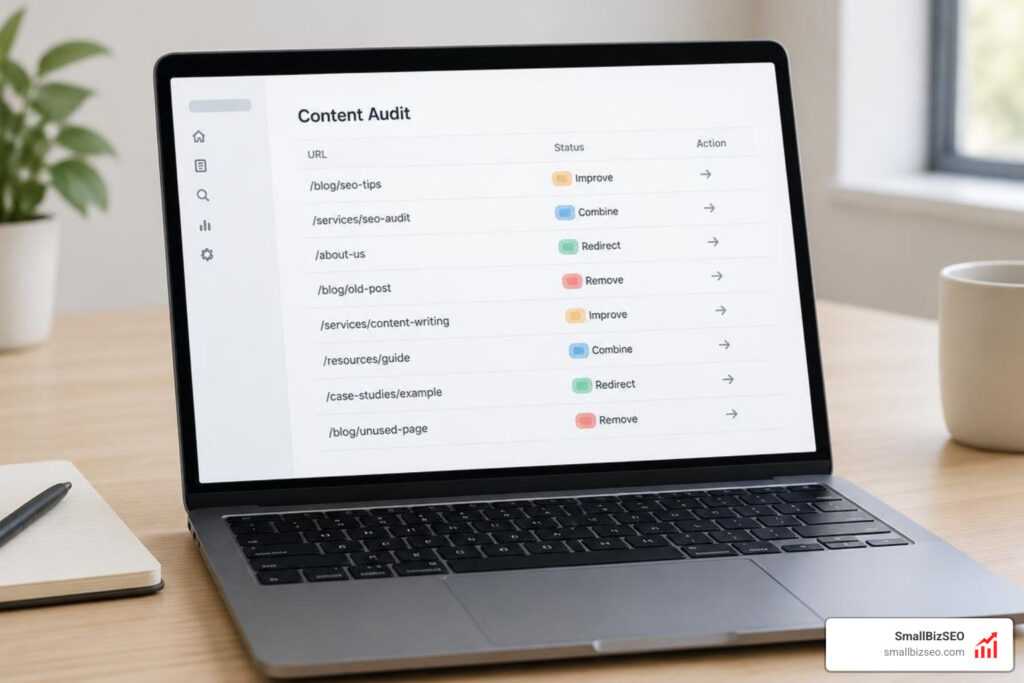
- Choose one evidence-based action: keep, update, merge, or retire.
When merging pages, preserve the strongest useful information and redirect only to a genuinely relevant replacement. Do not bulk-delete pages or send unrelated URLs to the homepage. A removal, redirect, canonical, or noindex decision should fit the actual page type and implementation goals.
Build More Useful Pages, One Decision at a Time
Thin-content work is not a bulk word-count exercise. Focus on whether each page contributes a useful answer, a clear task, or an important customer function. SmallBizSEO can help you prioritize content reviews, strengthen valuable pages, and consolidate overlapping coverage without treating deletion as the default.