Moving Targets: The Real Reasons Google AI Overview Sources Keep Changing
Why do Google AI Overview citations change between repeated searches?
Google AI Overview citations change between repeated searches because Google can draw on different related searches, pages, and passages each time it builds an answer. The main answer may stay similar while its supporting links change. In one large study, 45.5% of cited URLs changed between consecutive AI Overview updates.
That makes a single search a poor way to judge whether your business is consistently cited. This guide explains what causes the changes and how to spot patterns across repeated searches.
I'm Clayton Johnson, founder of SmallBizSEO, where I help small businesses connect SEO, content, and authority building to search visibility. My work in AI-driven discovery informs this guide to why Google AI Overview citations change between repeated searches.
Why Do Google AI Overview Citations Change Between Repeated Searches?
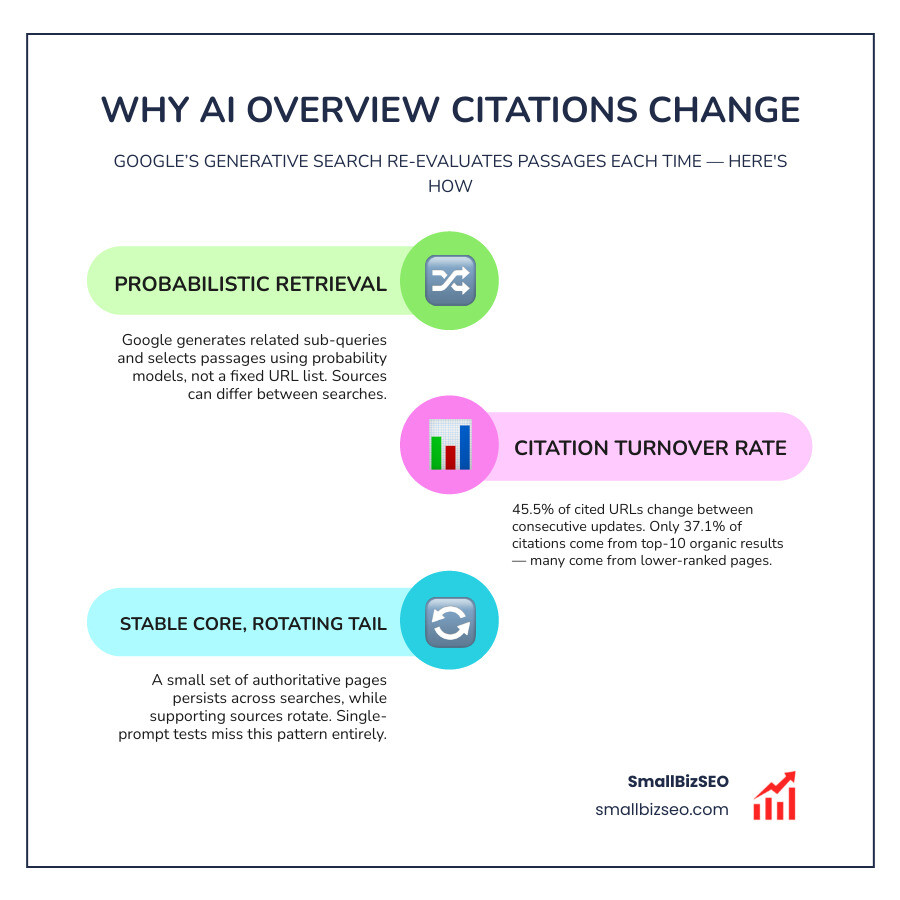
AI Overview citations change because Google's generative answer system uses probabilistic models that continuously re-evaluate web passages rather than pulling from a fixed, static list of URLs.
Traditional organic rankings are deterministic: identical queries executed seconds apart return the same ten blue links in the same order. Generative search features work differently. Large-scale data shows that AI Overviews change content 70% of the time from one sequential observation to the next, holding an average lifespan of just 2.15 days. While organic rank correlates with authority, only 37.1% of AI Overview citations come from pages ranking in the top 10 organic results, with 36.7% failing to rank in the top 100 altogether.
| Characteristic | Traditional Organic SERP | Google AI Overviews |
|---|---|---|
| Output Type | Deterministic list of URLs | Probabilistic synthetic summary |
| Source Overlap | High stability across searches | 45.5% citation turnover run-to-run |
| Content Lifespan | Months to years | Average persistence of 2.15 days |
| Ranking Dependency | Strict whole-page rank position | Granular passage-level relevance |
| Top 10 Overlap | 100% by definition | 37.1% to 38% organic top 10 match |
How Do Google’s Retrieval and Synthesis Processes Change Citations?
Google’s generative engine relies on a dynamic mechanism called query fan-out, which splits an original user query into multiple semantic sub-queries. The engine retrieves relevant passages for each sub-query simultaneously, evaluates competing evidence, and stitches the most informative fragments into a concise summary.
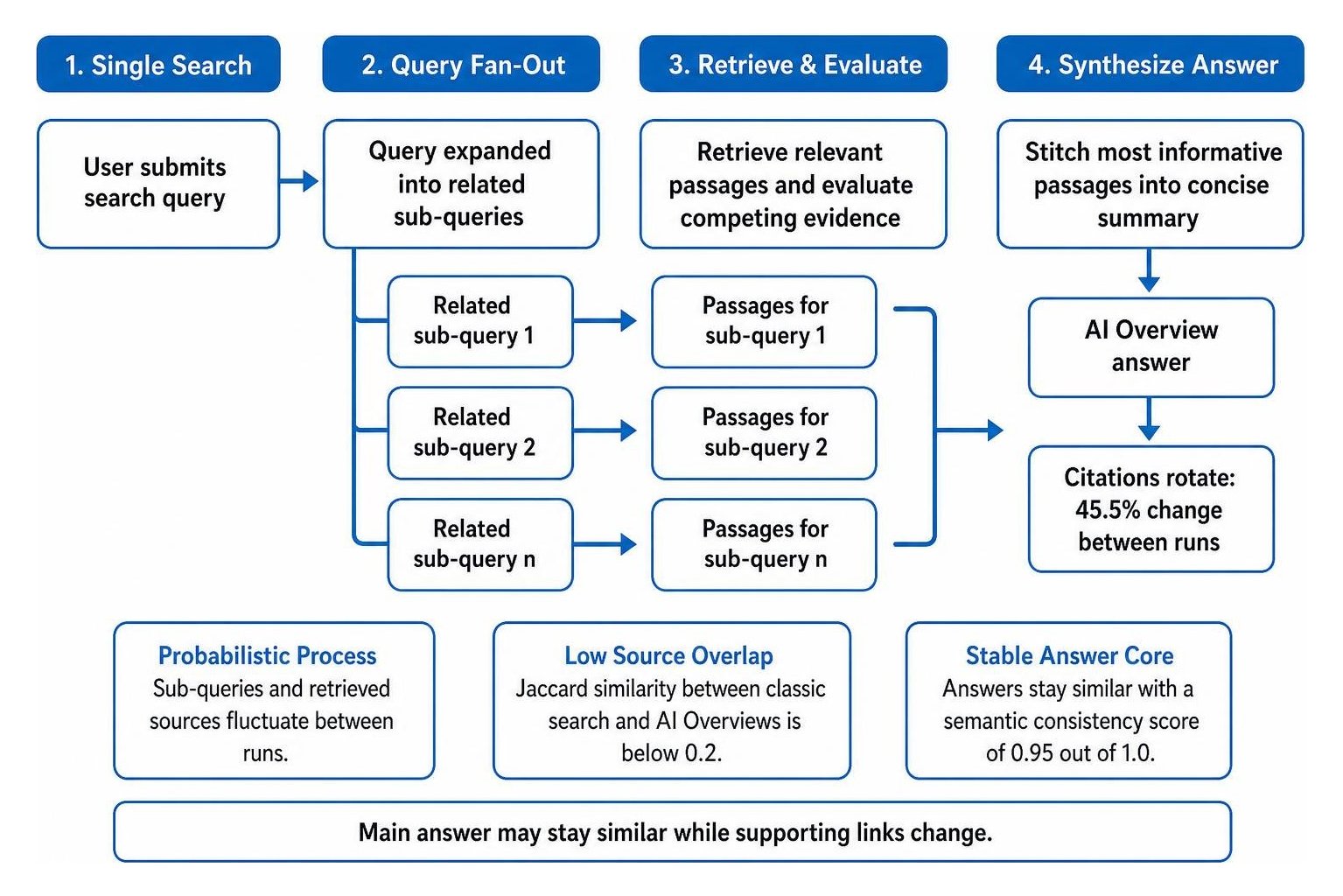
Because generative AI models are probabilistic, the expanded sub-queries and the retrieved source pool fluctuate between runs. An academic review on how generative AI disrupts search reveals that source overlap between classic Google Search and generative overviews produces a Jaccard similarity score below 0.2.
Despite the constant shuffling of source links, the synthesized answers maintain a 0.95 semantic consistency score out of 1.0. The underlying facts remain steady, but the cited references rotate. Regular auditing AI snippets helps teams distinguish between surface-level citation noise and deeper shifts in topical authority.
Which Citations Stay—and Which Sources Change?
Citation longevity follows a bimodal distribution: cited sources either disappear after a single query run or persist as a sticky core for several weeks.
Across large datasets, consecutive runs of the exact same query share only about 33% of their cited domains. When an overview updates, the source list separates into two structural tiers:
- The Anchor Set: A resilient core of authoritative reference hubs (such as encyclopedic domains and recognized industry leaders) that survive repeated generations.
- The Supporting Tail: A rotating pool of secondary blogs, news articles, and niche guides that Google shuffles into the remaining citation slots.
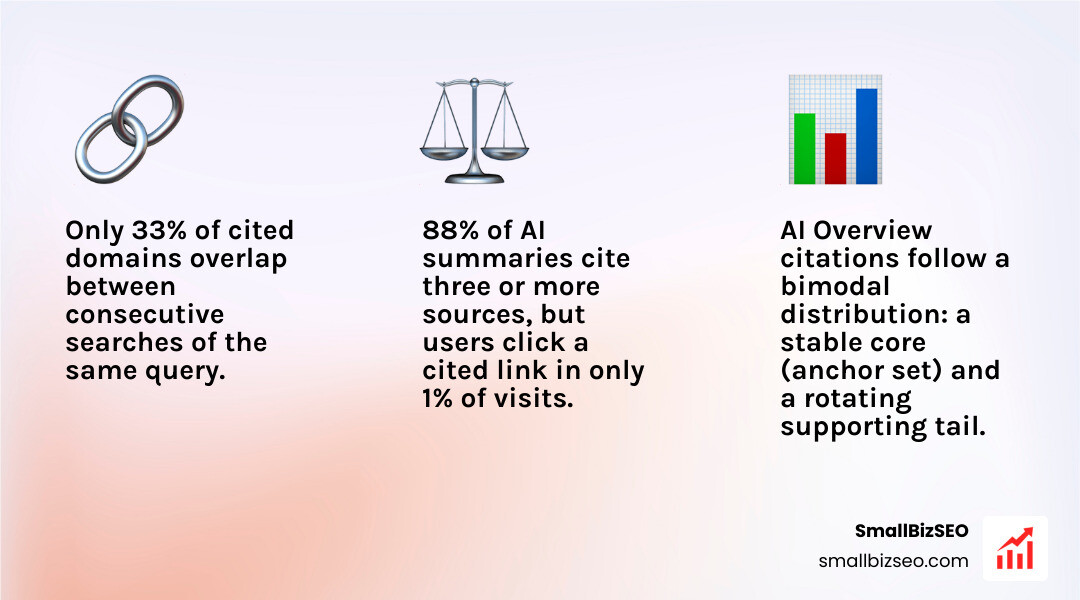
A study from Pew Research Center highlights that 88% of AI summaries cite three or more sources. However, searchers click a cited link in only 1% of visits where an overview appears. To measure your actual brand footprint against this volatility, focus on establishing a repeatable AI visibility baseline over multiple consecutive query runs rather than celebrating a single-run appearance.
How Do Video and Community Platforms Affect Citation Churn?
Google actively diversifies its citation portfolio by pulling from multimedia platforms and user forums, even when those pages do not rank within the top 100 organic search listings.
YouTube accounts for 5.6% of all AI Overview citations, and represents 18.2% of citations that lack a top-100 organic position. Google parses video transcripts, chapter titles, and metadata to extract direct answers. Similarly, community discussions on Reddit remain highly sticky, appearing as persistent anchor citations across repeated search tests. Conducting regular AI search competitor analysis reveals whether your competitors are earning citation real estate through video assets and community participation rather than classic text articles alone.
How Can You Measure and Improve AI Citation Stability?
Improving AI citation stability requires shifting focus from single-keyword tracking to passage-level clarity, structured topic coverage, and run-based tracking methodologies.
How Can Multi-Run Testing Show Citation Changes?
Single-snapshot rank tracking fails in generative search because a single query pull captures an isolated roll of the citation lottery.
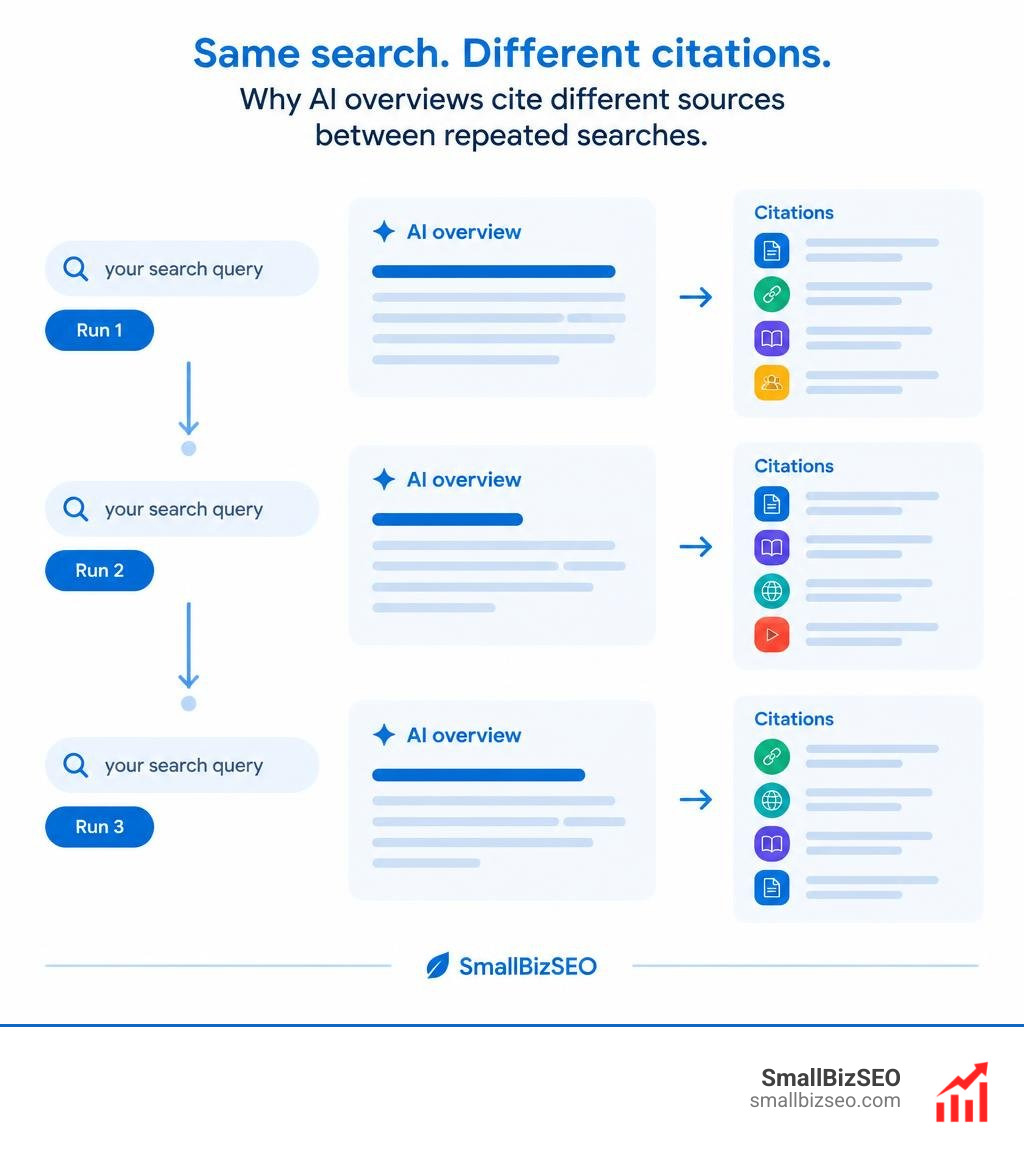
Testing an identical query three times in a single hour can reveal a 60% to 70% citation turnover rate among volatile informational queries. Run-based tracking executes queries across automated intervals, measuring source persistence across 5 to 14 runs. Recognizing that testing a single prompt warps your AI visibility data prevents marketing teams from making reactive site changes based on temporary algorithmic fluctuations.
How Can You Make Content More Likely to Earn a Stable Citation?
To transition from the volatile supporting tail into the stable anchor set, structure pages for rapid passage retrieval:
- Front-Load Core Answers: 55% of AI Overview citations come from the first 30% of a page, with the highest concentration appearing between the 10% and 20% page depth mark. Place direct answers within your opening two sentences.
- Build Self-Contained Passages: Structure sub-sections as complete, 40-to-60-word informational units containing a clear claim, supporting data, and contextual entities.
- Target Semantic Sub-Intents: Proactively address adjacent questions using clear subheadings to capture automated fan-out sub-queries.
- Clarify Named Entities: Ensure your brand, product names, and core terminology are clearly connected using descriptive schema markup and consistent on-page relationships.
Following a structured roadmap for getting featured in Google AI Overviews allows your content to satisfy retrieval algorithms consistently.
Building Resilient AI Search Visibility with SmallBizSEO
At SmallBizSEO, we help businesses navigate search disruption through our data-driven Velocity framework. Instead of chasing short-lived citation spikes, our team implements a holistic strategy combining technical SEO, entity modeling, and authoritative content architecture.
By monitoring how generative models extract and cite your core topics, we ensure your brand secures durable search real estate across both classic organic listings and evolving answer engines. Improving your long-term AI Overview citation rate establishes your brand as an indispensable source across modern search results.