Getting Featured in Google AI Overviews: A Tactical Roadmap
How Do You Rank in Google AI Overviews?
If you’re asking how to rank in ai overviews, start with pages that answer your customers’ questions clearly. Make sure Google can crawl and index those pages, put a direct answer near the top, cover useful follow-up questions, and back up important claims with reliable evidence. No tactic guarantees a citation.
Google AI Overviews combine information from multiple sources into answers shown in search results. The aim is to make your pages useful to readers and easy for Google to understand, whether or not an Overview appears.
I’m Clayton Johnson, founder of SmallBizSEO, where I help small businesses connect SEO, content, and digital PR with qualified leads. My work on how to rank in ai overviews focuses on clear answers, credible evidence, and a sound technical foundation.
Simple guide to how to rank in ai overviews terms:
- Auditing AI Snippets
- Investigating Click Changes on Queries with AI Overviews
- Turning Off AI Overviews
How Can You Improve Your Chances of Appearing in AI Overviews?
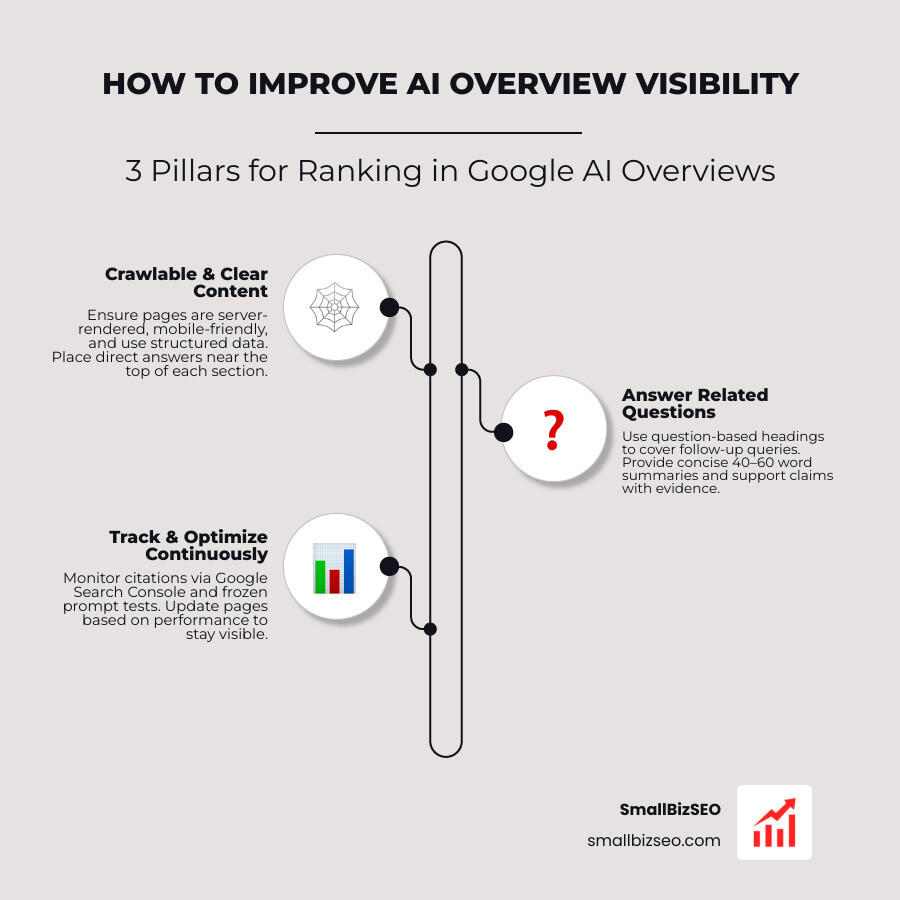
Start with pages that already serve relevant search needs. Make them easy to crawl, answer related questions clearly, and support claims with reliable evidence.
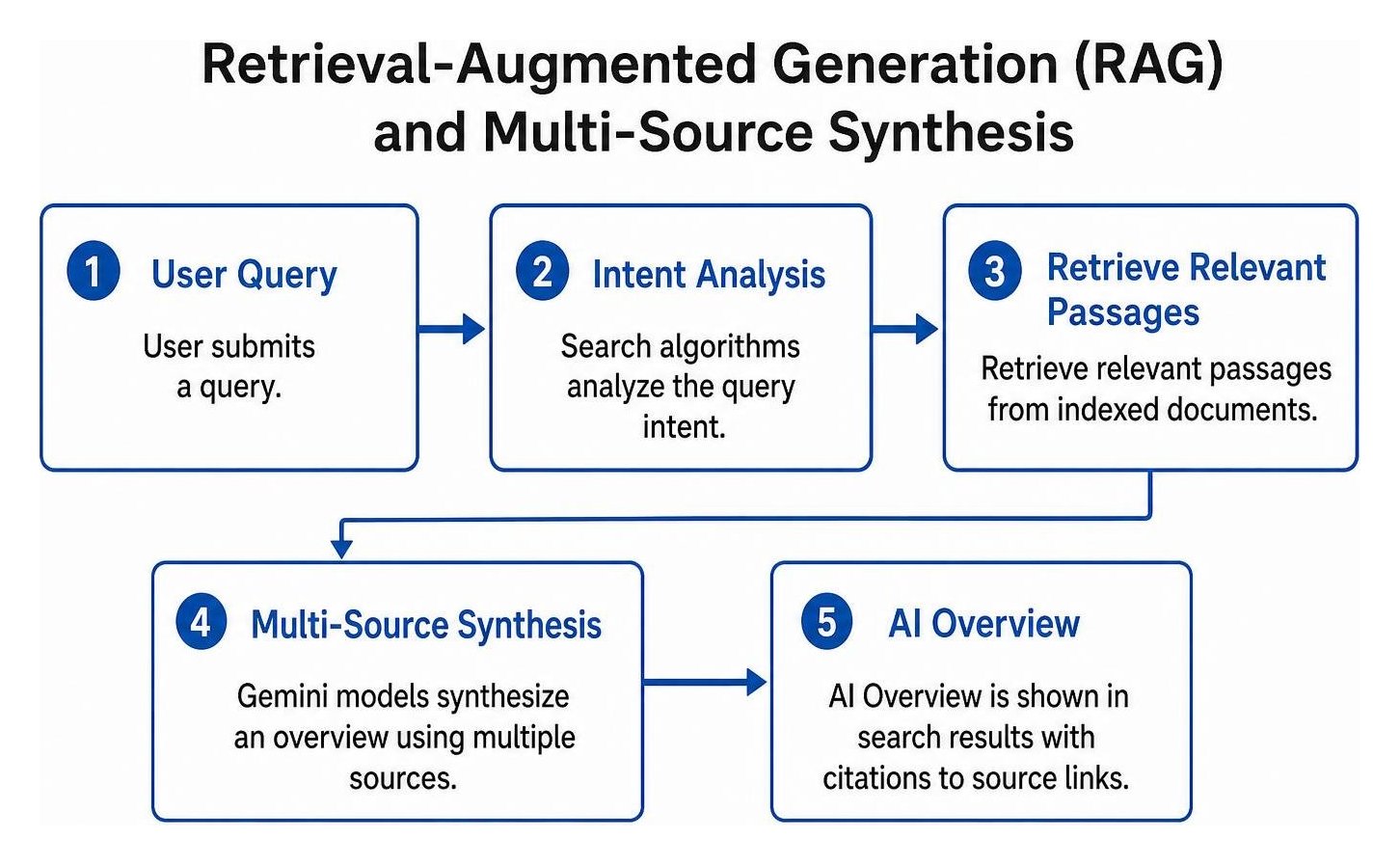
Google uses retrieval-augmented generation (RAG) powered by Gemini models to construct AI Overviews. When a user submits a query, search algorithms analyze its intent, retrieve relevant passages from indexed documents, and synthesize an overview using multiple sources. Research shows that AI Overviews trigger on roughly 15% to 21% of all search queries, drawing from an average of 3 to 8 distinct web sources per summary.
Because zero-click searches have risen—with traditional search result clicks dropping from 15% to about 8% when an AI summary appears—earning citations has become a vital component of modern search visibility. While click-through rates on standard listings can decrease, visitors who click source links within generative answers tend to be far more qualified. Earning these citations requires treating pages as extractable knowledge assets rather than long, unstructured narratives.
How Can You Make Your Site Easier for Google to Read?
Keep important content crawlable and readable on mobile, use clear page structure, and add accurate structured data where it applies. These steps help Google understand your pages, but do not guarantee an AI Overview citation.
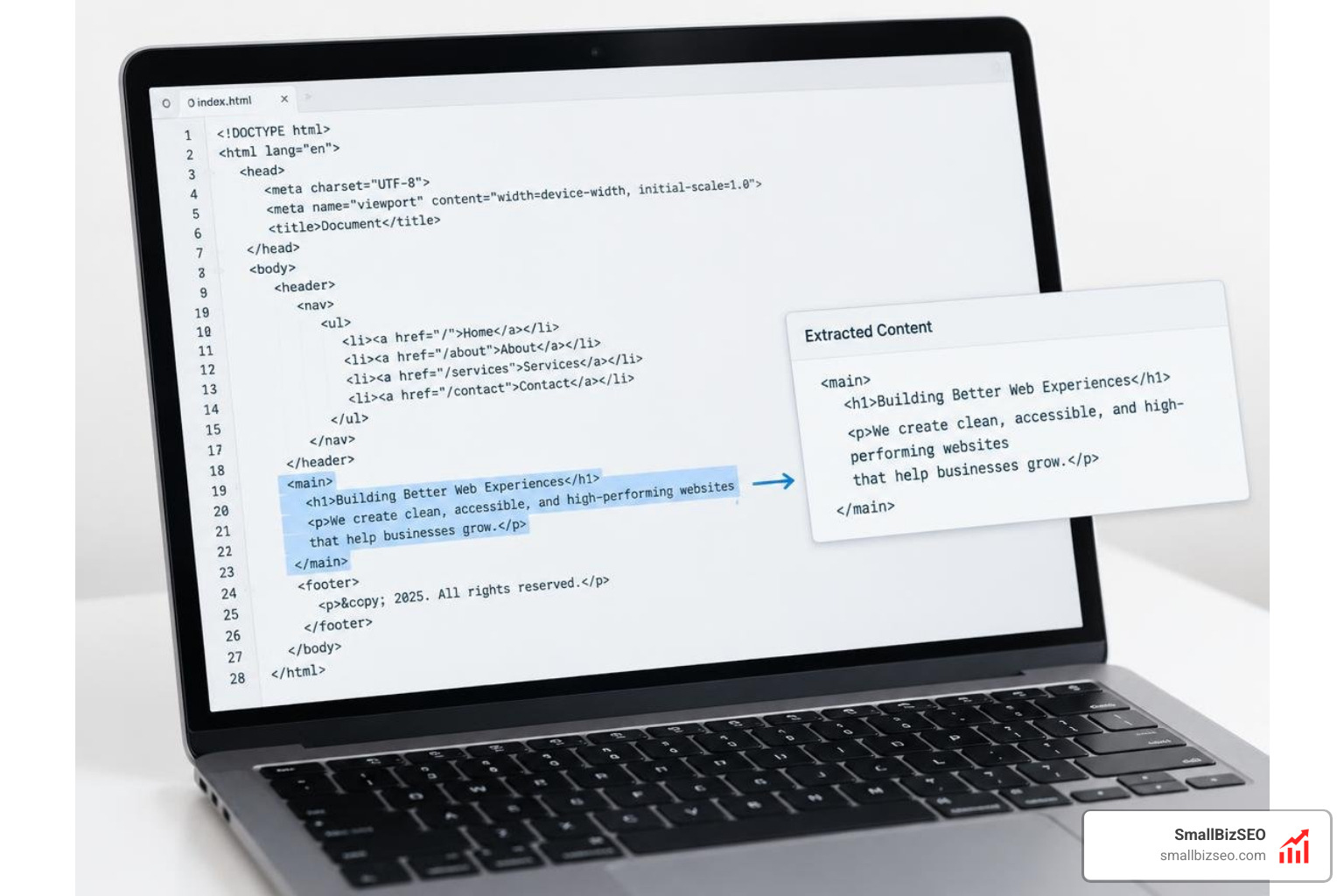
Technical accessibility is the foundation of any generative search strategy. Google's systems must retrieve your plain HTML text instantly. If core definitions, data tables, or steps rely entirely on heavy client-side JavaScript rendering, search crawlers may fail to parse those passages during passage indexing.
According to official Google Search Central documentation on AI features, search features do not require specialized AI schema or separate text files. Instead, standard technical health signals remain decisive:
- Maintain Core Web Vitals targets, including Largest Contentful Paint under 2.5 seconds and minimal layout shifts.
- Ensure full mobile responsiveness and HTTPS security across all indexed templates.
- Implement structured schema markup (such as Article, FAQPage, or HowTo schema) that strictly matches the visible on-page copy to support entity disambiguation.
- Avoid blocking essential pages in your robots.txt file, and audit headers to prevent accidental noindex or restrictive preview tags.
| Feature Area | Standard Snippet Requirements | AI Extraction Criteria |
|---|---|---|
| Technical Access | Standard Googlebot crawl and indexation | Plain HTML rendering without client-side scripts |
| Passage Location | Anywhere across the page body | First 1-2 sentences beneath clear subheadings |
| Content Density | Broad keyword relevance | Concise semantic facts (40-60 word answer blocks) |
| Schema Markup | Basic Article or BreadcrumbList data | Validated schema matching visible text exactly |
Ensuring these technical standards is essential when updating your search engine optimization for the AI era, as clean page architecture makes passage indexing seamless for generative extractors.
How Can You Structure Content to Answer Related Questions?
Put a clear answer near the start of each section, then add useful context and evidence. Use question-based headings to cover related follow-up questions—sometimes called query fan-out—and consider concise 40–60 word summaries where they fit.

Generative models rely on a process called query fan-out. When someone enters a prompt, the search system decomposes that topic into related subqueries, such as definitions, causes, step-by-step methods, and common comparisons. Data shows that pages ranking across these fan-out queries are 161% more likely to be cited in the final overview (with a strong 0.77 correlation) compared to pages that target only a single primary keyword.
To structure pages for generative extraction:
- Provide Direct Definitions: Answer the heading's target question within the first two sentences using a crisp 40–60 word summary.
- Use Clear Heading Hierarchies: Frame H2 and H3 tags as natural-language questions that match real user inquiries.
- Write in Semantic Triples: Construct sentences with clear subject-predicate-object relationships so search engines can easily parse standalone facts.
- Incorporate Formatted Lists and Tables: Use bullet points for features, numbered lists for processes, and structured tables for comparisons.
- Avoid Intent Dilution: Keep content dense and relevant. Studies indicate that grounding plateaus around 540 words per topic facet, with word count alone showing near-zero correlation (~0.04) with citation rates.
Applying these formatting techniques makes AI SEO content optimization made easy by aligning your text with search intent and demystifying AI search ranking factors for smarter SEO.
How Do Authority, Brand Mentions, and E-E-A-T Affect Citations?
Build trust with accurate, useful content, verifiable author credentials, and original research. Strong search visibility and brand mentions may support your reputation, but none guarantees a citation.
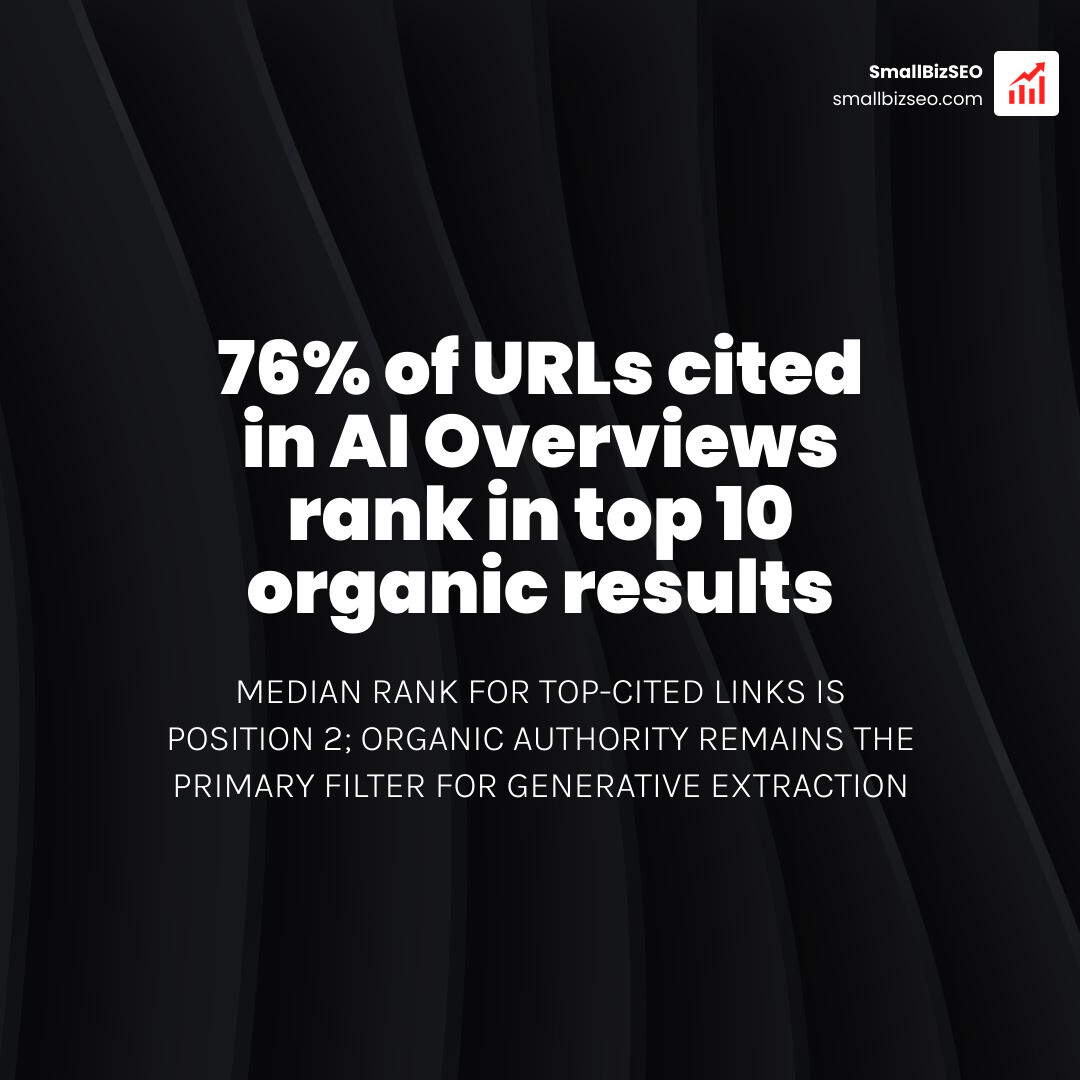
Traditional organic ranking remains strongly correlated with generative visibility. Approximately 76% of URLs cited in AI Overviews rank within the top 10 standard search results, with position 2 serving as the median rank for top-cited links. Organic search authority acts as a primary filter for the pool of pages selected for RAG synthesis.
Beyond organic rankings, external trust signals heavily influence model recommendations:
- Original Research and Data: Websites publishing proprietary benchmark data and original surveys see 67% more AI Overview appearances than sites relying purely on curated content.
- Third-Party Brand Mentions: Unlinked brand mentions across authoritative websites, industry publications, and community forums demonstrate real-world prominence. Mentions on highly-linked pages show a 0.70 correlation with AI Overview presence.
- Multimodal Video Assets: Video content hosted on YouTube shows the strongest domain-level citation correlation across search overviews.
- Verifiable Author Credentials: Detailed author biographies, transparent editorial standards, and clear organizational credentials support Google's quality evaluations.
As highlighted in the Google Search Central blog on succeeding in AI experiences, quality content and transparent authorship remain central to visibility. Investing in these signals aligns directly with mastering E-E-A-T SEO for small business survival in AI search and building AI share of voice metrics that actually reflect market perception.
How Should You Track AI Overview Citations?
Track visibility with Google Search Console, repeat checks against a consistent set of prompts, and review referral traffic for quality. Treat these measures as signals, since citation appearances can change.

Google Search Console bundles impressions and clicks from AI Overviews and traditional organic links into the standard Web performance report. Because there is no standalone filter for AI citations, you must evaluate performance using combined quantitative and qualitative tracking workflows.
To monitor your generative search footprint:
- Set Up a Frozen Prompt Set: Maintain a spreadsheet of 25 to 50 high-priority customer questions. Test these exact prompts on a bi-weekly schedule to record whether your brand appears in the synthesized text or citation carousels.
- Monitor Impression Shifts: Look for pages where impressions rise while traditional click-through rates decline. This pattern often indicates that an AI Overview is resolving simple intent directly on the results page.
- Evaluate Referral Engagement: Review analytics for session duration and conversion rates on high-ranking informational pages. Visitors referred through AI citation cards often demonstrate higher engagement because they received context prior to clicking.
Tracking these patterns over time helps benchmark your overall AI overview citation rate while keeping pace with the rising share of website traffic generated by AI assistants.
Building an Actionable Roadmap for Long-Term Search Visibility
Audit your most important pages, fix technical and content gaps, then review visibility and update pages based on what you learn. SmallBizSEO’s Velocity framework supports this ongoing, data-driven process.
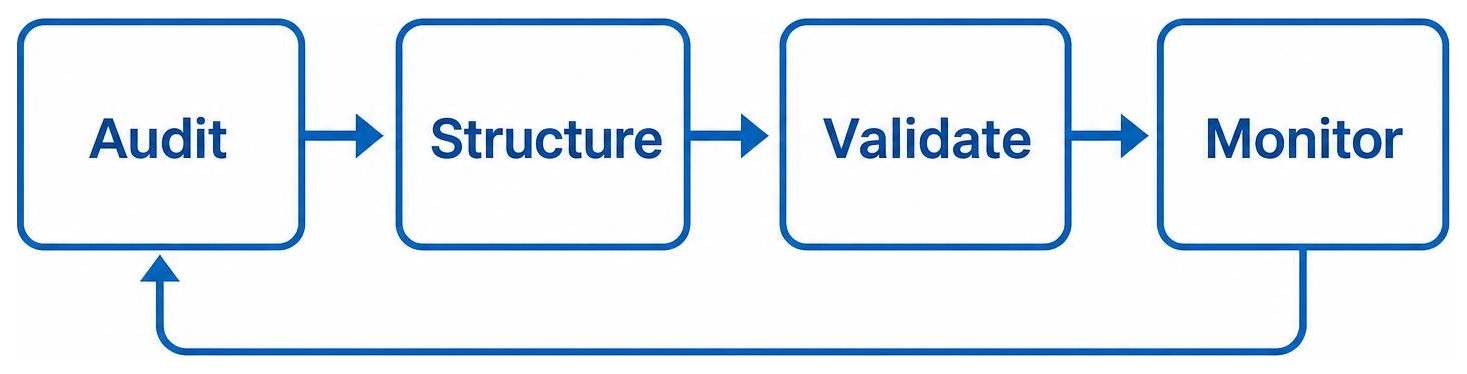
Succeeding in generative search is not a one-time technical update. It requires an iterative cycle of content structuring, entity authority building, and systematic performance measurement. By organizing your core service and informational assets around direct answers, query fan-out subtopics, and verified facts, you position your brand to capture valuable search exposure across standard organic results and generative summaries alike.
At SmallBizSEO, we help businesses implement these strategies using our data-driven Velocity framework, combining technical precision with authoritative content optimization. To build a resilient search presence across emerging search platforms, explore our dedicated AI Overviews optimization and strategy resources.