Scale Your Search Visibility Using Actionable Customer Analytics

Scale Your Search Visibility Using Actionable Customer Analytics
How Can Small Businesses Use Data to Grow Search Visibility?
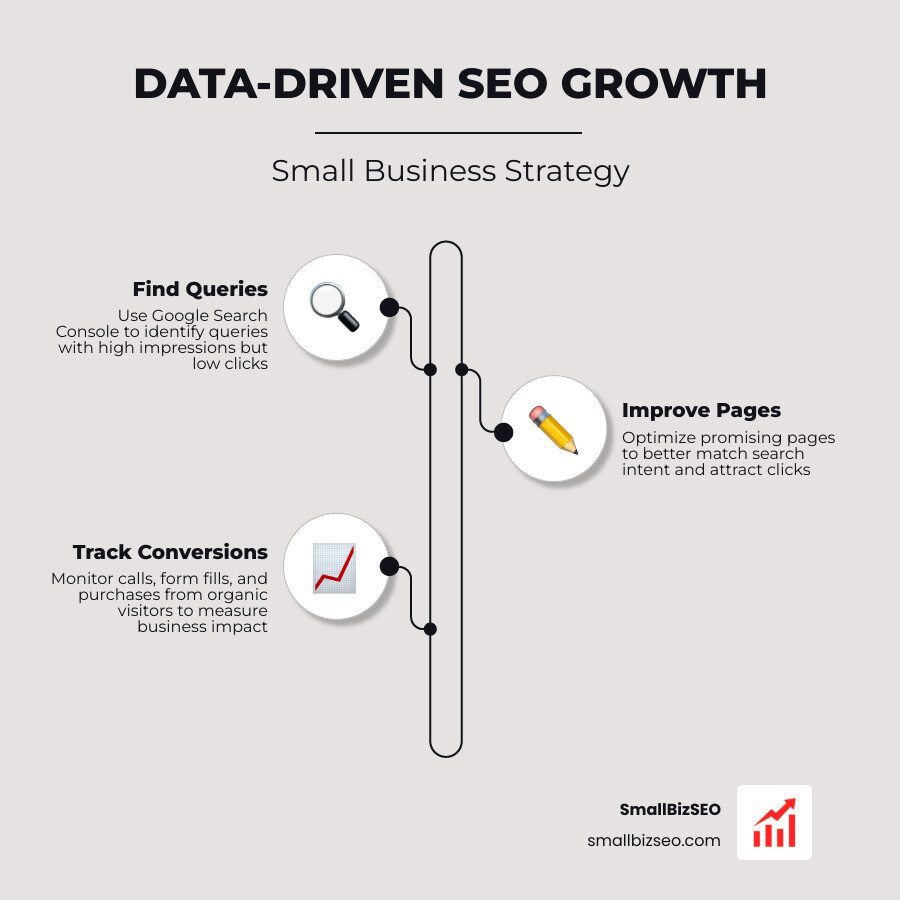
Start with two questions: What are customers searching for, and which visits turn into leads? Use Google Search Console to find relevant queries and pages that get impressions but few clicks. Improve the most promising pages first, then use conversion tracking to check whether organic visitors call, fill out a form, or buy. Repeat the review each month so your next SEO task is based on results, not guesswork. Adopting data-driven SEO for a small business turns scattered analytics into a repeatable growth habit.
I'm Clayton Johnson, a digital marketing and SEO strategist specializing in data-driven SEO for small businesses. My work connects search strategy, content, and digital PR; the simple loop below shows how those efforts can lead to measurable business outcomes.
Helpful small business SEO resources:
- Why Getting Found Matters
- Local SEO Optimization and Small Business Growth
- Wall Street Local SEO Services That Will Make Your Competitors Bearish
How Can Small Businesses Build a Data-Driven SEO Strategy?
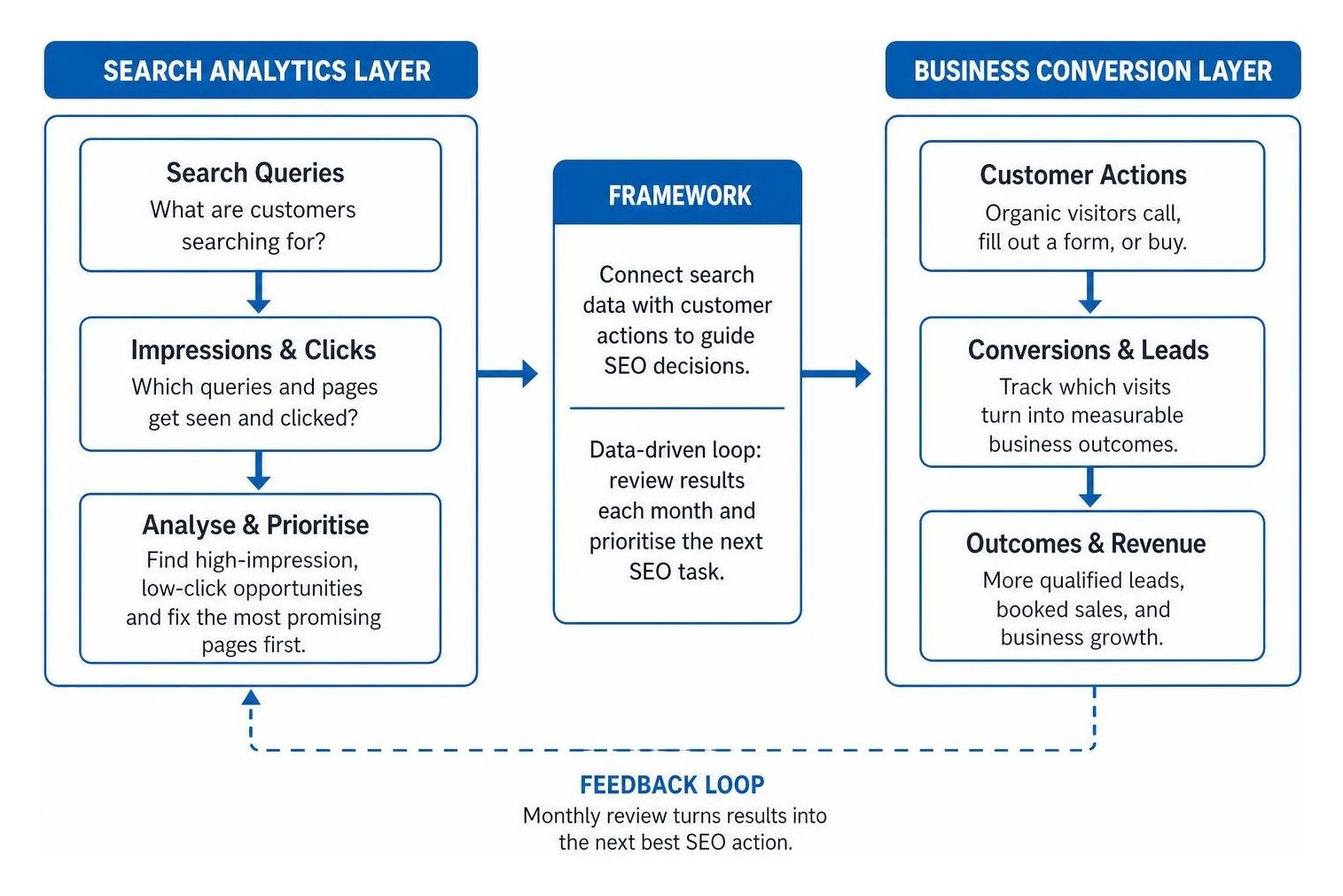
To build an effective data-driven SEO strategy for a small business, connect what searchers enter into Google with what happens on your site when they arrive. This means combining your search layer (queries, impressions, and clicks) with your business layer (conversions, phone calls, and booked sales). Instead of making random content updates or chasing generic keyword checklists, use customer data to identify real buyer intent and turn search data into traffic.
Why Should Small Business SEO Teams Focus on Clicks Over Vanity Rankings?
Focusing on clicks rather than rankings matters because impressions and rank positions do not deposit revenue into your bank account. A keyword sitting at position three that receives zero clicks provides far less business value than a position-six term that delivers steady organic visitors.
Organic listings in top positions capture an average click-through rate (CTR) of 27.6%, compared to just 3.17% for paid search ads. Furthermore, only 0.63% of searchers ever click through to page two. While tracking your average position gives useful context, clicks reflect actual visits from potential customers actively seeking your solutions.
How Can You Connect Search Console Data to Phone Calls and Revenue?
Connect Google Search Console to real-world outcomes by pairing it with Google Analytics 4 (GA4) and call-tracking software. Since Search Console stops tracking at the click, GA4 takes over to monitor conversion events such as form submissions, quote requests, and appointment scheduling.
Industry studies show that 46% of all Google searches carry local intent, and 97% of consumers research an organization online before buying. By using dedicated call-tracking numbers on your site and recording intake sources in your CRM, you can link high-intent organic landing pages directly to generated pipeline. For broader context on customer trends, explore key SEO statistics for small businesses across service sectors.
How Can You Forecast Organic Traffic and Prioritize High-Impact Tasks?
To forecast organic traffic and prioritize work, estimate potential click gains by applying position-based CTR benchmarks to your existing impression volume, then score each task by its estimated business impact against the required technical effort.
How Can You Forecast Potential Traffic Gains Using CTR Benchmarks?
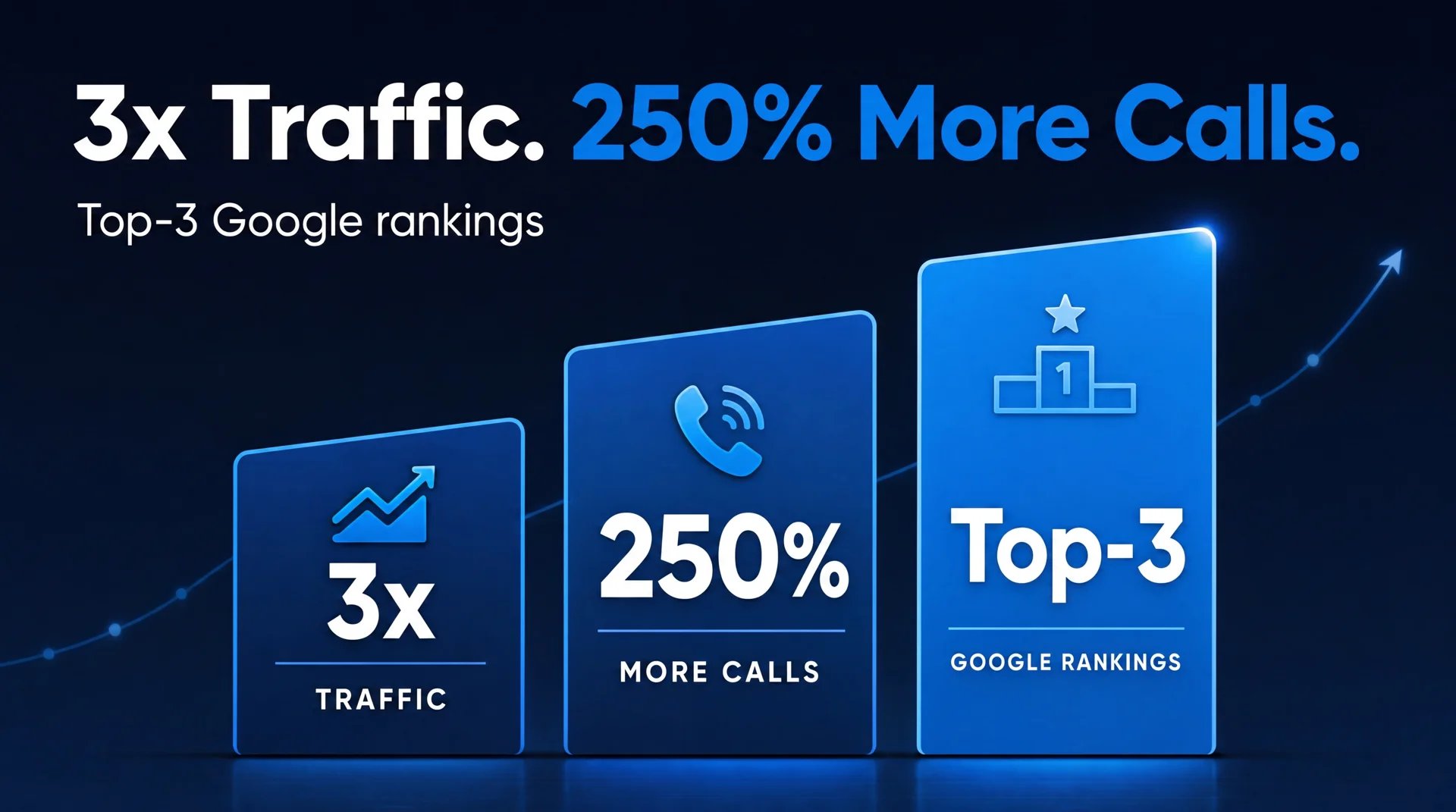
Forecast traffic gains using historical CTR curves. The CTR jump between search positions is non-linear: moving from position nine to position four yields an estimated 5.5 percentage-point increase in CTR, whereas climbing from position three to position one generates an approximate 17 percentage-point jump.
To calculate expected click gains:
- Identify a query in Search Console with established impressions where your page ranks between positions four and twenty.
- Note the monthly impression volume (for example, 2,000 monthly impressions at position eight with a 1.5% CTR = 30 clicks).
- Apply the target position benchmark CTR (for example, position four averages roughly 7.5% CTR).
- Calculate the projected traffic: 2,000 impressions × 7.5% = 150 clicks, delivering a net gain of 120 incremental organic visits per month.
How Can You Prioritize SEO Tasks with an Impact vs Effort Matrix?
Use a simple impact versus effort matrix to allocate limited team resources. This prevents spending weeks on minor site tweaks that yield negligible returns.
| Task Category | Example Action | Click & Revenue Impact | Implementation Effort | Execution Priority |
|---|---|---|---|---|
| Quick Wins | Rewrite metadata on position 5–10 pages with high impressions | Moderate to High | Low (1–2 hours) | 1 (Immediate) |
| Strategic Assets | Publish focused service pages targeting unmet search intent | High | Moderate (3–5 hours) | 2 (High) |
| Technical Fixes | Resolve indexation blocks and mobile Core Web Vitals issues | Moderate | Moderate to High | 3 (Medium) |
| Low-Yield Tasks | Rewriting old blog posts that target zero-volume queries | Low | Moderate | 4 (Deprioritize) |
How Can You Avoid Misleading SEO Data Traps and Build a Lean Tech Stack?
To avoid misleading data traps, evaluate performance over three-to-six-month windows to filter out day-to-day noise, separate branded searches from non-branded discovery queries, and rely on a lean analytics foundation. For a comprehensive overview of small-market optimization, refer to The Complete Guide to SEO for Small Businesses.
What Data Traps Can Mislead Small Business Owners?
Small business owners frequently fall into common data traps that skew strategic decisions:
- Small Sample Sizes: Reacting to a drop in clicks over a two-day period creates false alarms. Always review rolling multi-month trends.
- Branded Query Distortion: An increase in organic traffic driven entirely by people searching your company name reflects offline awareness, not discovery SEO success.
- Seasonal Demand Shifts: Comparing December search traffic directly to November often reflects consumer buying cycles rather than algorithm penalties.
- Ignoring On-Site Behavior: High traffic that leaves immediately without interacting signals misaligned intent. Study our guide on analyzing user behavior for search to spot navigation friction early.
How Can You Set Up a Lean Data-Driven SEO Tech Stack?
A productive analytics stack does not require thousands of dollars in monthly subscriptions. Our minimal viable tech stack consists of:
- Google Search Console: Essential for keyword impressions, query clicks, indexing health, and technical crawl diagnostics.
- Google Analytics 4: For tracking user sessions, engagement paths, and specific lead conversions.
- Google Business Profile Insights: To track map calls, direction requests, and photo views.
- Periodic Technical Audits: Regular site reviews maintain clean data collection; learn more about running a structured review in our walk-through on conducting Google Analytics audits.
How Can You Run a 30-Minute Monthly SEO Review?
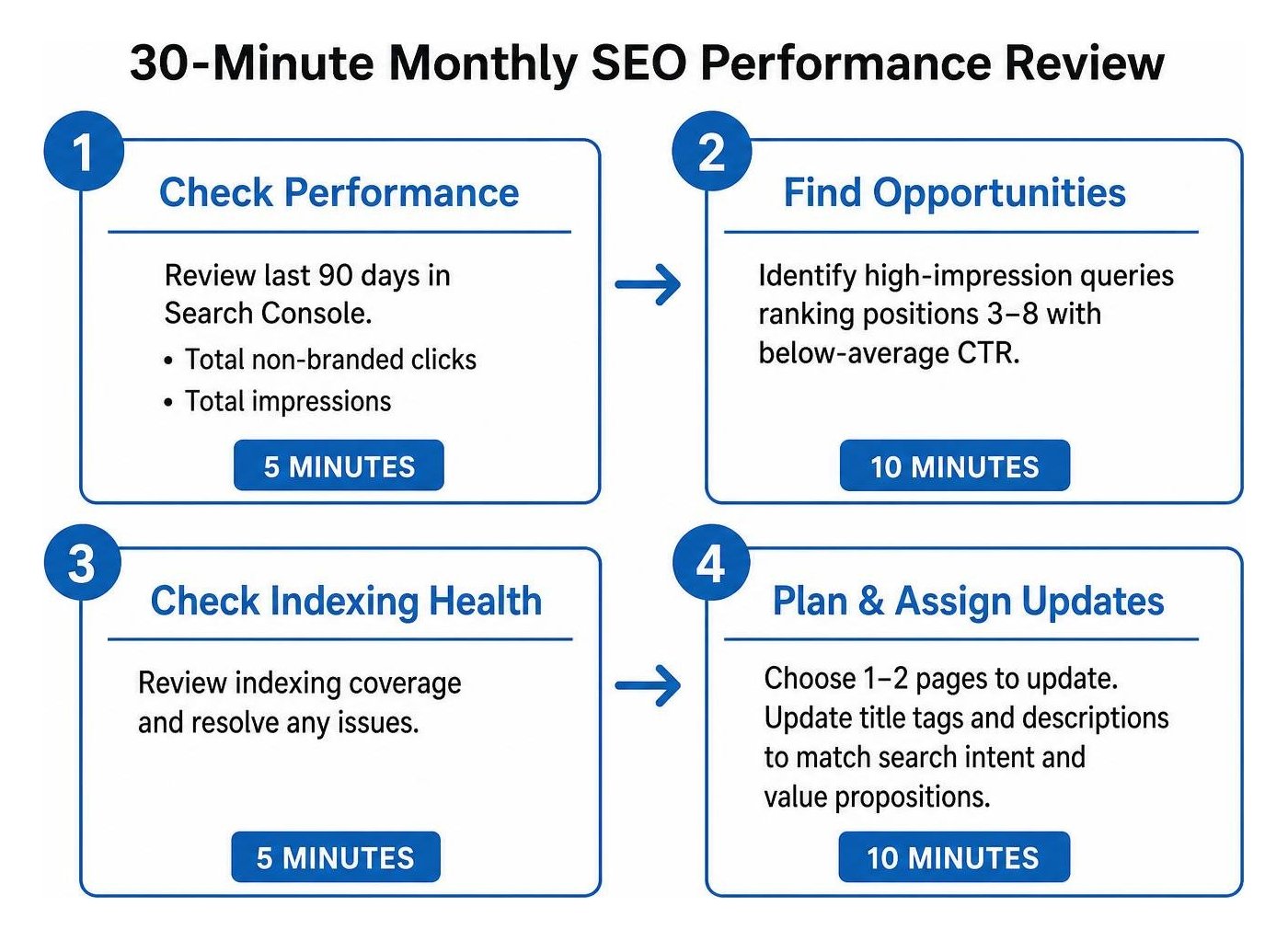
To run a fast monthly SEO review, follow a repeatable four-step process: inspect total non-branded clicks and impressions, identify low-CTR queries on ranking pages, check indexing health, and assign one or two specific page updates for the next month.
What Should You Check During a Monthly Search Console Audit?
Set a rolling 90-day comparison window in Search Console and execute this checklist:
- Identify High-Impression, Low-CTR Queries: Filter queries with high impressions ranking between positions three and eight that have below-average click-through rates.
- Optimize Title Tags and Descriptions: Update title tags for those identified queries to incorporate search intent and value propositions.
- Verify Indexing Coverage: Review the Pages report to ensure key landing pages are indexed and free of crawl errors.
- Log Actionable Updates: Document your changes so you can measure impact in future reviews. For deeper diagnostic methods, see our guide on performing detailed SEO analysis.
How Can You Monitor AI Visibility and Query Indexation?
AI search platforms and Google AI Overviews generate synthesized answers directly in the search interface. To monitor and maintain visibility across both classic search and generative AI engines:
- Submit clean XML sitemaps to verify that search engines index newly published service pages promptly.
- Format informational headers as direct questions and answer them clearly in the opening two sentences.
- Implement structured schema markup (such as LocalBusiness and FAQPage) to help search engines accurately interpret your business details and cite your content.
How Can You Measure Organic Revenue and Prove SEO ROI?
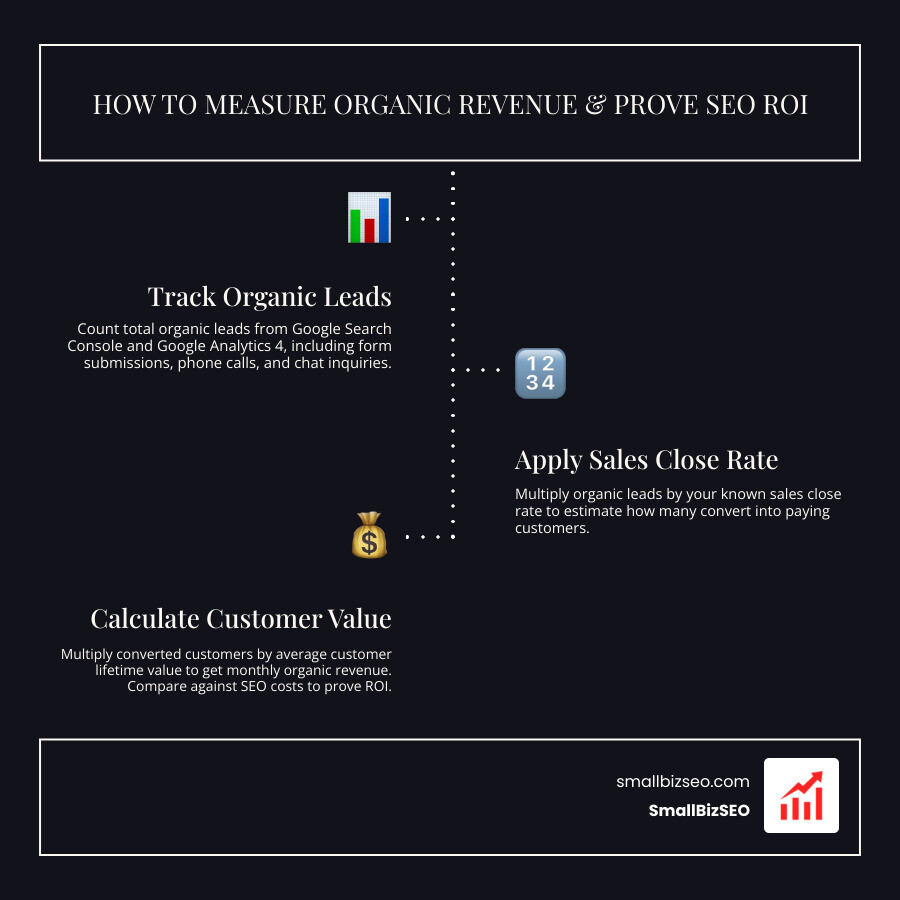
To measure organic revenue and prove ROI, calculate the total monetary value of organic leads by multiplying organic inquiries by your sales close rate and average customer lifetime value, comparing that total against your SEO costs.
How Can You Quantify SEO Revenue for Lead Generation and Local Sales?
Quantifying organic revenue transforms SEO from an abstract marketing expense into a predictable acquisition channel. You can implement affordable small business SEO strategies while clearly demonstrating business value through a straightforward economic formula. Monthly SEO revenue equals organic leads multiplied by your sales close rate, then multiplied by your average customer value.
For example, if your organic search visibility produces 40 qualified leads per month, your team closes 25% of inbound leads, and your average customer transaction value is $1,500, the calculation works out to 40 leads times 0.25 times $1,500, which equals $15,000 in monthly attributable value.
Review our compilation of essential small business metrics to benchmark your conversion performance against industry standards.
How Can You Show Organic Search Value When Conversions Lag?
In industries with long sales cycles, organic visitors may take months to finalize a purchase. To show early progress before final sales close:
- Track Assisted Conversions: Use GA4 attribution reports to identify organic search touchpoints that introduced prospects who later converted via direct or email channels.
- Monitor Pipeline Velocity: Track how organic landing pages educate prospects and accelerate qualified lead velocity through your sales funnel.
- Measure Non-Branded Visibility Growth: Document steady increases in non-branded search impressions and clicks on core commercial pages as leading indicators of revenue growth.
Frequently Asked Questions about Small Business SEO Analytics
What Is the Single Most Important Metric in Google Search Console for a Small Business?
Organic clicks are the most critical metric in Google Search Console. While impressions indicate visibility and average position shows ranking status, clicks represent real, qualified individuals visiting your website.
How Far in Advance Can a Small Business Accurately Forecast SEO Results?
A small business can reliably forecast SEO results three to six months in advance. Making reliable forecasts beyond six months is difficult due to algorithm shifts, competitor activity, and seasonal fluctuations.
How Do AI Overviews and AI Search Affect Small Business SEO Data?
AI Overviews summarize search queries directly at the top of the results page, which can reduce clicks on simple factual questions. However, for high-intent, local, and commercial queries, earning citations within AI answers provides trusted brand exposure and drives highly qualified visitors to your site.
Turn Customer Search Data into Compounding Revenue
Building a sustainable organic presence does not require endless hours of guesswork or expensive software. By connecting search query data with real conversion metrics, you can focus on the tasks that directly generate phone calls, form submissions, and customer revenue.
Our team implements this structured approach every day using our data-backed Velocity framework to deliver transparent, compounding growth. When you are ready to scale your organic visibility and turn search queries into measurable pipeline, explore our dedicated solutions at our small business SEO company.