SEO for Bankruptcy Attorneys

How Can SEO Help Bankruptcy Attorneys Reach Clients Who Need Help?
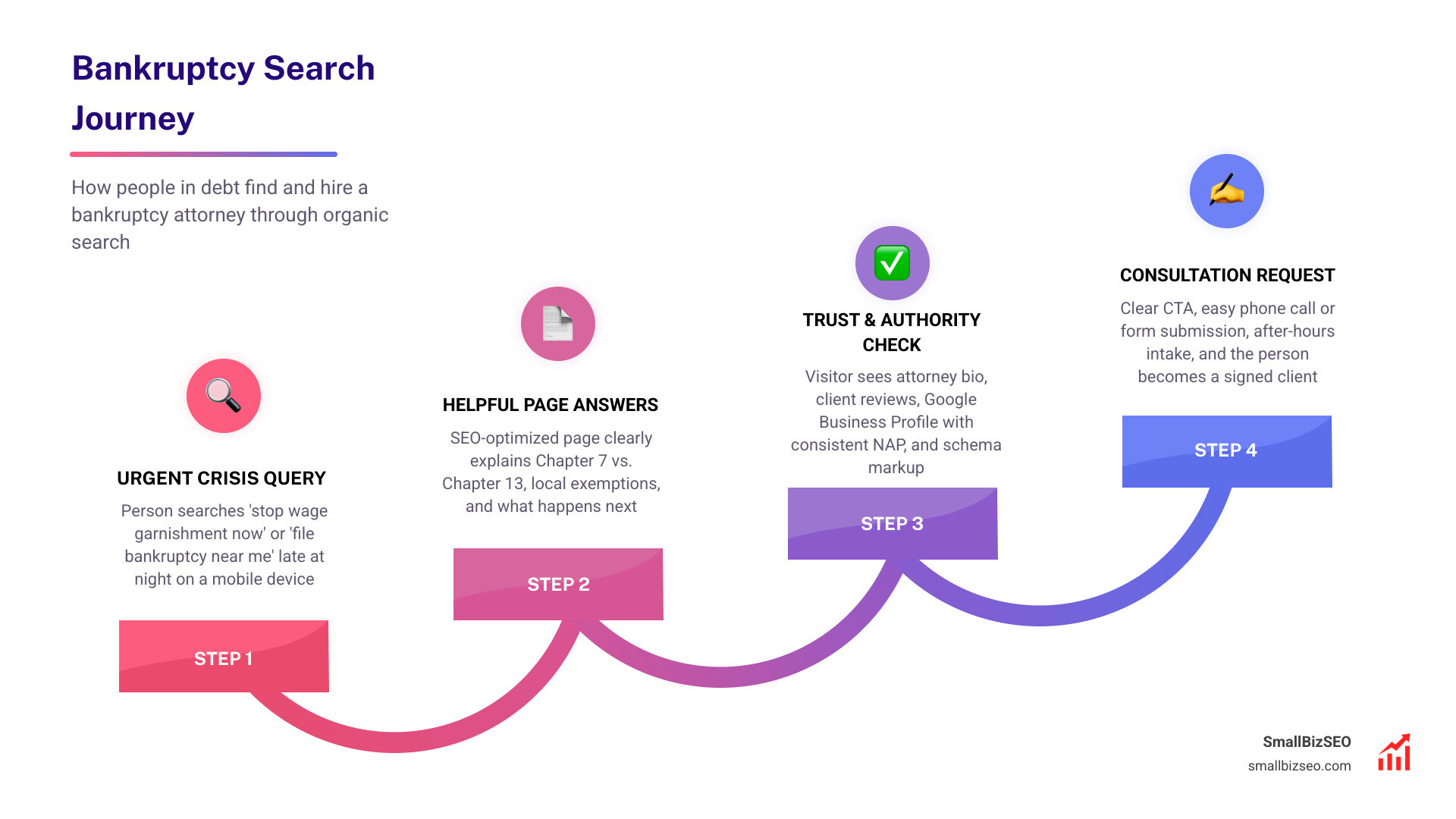
SEO for a bankruptcy attorney helps people find the firm when they search for debt relief. Start with clear pages for Chapter 7 and Chapter 13, answer urgent questions about issues such as wage garnishment, and keep your Google Business Profile accurate. Make the site easy to use on a phone, show who wrote and reviewed its legal content, and give visitors a simple way to request a consultation.
These searches often involve stressful decisions about money and the law. A useful page should answer the question first, explain what may depend on local rules, and make the next step clear without promising an outcome.
I’m Clayton Johnson, founder of SmallBizSEO. My work in SEO for bankruptcy attorney websites draws on content strategy, technical SEO, and authority building to help firms turn useful answers into qualified inquiries.
Terms related to SEO for bankruptcy attorney:
What Are the Core Pillars of SEO for Bankruptcy Attorneys?
Bankruptcy search marketing requires an integrated approach that connects technical stability, clear legal content, and local trust signals. Approximately 96% of consumers seeking legal advice turn to search engines, and organic search drives up to 66% of legal call conversions. Because 93% of global web traffic flows through Google Search, Images, and Maps, establishing prominence across search results is essential for legal practices.
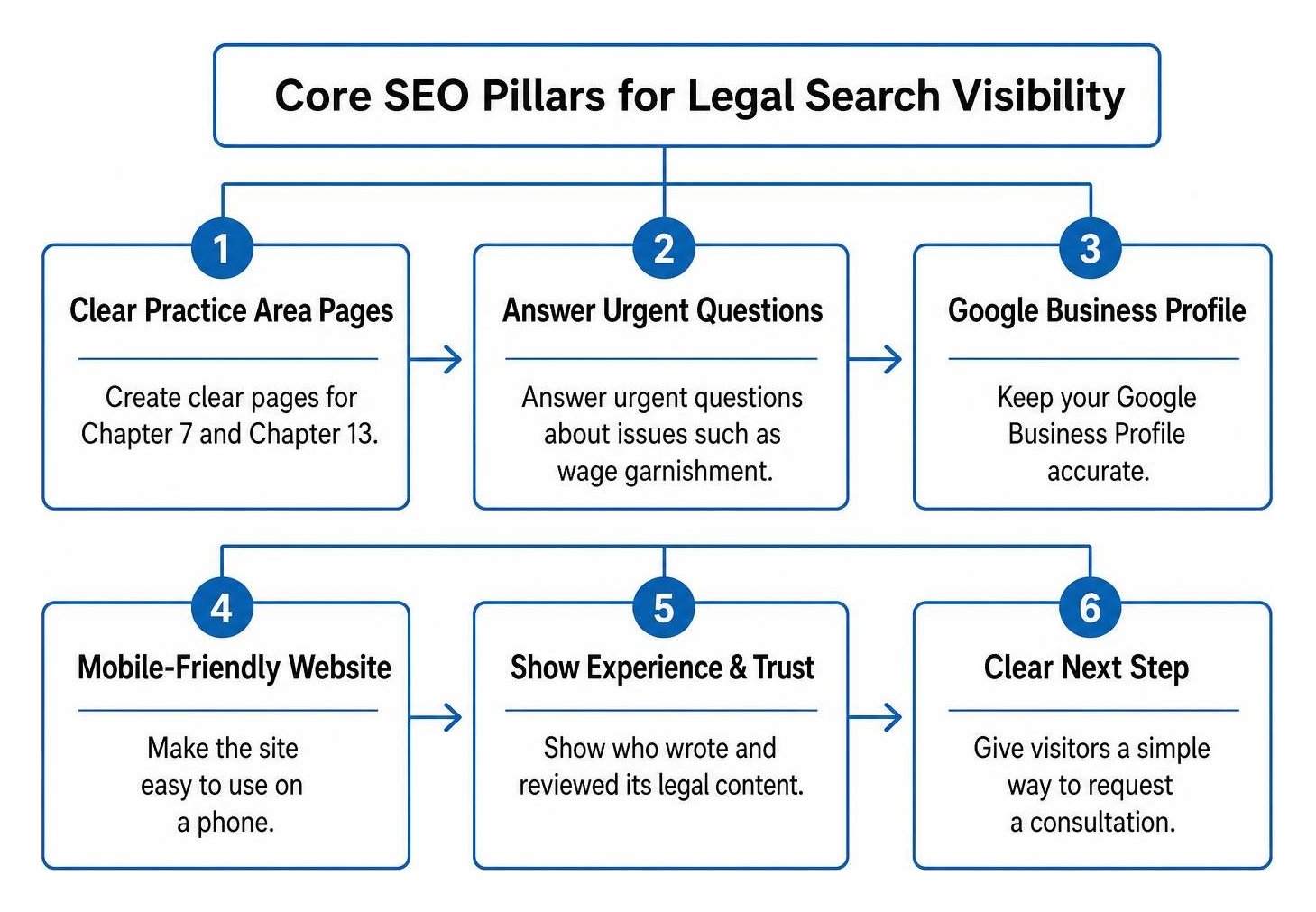
Google categorizes debt relief and legal advice under "Your Money or Your Life" (YMYL) topics. This classification requires strict adherence to search quality standards, demanding demonstrable Experience, Expertise, Authoritativeness, and Trustworthiness (E-E-A-T). When prospective clients face imminent financial challenges, they look for authoritative answers regarding the automatic stay, means testing, and asset protection.
To help search engines evaluate content quality, review the fundamentals for creating helpful, reliable, people-first content. Establishing genuine authority involves publishing comprehensive, attorney-reviewed guides, managing accurate directory listings, maintaining fast page load speeds, and presenting transparent contact methods across all devices.
How Does SEO for a Bankruptcy Attorney Differ from Other Legal Practice Areas?
Bankruptcy marketing differs significantly from personal injury or corporate law due to its distinct user psychology, shorter decision windows during financial crises, and mandatory statutory disclosures. While personal injury claimants often evaluate firm track records over several weeks, bankruptcy searchers frequently need immediate relief to stop vehicle repossessions, creditor harassment, or pending foreclosure sales.
| Marketing Dimension | Bankruptcy Law SEO | Personal Injury SEO |
|---|---|---|
| Search Intent | Crisis-driven, relief-focused, and educational | Fault-driven, settlement-focused, and outcome-oriented |
| Research Timeline | Multi-week quiet research shifting to urgent 24-hour crisis action | Extended evaluation following an incident |
| Primary Conversion Triggers | Immediate wage garnishment defense, foreclosure halt, creditor calls | Contingency fee reassurance, past case settlement amounts |
| Regulatory Disclosures | Mandatory statutory debt relief agency disclaimers | Bar association contingency fee advertising rules |
| Search Competition Context | High local search competition with localized district focus | Extreme national and metro search competition |
Under federal law, bankruptcy practitioners must include designated debt relief agency disclosures across their public marketing assets. Balancing compassionate messaging with regulatory compliance is key. To capture searchers effectively, many firms partner with an experienced bankruptcy attorney SEO company or review directory citations through resources like the Justia directory of bankruptcy lawyers.
Which High-Intent Keywords and Crisis Queries Drive the Most Qualified Consultations?
High-intent bankruptcy keywords generally divide into crisis-driven emergency phrases, chapter-specific queries, and educational research terms. Rather than targeting only broad head terms like "bankruptcy lawyer," successful firms organize content around distinct stages of the debtor's evaluation journey.
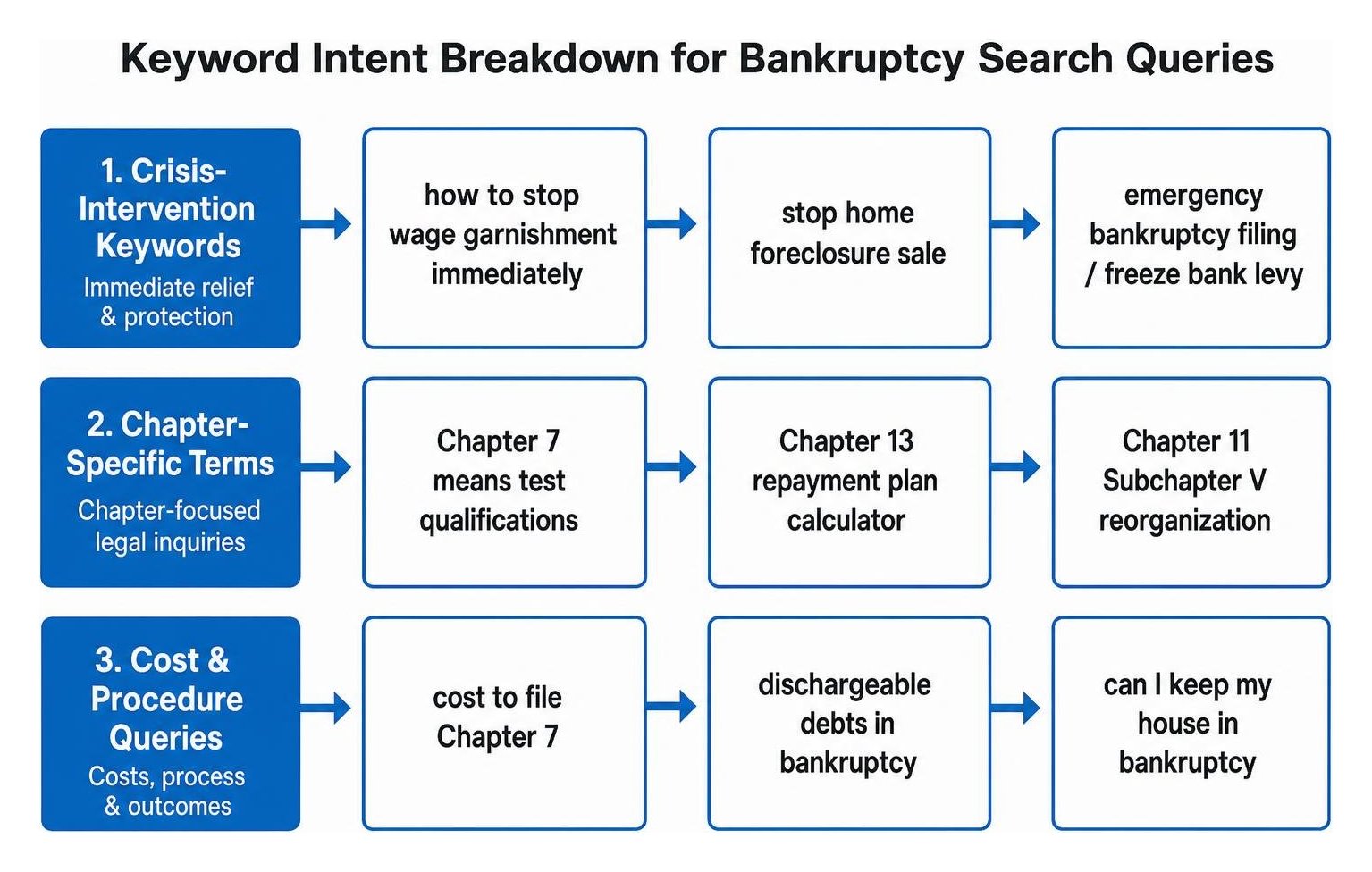
Implementing disciplined keyword mapping helps prevent keyword cannibalization and ensures each landing page addresses a specific legal inquiry:
- Crisis-Intervention Keywords: "how to stop wage garnishment immediately," "stop home foreclosure sale," "emergency bankruptcy filing," "freeze bank levy."
- Chapter-Specific Terms: "Chapter 7 means test qualifications," "Chapter 13 repayment plan calculator," "Chapter 11 Subchapter V reorganization."
- Cost and Procedure Queries: "cost to file Chapter 7," "dischargeable debts in bankruptcy," "can I keep my house in bankruptcy."
Focusing on long tail keyword variations enables solo practitioners and boutique practices to rank for highly motivated, localized searches without competing solely on broad, high-difficulty phrases.
How Can You Dominate Local Map Packs with Google Business Profile Optimization?
Local search visibility is vital because bankruptcy petitions are filed within specific federal judicial districts, and prospective clients prefer working with accessible local attorneys. Optimizing your profile for Google Maps and local pack results requires precise categorization, consistent business information, and regular profile maintenance.

Key actions for strengthening local pack rankings include:
- Primary and Secondary Categories: Designate "Bankruptcy Attorney" as the primary business category, supported by secondary categories such as "Legal Services" or "Trial Attorney."
- Consistent NAP Citations: Ensure the firm Name, Address, and Phone number remain identical across all directories, legal portals, and website footers as outlined in our local search optimization basics.
- Profile Completeness: Add clear interior and exterior office photos, verified operating hours, an appointment booking URL, and comprehensive practice area descriptions.
- Ethical Review Generation: Collect authentic client reviews while respecting privacy. Encourage clients to share feedback regarding communication and professionalism, and always respond in a professional manner.
Consistently maintaining your Google Business Profile signals localized activity and trust to search engines.
What Technical and Content Strategies Accelerate SEO for Bankruptcy Attorneys?
A technically optimized website ensures search engines crawl, index, and interpret legal content efficiently. Over 60% of bankruptcy-related searches occur on mobile devices, making fast page load times and responsive design essential for user retention.

Prioritize these core technical and content optimization tactics:
- Mobile Performance and Core Web Vitals: Maintain load speeds under two seconds by compressing images, minifying code, and leveraging modern content delivery networks.
- Structured Data Schema Markup: Implement
LegalService,Attorney, andFAQPageschema to assist search engines in parsing practice areas, attorney credentials, and common questions. - Educational Content Hubs: Publish in-depth guides explaining state homestead exemptions, vehicle equity limits, and the role of the bankruptcy trustee.
- Site Architecture: Structure URLs logically (for example,
/services/chapter-7-bankruptcy/) to provide an intuitive path for visitors and search engine crawlers.
Review our comprehensive technical SEO guide to evaluate and enhance your firm's site infrastructure.
How to Measure ROI and Convert Search Visibility into Signed Retainers
Measuring organic search performance requires tracking business-level outcomes—such as phone inquiries, scheduled consultations, and retained cases—rather than relying solely on organic impressions. Most legal practices observe initial ranking movement on long-tail queries within 3 to 6 months, while competitive localized market terms mature over 6 to 12 months.
To calculate true return on investment, measure the revenue generated from retained organic inquiries against your ongoing search marketing budget. A useful way to think about it is to subtract your SEO investment from the revenue generated by retained cases, then divide that result by the SEO investment and multiply by 100 to express it as a percentage.
Because approximately 65% of bankruptcy form submissions take place outside traditional business hours, integrating automated after-hours responses, text-first intake options, and live chat can increase initial contact rates from 35% up to 85%.
What Are the Key Differences Between Chapter 7 and Chapter 13 SEO Strategies?
Chapter 7 liquidation and Chapter 13 reorganization attract prospective clients with different financial circumstances, requiring distinct content strategies and landing page designs.
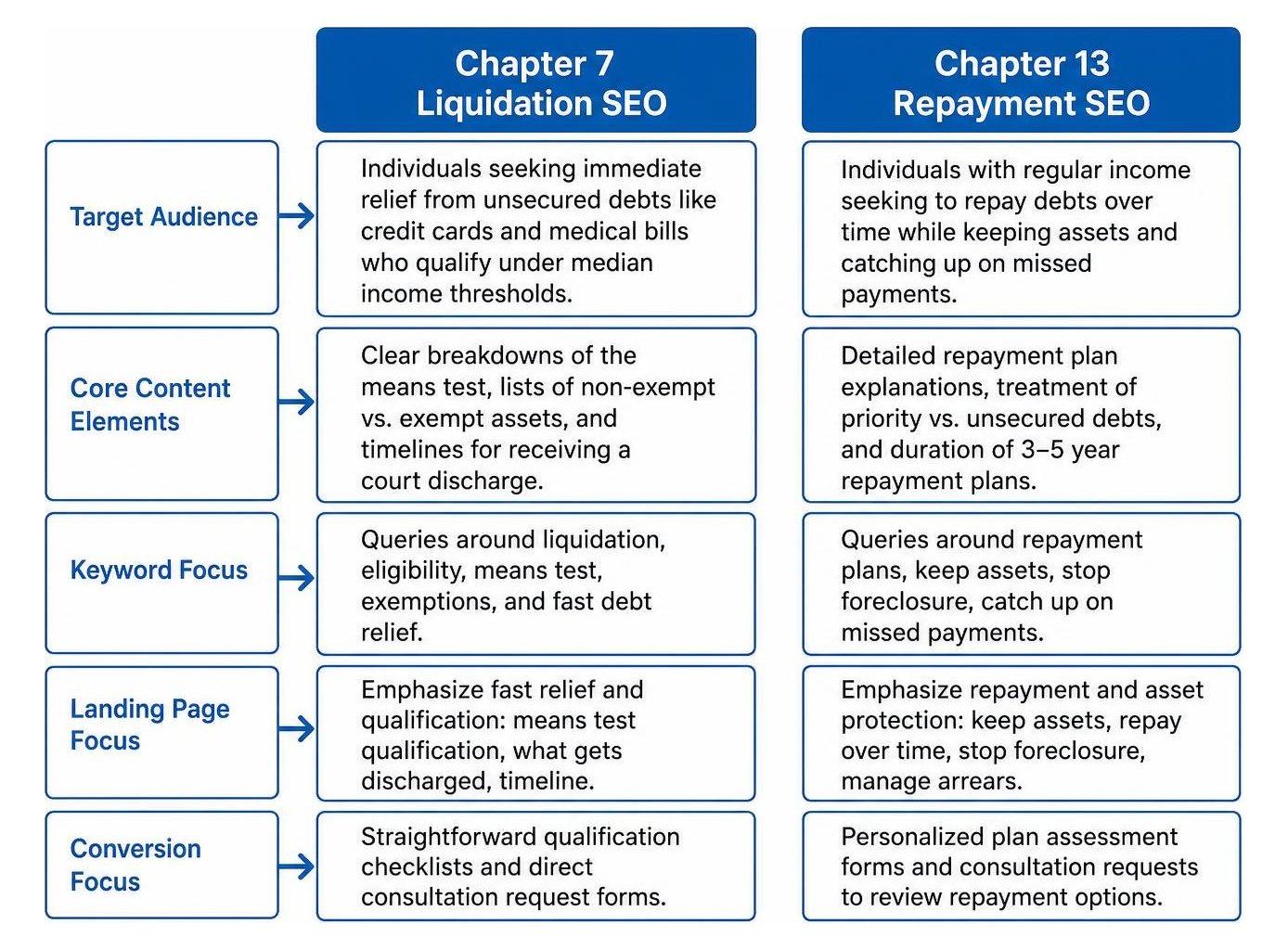
Chapter 7 Liquidation Pages:
- Target Audience: Individuals seeking immediate relief from unsecured debts like credit cards and medical bills who qualify under median income thresholds.
- Core Content Elements: Clear breakdowns of the means test, lists of non-exempt vs. exempt assets, and timelines for receiving a court discharge.
- Conversion Focus: Straightforward qualification checklists and direct consultation request forms.
Chapter 13 Reorganization Pages:
- Target Audience: Wage earners, homeowners seeking to prevent mortgage foreclosure, or debtors with disposable income exceeding Chapter 7 thresholds.
- Core Content Elements: Explanations of structured 3- to 5-year court repayment plans, curing mortgage arrears, and retaining non-exempt property.
- Conversion Focus: Detailed payment schedule illustrations and strategic case evaluation scheduling.
Building dedicated, conversion-ready local landing page designs for each chapter ensures your messaging matches the specific financial goals of your prospective clients.
What Common Mistakes Derail Law Firm SEO and How Can You Avoid Them?
Even experienced legal practices encounter common technical and strategic pitfalls that limit organic visibility and client acquisition.
- Using Overly Dense Legal Jargon: Replacing simple, empathetic explanations with complicated statutory citations creates unnecessary friction for searchers seeking quick answers.
- Ignoring Mobile Experience and Page Speed: Slow loading speeds and hard-to-read pages cause mobile visitors to bounce immediately to competing firms.
- Missing Clear Calls to Action: Providing comprehensive information without an easy, visible way to schedule a consultation leaves potential inquiries unanswered.
- Neglecting Inbound Link Equity: Relying solely on on-page text without earning authoritative links from bar associations and financial publications slows ranking growth.
Law firms can accelerate organic results by securing authoritative links through specialized link building services and refining on-page elements through structured conversion rate optimization. Our data-driven Velocity framework pairs continuous technical improvements with transparent reporting to help practices build lasting organic search authority.
Ready to Turn Organic Search into Your Law Firm's Best Source of Cases?
Attracting qualified bankruptcy inquiries requires a balanced combination of technical performance, local map pack visibility, empathetic content, and rapid client intake. Relying solely on short-term marketing tactics often increases client acquisition expenses while delivering inconsistent inquiry quality.
By creating chapter-specific practice pages, addressing urgent financial concerns, optimizing your local business profile, and maintaining an accessible mobile site, your firm can establish sustainable search visibility and connect with individuals when they need trusted debt relief representation.
Schedule a comprehensive SEO visibility audit with our team to discover how our Velocity framework can improve your practice's search presence and deliver qualified consultations.