Small Business AI Spending Benchmarks for Software and API Budgets

Small Business AI Spending Benchmarks for Software and API Budgets
How Much Should a Small Business Budget for AI Subscriptions?
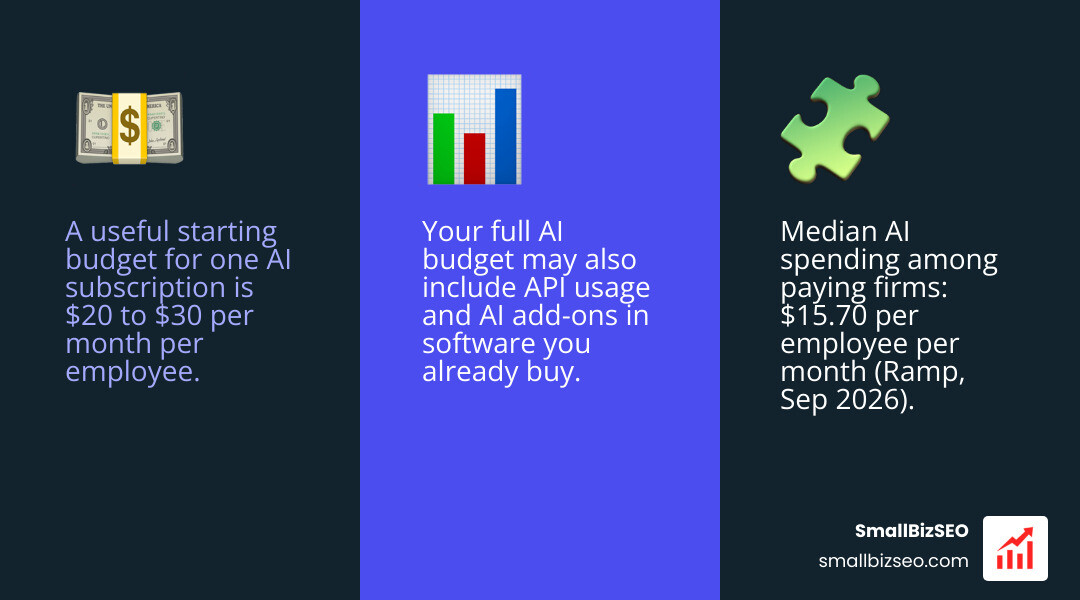
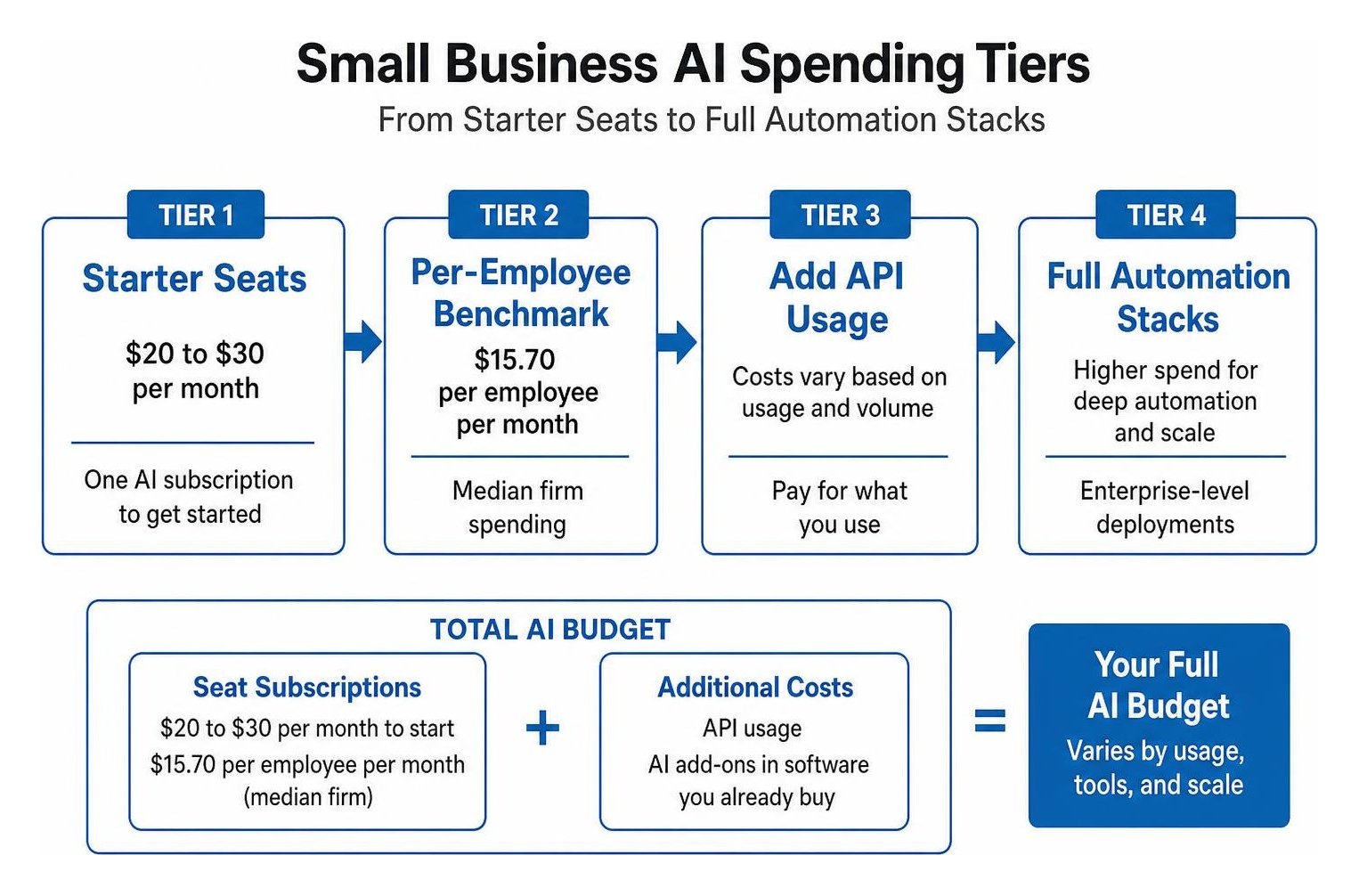
A useful starting point is $20 to $30 per month for one AI subscription. Actual spending varies widely. Among firms paying for AI, Ramp reported a median of $15.70 per employee per month. That figure is a benchmark across its paying firms, not a small-business-only estimate. Your full budget may also include API usage and AI add-ons in software you already buy.
I’m Clayton Johnson, founder of SmallBizSEO, where I develop data-driven SEO guides that help small businesses make clearer decisions. That experience shapes my approach to understanding how much small businesses pay for AI subscriptions: start with a useful benchmark, then account for costs that may not appear in the seat price.
Glossary of related AI budgeting guides:
- AI Tools Market Share: The Most Popular Artificial Intelligence Platforms for Businesses
- The Economics of AI Content Creation: Costs, Output, and Marketing Productivity
- AI Workforce Statistics: Jobs Created, Tasks Automated, and Productivity Gains
Small Business AI Spending: How Much Do Companies Pay for AI Subscriptions?
Spending on artificial intelligence differs drastically across companies based on operational posture and workflow integration. While median monthly spending remains accessible for smaller operators, high-tier software deployments and API consumption create massive cost dispersion across the wider market.
To evaluate overall software investments, we track macroeconomic adoption and pricing dynamics closely. According to research on how much money are businesses spending on ai investment statistics and projections, firm-level expenditure reflects a sharp divide between casual seat licenses and high-throughput automation stacks.
How Much Do Small Businesses Pay for AI Subscriptions per Employee?
For businesses actively paying for tooling, the median monthly expenditure sits at $15.70 per employee. However, spending escalates rapidly as organizations implement deeper automation:
- Median Firm: $15.70 per employee per month
- Top 10 Percent: $813.43 per employee per month
- Top 1 Percent: $9,567.53 per employee per month
This distribution shows how specialized firms integrate high-volume token consumption and custom infrastructure directly into day-to-day operations. As documented in the Ramp AI Index, adoption rates have crossed fifty percent among commercial businesses, though overall spending per worker varies widely across industry sectors. Knowledge-heavy industries like professional and legal services spend significantly more per seat than light-touch retail businesses.
Understanding these underlying the cost of artificial intelligence ai software pricing and spending benchmarks helps managers determine whether their current technology outlay matches operational requirements.
| Business Tier | Monthly Spend per Employee | Primary Cost Drivers |
|---|---|---|
| Median Adopter | $15.70 | Single seat licenses, basic productivity assistants |
| Top 10 Percent | $813.43 | Multi-tool stacks, dedicated coding and marketing seats |
| Top 1 Percent | $9,567.53 | Custom API pipelines, autonomous agents, heavy compute |
How Have Company AI Subscription Costs Changed Over Time?
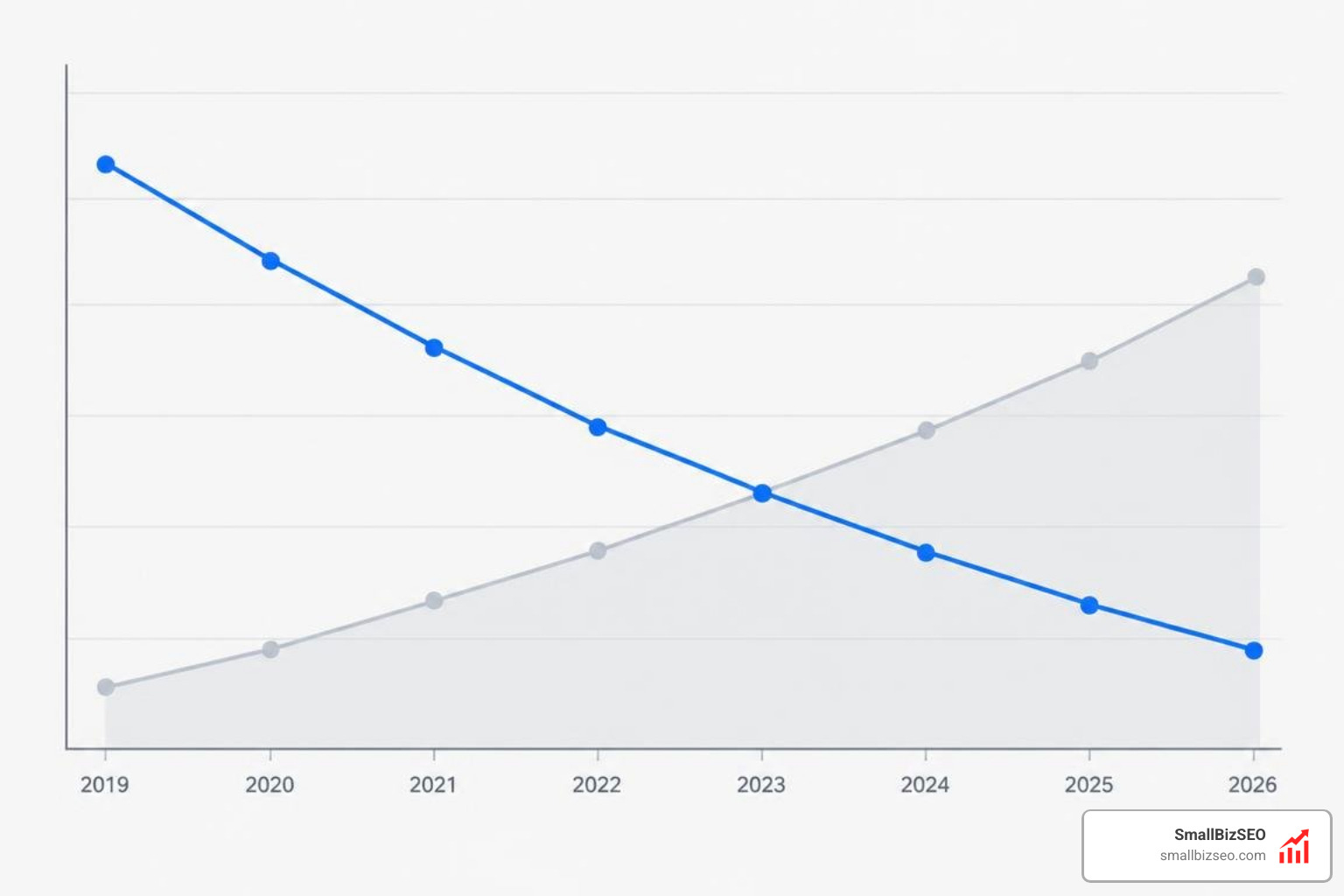
Historical expenditure patterns reveal an interesting shift. Early enterprise tools commanded higher starting price tags, but the rapid influx of generative applications democratized entry pricing:
- Early adopters began with median expenditures near $50 monthly.
- Overall median monthly spending reached a peak near $80 as specialized point solutions proliferated.
- Normalization brought median monthly spending down into the $28 to $30 range as accessible, general-purpose models entered the market.
This reduction represents a composition effect rather than reduced usage. Millions of micro-businesses entered the market at entry-level tiers between $1 and $40 per month, shifting the broader user base. By contrast, employer firms maintain higher overall adoption rates and total software outlays than nonemployer operations, widening the operational gap between structured teams and solo entrepreneurs.
Which AI Software Categories Take the Biggest Share of Small Business Budgets?
Small business software allocations are rarely concentrated in a single tool. Instead, modern technology stacks distribute capital across several core categories:
- Generative AI Platforms: Foundational text, image, and analysis subscriptions serving as general office assistants.
- Marketing Automation: Workflow platforms managing campaign creation, email sequencing, and paid ad optimization.
- AI Infrastructure and APIs: Direct developer access to foundational models powering customer support bots and proprietary software.
- Operations and Analytics: Specialized tools automating scheduling, document extraction, bookkeeping, and customer relationship management.
As companies expand usage, multi-tool adoption increases. Research on how to select the right high performing ai tool for your business stack shows that organizations paying for three or more distinct software services achieve significantly higher operational efficiency than those relying on isolated free tiers.
What Hidden AI Expenses Can Increase a Small Business’s Budget?
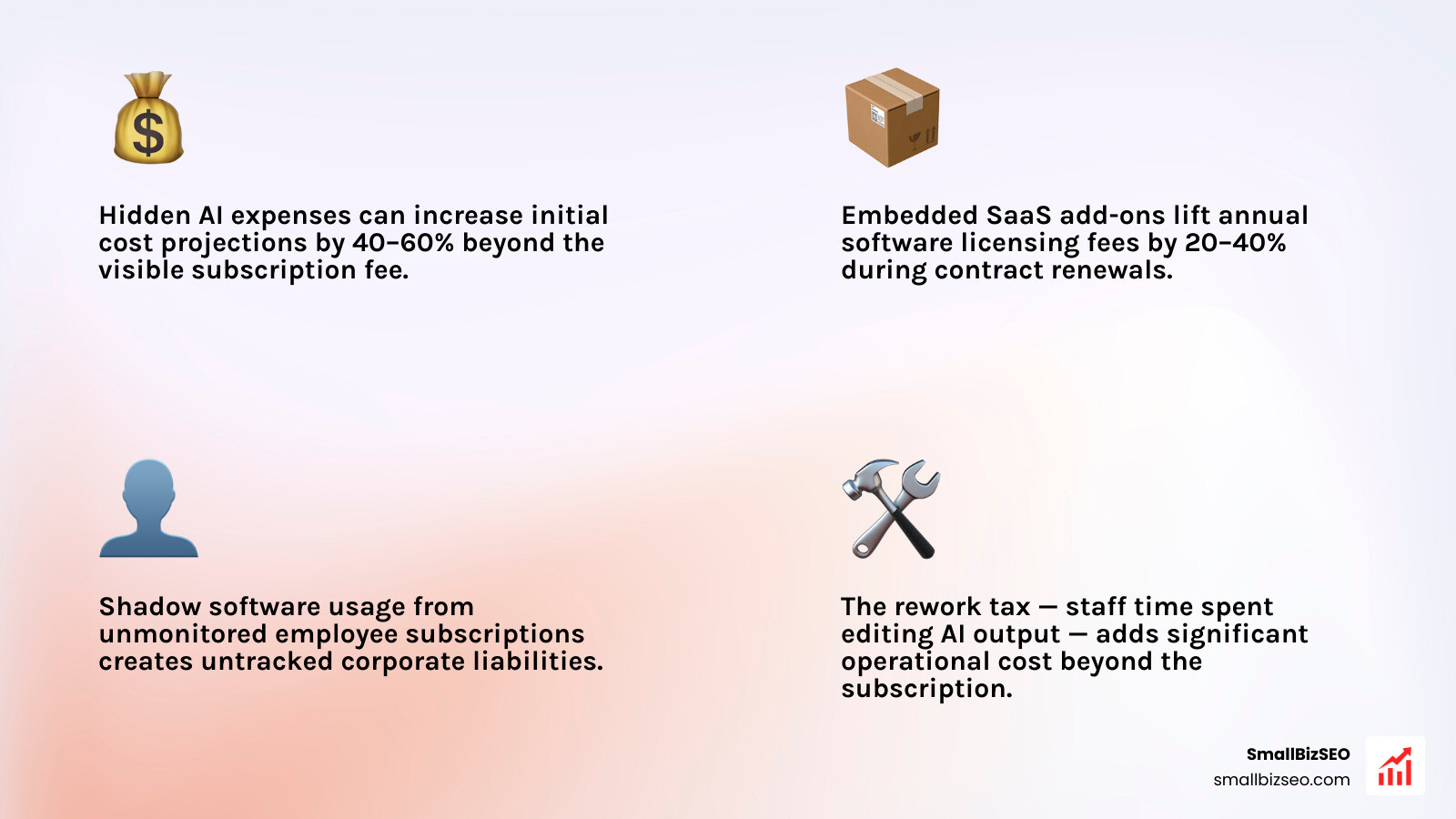
The sticker price of a seat license rarely represents the full financial commitment. Unbudgeted expenses often increase initial cost projections by forty to sixty percent.
According to research from How Much Does AI Cost? Pricing & Budgets, major hidden cost drivers include:
- Embedded SaaS Add-ons: Existing software vendors bundling automated features into contract renewals, lifting annual software licensing fees by twenty to forty percent.
- Shadow Software Usage: Unmonitored employee subscriptions that duplicate existing corporate licenses or create untracked corporate liabilities.
- Integration Maintenance: Developer hours required to update prompt chains and API configurations when foundational models update or deprecate features.
- The Rework Tax: Staff time spent fact-checking, editing, and formatting machine-generated output before deployment.
How Can Small Businesses Optimize AI Budgets and Maximize ROI?
Controlling technology expenses requires active software governance, clear usage policies, and disciplined metric tracking. Businesses that establish oversight prevent budget volatility while maintaining strong output quality.
How Do API Pricing, Tokens, and Multiple AI Agents Affect Costs?
Metered developer interfaces follow usage-based token models where costs depend on total input and output volume. Output tokens generally cost up to five times more than input tokens because text generation demands significantly more compute than text reading.
Market preferences have also shifted toward high-context models. Provider telemetry indicates that Anthropic captured 60.5 percent of commercial token spend during recent measurement periods, driven by enterprise adoption of models tailored for coding and document analysis.
To forecast consumption-based infrastructure using an AI cost calculator: estimate your total spend, teams must account for three structural mechanisms:
- Prompt Caching: Keeping static instructions and system context cached reduces repetitive input charges by twenty-five percent or more.
- Batch Processing: Scheduling non-urgent document processing during off-peak windows secures significant API price discounts.
- Agentic Workflows: Multi-step autonomous systems can consume fifty times more tokens than standard single-prompt queries due to iterative loops and growing context windows.
Evaluating are ai agents really replacing human workflows helps teams determine when autonomous systems justify their higher token consumption.
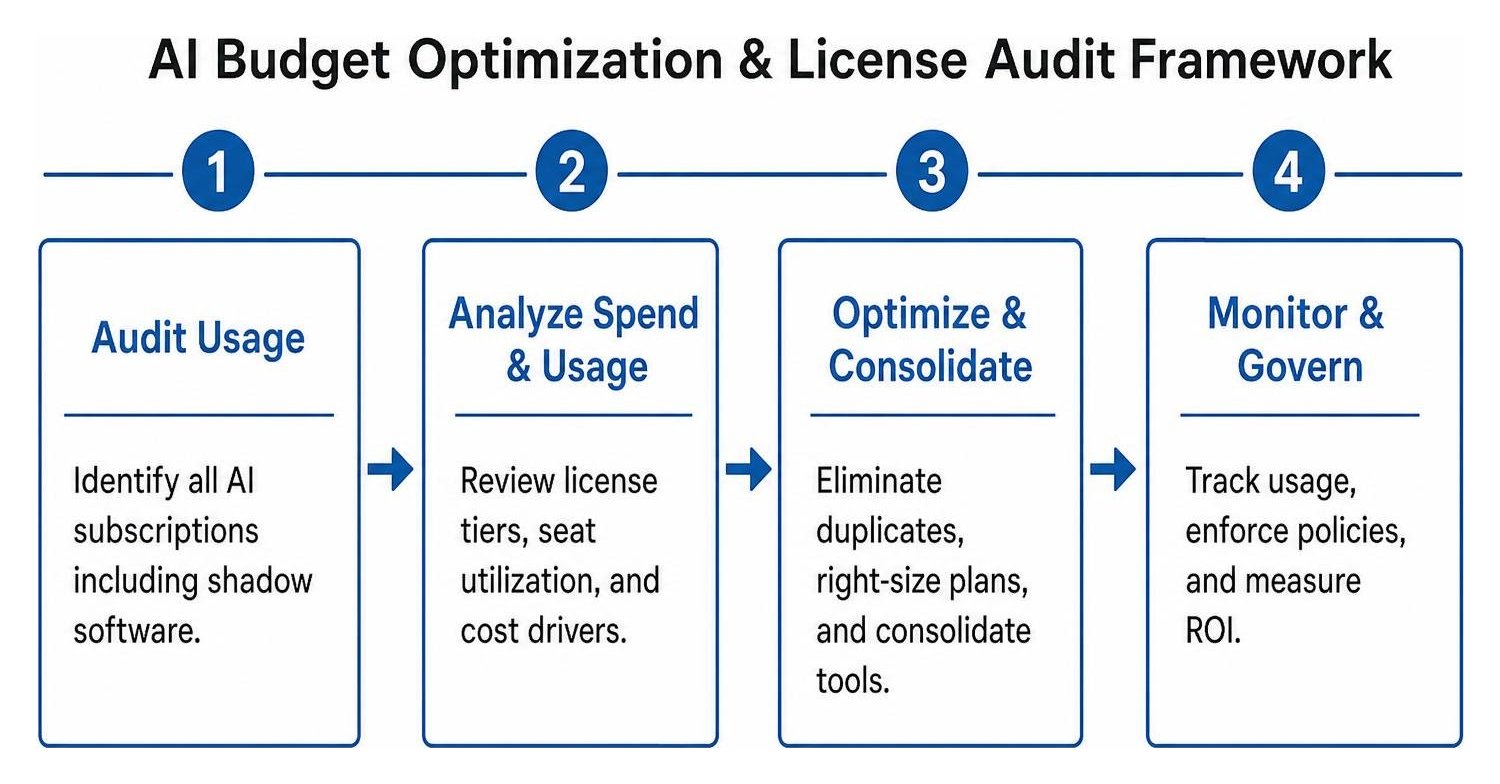
How Can Small Businesses Audit Licenses and Remove Duplicate Tools?
Optimizing software outlays requires moving away from tracking tool adoption and focusing on business outcomes. An effective quarterly governance cadence includes:
- Cataloging Every Active License: Inventory all corporate card transactions and vendor invoices to uncover hidden software add-ons.
- Eliminating Redundant Subscriptions: Consolidate overlapping tools across marketing, sales, and customer service teams into standardized business accounts.
- Evaluating Seat Utilization: Revoke paid licenses from team members averaging minimal monthly logins and transition them to shared resources.
- Quantifying Operational Yield: Measure saved labor hours against total software, training, and maintenance costs.
Our team at SmallBizSEO helps businesses achieve measurable growth through data-driven frameworks. Tracking realistic productivity returns is essential, as detailed in research exploring how much money does ai actually save businesses productivity and roi statistics. Furthermore, examining 50 generative ai statistics every business owner should know provides practical benchmarks for balancing software investments against tangible commercial value.
Maximizing Value from Your Business AI Investments
Managing business technology budgets successfully comes down to visibility and intentional deployment. Starting with baseline seats between $20 and $30 monthly allows teams to test automation safely, while active license audits prevent unexpected spending spikes. By monitoring API tokens, eliminating duplicate software, and aligning every tool with clear productivity goals, small businesses can achieve enterprise-grade efficiency without overspending.