14 Key Metrics on the Economics of AI Content Creation and Output

14 Key Metrics on the Economics of AI Content Creation and Output
How Do You Know If AI Content Is Worth the Cost?
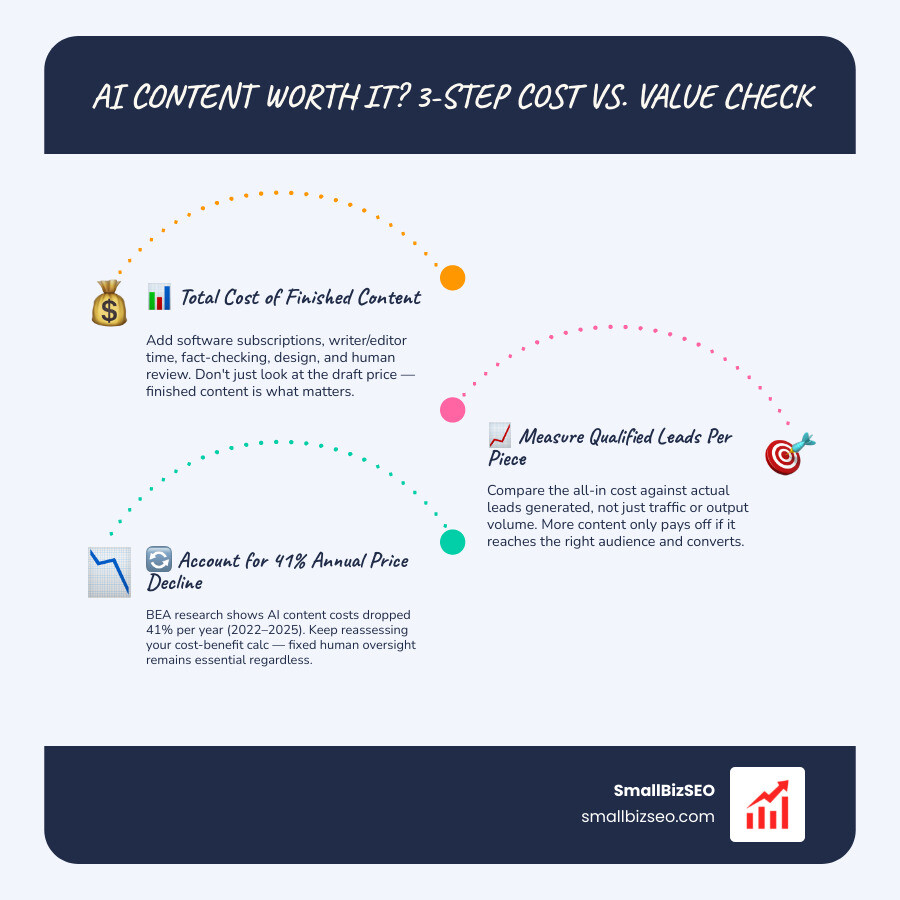
The Economics of AI Content Creation: Costs, Output, and Marketing Productivity comes down to more than cheaper drafts. To judge whether AI pays off, add up software fees, staff time, editing, fact-checking, and design. Then compare the cost of finished content with the qualified leads it brings in. More content only helps if it is useful and reaches the right people.
A recent working paper on free digital content estimates that AI-created content prices have fallen sharply in recent years. That is a major shift in production costs, but it does not remove the need for human review or a sound marketing plan.
I'm Clayton Johnson, founder of SmallBizSEO, where I work on SEO, digital PR, and content that helps small businesses earn visibility and qualified leads. My approach to The Economics of AI Content Creation: Costs, Output, and Marketing Productivity is to measure the full workflow and its business results, not just the cost of a draft.
Relevant articles related to The Economics of AI Content Creation: Costs, Output, and Marketing Productivity:
- AI-Generated Content Statistics: How Much of the Internet Is Created by AI?
- Human vs. AI-Generated Content: Traffic, Engagement, and Conversion Statistics
- AI Marketing Statistics: How Businesses Are Using Artificial Intelligence to Attract Customers
The Economics of AI Content Creation: Costs, Output, and Marketing Productivity Across Industries

When we look across major commercial sectors, the economic shift brought on by generative tools is not just about writing faster sentences. It represents a fundamental collapse in the marginal cost of producing rich digital information. Understanding how this transformation affects balance sheets and national production statistics requires examining traditional media production costs alongside modern automated pipelines.
| Content Format | Traditional Production Benchmark | AI-Assisted Production Cost | Observed Production Velocity Lift | Primary Cost Drivers |
|---|---|---|---|---|
| Long-Form Written Content | $611 per comprehensive article | $131 per comprehensive article | 3.2x to 4.2x monthly publishing volume | Subject matter research, editorial review, SEO alignment |
| Digital Visuals & Display Ads | $25 – $170 per custom visual asset | Less than $0.10 in computing resources per asset | 70% – 80% faster variant turnaround | Model prompt calibration, brand safety review, format resizing |
| High-Definition Commercial Video | $800 – $10,000+ per finished minute | ~$80 – $400 per finished minute | 90% reduction in production schedules | Script generation, synthetic voiceover, visual timeline rendering |
What Is the Economics of AI Content Creation: Costs, Output, and Marketing Productivity in GDP Accounting?
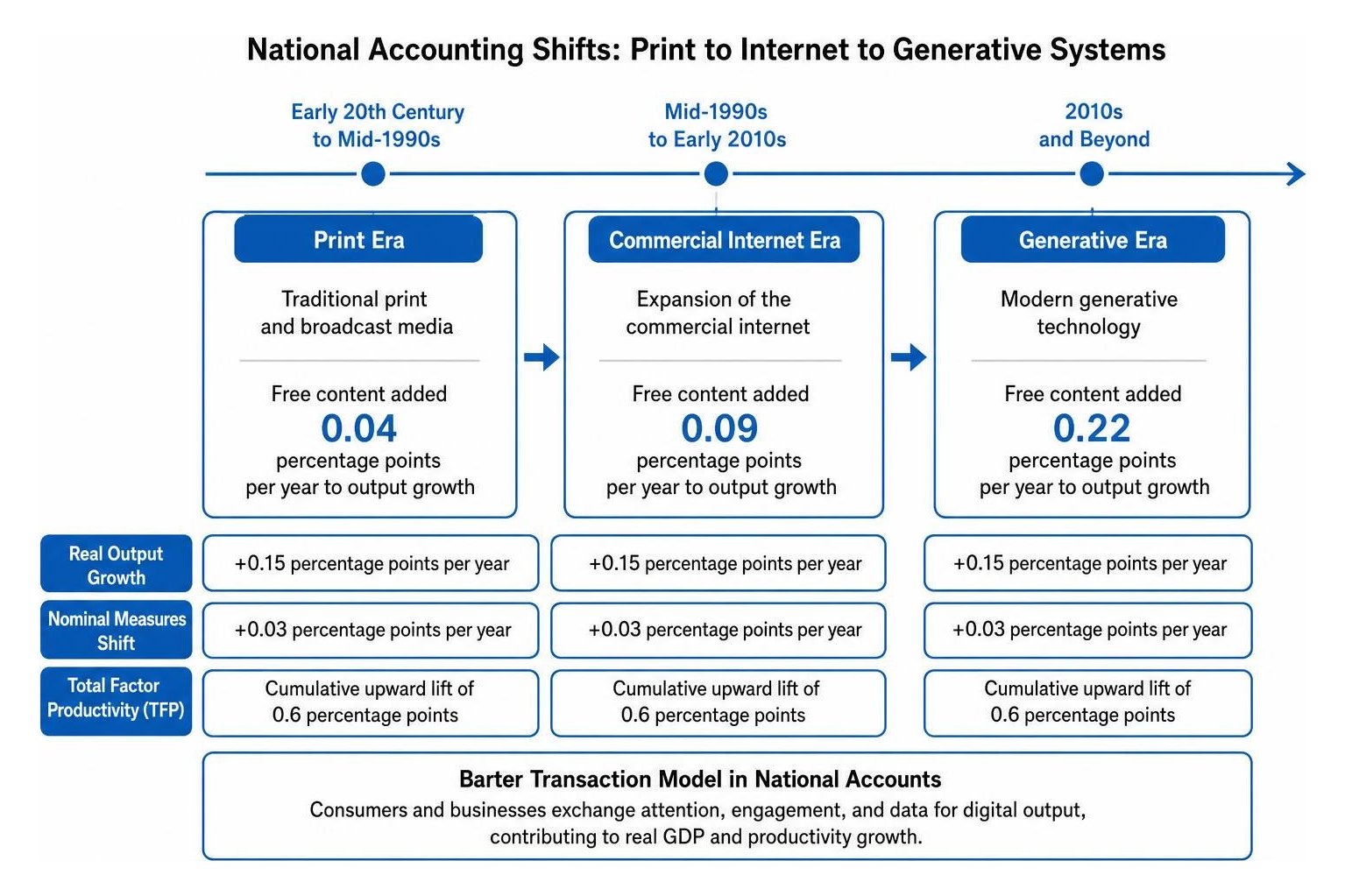
In national accounting, free and subsidized AI content contributes directly to real gross domestic product and productivity through a barter transaction model. When consumers and businesses use ad-supported search engines, free AI assistants, or brand-published educational media, they trade their attention, engagement, and data in exchange for valuable digital output.
Economists at the Bureau of Economic Analysis pioneered this barter transaction framework to capture the value of non-priced digital assets. According to BEA research on free digital content and AI accounting, focusing solely on direct cash transactions underestimates actual economic activity:
- Marketing-supported information represents nearly double the volume of third-party advertising media, reaching roughly $951 billion in annual economic value compared to $538 billion for pure ad-supported platforms.
- User-generated digital content adds an estimated $407 billion annually, serving as the foundational training data and engagement substrate for generative models.
- Total Factor Productivity (TFP) accounts show a cumulative upward lift of 0.6 percentage points when these unpriced barter dynamics are fully incorporated into national accounts.
- Real output growth expands by 0.15 percentage points per year, while nominal economic measures shift upward by 0.03 percentage points annually.
Historical records demonstrate distinct structural acceleration points across digital eras. In the early twentieth century through the pre-internet era, free content added 0.04 percentage points per year to output growth. The expansion of the commercial internet lifted that contribution to 0.09 percentage points annually, while modern generative technology pushed the growth dividend to 0.22 percentage points per year. Properly allocating these intermediate inputs across all 63 primary domestic industry classifications is critical for accurately evaluating overall business cost reductions and ROI.
How Does the Economics of AI Content Creation: Costs, Output, and Marketing Productivity Shift Firm-Level Unit Costs?
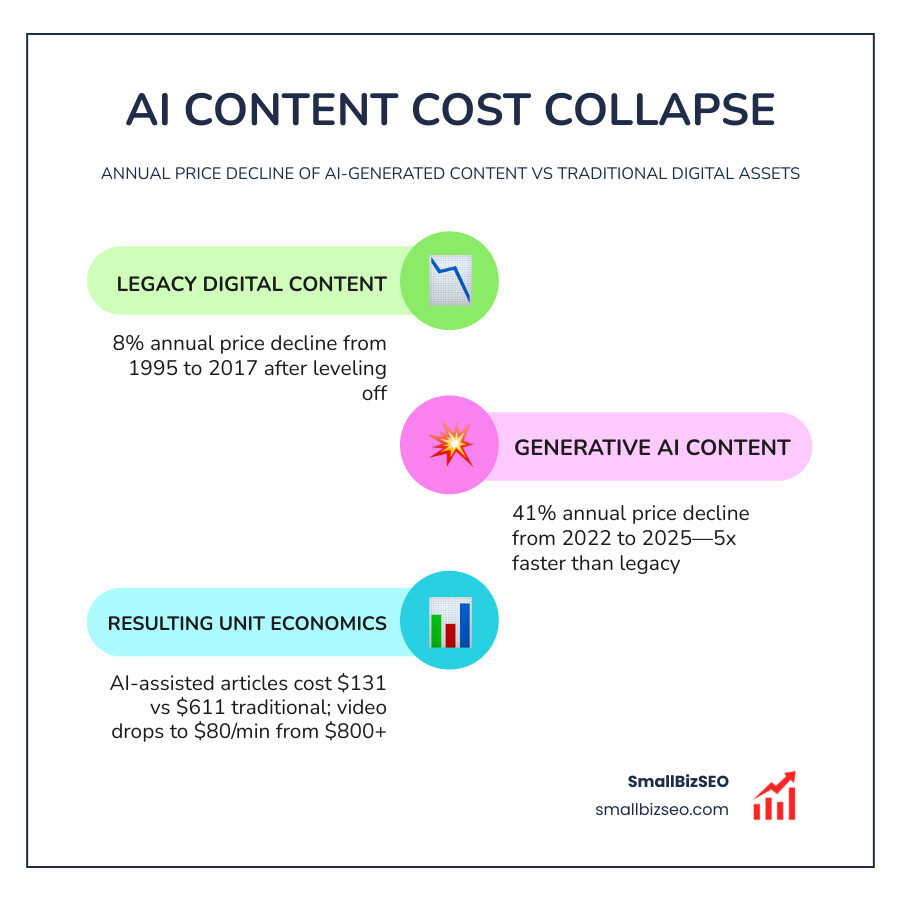
Generative tools cut firm-level asset production costs by 70% to 90% while simultaneously increasing monthly output capacity. While legacy digital production prices drifted downward at an average of 8% annually over two decades before leveling off, generative computing costs have fallen dramatically in recent production cycles.
These hardware and algorithmic efficiencies flow directly into marketing unit economics:
- Written content production: As documented across digital publishing benchmarks, the average fully loaded expense of creating a comprehensive written article drops from $611 under purely manual workflows to $131 under AI-assisted production models.
- Commercial visual assets: A comprehensive academic analysis on generative marketing and visual content performance shows that synthetic visual ads can achieve up to a 50% higher click-through rate in controlled field tests while costing pennies in server compute compared to traditional photo shoots.
- Publishing velocity: Active marketing teams maintain an average output multiplier between 3.2x and 4x without expanding their physical headcount.
- Video asset creation: Finished video production drops from thousands of dollars per minute to roughly $80 per minute for localized and personalized campaigns.
To capture these gains without creating technical debt, companies are actively benchmarking software pricing and AI infrastructure spend. When teams integrate automated pipelines into daily publishing schedules, analyzing key AI marketing statistics and workflow automation helps pinpoint where human oversight creates the highest return.
Why Do Task-Level Micro Gains Face the Productivity J-Curve and Measurement Frictions?
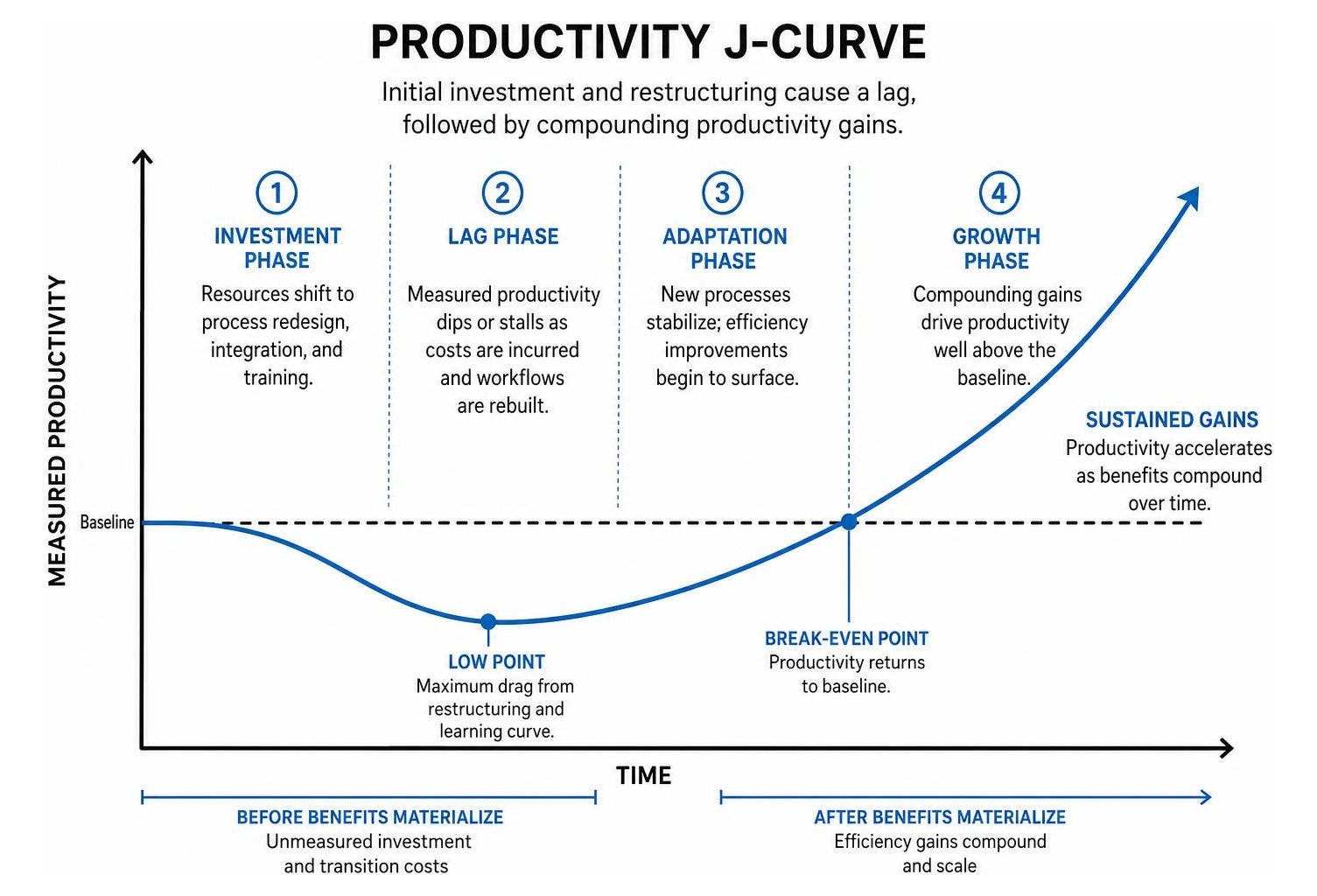
Micro-level efficiency gains do not immediately show up in aggregate financial reports because firms must first invest heavily in organizational redesign, workflow integration, and employee retraining. While individual workers complete isolated tasks up to 55% faster, the surrounding business processes require significant restructuring before those time savings translate into bottom-line profits.
Controlled academic trials confirm substantial task-level speedups:
- Business writing and communications: Economists Shakked Noy and Whitney Zhang found that generative assistance reduced task completion times by 40% while simultaneously raising output quality ratings by 18%.
- Software engineering: Research by Sida Peng and colleagues demonstrated that developers equipped with GitHub Copilot completed real-world programming benchmarks 55.8% faster than unassisted developers.
- Customer operations: Field experiments across major enterprise support teams revealed an average 15% increase in resolved issues per hour, with task durations dropping significantly across technical support channels.
The delay between task-level speed and enterprise-wide financial returns is explained by the classic productivity J-curve. When a general-purpose technology emerges, businesses initially experience flat or slightly depressed measured performance as they divert resources into unmeasured intangible capital, custom software configuration, and workflow rebuilding.
As highlighted in empirical evidence on AI productivity and labor market adjustments, standard economic metrics often fail to capture qualitative improvements such as round-the-clock availability, hyper-personalized customer interactions, and rapid campaign iteration. Bridging this gap requires addressing the corporate skills gap and workforce AI training benchmarks so staff spend their newly recovered hours on strategic growth tasks rather than administrative filler.
What Are the Real Labor Market Impacts, Skill Compression, and Startup Scale Reductions?
Rather than driving widespread job elimination, generative tools compress internal skill disparities and dramatically lower the capital required to launch a new business. Across international enterprise surveys, 83% of small and mid-sized adopters report maintaining stable staffing levels while using automation to expand their total operational output.
The most profound labor market dynamic is intra-occupational skill compression:
- Disproportionate baseline gains: Studies evaluating enterprise customer support deployments show that while top-tier professionals experience modest single-digit productivity improvements, workers in the bottom skill quintile gain a 36% performance uplift. Generative models act as an automated coaching layer that elevates entry-level proficiency toward senior benchmarks.
- Entry-level hiring shifts: The labor market shows targeted friction for early-career applicants, with a 16% hiring contraction observed for workers in highly exposed analytical roles as companies rely on automated tools for initial drafting and basic data collection.
- Minimum viable scale reduction: Startups that previously required dozens of specialized employees to handle marketing, coding, design, and operations can now launch with compact, multi-disciplinary teams.

With over $20 billion in venture capital funding modern generative infrastructure, the market is splitting into concentrated upstream foundation models and highly competitive downstream applications. For growing businesses, the primary challenge is scaling enterprise content volume without compromising E-E-A-T quality, ensuring that automated production maintains genuine topical authority, verifiable factual accuracy, and authentic brand voice.
How Businesses and Marketers Can Maximize Economic ROI from AI Content Production
To achieve maximum economic return from automated content workflows, companies must connect creative volume directly to financial performance indicators rather than treating AI as a simple cost-cutting shortcut. True marketing productivity multiplies qualified pipeline and enterprise value by linking technical execution to clear commercial objectives.
We recommend executing a structured, high-ROI operational framework:
- Establish a C-Suite Growth Alliance: Move beyond surface-level discussions about freelance budget cuts. Align your marketing leadership and financial controllers around the PwC strategic framework on marketing value creation. Construct a formal "value equation pyramid" that maps asset velocity directly to customer lifetime value, market share expansion, and operating margins.
- Leverage Accessible Open-Source Deployments: With roughly 89% of active enterprise adopters utilizing open-source or fine-tuned model components, build internal workflows on adaptable, cost-effective infrastructure rather than locked proprietary ecosystems that carry runaway per-seat fees.
- Enforce Strict Verification and Governance: Pure, unedited automated text carries high risks of factual hallucination and search engine quality penalties. Implement mandatory editorial checkpoints where subject matter experts verify factual claims, add original data, and maintain strict brand voice compliance.
- Deploy the SmallBizSEO Velocity Framework: At SmallBizSEO, we integrate automated drafting into our proprietary technical SEO, link-building, and high-authority digital PR pipelines. By applying Answer-Ready structures, transparent automated reporting, and human editorial oversight, we turn high-volume content into measurable, top-tier organic visibility.
Reviewing current generative AI statistics for business strategy provides the empirical baseline needed to modernize your marketing operations. By balancing algorithmic speed with authentic human expertise, your business can lower unit production expenses while building durable organic market dominance.