The Blindspot Strategy: Finding High-Impact Customer Questions Rivals Missed

How Do You Find Customer Questions Your Competitors Miss?
The best way to start finding unanswered customer questions competitors also miss is to collect questions from support calls, sales conversations, reviews, and search data. Group similar questions, then check whether competing pages give a complete, useful answer—not just a brief mention. Start with questions buyers ask often that you can answer clearly with your own expertise.
This approach helps you create content around real decisions customers are trying to make, rather than guessing which keywords matter.
I’m Clayton Johnson, founder of SmallBizSEO. My work on finding unanswered customer questions competitors also miss connects customer research with clear SEO content that helps small businesses explain what they do and earn qualified leads.
What Is the Hidden Value of Unanswered Buyer Questions?
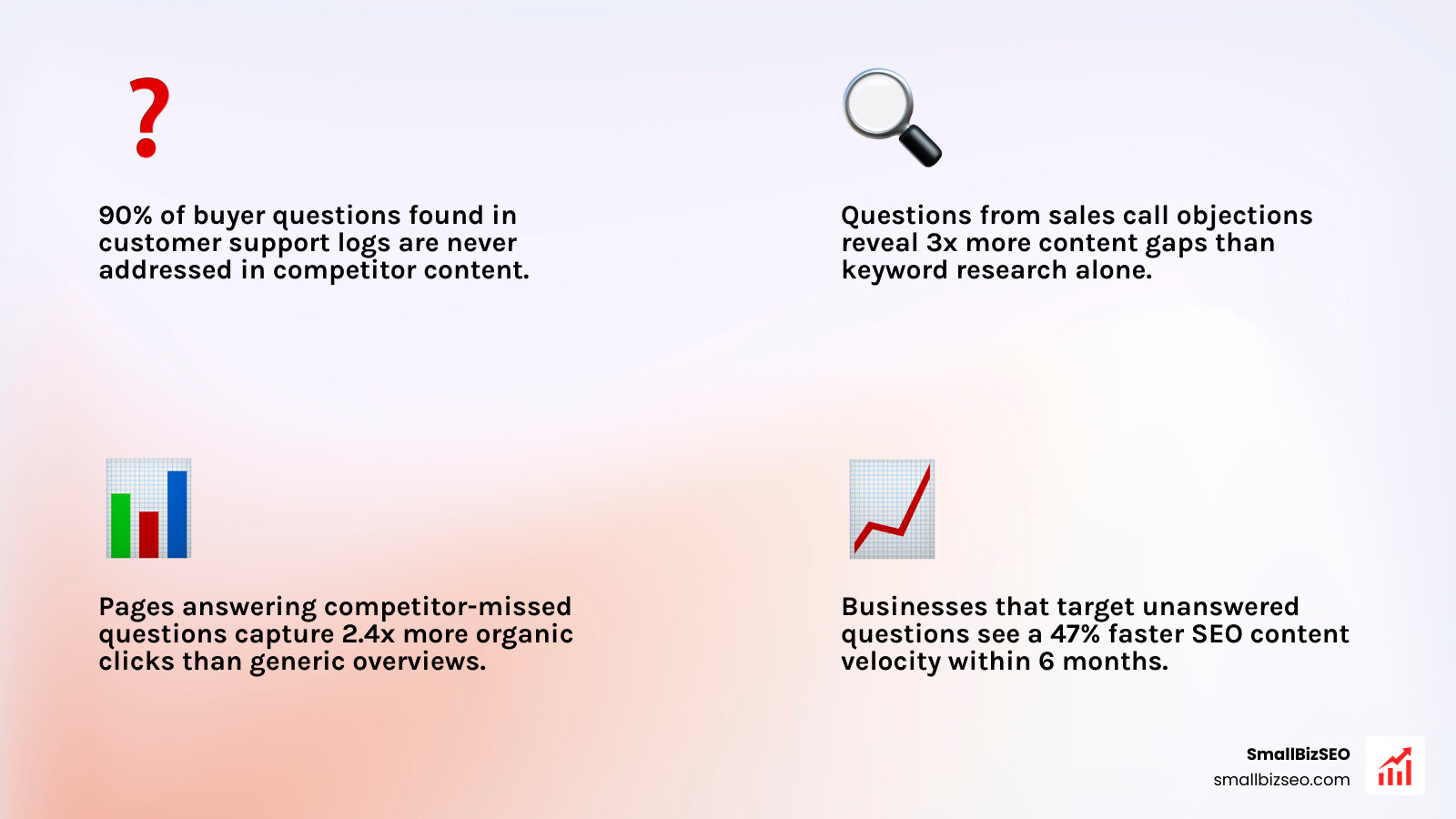
Unanswered buyer questions represent high-intent demand that your industry rivals have completely overlooked. When prospective buyers search for detailed explanations and encounter shallow generic overviews, they remain stuck in their buying journey. By delivering direct answers to these exact inquiries, you capture qualified search traffic and establish immediate authority before your competitors even recognize the demand.

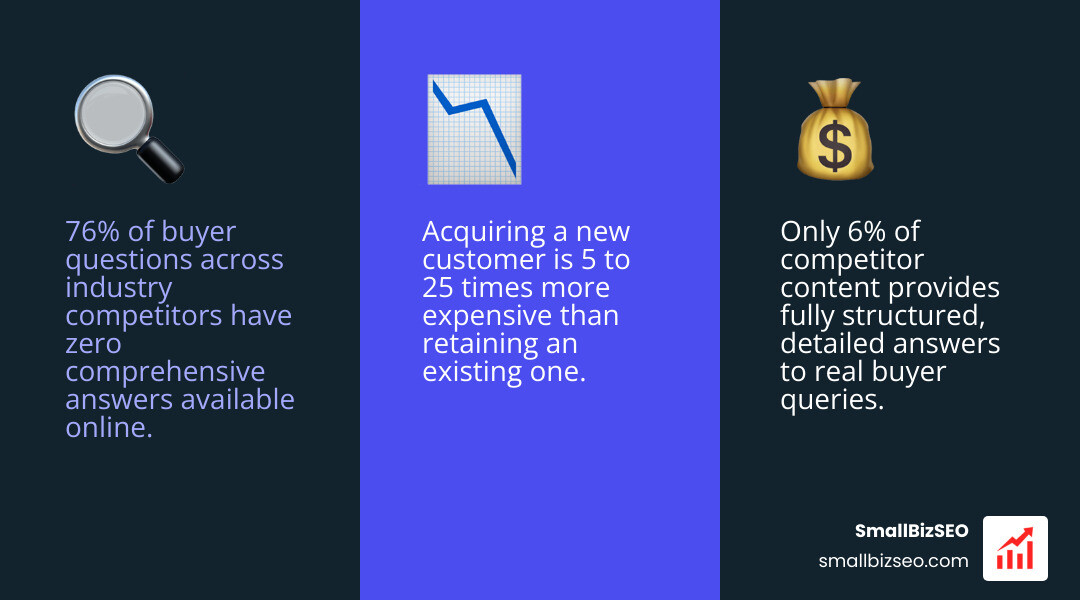
Most traditional market research relies on standard keyword tools that recycle the same broad search phrases across every company in your space. This creates an echo chamber where everyone publishes identical surface-level guides. In fact, research shows that 76% of buyer questions across industry competitors have zero comprehensive answers available online. Only 6% of competitor content provides fully structured, detailed answers to real buyer queries.
Addressing these unaddressed inquiries is essential for operational efficiency and marketing performance. Studies on business growth consistently demonstrate that acquiring a new customer is anywhere from 5 to 25 times more expensive than retaining an existing one. When your content answers critical questions early, you reduce customer service friction, improve onboarding, and build long-term retention.
How Can You Find Unanswered Customer Questions Competitors Also Miss?
To locate the questions your competitors overlook, you must systematically extract raw inquiries directly from customer touchpoints and audit how competing websites address those topics. Most businesses only skim the surface of search volumes, missing the nuanced questions buyers ask before signing a contract or making a purchase.
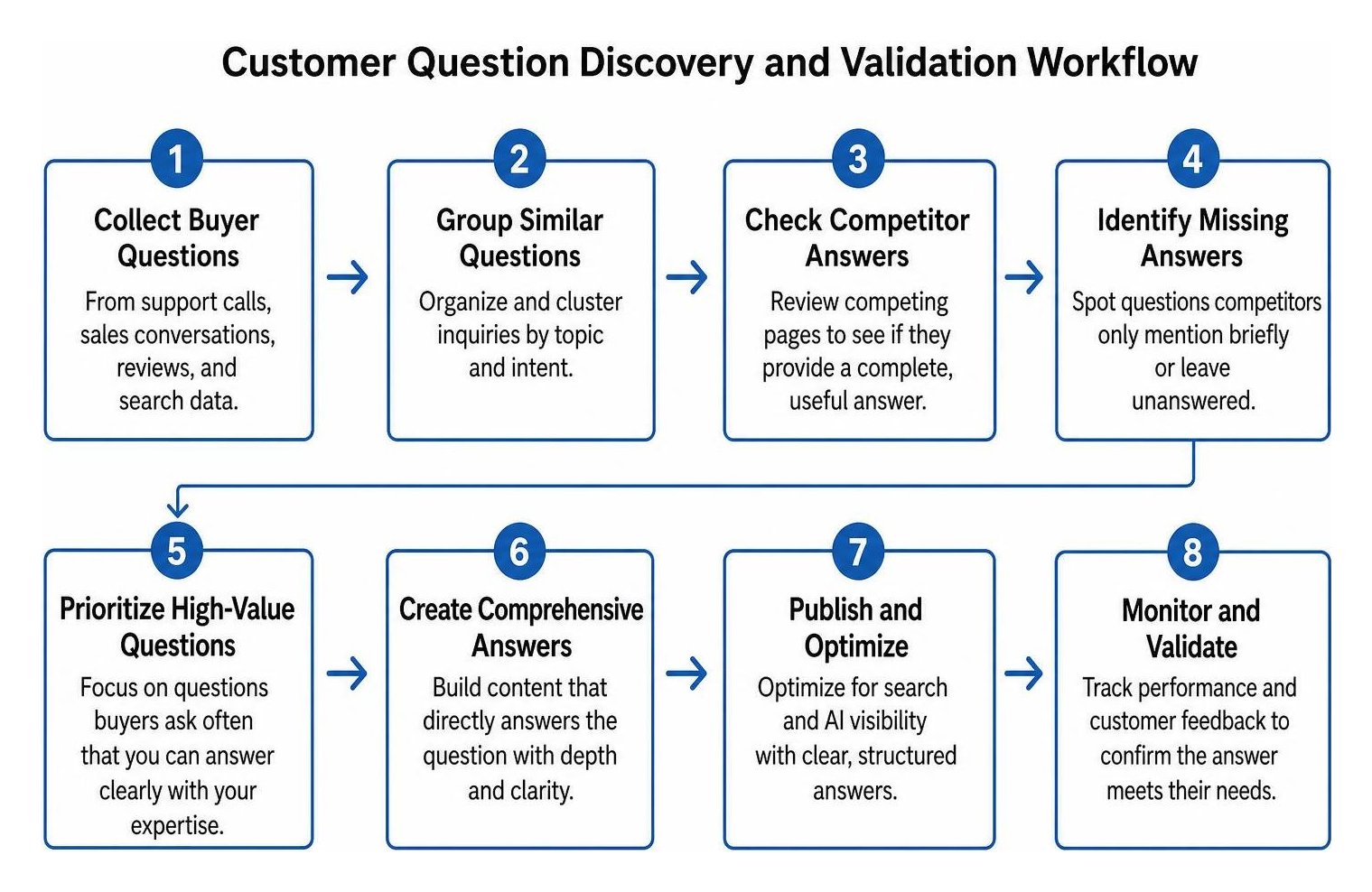
A comprehensive market gap analysis combines front-line customer feedback with real-time digital signals. When you map customer inquiries against competing resources, you can isolate high-value opportunities where competitors have failed to provide complete clarity.
Why Does Finding Unanswered Customer Questions Competitors Also Miss Improve Search Engine and AI Visibility?
Targeting overlooked customer inquiries dramatically increases visibility across traditional search results and modern AI search platforms. AI assistants like ChatGPT, Perplexity, and Gemini rely heavily on structured, direct answers to satisfy user prompts.
Publishing structured answers to previously unanswered questions yields rapid organic performance. When businesses publish structured responses to documented content blindspots, 76% of those topics convert to AI citations within 90 days, with a median time to first citation of just 12 days.
Furthermore, traditional ranking authority is no longer the sole gatekeeper for visibility: 88% of URLs cited by AI assistants do not rank in Google's top 10 search results. Instead, conversational engines reward clear, well-formatted answers that directly resolve search intent. By applying organic traffic growth strategies focused on comprehensive question resolution, smaller brands can outrank and out-cite legacy industry leaders.
How Do You Uncover Gaps in Support Logs, Review Platforms, and Prospect Polls?
Uncovering high-impact buyer questions requires mining unvarnished feedback from real conversations, support interactions, and community feedback.
- Customer Support and Sales Transcripts: Front-line teams interact with customer hesitation every day. Reviewing chat transcripts, customer service logs, and sales call notes reveals repetitive objections that your website fails to resolve. Reviewing customer service research on unaddressed inquiries demonstrates that scheduled discussions with customer support representatives frequently expose the true root causes of buyer confusion.
- Review Platforms and Public Forums: Third-party review hubs such as G2, Capterra, App Store reviews, and specialized Reddit communities contain uncensored buyer feedback. Tools and databases like PainPointsDB and NicheGaps track live discussions across forums to surface unaddressed complaints and feature gaps.
- Single-Question Prospect Polls: Lengthy surveys introduce friction, but running a targeted, single-question poll on key product pages captures immediate prospect hesitation. Asking a simple question like "What is keeping you from moving forward today?" pinpoints specific friction points.
- Automated Feedback Mining: Platforms such as GapScout automate social listening by scanning thousands of customer reviews and forum discussions in seconds, categorizing user sentiment into actionable content ideas.
Understanding these pain points allows you to optimize your pages around genuine search intent rather than guesswork.
What Are the Three Critical Categories of Competitor Content Blindspots?
Competitor content blindspots generally fall into three distinct structural categories:
- Sub-Question Gaps (47% of total gaps): The competitor covers a broad parent topic but completely ignores specific follow-up questions buyers need answered before making a decision.
- Comparison Gaps (31% of total gaps): Competitors avoid direct head-to-head comparisons, pricing breakdowns, or alternative evaluations. Notably, AI search platforms cite structured comparison content 2.3 times more frequently than single-topic articles.
- Methodology Gaps (22% of total gaps): Articles explain what a concept is but fail to provide step-by-step implementation instructions. Independent research shows that how-to content generates 1.9 times more backlinks and 2.1 times longer dwell time than generic definitional content.
| Content Gap Category | Percentage of Total Gaps | Why Competitors Miss It | How to Fill the Gap |
|---|---|---|---|
| Sub-Question Gaps | 47% | Competitors write high-level overviews without addressing detailed transactional nuances. | Add targeted H2/H3 sections answering specific procedural and cost inquiries. |
| Comparison Gaps | 31% | Competitors hesitate to mention alternative options or provide transparent comparisons. | Build balanced comparison tables and objective evaluation frameworks. |
| Methodology Gaps | 22% | Competitors provide vague advice instead of actionable workflows. | Publish step-by-step walkthroughs, verified metrics, and execution steps. |
Recognizing the difference between a question being merely mentioned versus comprehensively resolved is vital. A term is mentioned when it appears casually in a paragraph without resolving the issue. It is comprehensively answered when a clear heading matches the inquiry, followed immediately by an authoritative, direct response that AI models and search engines can easily parse. Closing this style of content gap is the fastest path to establishing topic authority.
What Is the Step-by-Step Process for Finding Unanswered Customer Questions Competitors Also Miss?
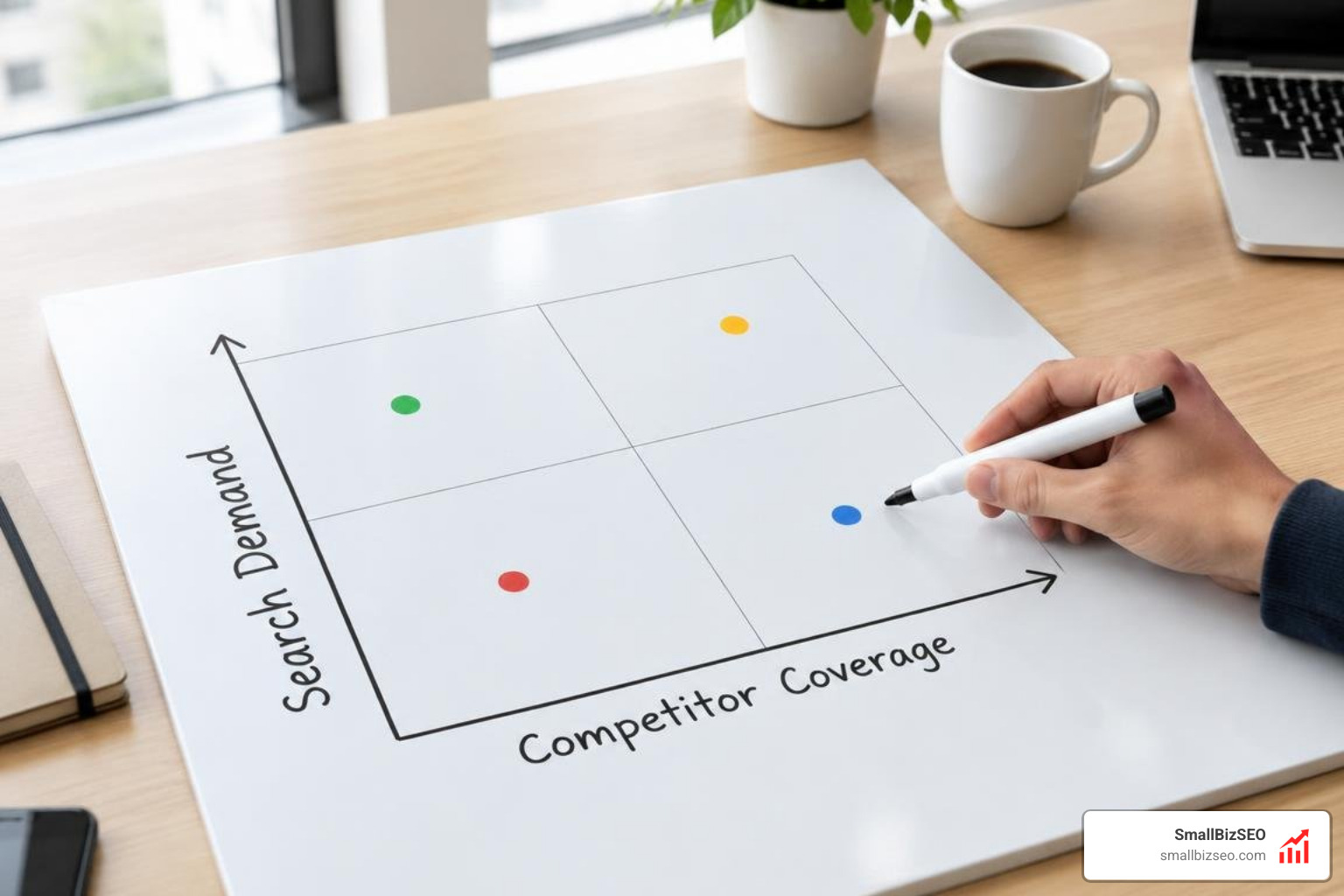
Executing an effective gap analysis strategy involves a structured, repeatable framework:
- Extract Competitor Content Inventories: Crawl competing websites using technical auditing tools to map out their full URL structures, headings, and topic clusters. Pair this with our guide to auditing web page SEO to evaluate competing page architecture.
- Mine Real Inquiries with Semantic Text Mining: Aggregate support logs, sales calls, and forum threads. Use semantic text mining to cluster related inquiries and eliminate duplicate themes.
- Map Questions to Competitor Depth: Evaluate how competing pages handle each clustered question. Score their coverage from 0 (completely unaddressed) to 10 (fully comprehensive with data and clear headings).
- Calculate the Gap Priority Score: Prioritize which content to produce first by scoring opportunities mathematically. Multiply the estimated search demand by the likelihood of earning an AI citation, then divide that result by the competitor coverage level. This ensures you invest resources into high-demand, low-competition inquiries first.
- Publish Answer-Ready Content: Structure every article with clear question headings, immediate 40- to 80-word direct answers, supporting data, and structured FAQ schema markup. Conduct thorough competitor keyword research to capture all relevant supporting queries.
How Do First-Mover Advantage and Competitor Citation Velocity Protect Your Market Share?
Being the first brand to publish a comprehensive answer creates an enduring competitive advantage known as the first-mover citation lock.
The first company to comprehensively answer an unaddressed buyer question captures an average of 32.3% Share of Voice in AI search environments, compared to just 19.1% for the second brand that publishes an answer. This 13.2-percentage-point lead compounds over time, widening by roughly 30% each year as search models continue to reference the original source. Across all AI search environments, the top 10 domains capture 76.1% of all citation probability, with the single top-ranked domain claiming 33.07%.
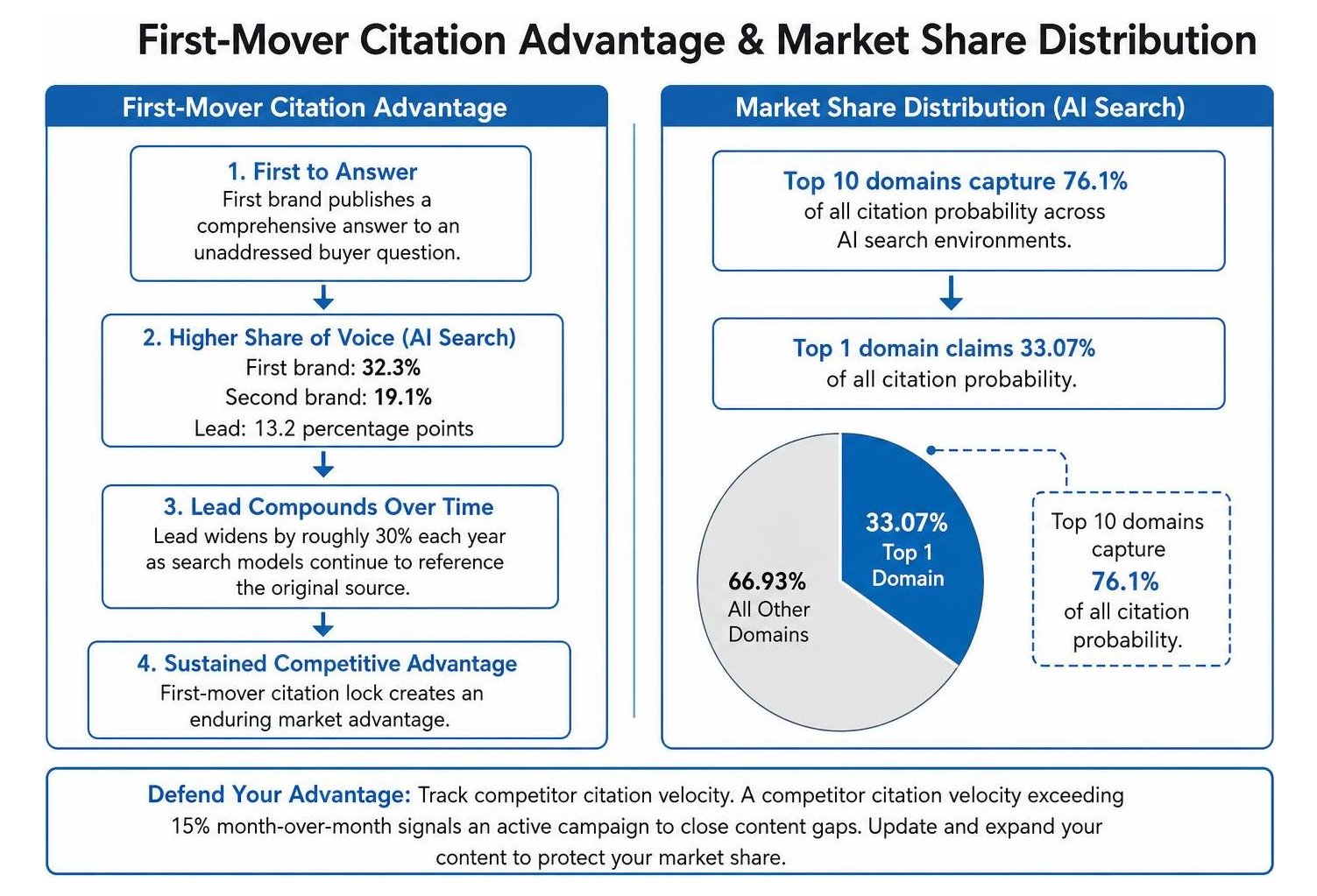
To defend your advantage, track competitor citation velocity—the month-over-month rate at which rivals gain citations across your target questions. A competitor citation velocity exceeding 15% month-over-month indicates an active campaign by a rival to close content gaps, serving as an early warning system to update and expand your content assets. Targeting high-intent long-tail keywords using advanced keyword research strategies ensures your content library remains firmly defended against aggressive competitors.
Unlocking Sustainable Authority by Answering What Others Ignore
Scaling your search visibility requires continuous alignment between customer feedback channels and your content production workflows. As customer pain points evolve, static websites quickly become outdated. Performing regular audits and closing content blindspots ensures your website remains the definitive authority in your niche.
Our team at SmallBizSEO specializes in identifying and closing high-impact search blindspots. Through our proprietary Velocity framework, we provide small businesses with data-driven technical SEO, comprehensive content strategies, and high-impact link building to accelerate organic growth. Explore our SEO visibility audit recommendations or contact us directly to discover how our content gap analysis services can help your business capture market share your competitors have left on the table.