The Corporate Divorce: Separating a Brand Entity from Its Parent Company

How do you separate a brand entity from its parent company?
Start by deciding what needs to be independent: the brand’s public identity, its legal ownership, its operations, or all three. When separating a brand entity from its parent company, map who owns its trademarks, contracts, customer data, and digital assets. Then choose a structure, such as a subsidiary, spin-off, or sale, and plan how the brand will keep serving customers while shared systems are replaced.
A new name alone does not create a separate company or protect it from liability. The goal is to give the brand enough control to operate on its own without losing the trust and recognition it has already built.
I’m Clayton Johnson, founder of SmallBizSEO. My experience relevant to separating a brand entity from its parent company is in brand visibility and SEO: helping businesses make their identity clear to customers and search engines as their presence changes.
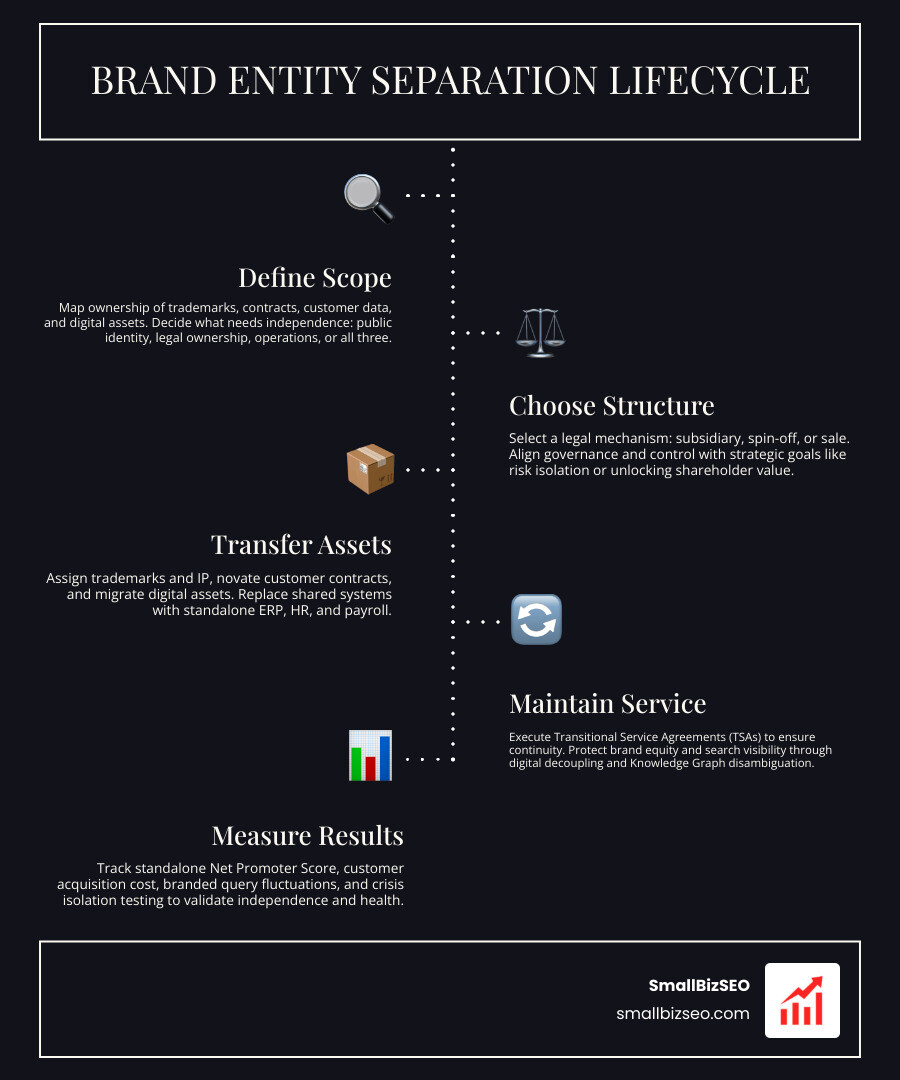
Why and How: Separating a Brand Entity from Its Parent Company

Separating a brand entity from its parent company requires aligning commercial strategy, legal structuring, and operational mechanics. A brand cannot thrive independently simply by redesigning its logo; it requires clear ownership lines, isolated governance, and a standalone operating model that protects long-term value.
What Strategic Drivers Require Separating a Brand Entity from Its Parent Company?
Companies separate a brand entity when holding multiple divisions under one roof creates operational friction, exposes the parent to legal risk, confuses target markets, or suppresses market valuation.
Key catalysts include:
- Mission Drift and Cultural Divergence: When a subsidiary brand’s founding values clash with enterprise-level mandates, strategic separation restores operational freedom and stakeholder trust.
- Regulatory and Antitrust Mandates: Regulatory agencies frequently require corporate carve-outs to eliminate market concentration and protect competitive dynamics.
- Unlocking Shareholder Value: Mixed-asset conglomerates often suffer from valuation discounts. Disentangling high-growth units allows the market to value the independent entity on its own merits, as highlighted in Harvard Law School corporate divestiture insights.
- Liability Containment and Corporate Veil Protection: Operating high-risk product lines under separate corporate entities safeguards core enterprise assets from catastrophic claims.
- Audience and Positioning Realignment: When a parent brand carries enterprise or legacy associations that do not resonate with a younger or premium audience, full autonomy is critical. Securing an unencumbered position also helps when optimizing brand authority in crowded organic search landscapes.
How Do Spin-Offs, Carve-Outs, and Divestitures Compare in Control and Ownership?
The three primary separation pathways—equity carve-outs, spin-offs, and outright divestitures—differ fundamentally in their distribution of equity, retained management control, and governance frameworks.
Selecting the right transaction structure depends on whether leadership wants partial liquidity, complete tax-free autonomy for existing shareholders, or an outright cash exit.
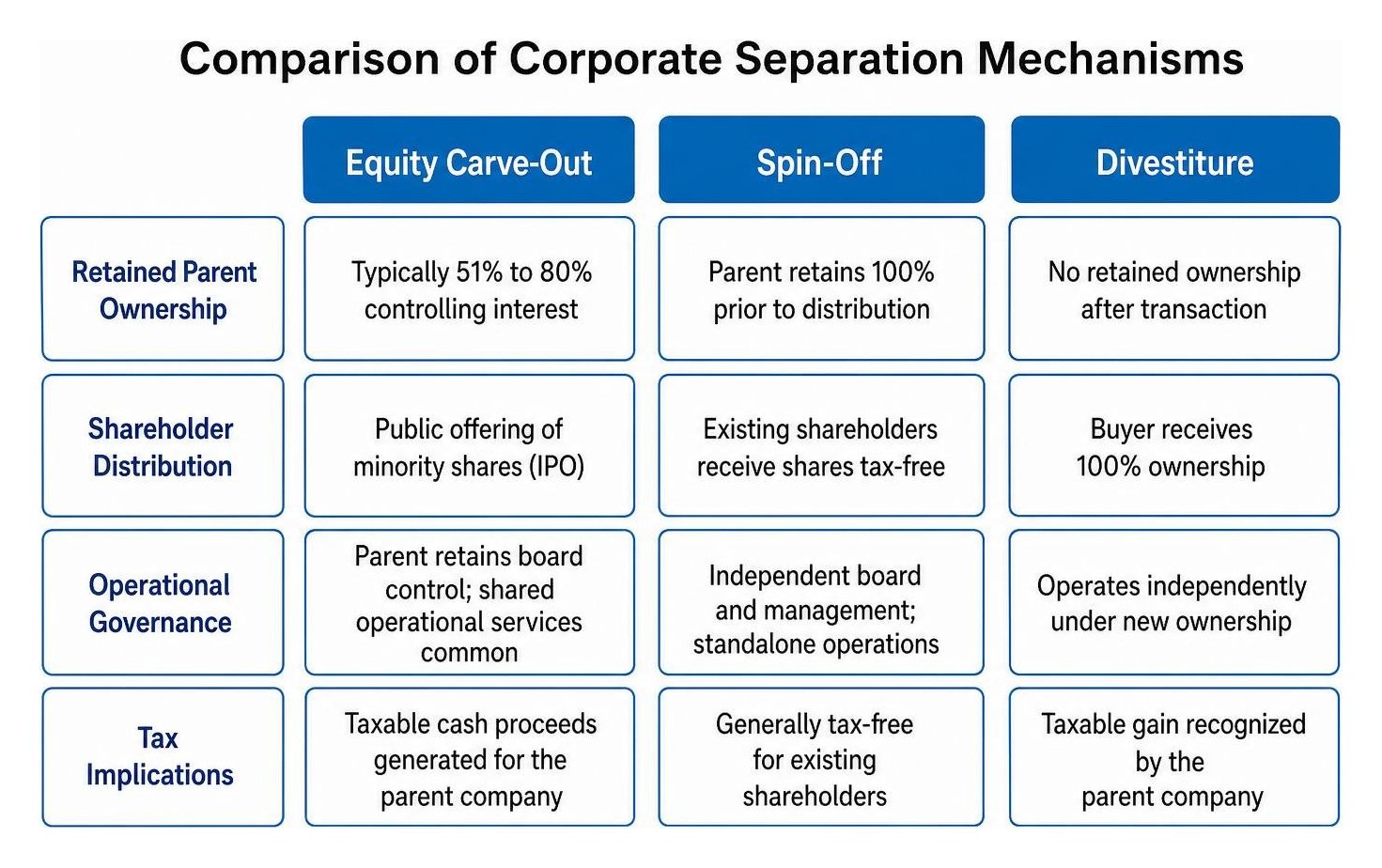
Understanding these operational nuances is essential for effective transaction design, as detailed in comprehensive M&A separation strategy analysis:
| Separation Mechanism | Retained Parent Ownership | Shareholder Distribution | Operational Governance | Tax Implications |
|---|---|---|---|---|
| Equity Carve-Out | Typically 51% to 80% controlling interest | Public offering of minority shares (IPO) | Parent retains board control; shared operational services common | Taxable cash proceeds generated for the parent company |
| Spin-Off | 0% (or minor temporary non-voting stake) | 100% proportional stock distribution to current shareholders | Fully independent board and autonomous leadership | Generally structured as a tax-free corporate distribution |
| Outright Divestiture | 0% (complete asset or entity transfer) | None (parent receives direct cash or equity from buyer) | Transferred entirely to strategic or private equity acquirer | Capital gains tax applied to net proceeds |
How Do Real-World Splits Like Ben & Jerry’s and Lipton Handle Independence?
Global enterprise restructuring showcases both the strategic opportunities and operational challenges of brand divorces.
- Ben & Jerry’s: Acquired under an agreement preserving an independent board to safeguard its activist roots, ongoing tensions between corporate governance and brand advocacy led founders to publicly voice concerns over muted social missions. This tension is detailed in coverage of Ben & Jerry’s social mission challenges under Unilever.
- Lipton Teas and Infusions: Operating across more than 100 countries with a £2 billion turnover, Lipton’s full operational separation required a two-hundred-person cross-functional transition team across four continents to replace legacy infrastructure inside a strict two-year transitional services window, documented in the PwC consulting case study on Lipton's 100-country carve-out.
- Kwality Wall’s: The National Company Law Tribunal approved the demerger of Hindustan Unilever's ice cream business into Kwality Wall’s (India) Limited using a 1:1 share entitlement ratio, as analyzed in the NCLT approval of HUL Kwality Wall’s demerger.
How to Execute and Measure an Independent Brand Entity Separation
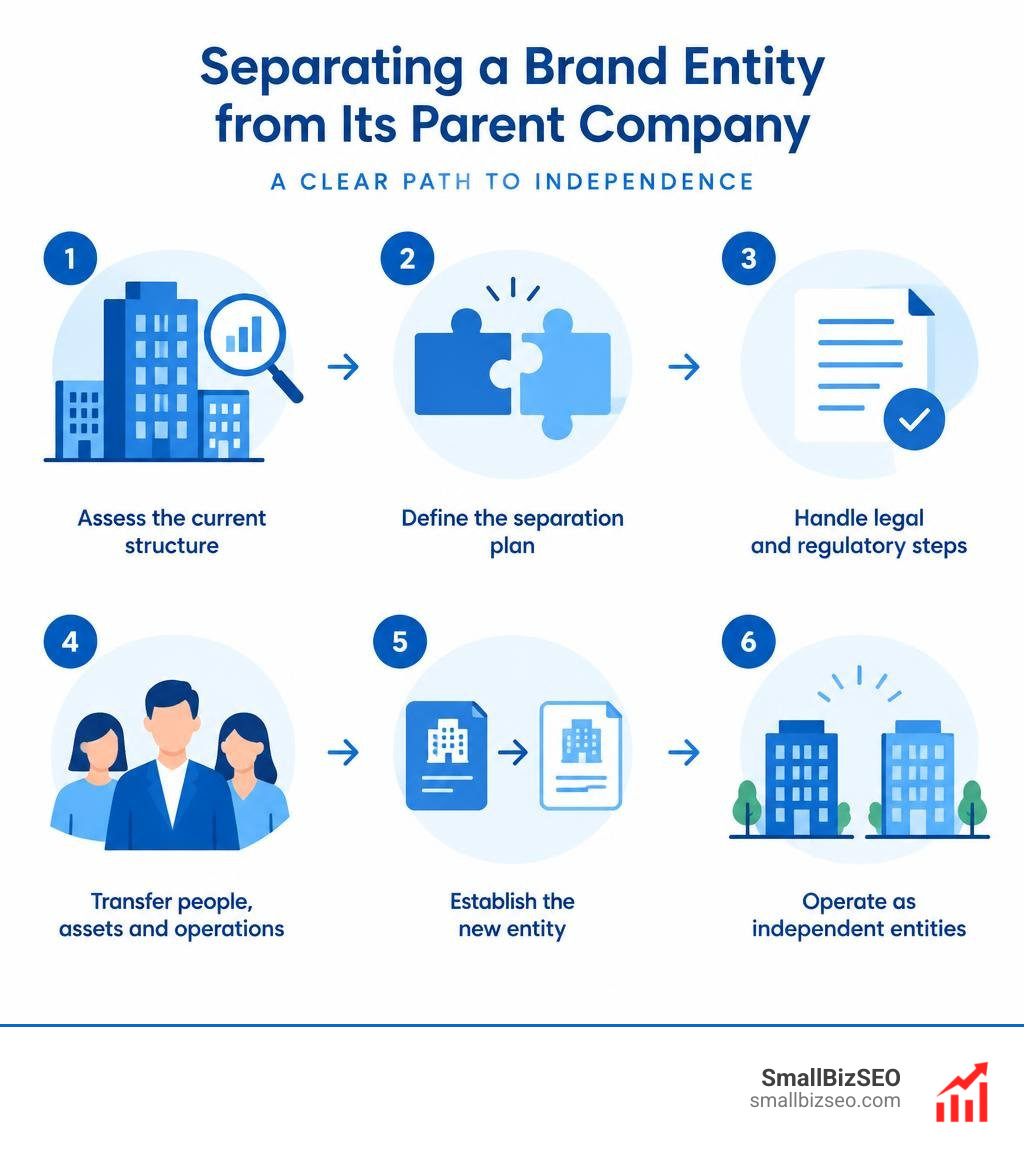
Executing an operational divorce requires untangling shared systems, novating third-party contracts, migrating digital assets, and establishing clear performance baselines for the independent business.
What Are the Operational Steps for Separating a Brand Entity from Its Parent Company?
The operational separation process follows five distinct phases:
- Target Operating Model Design: Define the standalone organization's staffing, software architecture, supply chain footprint, and reporting hierarchies.
- Transitional Service Agreements (TSAs): Execute legally binding contracts where the parent provides temporary back-office support (payroll, enterprise resource planning, IT hosting) for twelve to twenty-four months while the new company builds independent capacity.
- Intellectual Property and Trademark Novation: Formally assign all registered trademarks, domain names, proprietary technology, and commercial licensing rights to the new corporate entity.
- Contract and Supplier Separation: Re-negotiate vendor agreements, customer master service agreements, and channel distributor terms to remove parent guarantees.
- Digital Identity and Entity Establishment: Build the new legal and digital baseline needed when establishing a distinct brand entity across web registries, search directories, and legal filings.
How Do You Protect Brand Equity and Search Visibility After the Split?
Separating digital ecosystems risks major visibility loss if search engines conflate the standalone brand with its former parent or mishandle migrated website properties.
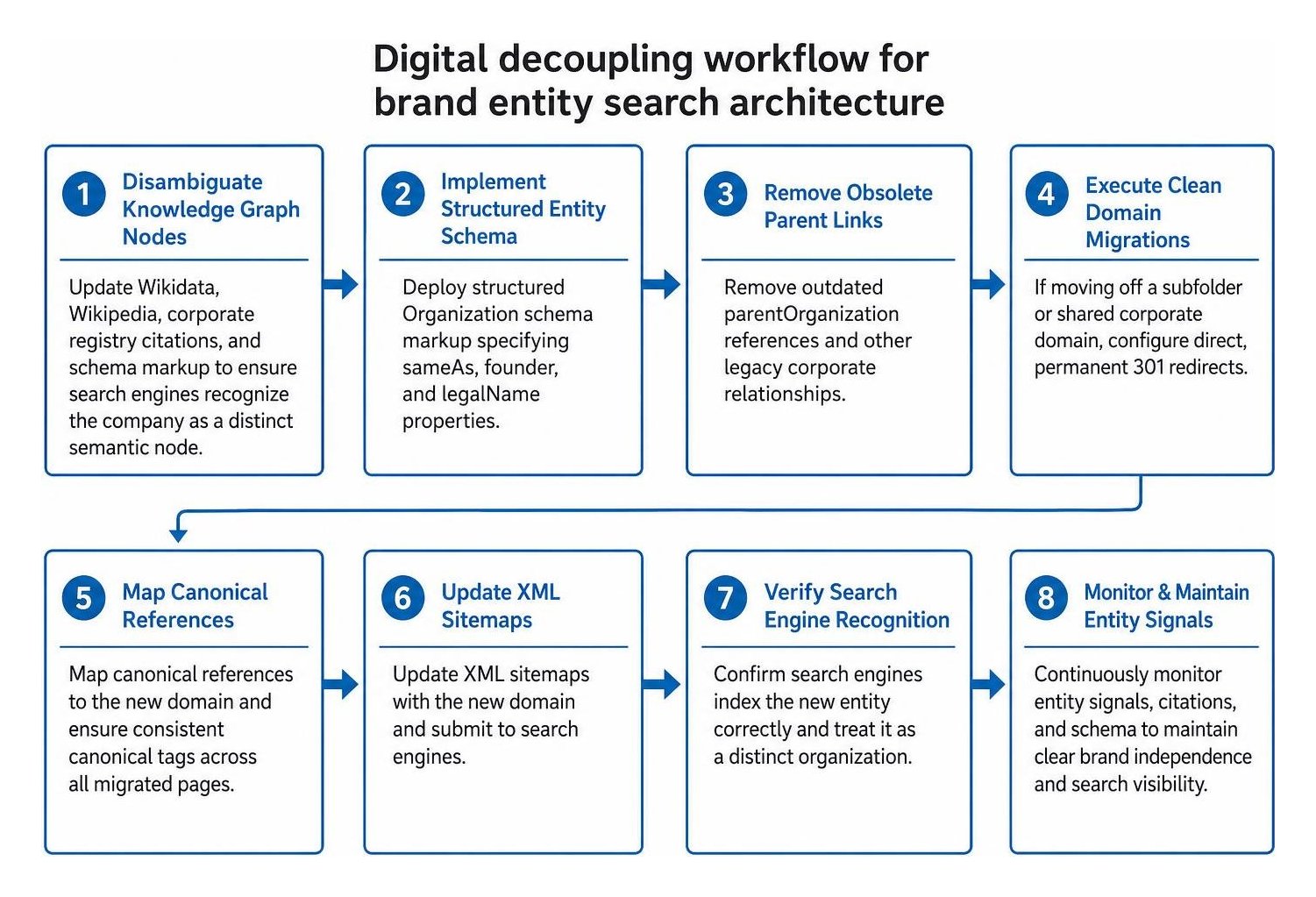
To preserve organic equity and digital relevance:
- Disambiguate Knowledge Graph Nodes: Update Wikidata, Wikipedia, corporate registry citations, and schema markup to ensure search engines recognize the company as a distinct semantic node.
- Implement Structured Entity Schema: Deploy structured
Organizationschema markup specifyingsameAs,founder, andlegalNameproperties while removing obsoleteparentOrganizationreferences through systematic execution of entity SEO. - Execute Clean Domain Migrations: If moving off a subfolder or shared corporate domain, configure direct, permanent 301 redirects, map canonical references, and update XML sitemaps to prevent indexing confusion.
- Track Market Interest: Actively measure shifts by monitoring branded search demand across primary market territories.
- Control Standalone Search Results: Secure all official knowledge panels, sitelinks, executive profiles, and review assets when optimizing the standalone Brand SERP.
How Do You Measure the Health of the Newly Separated Subsidiary?
Measuring a newly independent brand requires dedicated metrics that reflect market vitality rather than consolidated parent reporting.
Key diagnostic indicators include:
- Isolated Customer Acquisition Cost (CAC): Evaluate direct acquisition costs without parent-subsidized brand lift or cross-promotional channels.
- Direct Brand Visibility: Audit presence across organic search, industry citations, and category keywords by tracking brand visibility metrics.
- Query Trend Analysis: Protect analytical accuracy from indexation swings and migration anomalies by analyzing branded query fluctuations inside search reporting tools.
- Standalone NPS and Customer Retention: Track sentiment directly within target customer segments to verify that operational independence has not disrupted service delivery.
Securing Long-Term Independence and Search Authority
Successfully separating a brand entity from its parent company requires methodical execution across corporate governance, operational workflows, and digital identity management. By replacing shared enterprise infrastructure with robust standalone systems and clarifying your distinct brand footprint for both users and search engines, your newly independent organization can establish lasting market authority.
Explore how our data-driven Velocity framework supports corporate restructurings, digital asset migrations, and technical search transitions through our specialized SmallBizSEO Brand Entity Optimization Services.