The Ultimate Guide to Google Visibility Score
The Ultimate Guide to Google Visibility Score
Understanding the Google Visibility Score
A google visibility score measures your total organic reach and search footprint across a designated set of keywords. Instead of looking at a single keyword in isolation, this metric aggregates your presence across search engine result pages (SERPs) to show your site's overall click potential and real-world market presence.
Think of it like evaluating a physical retail store. If you only track one keyword, it is like counting how many people look through one specific display window. A google visibility score measures how many people see your entire storefront across every digital avenue, providing a holistic evaluation of your online brand footprint.
How the Google Visibility Score Is Calculated
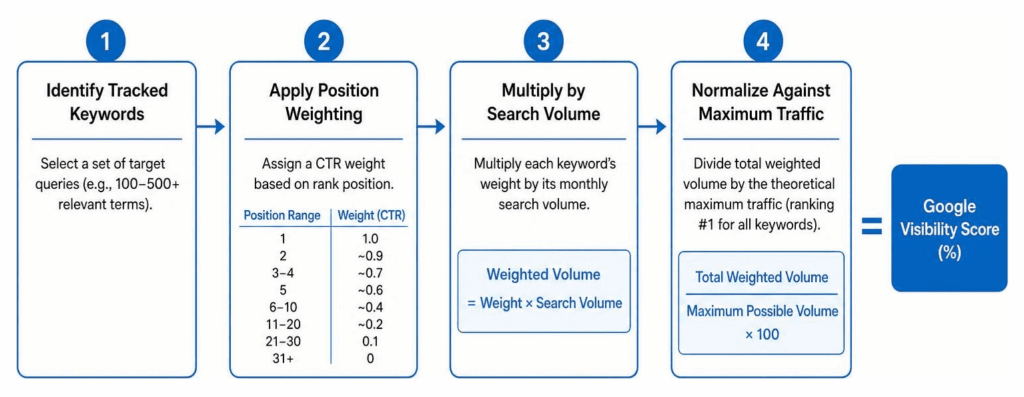
While Google does not publish an official native visibility score in Google Search Console, third-party rank trackers and analytics platforms derive this metric using a proven mathematical framework that accounts for keyword positions, click behavior, and search volumes:
- Identify Tracked Keywords: A tailored set of target queries is established for your domain (typically 100 to 500+ relevant high-intent terms).
- Apply Position Weighting: Each rank position is assigned an estimated Click-Through Rate (CTR) factor based on user click patterns. For instance, position 1 receives a 1.0 weight (roughly 28–32% CTR), position 2 drops to ~0.9, position 5 receives ~0.6, and positions 21–30 receive 0.1. Positions outside the top 30 generally carry zero weight.
- Multiply by Search Volume: Each keyword's weighted factor is multiplied by its average monthly search volume to reflect actual user demand.
- Normalize Against Maximum Traffic: The final aggregated score is calculated by dividing your total weighted volume by the theoretical maximum traffic you would receive if you held rank #1 for every single keyword in your tracking set.
Understanding how these elements interact helps webmasters prioritize their optimization strategy. A ranking improvement on a high-volume head keyword moves the needle far more than a similar bump on a low-volume phrase, making volume-weighted calculations essential for realistic performance assessment.
Merchant platforms and e-commerce brands also utilize specialized APIs like Google Shopping visibility data to monitor competitive impression trends across product categories and merchant listings.
| Feature | Google Visibility Score | Simple SEO Ranking |
|---|---|---|
| Scope | Whole keyword portfolio | Single query |
| Search Volume Weighted | Yes | No |
| Position-CTR Sensitivity | Exponential decay (Top 3 heavily weighted) | Linear scale (1 to 100) |
| Business Impact Focus | High (estimates overall organic reach) | Low (ignores query volume) |
Visibility Score vs. SEO Ranking vs. Share of Voice
It is easy to mix up these performance metrics, but they serve distinct strategic purposes in modern search engine optimization:
- SEO Ranking: Simple positional tracking for a specific query. Ranking #1 for a hyper-niche term with 10 monthly searches yields high individual rankings but near-zero visibility value.
- Share of Voice (SoV): Measures your market impression share compared directly against key industry competitors for a defined query pool.
- Google Visibility Score: A weighted average calculating your total potential organic traffic footprint relative to market limits. Learning how to boost your search engine visibility score without selling your soul comes down to systematically expanding this footprint across relevant topics and user intent categories.
Measuring and Benchmarking Search Visibility
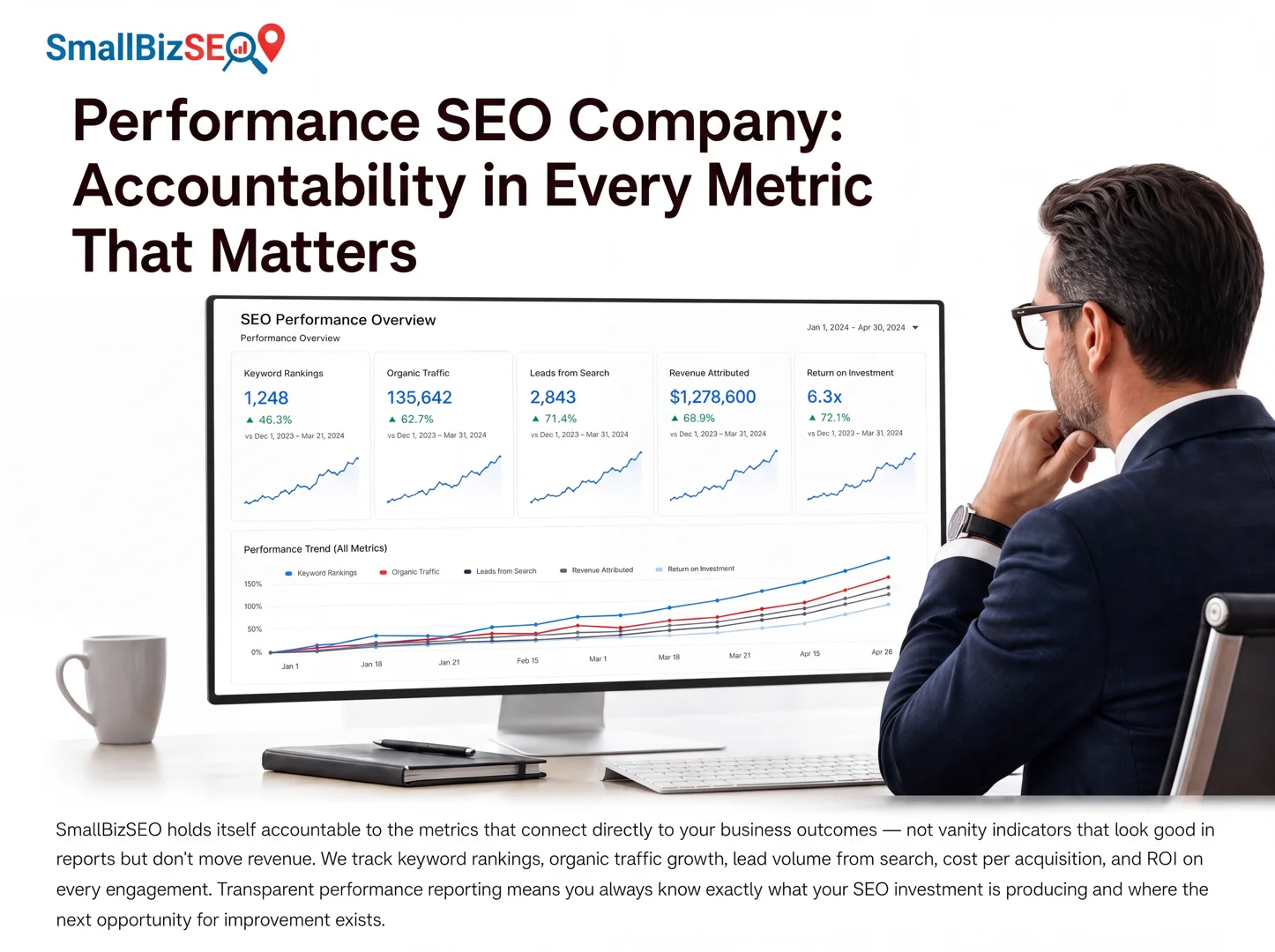
Tracking your google visibility score gives you an unbiased baseline to evaluate strategic content updates, technical migrations, and algorithm shifts over time.
Top Tools to Check Your Google Visibility Score
Different software applications calculate visibility slightly differently based on their internal keyword databases, update frequencies, and CTR models:
- Google Search Console: While GSC lacks a consolidated percentage metric, tracking total impression trends filtered by exact queries provides the purest raw metric of search exposure and brand reach.
- SISTRIX Visibility Index: A long-standing industry standard that calculates domain visibility independent of seasonal traffic fluctuations across standardized keyword sets.
- Semrush & SE Ranking: Comprehensive position tracking suites that assign percentage visibility scores based on rank distribution across top-30 positions. Performing a regular SEO analysis for better rankings helps pinpoint exactly which keyword buckets are dragging down your overall domain score.
Benchmarks: What Is a Good Score?
A "good" score depends heavily on your industry vertical, market competition, and tracking scope. Tracking a small set of 20 highly specific branded terms will produce an artificially inflated score, whereas tracking 2,000 broad industry terms yields lower overall percentages:
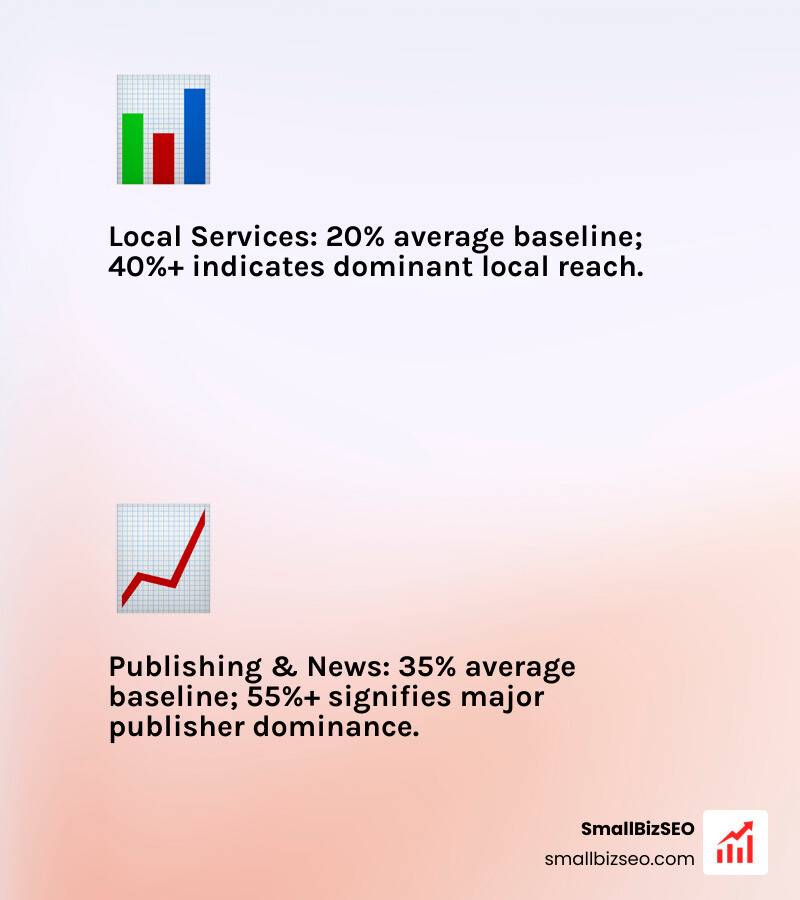
- Local Services: 20% average baseline (40%+ indicates dominant local reach across targeted service keywords)
- Niche E-Commerce: 15% average baseline (30%+ represents top market share in product search)
- B2B SaaS / Professional Services: 12% average baseline (25%+ represents strong topical authority and brand presence)
- Publishing & News: 35% average baseline (55%+ signifies major publisher dominance across informational search queries)
How AI Overviews Impact Search Real Estate
Generative search features like AI Overviews, rich snippets, and Knowledge Panels have transformed modern search engine result pages (SERPs). AI Overviews typically cite 3 to 5 primary sources at the very top of the SERP, absorbing direct clicks before a user ever scrolls down to traditional organic blue links.
If your content ranks #2 organically but is completely omitted from the AI Overview citation box, your practical visibility score suffers in real-world organic click-throughs. Furthermore, Google uses complex internal entity metrics—such as the leaked person visibility signal—to evaluate recognized brand entities, authors, and authority figures when populating Knowledge Panels and generative summaries.
Because AI Overviews curate answers directly from authoritative sources, gaining inclusion in these AI summary boxes can significantly expand your overall impression footprint. Sites that optimize for concise, factual definitions and clear structured data are best positioned to maintain high visibility in this changing SERP landscape.
How to Improve Your Search Visibility Score
Improving your google visibility score requires systematic optimization and strategic intent targeting rather than random guesswork.
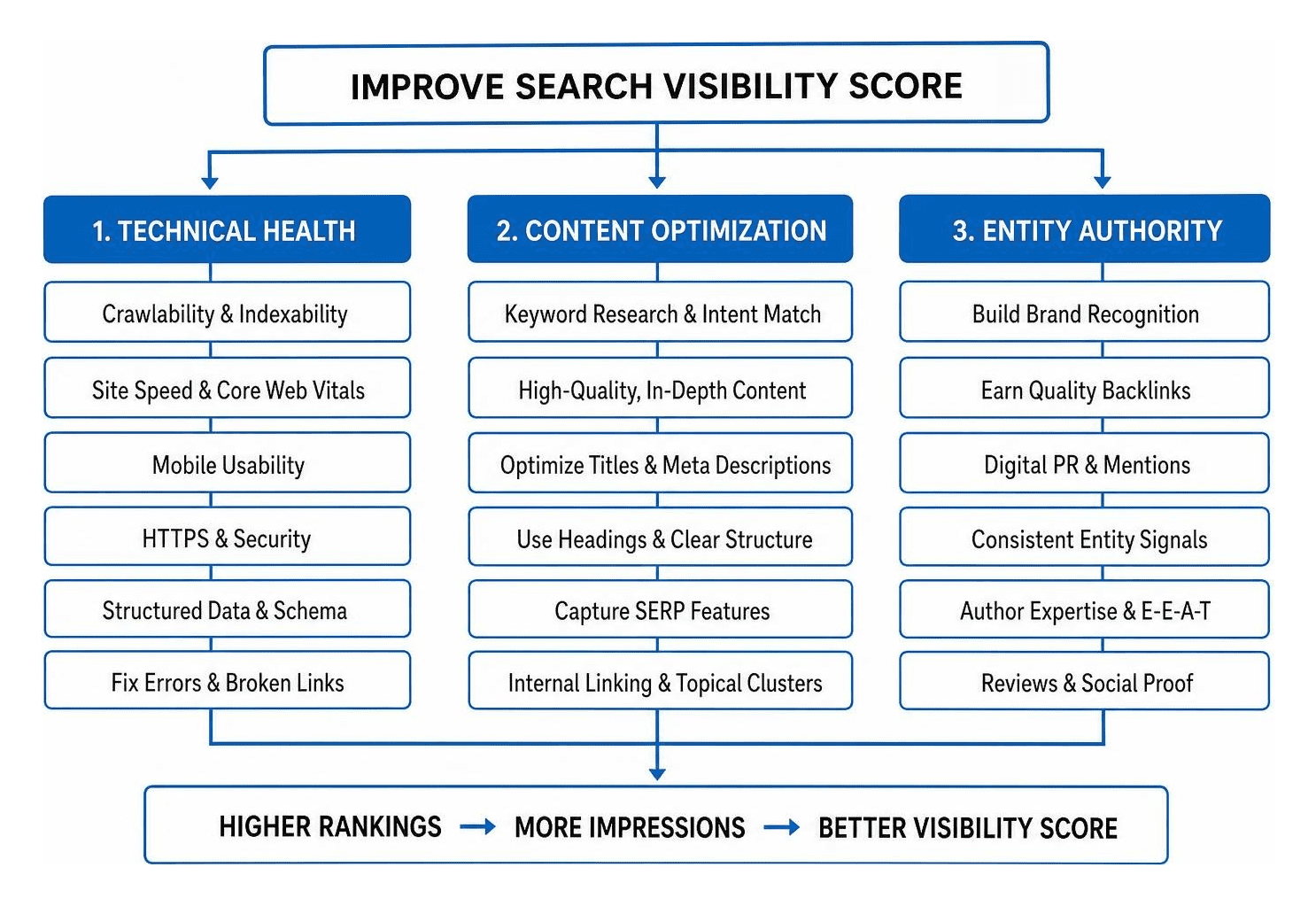
- Target Keywords in Positions 6–15: Moving a query from position 12 to position 4 delivers an exponential boost to your overall visibility score compared to moving a term from position 3 to position 2 due to steep CTR curve dynamics.
- Eliminate Keyword Coverage Gaps: Identify target terms your direct competitors rank for that your domain completely lacks content for, and create dedicated landing pages to capture that traffic.
- Capture SERP Features: Structure answers with bulleted lists, clear tables, and concise 40–60 word definitions to secure featured snippets and AI Overview citations that dominate above-the-fold space.
Optimizing Content and E-E-A-T Signals
Topical authority is the primary engine behind sustained visibility growth. To establish trust with search engines and improve domain-wide rankings:
- Publish original content backed by real-world expertise, original research, and first-hand data.
- Implement structured schema markup (Organization, Article, FAQPage) to explicitly declare entities, relationships, and topics to search crawlers.
- Ensure your brand signals are consistent across external web profiles, media mentions, and industry directories.
- Follow a structured roadmap on how to optimize your content for E-E-A-T and build real search trust to boost search engine credibility.
Fixing Technical Indexing and Cannibalization
Technical debt creates silent visibility loss across growing websites. If search engine bots waste crawl budget on thin, redundant, or duplicate URLs, core revenue pages lose authority and index coverage:
- Prune and Consolidate: Merge multiple thin pages targeting similar user intents into single comprehensive resources. Consolidating four weak posts into one authoritative guide can raise domain visibility by 10 to 15 points without building a single new link.
- Resolve Keyword Cannibalization: Cannibalization occurs when multiple pages compete for the same keyword, diluting link equity and confusing search crawlers. Merging overlapping pages consolidates page equity into a stronger ranking candidate.
- Fix Crawl Blocks: Review your robots.txt file, meta robots headers, and canonical tags to ensure high-priority landing pages are fully indexable.
- Resolve Structural Errors: Review common site breakdowns using the ultimate guide to SEO audit errors to fix 404 redirects, broken internal links, and complex chain redirects.
Frequently Asked Questions About Search Visibility
How often should you measure search visibility?
We recommend tracking your visibility score on a weekly basis. Weekly tracking provides enough consistent data to spot sudden algorithmic updates or technical crawl drops without creating excessive daily reporting noise. Monthly reviews are ideal for evaluating broader strategic trends and long-term organic growth.
What are common mistakes when tracking visibility scores?
The most common mistake is relying on vanity keywords—tracking broad, high-volume terms that bring zero qualified leads or sales conversions to your business. Another frequent error is ignoring device segmentation; a site may hold a dominant visibility score on desktop search while suffering severe performance, layout, or speed issues on mobile devices.
Can you increase visibility without new backlinks?
Yes! You can achieve massive visibility growth simply by resolving internal keyword cannibalization, improving internal link structure, capturing featured snippets, and writing comprehensive content to fill obvious keyword coverage gaps.
Strategic Growth Through Complete Search Presence
Your google visibility score is much more than a cosmetic metric—it serves as a reliable strategic compass for your entire SEO strategy. By tracking your overall search footprint rather than isolated keyword ranks, you gain a clear, accurate picture of your real market share and organic potential.
At SmallBizSEO, we utilize our proprietary Velocity framework to help small businesses audit technical bottlenecks, fill content coverage gaps, and capture prime search real estate. Ready to discover where your organic search footprint truly stands? Request a comprehensive SEO visibility audit today.