How to Evaluate SEO and Answer Engine Optimization Services

What Should You Expect From SEO and Answer Engine Optimization Services?
An SEO service should make a website easier to crawl, understand, use, and evaluate. A sound proposal describes the pages or systems it will review, the changes it may recommend, who approves them, and how completed work will be documented.
SEO, answer engine optimization (AEO), and generative engine optimization (GEO) are overlapping marketing terms, not distinct universal technical standards. A provider can improve the quality, accuracy, and accessibility of information on a site, but cannot control whether an AI product represents, cites, or links to that site.
Start by separating promised work from hoped-for outcomes. A useful proposal explains the problems being addressed, the evidence behind the diagnosis, and the limits of what the provider can influence.
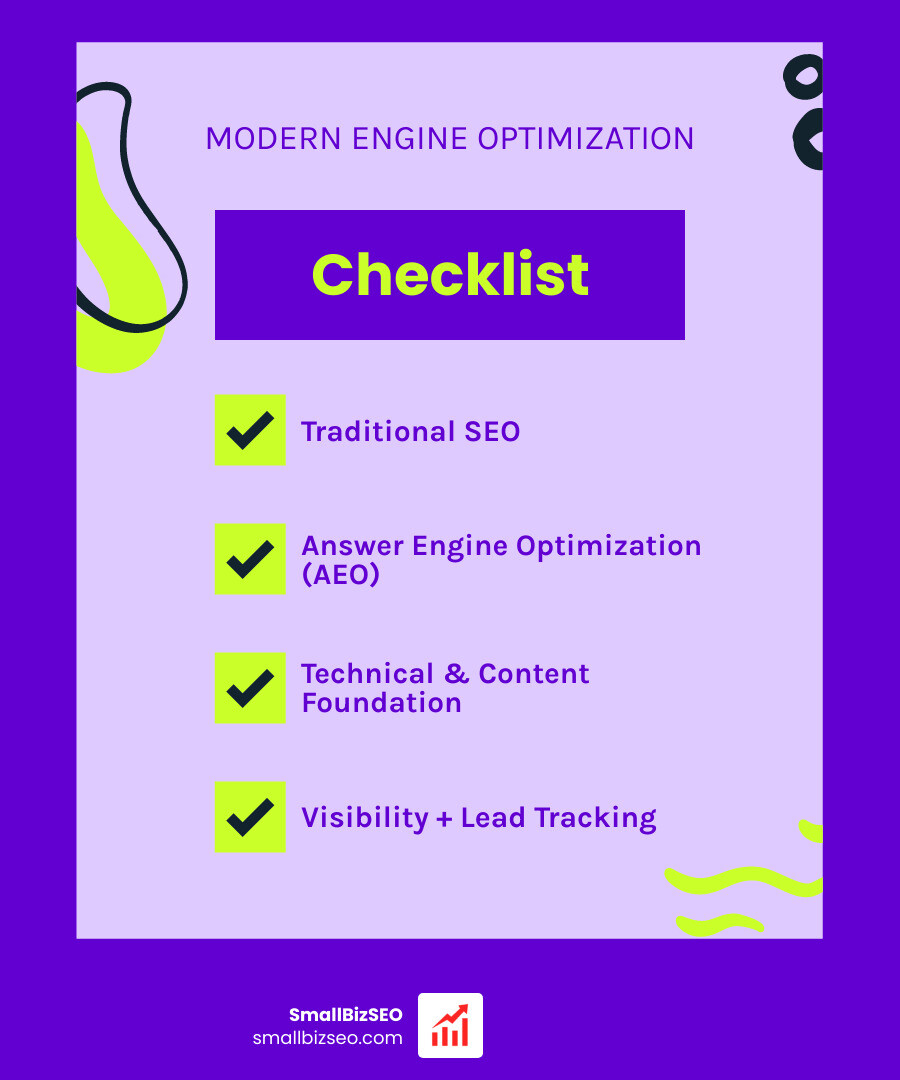
Use plain-language definitions for answer engine optimization (AEO), and ask prospective providers to connect each recommendation to a specific page, system, or customer question. That makes it easier to compare SEO and AEO proposals and prioritize recurring customer questions without treating labels such as SEO, AEO, or GEO as guarantees.
Compare the Work, Evidence, and Limits Behind Each Proposal
A strong evaluation looks past broad claims about search or AI visibility. Ask what is being examined, what will change, whose approval is needed, and what evidence will show that the work was completed. Clear scope is more useful than a promise of rankings, citations, or inclusion in an AI answer.

For Google Search, Google's guidance on AI features says ordinary SEO fundamentals remain relevant to AI Overviews and AI Mode. Google does not require special schema or an AI text file. A page must be indexed and eligible to show a snippet to be eligible as a supporting link, but eligibility does not guarantee selection. Google reports this traffic within the overall Web view in Search Console rather than in a dedicated AI report. Those points describe Google's products only; other platforms may operate differently.
| Customer problem | Exact work | Page or system scope | Owner | Evidence or deliverable | Acceptance check | Exclusions | Reporting method |
|---|---|---|---|---|---|---|---|
| Crawl-access diagnosis | Review crawl blocks, indexability signals, and key technical errors | Named templates and priority URLs | Provider identifies issues; site team approves changes | Issue log with affected URLs and rationale | Agreed fixes are documented as implemented, deferred, or declined | No promise that every page will be crawled or ranked | Before-and-after issue log and Search Console review |
| Content fact and intent review | Check whether priority pages answer customer questions accurately and clearly | Named service pages and supporting content | Subject-matter owner validates facts | Page recommendations with sources or reviewer notes | Approved edits are published or logged as pending | No invented claims or forced keyword repetition | Change log and page-level review |
| Internal navigation | Improve links, labels, and paths to important information | Navigation, hubs, and related pages | Provider proposes; site team approves | Link map or annotated recommendations | Priority links are live and testable | No guarantee of a ranking outcome | Implementation log and crawl review |
| Appropriate, accurate markup | Review markup that matches visible facts and a supported use case | Eligible page types only | Provider drafts; site team validates facts | Markup recommendation and validation notes | Markup matches reader-visible content | No blanket schema recipe or guaranteed attribution | Validation record and page notes |
| Measured visibility sample | Test a defined set of queries or prompts and review search data | Fixed sample and documented conditions | Provider records; site team reviews | Repeatable measurement sheet | Method, observations, and limits are recorded | No universal census of AI results | Trend notes alongside site analytics |
What Makes a Proposal Credible?
Credible proposals distinguish between a diagnosis, a recommended change, and an outcome that may or may not follow. They identify the evidence behind each claim, name the pages or systems involved, and explain what the provider will deliver for review.
Concise, answer-first copy can help a reader when it directly addresses a real question, but it is not a mandatory format. In AEO work, the right structure depends on the page, the evidence available, and what the customer needs to understand.
Likewise, markup should reflect visible facts and an actual supported use case. AI-focused SEO work can clarify information for search systems, but it does not prove credentials or ensure that a platform will attribute a result to a particular business.
How Should Brand Information and Off-Site Signals Be Handled?
A responsible provider helps maintain accurate business information, corrects mistakes, and identifies sources that need review. That work supports trust for customers and search systems without manufacturing consensus or treating third-party mentions as a controllable ranking lever.
Practical work may include:
- Reviewing public facts on priority pages and profiles for accuracy.
- Identifying conflicting business details that need correction by the responsible owner.
- Improving helpful on-site explanations where customers repeatedly need clarification.
- Documenting legitimate outreach or editorial opportunities without buying ranking links or manipulating reviews.
What Should the Content and Markup Plan Include?
Ask for a page-by-page plan that explains the customer question, the supporting evidence, the proposed copy or navigation change, and the person who will approve it. A direct answer near the relevant question can be useful when it improves comprehension, but the page should not be forced into a formula that weakens accuracy or usability.
For markup, request a clear explanation of the supported feature, the visible information it represents, and the validation method. Evidence and trust signals should be accurate and reviewable. If the facts are incomplete or the feature does not fit the page, leaving markup unchanged can be the more accurate choice.
Build a Scoped Work Plan and Measure What Happened
An effective engagement starts with a scoped work plan rather than a fixed timeline. The plan should identify the baseline, priorities, dependencies, named owners, proposed changes, approval steps, test or rollback needs, a completed-work log, and when later measurement will occur.
A practical work plan can include:
- A baseline of the pages, technical issues, and tracking limitations being reviewed.
- A prioritized list of changes with the evidence supporting each recommendation.
- Named owners for content facts, technical implementation, approvals, and publication.
- Test and rollback steps for changes that could affect rendering, tracking, or access.
- A completed-work log that separates implemented, deferred, and rejected recommendations.
- A later measurement plan that explains what can be observed and what cannot be attributed with certainty.
How Can You Compare Two Providers?
Consider a hypothetical comparison. Provider A promises AI citations and special markup. Provider B identifies the service pages to review, the evidence issues to resolve, the technical checks to perform, the owners who must approve changes, and the measures it will record. Provider B is easier to evaluate because its scope and evidence are clear, not because it can claim a particular result.
Before signing, ask about account and content ownership, the access the provider needs, the evidence behind case claims and any competitor-visibility comparisons, subcontracting, cancellation and handback, excluded costs, who can publish changes, and what success means. This is a practical evaluation list, not legal advice or a statement of any provider's contract terms.
What Metrics Can Be Interpreted Responsibly?
Measurement should separate observations from business outcomes. A sampled review of AI mentions or citations needs a fixed prompt set, documented model and location conditions, repeated checks, and an explanation that results can vary. It is not a universal census of AI answers.
Referral visits can be reviewed in analytics, but attribution may be incomplete. Qualified inquiries and actual outcomes need validated tracking and a clear definition of what counts. A mention is not the same as a visit, conversion, or return on investment, and timing alone does not prove causation.
Choose a Provider Who Makes the Work Inspectable
The most useful SEO and AEO proposals make their assumptions, scope, evidence, ownership, and limitations visible. They help you decide what will be changed and how the work will be checked, without presenting AI citations or rankings as guaranteed deliverables.
If you want to discuss an evidence-based scope for search and answer visibility, review SmallBizSEO's AEO services or book a scope discussion. Start with the pages, customer questions, and measurement limits that matter most to your business.