Are Paid Website Audits Worth the Money for Mid-Sized Brands?

Are Paid Website Audits Worth the Money for Mid-Sized Brands?
Which SEO Auditing Companies Can Fix Crawling and Indexing Problems?
Start with the problem your site has, not a generic agency ranking. For deep crawling and indexing issues, compare technical SEO specialists such as 410 Gone in France, Screaming Frog in the UK, and iPullRank in the US. Ask each one how it will find blocked pages, test what search engines can see, and confirm that its fixes worked. If you run an ecommerce site, add OuterBox to your shortlist.
A useful audit should end with specific fixes your team can make, not just a long list of errors. The sections below compare providers and show what to ask before you hire one.
I'm Clayton Johnson, founder of SmallBizSEO. My work connects SEO, content, and search visibility for small businesses; here, I'll help you evaluate SEO auditing companies by the quality of their findings and the clarity of their action plans.
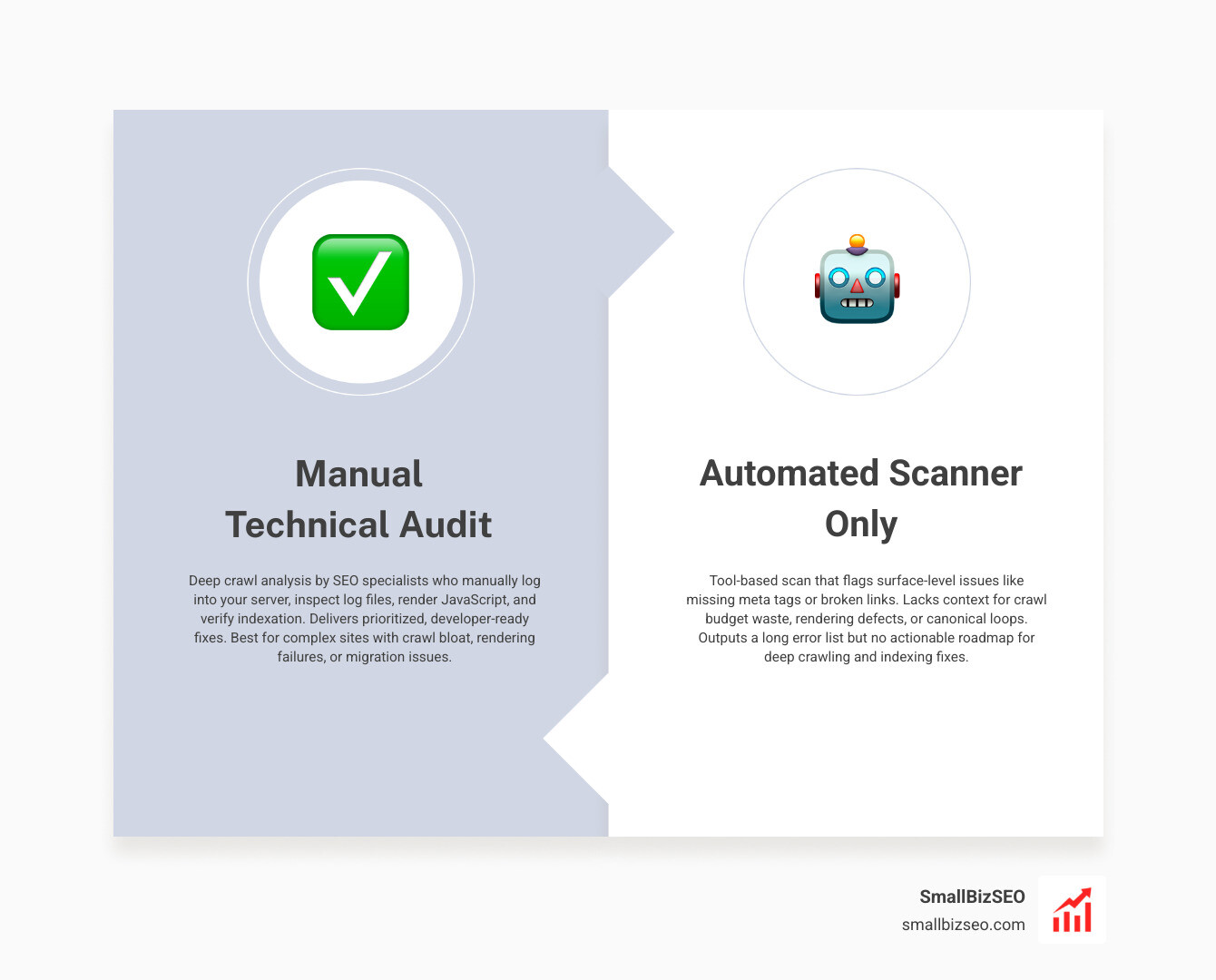
Quick SEO auditing companies definitions:
Introduction: How Can You Solve Deep Crawlability and Indexation Errors?
Direct Answer: You solve deep crawlability and indexation errors by identifying technical barriers in your server configurations, fixing code and directive conflicts, and verifying that search engine bots can fetch, render, and index your critical pages.
When search engines attempt to crawl complex websites, they frequently encounter severe bottlenecks:
- Crawl budget waste: Bots consume their finite request allowance on auto-generated parameters or duplicate search query pages rather than core money pages.
- Indexation traps: Orphan pages, infinite calendar loops, and rogue
noindexdirectives hide valuable content. - JavaScript rendering failures: Client-side frameworks deliver blank HTML shells that bots cannot process during the initial crawl pass.
- Canonical loops and redirect chains: Circular reference loops drain server resources and dilute internal PageRank distribution.
- Unaddressed technical debt: Lingering legacy server response codes (5xx internal server errors, broken 4xx endpoints) prevent consistent crawling.
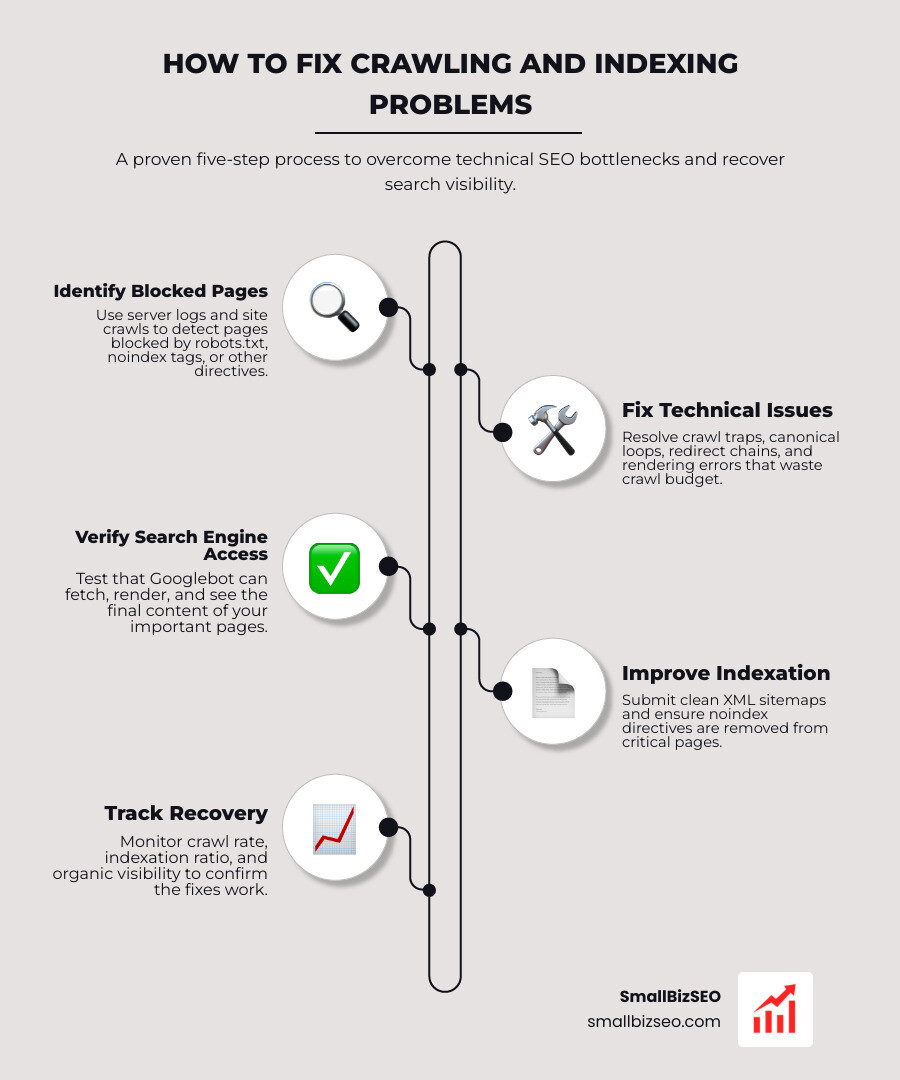
Solving these technical bottlenecks requires methodical isolation of server configurations, edge caching rules, and document rendering pipelines.
Why Hire Specialized SEO Auditing Companies to Resolve Technical Bottlenecks?
Direct Answer: Specialized SEO auditing companies uncover hidden rendering failures, crawl traps, and server configurations that standard automated crawlers miss by combining custom log file inspection with manual architectural reviews.
Automated scanners provide a baseline overview, but they treat every URL identically. They cannot easily distinguish between intentional faceted navigation and an uncontrolled crawl trap generating millions of thin parameter URLs. In contrast, experienced technical teams understand how to prevent site-breaking technical SEO audit errors before minor configuration drift turns into catastrophic traffic loss.
Specialized firms analyze server log files directly to see how search engines interact with your infrastructure in real time. They trace crawl bloat back to its source, optimize Googlebot resource allocation, and ensure that every crawl request targets a page capable of generating commercial revenue.
What Core Technical Capabilities Distinguish Top SEO Auditing Companies?
Direct Answer: Top technical auditing agencies stand out through advanced server-side diagnostics, granular canonicalization resolution, custom directive controls, and deep structured data validation.
A standard checkup merely verifies that title tags exist. An enterprise-grade diagnostic evaluates the entire technical stack:
- Server-Side Diagnostics: Auditing edge routing, CDN headers, TTFB (Time to First Byte), and server response codes under high crawl concurrency.
- Directive Integrity: Checking
robots.txtrules andX-Robots-TagHTTP headers to prevent accidental indexing blockades. - Sitemap and Canonical Hygiene: Resolving non-200 URLs in XML sitemaps and aligning canonical references to pass Google-compliant SEO analysis audits.
- Comprehensive Structure Analysis: Pairing on-page audits with an onsite and off-page SEO analysis checklist to verify schema implementation and internal PageRank flow.
How Do Leading SEO Auditing Companies Diagnose Crawl Budget and Rendering Defects?
Direct Answer: Leading auditors diagnose rendering and crawl waste by comparing server access logs against front-end rendering outputs, pruning redirect chains, and isolating faceted search parameters.
When search bots request a URL, client-side rendering engines can fail silently, leaving valuable body copy and structured data unindexed. Leading specialists simulate search engine rendering environments alongside AI-driven technical SEO audits to verify that both traditional search engines and large language model crawlers extract complete document data.
By mapping server log requests against internal taxonomies, auditors spot redirect chains, broken pagination sequences, and faceted navigation bloat, isolating wasteful paths so crawlers spend their resources strictly on high-impact URLs.
How Do You Compare SEO Audit Agencies and Select the Right Partner?
Direct Answer: Compare SEO audit agencies by evaluating their technical depth, their ability to provide developer-ready execution roadmaps, and their past performance on complex site architectures.
Do not select an agency based solely on generic checklists. Review how prospective partners structure technical governance, handle code recommendations, and translate complex log file observations into prioritized business roadmaps. Industry benchmarks and technical service comparisons illustrate the wide variance in deliverable depth across providers.
| Provider Model | Typical Focus Areas | Deliverable Format | Turnaround Time | Best Fit For |
|---|---|---|---|---|
| Specialized Technical Firm | Log analysis, JS rendering, crawl bloat, architecture | Developer Jira tickets, priority matrix | 2 to 4 weeks | Large sites, complex frameworks, enterprise apps |
| Full-Service SEO Agency | Technical, content, backlinks, competitor gaps | Comprehensive slide decks, roadmaps | 3 to 6 weeks | Mid-market brands needing complete strategy overhauls |
| Automated Tool / Scanner | High-level errors, meta tags, basic broken links | Standardized PDF reports, raw exports | Instant to 72 hours | Small baseline checks, initial diagnostics |
Which Enterprise and Mid-Market Technical Audit Agencies Should You Compare?
Direct Answer: Compare agencies based on their experience with your specific technical challenges, whether that involves large-scale ecommerce, complex migrations, or international architectures.
Different agencies excel at different challenges:
- Large-Scale Architectures: Agencies like Botify, Screaming Frog, and OuterBox handle massive multi-million page ecommerce catalogs and complex faceted filtering.
- Migrations and Enterprise Governance: Teams like WebFX, Victorious, and Coalition Technologies provide structured workflows that integrate directly with developer ticketing backlogs.
- Holistic Search Visibility: Applying a structured search visibility audit methodology ensures technical fixes align with keyword targeting and content performance.
Should You Choose an Agency, a Consultant, or an Automated Scanner?
Direct Answer: Choose an automated scanner for quick surface checks, an independent consultant for hands-on personalized audits on smaller sites, or a specialized agency for complex architectures requiring cross-functional developer collaboration.
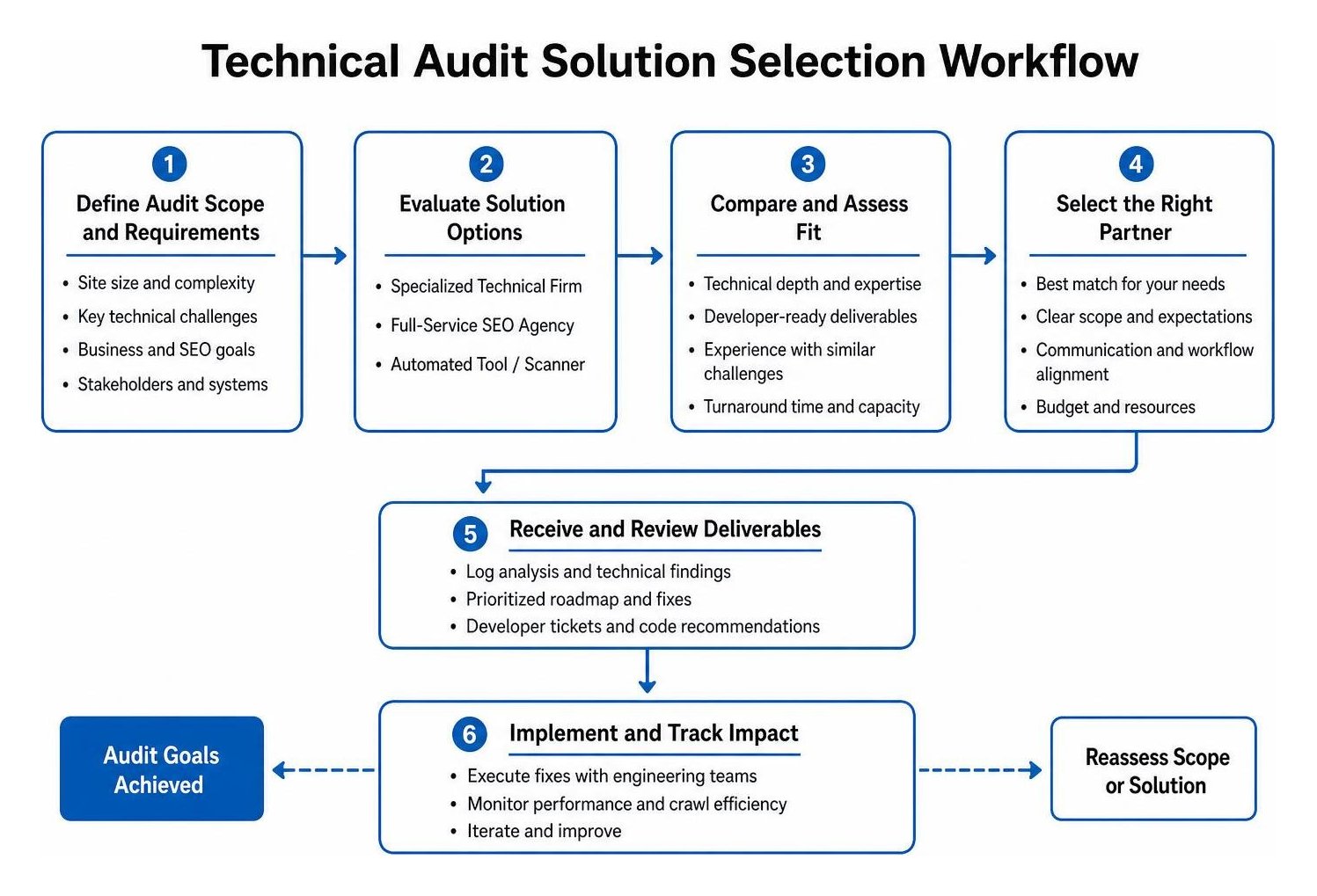
Automated scanners are helpful for broad diagnostics, but comparing paid SEO audits versus free tool scanners demonstrates that automated software cannot contextualize business logic. A raw 100-page scanner export dumps data without telling engineering teams what to fix first.
A dedicated agency or senior consultant translates crawl anomalies into ready-to-implement developer tickets complete with code snippets, drastically lowering the engineering hours required for execution.
How Much Do Audits Cost, What Do They Include, and How Long Do They Take?
Direct Answer: Professional technical SEO audits range from €1,000 to €5,000 for standard websites, while enterprise-scale deep audits range from $900 to over $30,000, taking anywhere from 48 hours for rapid assessments to 30 days for exhaustive analyses.
Audit pricing and timelines depend on total URL inventory and underlying complexity:
- Basic / Diagnostic Audits: $300 to $1,500. Quick 48- to 72-hour turnaround reviewing basic indexation, robots directives, and top-level errors.
- Comprehensive Full-Scope Audits: $1,500 to $7,500 (or €1,000 to €5,000). Typically delivered in 2 to 4 weeks, covering deep technical crawls, on-page architecture, log reviews, and competitor gap analyses.
- Enterprise & Migration Audits: $8,000 to $30,000+. Deep forensic reviews taking up to 30 days, incorporating white-label agency auditing, custom API scripting, database querying, and international multi-language verification.
How Do You Measure ROI and Remediate Critical Findings?
Direct Answer: Measure audit ROI by tracking the percentage of indexed valid URLs, crawl frequency increases on priority pages, and organic impression rebounds following technical remediation.
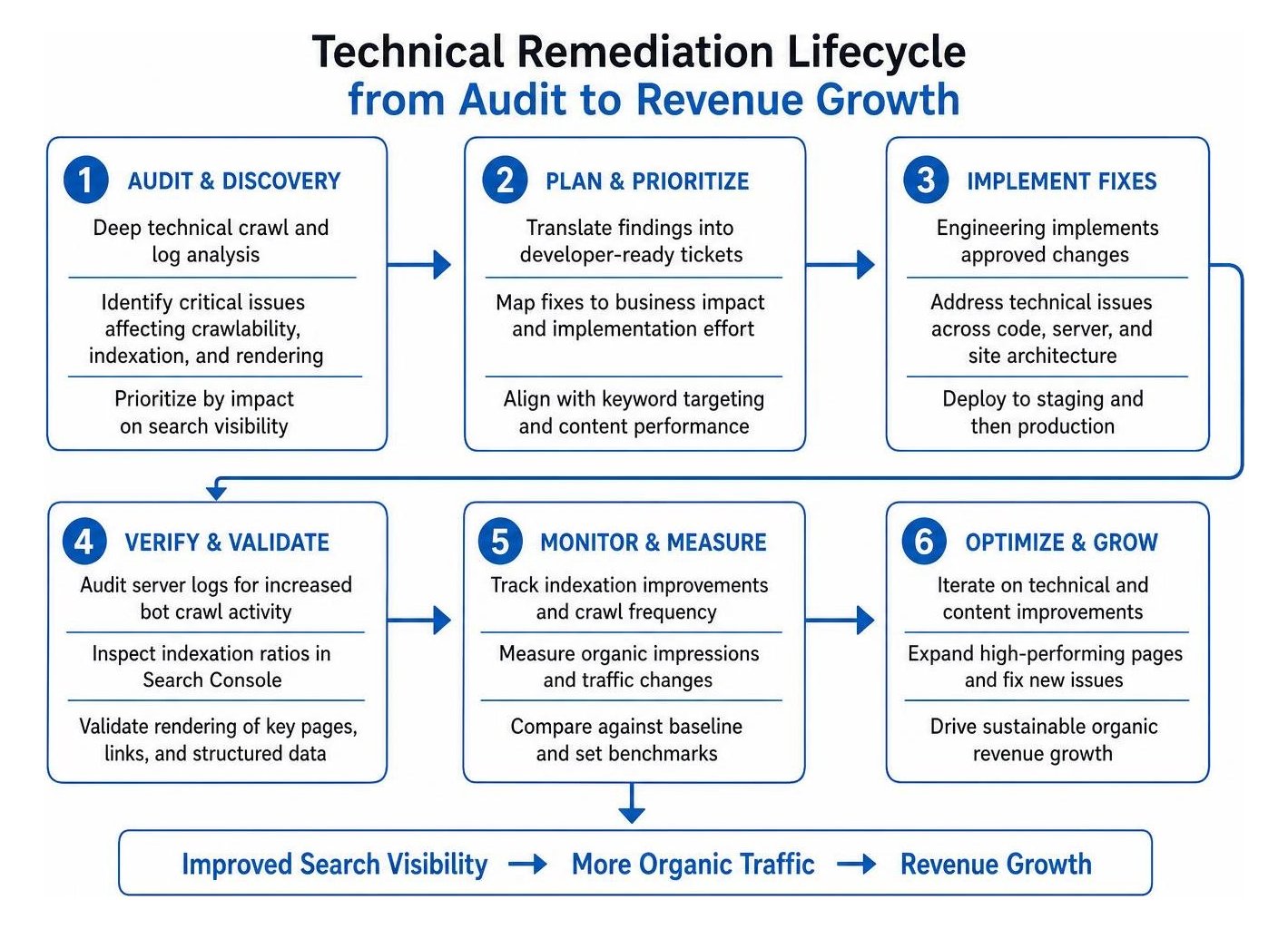
To ensure technical fixes yield lasting revenue growth, follow this clear verification sequence:
- Audit Server Logs: Confirm that search bots have increased crawl requests on previously ignored commercial directories.
- Inspect Indexation Ratios: Check Google Search Console to verify that valid pages move from "Discovered - currently not indexed" to indexed status.
- Validate Rendering: Test live URLs to ensure client-side code renders critical text, links, and structured schema cleanly.
- Track Impression Velocity: Monitor search impressions across optimized directories to catch positive ranking movements early.
- Establish Ongoing Monitoring: Schedule bi-annual health checks to prevent technical regression as developers deploy new website features.
At SmallBizSEO, we implement this process through our data-driven Velocity framework, delivering fast rankings and E-E-A-T-compliant growth through transparent, automated reporting. If your website is struggling with stubborn indexation plateaus or hidden technical errors, explore our SmallBizSEO comprehensive SEO visibility audit to identify your site's bottlenecks and build an actionable roadmap to organic search growth.
Action Plan: Fixing Your Technical Crawling and Indexation Debt
Direct Answer: Resolve indexation debt by triaging findings by impact, deploying code fixes to staging, and verifying that search engines can cleanly crawl and index your site's core revenue pages.
A technical SEO audit is only as valuable as the changes your team actually ships to production. If an audit report sits in your inbox as an unread PDF, crawl traps will continue draining your server resources and masking high-value pages from potential customers.
- Isolate Critical Blockers First: Address server-side errors, incorrect
noindexdirectives, and canonical mismatches before refining metadata or secondary elements. - Bridge the Developer Gap: Translate technical findings into structured engineering tasks with clear steps to reproduce and verify fixes.
- Monitor Crawl Logs Continuously: Watch server logs immediately following code deployments to confirm that search engine crawlers adapt to your new architecture.
By systematically diagnosing, prioritizing, and resolving deep crawling defects, you ensure that every valuable page on your site earns its place in search engine indexes and drives organic growth.