Turn Your About Page into a Clear Entity Signal for Search Engines
How Do You Build an Entity-Focused About Page?
Build an entity-focused About page by making the opening section answer four basic questions: who the business is, what it does, who it serves, and what evidence supports those claims. Present those facts in plain language, then reinforce them with consistent contact details, leadership information, relevant credentials, official profiles, and structured data that matches the visible page.
An effective About page still tells a human story, but it does more than describe a mission or repeat marketing language. It gives search engines, AI systems, and prospective customers a dependable reference point for the business. That reference point is often called an entity home: the primary page that explains the organization’s identity in one clear, verifiable place.
For SmallBizSEO, that means describing the company’s SEO, content strategy, and link-building services in specific terms, explaining the expertise behind the work, and linking visitors to supporting resources that validate those details. The goal is not to sound encyclopedic at the expense of personality. The goal is to make the important facts easy to find, understand, and confirm.
What Should an Entity-Focused About Page Include?
At a minimum, include the following elements:
- A direct identity statement: Name the business and its primary services in the first paragraph.
- A concise audience statement: Explain the types of customers or organizations the business serves.
- Verifiable proof: Add credentials, memberships, case-study evidence, media mentions, or authoritative profiles where they genuinely exist.
- Leadership and authorship details: Show who is responsible for the expertise presented on the site.
- Consistent business information: Use the same business name, website, service descriptions, and public profile links across the page and supporting channels.
- Matching schema markup: Use Organization or LocalBusiness structured data only for facts that readers can also see and verify on the page.
A useful test is simple: if a customer, journalist, or search system needed to confirm what the business is and why it is credible, could they do so from this page and the linked evidence? If the answer is no, the page needs clearer facts or stronger proof.
Why Building an Entity-Focused About Page Supports Search Visibility
An entity-focused About page supports search visibility by giving search engines a clear, consistent description of the organization behind the website. Search systems try to understand people, businesses, products, and topics as connected real-world entities. When a site presents vague or conflicting information, it becomes harder for those systems to connect the site with the right services, expertise, and supporting sources.
A strong entity home reduces that ambiguity. It does not guarantee a Knowledge Panel, rankings, or inclusion in an AI answer, but it gives search engines and readers better evidence for understanding the business. It also gives internal pages a trustworthy destination to link back to when they mention the company’s expertise, methodology, authors, or services.
Google and other search engines use many signals when interpreting a business. The About page is only one of them. Consistency across the website, relevant third-party references, technical accessibility, helpful content, and accurate structured data all matter. Think of the About page as the central explanation that helps these other signals make sense together.
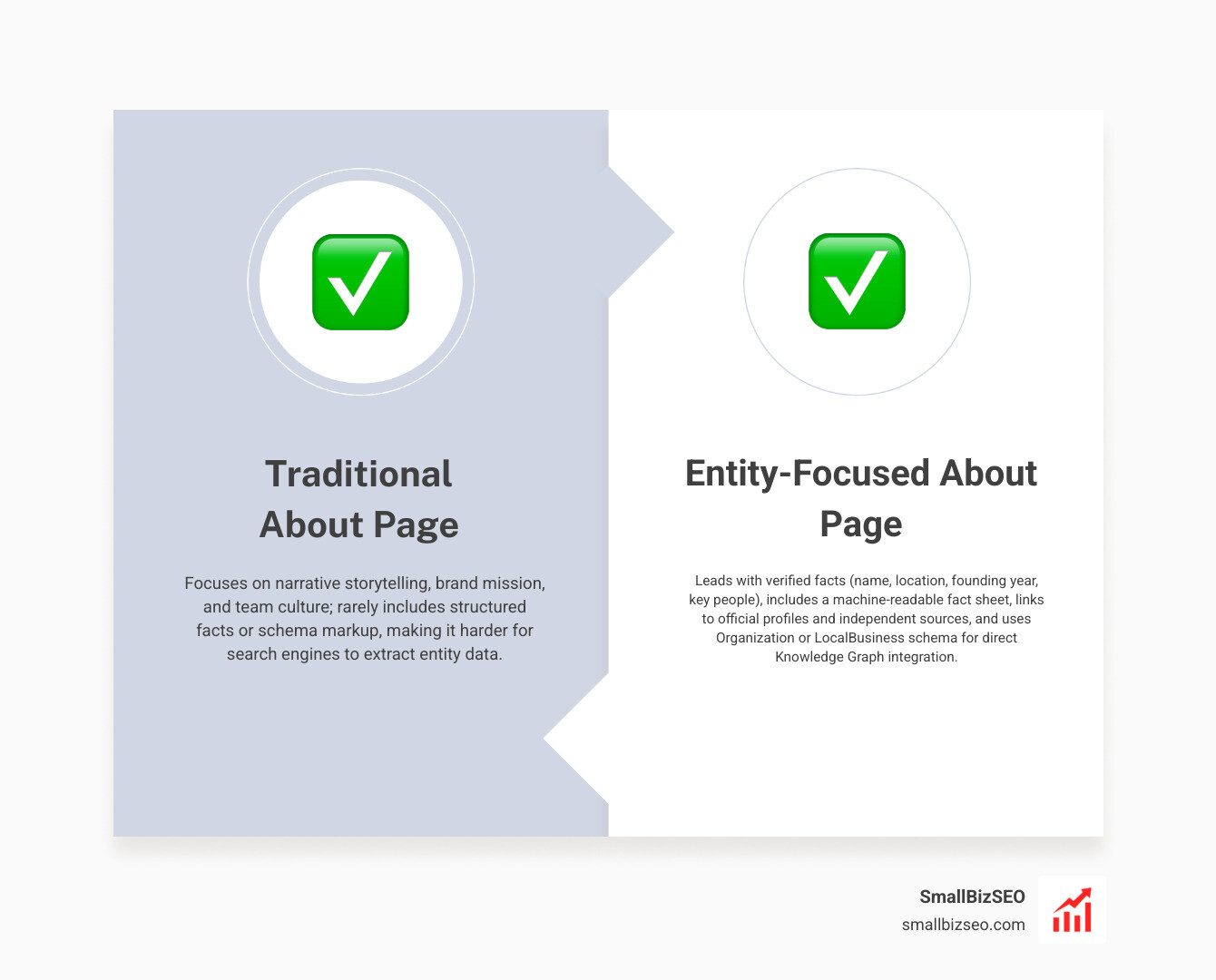
| Feature | Traditional Marketing About Page | Entity-Focused About Page |
|---|---|---|
| Primary purpose | Tell a brand story or share a mission | Explain the business identity and support it with evidence |
| Opening content | Broad positioning or promotional language | A concise statement of who the business is, what it does, and who it serves |
| Proof | General claims and testimonials | Verifiable credentials, leadership information, official profiles, and relevant references |
| Page structure | Long narrative paragraphs | Scannable facts, supporting context, and clear next steps |
| Structured data | Missing or disconnected markup | Organization or LocalBusiness markup that matches visible content |
| Audience | Primarily human visitors | Human visitors, search systems, and AI retrieval systems |
What Is an Entity Home and How Does It Help Readers and Search Systems?
An entity home is the canonical page on a website that explains the organization’s digital identity. In many cases, the About page is the best entity home because it is naturally where readers expect to find ownership, leadership, purpose, services, and proof.
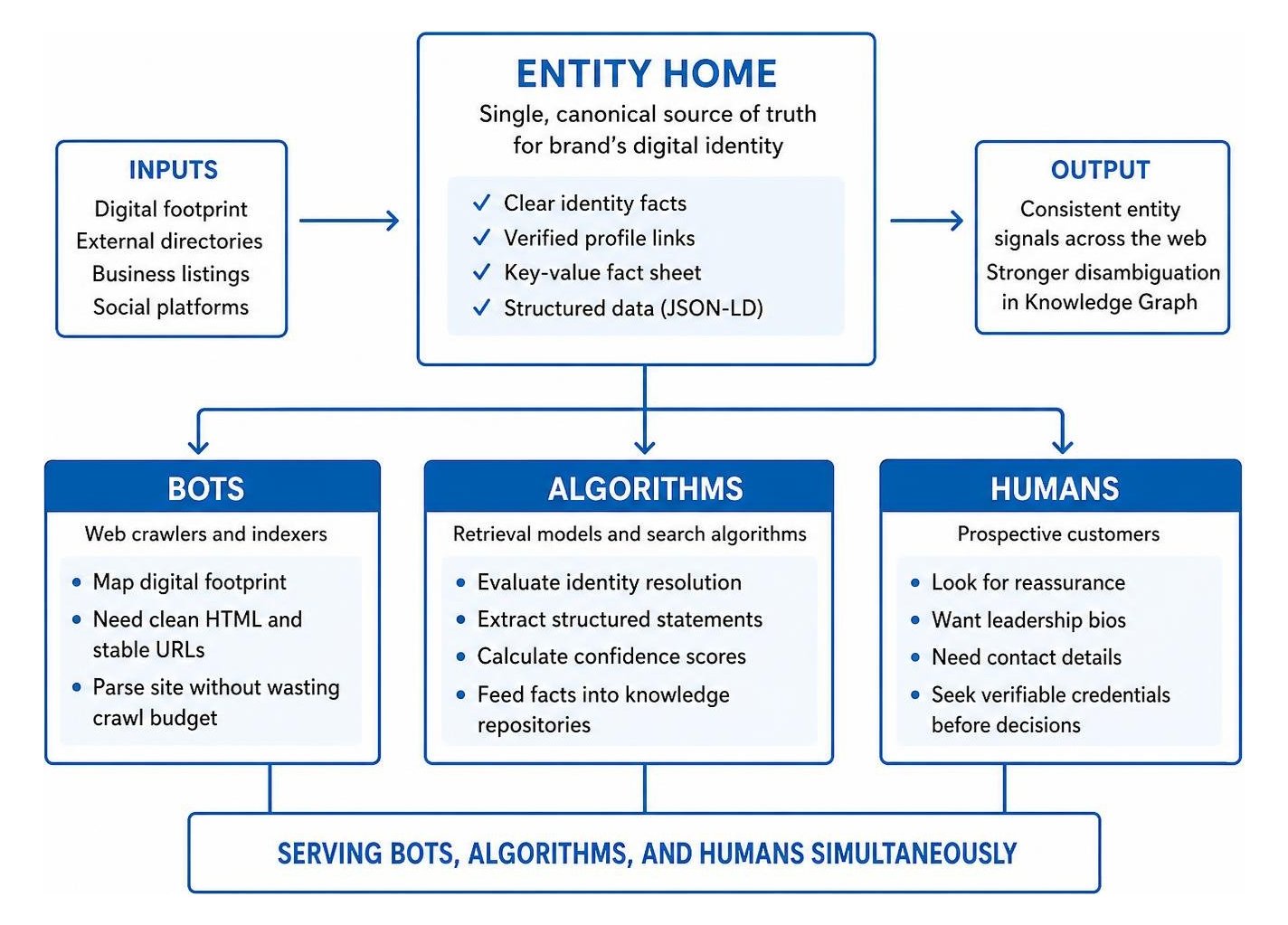
An entity home should help three audiences at once. For additional context, see the entity SEO foundations overview and the Search Engine Land entity home analysis.
- Readers: Customers want to know who will do the work, what the business specializes in, and why its advice or services deserve trust.
- Search systems: Crawlers need clear headings, readable HTML, stable internal links, and consistent references to interpret the page efficiently.
- AI answer systems: Retrieval systems benefit from concise, factual statements that can be connected to reliable supporting sources.
For example, a service page can link to the About page when it references the company’s experience, while author pages can link back when they describe an expert’s role. This creates a logical internal structure instead of leaving key trust information scattered across unrelated pages. See entity SEO foundations for a broader view of how identity signals work across a site.
What Are the Practical Benefits of an Entity-Focused About Page?
An entity-focused About page can improve the quality of the site’s trust signals in several practical ways:
- It gives visitors a fast answer to basic questions about the business.
- It creates one page to reference from service pages, author bios, media mentions, and relevant supporting content.
- It makes it easier to audit inconsistent claims before they spread across the site.
- It gives structured data a visible source of truth.
- It supports clearer author and organization signals for content that discusses specialized topics.
- It can make the site more useful when AI systems and search features look for concise, attributable business information.
The page should not rely on exaggerated outcomes or unverified statistics. Strong entity SEO comes from accuracy, consistency, and evidence. For more trust-building guidance, review optimizing content for search trust and EEAT and calculating and boosting brand authority.
Step-by-Step Framework for Optimizing Your Entity About Page
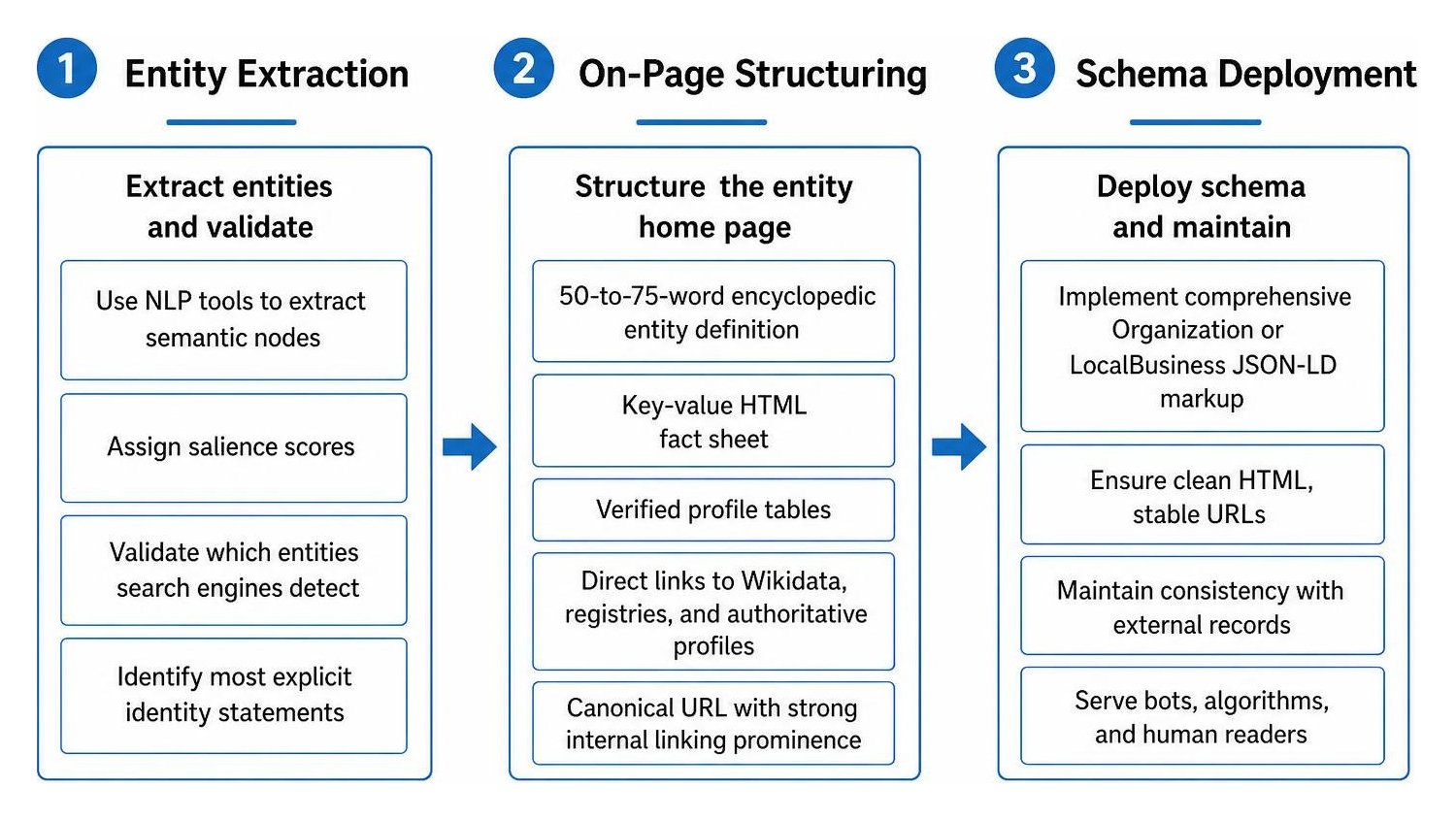
Optimize an entity-focused About page by auditing the facts already published about the business, choosing one canonical page to serve as the entity home, organizing the page around direct answers and proof, and then aligning schema and public profiles with the visible copy. Accuracy matters more than volume.
Before adding new language, collect information the business can prove, such as its official name, core services, leadership roles, professional credentials, public profiles, industry memberships, and original resources. Every important statement should be defensible if a customer asks for evidence.
Step 1: Choose the Canonical Entity Home
Choose one stable, prominent page to serve as the primary source for the business identity. For most sites, this is the About page. It should be easy to reach from the main navigation and receive internal links from key service, author, and contact pages.
A strong entity home uses a stable URL, identifies the organization near the top, remains indexable, is linked from important pages, and does not contradict information elsewhere on the site. Do not create several competing About pages with slightly different descriptions. If the site needs separate company, founder, team, or methodology pages, give each one a distinct purpose and connect them with clear internal links.
Step 2: Write a Clear Definition Lead
The first paragraph should define the business in everyday language. State the official name, core services, audience, and distinguishing expertise without overloading the reader with slogans.
A useful opening follows this pattern:
Business name is a type of business that helps audience with primary services. The company is known for specific expertise, process, or proof point.
Keep the lead factual. Replace phrases such as “industry-leading solutions” with concrete descriptions of the work performed and the customers served.
Step 3: Add a Scannable Fact Sheet
A fact sheet helps readers locate core details without reading the entire narrative. Use a simple HTML table, definition list, or short labeled sections. Include only facts that are current, useful, and supported elsewhere on the site or in official references.
Useful fields may include:
- Official business name: The name used consistently across the site and public profiles.
- Primary services: The main work the company performs.
- Primary audience: The customers, industries, or organization types it serves.
- Leadership: The people responsible for strategy, delivery, or subject-matter expertise.
- Credentials and memberships: Relevant, verifiable professional affiliations or certifications.
- Official profiles: Links to public profiles that genuinely represent the company.
- Contact path: A clear way for visitors to verify they have reached the right business.
Do not turn the fact sheet into a keyword list. Clear labels and plain language are more useful than repeated service terms.
Step 4: Add Proof That Supports the Claims
An entity page becomes more credible when its claims are connected to meaningful proof. Proof can include original case studies, named authors, external publications, professional profiles, independent reviews, recognized memberships, or direct links to official records when appropriate.
The strongest proof is specific and relevant. A generic badge or a long list of logos does little if it does not explain what the recognition represents. Add context about the expertise demonstrated, the scope of a credential, or the connection between a profile and the business.
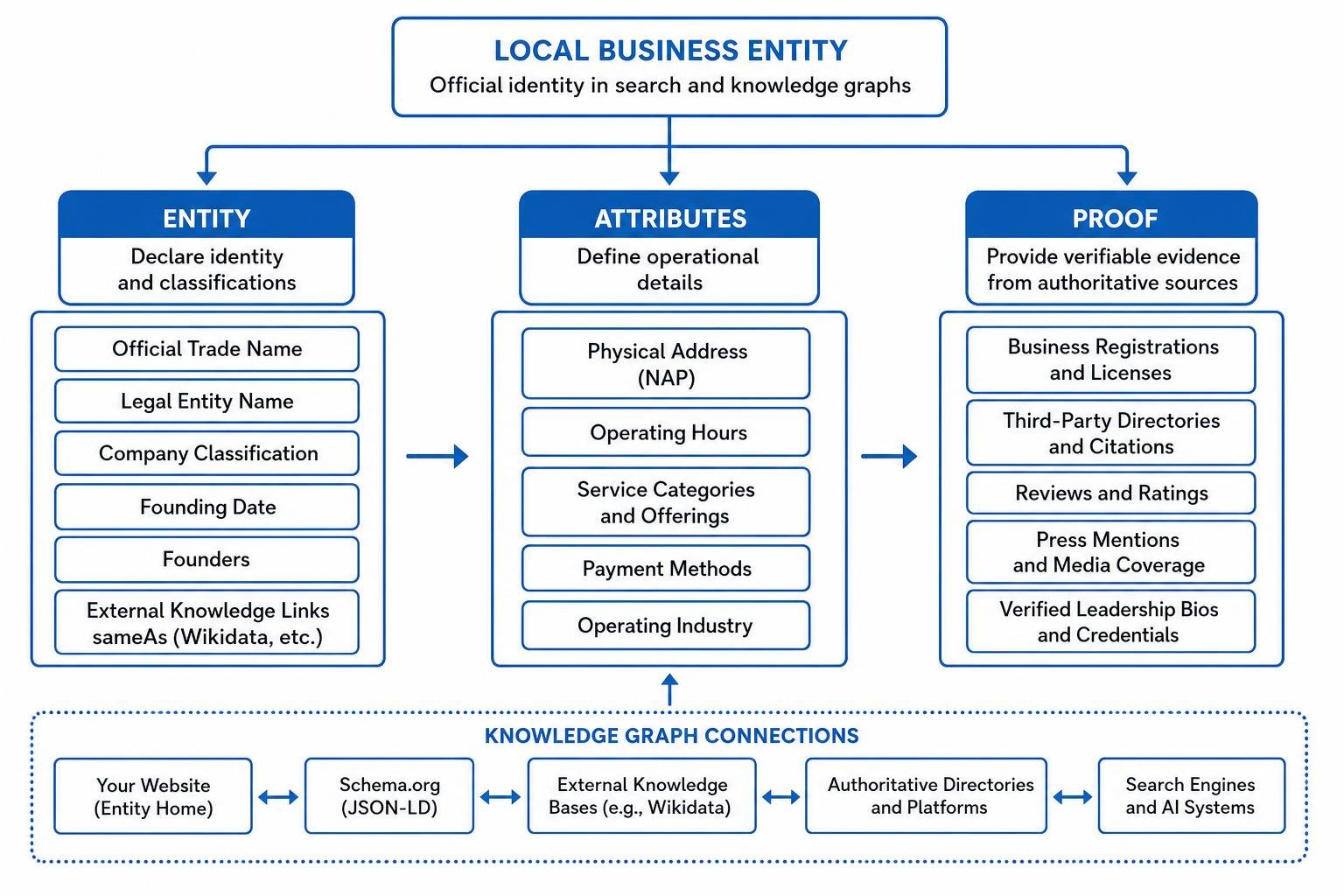
For service businesses, the EAP framework is a practical review method:
- Entity: Clearly state the exact business identity and core service categories.
- Attributes: Describe the operational details customers need, such as services, availability, policies, and accepted ways to work with the business.
- Proof: Link to evidence that supports the important attributes instead of asking readers to accept them without context.
Step 5: Connect Supporting Pages with Internal Links
The entity home should not stand alone. Understanding knowledge graphs for data teams and connecting supporting topic clusters can help clarify how the entity home supports related content. Link to it from pages where trust information is relevant, such as service pages, author pages, case studies, contact pages, and guides that discuss the company’s methodology. In return, the About page should guide visitors to the services, people, and resources that substantiate its claims.
Use descriptive internal anchor text. Review entity-based search fundamentals before deciding which identity concepts should connect across the site. A guide about technical SEO can link to SmallBizSEO entity SEO services when the service is relevant, while a discussion of business-information consistency can link to NAP consistency across platforms.
Step 6: Match Schema Markup to the Visible Page
Schema markup can help search engines interpret information that readers can already see, but it should never introduce hidden claims or contradictory facts. Use Organization or LocalBusiness markup where it accurately represents the business, and ensure fields such as name, URL, logo, contact information, and sameAs links align with the visible page.
The @id property can provide a stable identifier for the organization across related markup. Keep that identifier consistent across the site, and use it to connect appropriate entities, such as the organization, website, authors, services, and relevant pages.
Review JSON-LD markup implementation, advanced schema markup strategies, and LocalBusiness schema properties for implementation guidance. Test markup after changes and correct warnings that point to missing, inconsistent, or invalid information.
Step 7: Audit External Profiles and References
Review the public profiles linked from the About page. Each profile should represent the same business, use compatible descriptions, and link to the correct website. Remove broken links, abandoned profiles, and references that no longer reflect the current business.
Prioritize accuracy over quantity. A short list of active, authoritative profiles is better than a long list of outdated directories. When a third-party page contains a mistake, correct it where possible and avoid treating that page as proof until the information is accurate.
What Mistakes Should You Avoid?
Avoid leading with a slogan instead of an identity statement, publishing inconsistent service descriptions, adding schema that does not match the page, using weak proof as a substitute for evidence, burying the About page, or letting public profiles go stale.
How Do You Maintain an Entity About Page?
Maintain the page whenever a core business fact changes or when an audit reveals a contradiction between the site and public profiles. Review the page alongside linked schema, author bios, service descriptions, and official accounts. The goal is to keep the facts stable, clear, and consistent wherever customers or search systems encounter them.
SmallBizSEO uses its data-driven Velocity framework to help businesses organize technical SEO, content, and authority signals into a measurable strategy. Explore entity SEO services if you need help assessing your current entity signals and prioritizing practical fixes.
Putting Your Entity About Page into Action
An entity-focused About page gives your website a dependable foundation for trust. Start with a direct statement of who the business is, what it does, and who it helps. Then add proof that supports those claims, connect the page to relevant services and author resources, and make sure the visible content matches your structured data and public profiles.
Do not try to complete every improvement at once. Begin by correcting conflicting business descriptions and strengthening the first section of the page. Next, add a scannable fact sheet, review internal links, and verify that the schema reflects only what readers can confirm on the page. Finally, revisit the page whenever a material business fact changes.
The result should be useful to a prospective customer before it is useful to a crawler: clear, specific, easy to verify, and connected to the rest of the website. That combination makes the About page a stronger digital anchor for search visibility, AI discovery, and long-term brand trust.