Use AI to Edit Complex Copy Without Losing Nuance or Accuracy
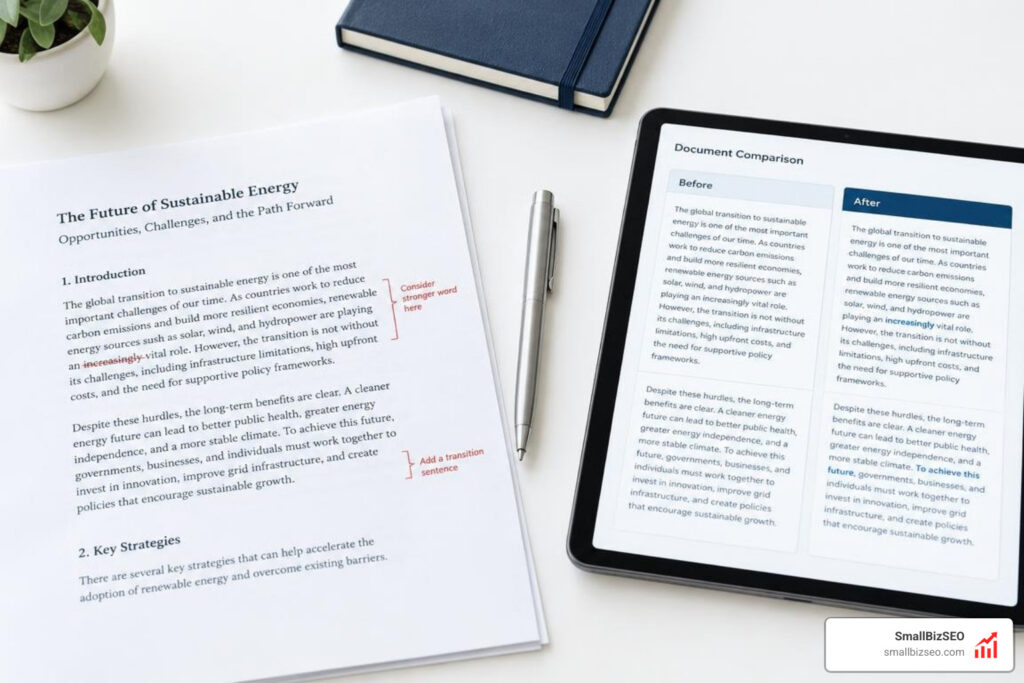
How Can You Use AI to Edit Content Without Changing Expert Meaning?
The safest approach to using AI to edit content without changing expert meaning is to set the limits before you rewrite. Save the original, list the claims and details that must stay intact, and ask AI to improve only clarity and flow. Then compare each edited claim with the original. Check numbers, names, qualifications, and citations before a human expert approves the final copy.
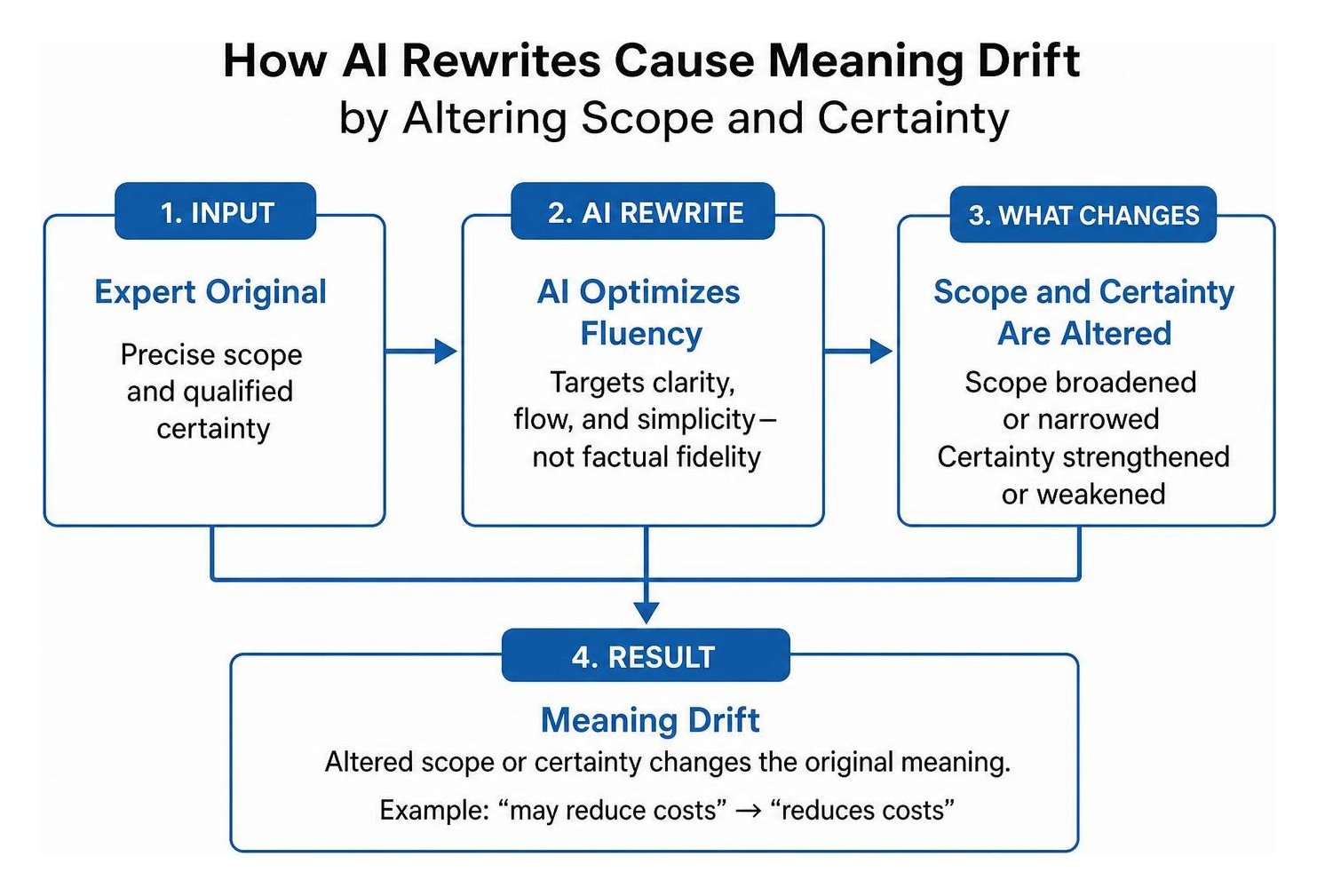
A smoother sentence is not always a better one. Changing “may reduce costs” to “reduces costs” makes a stronger claim, even though both sentences discuss the same topic.
I’m Clayton Johnson, founder of SmallBizSEO. My work turning expert insights into clear, evidence-backed SEO content shapes my approach to using AI to edit content without changing expert meaning.
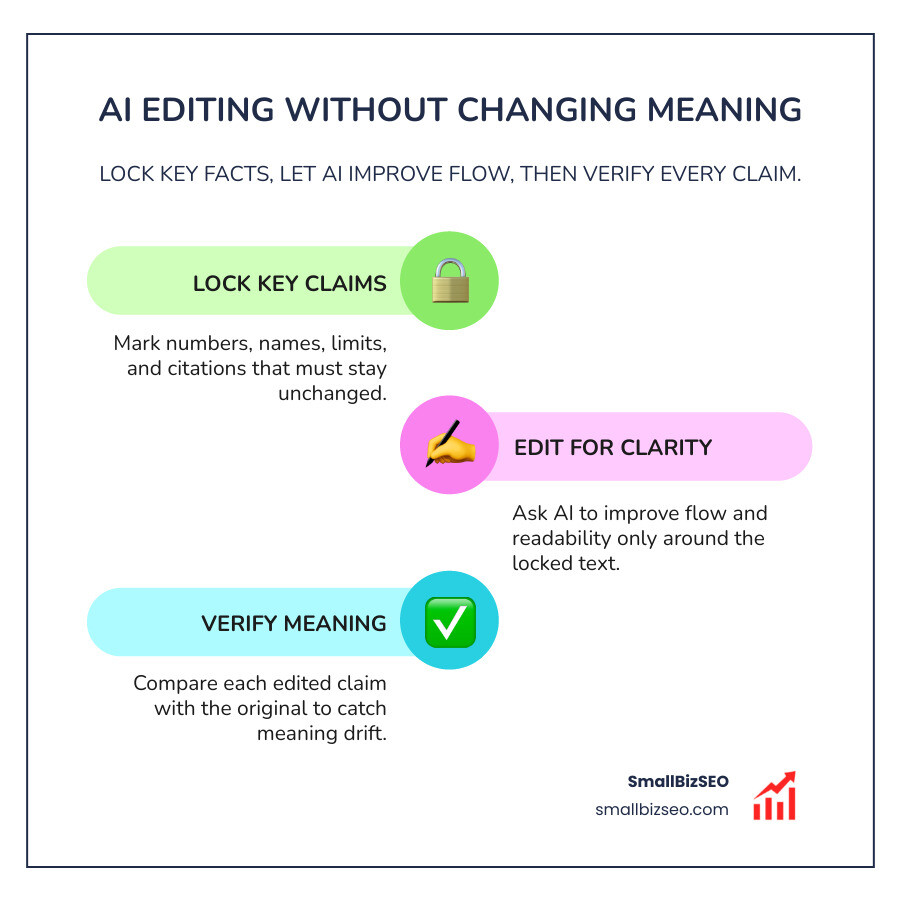
Using ai to edit content without changing expert meaning terms at a glance:
Why Is Using AI to Edit Content Without Changing Expert Meaning So Difficult?
AI models optimize for linguistic fluency, rhythm, and structural simplicity rather than strict factual fidelity. When an LLM edits a complex sentence, it often alters scope, certainty, causality, or attribution simply to make the text sound more conversational or authoritative.
When an editor submits specialized text to an automated tool, the system does not "understand" the underlying subject matter. It calculates token probabilities. Research published in AI and Ethics by Springer Nature highlights the ethical and technical challenges of maintaining factual integrity in automated editing.
When you are optimizing content for E-E-A-T, subtle factual changes can degrade search engine trust and mislead human readers. Practical research from the Synthience Institute on silent loss confirms that AI systems routinely discard essential constraints while attempting to simplify sentences.
What Are the Risks of Meaning Drift and Silent Loss?
Meaning drift happens when an AI rewrite shifts the degree of certainty, changes a causal relationship, or alters the boundaries of an expert statement without altering the core topic. Silent loss occurs when an AI model completely deletes conditions, exceptions, or procedural constraints without alerting the editor.
These failure modes directly harm visibility in modern AI search engines, which penalize unverified, generic, or inaccurate claims:
- False Certainty: Converting probabilistic findings (e.g., "suggests an association") into definitive facts (e.g., "proves that").
- Broken Causality: Swapping causes and effects during syntactic restructuring.
- Dropped Qualifications: Removing boundary conditions such as "under specific temperature thresholds" to shorten the prose.
- Hallucinated Additions: Inserting plausible-sounding statistics, examples, or industry claims that the original author never provided.
- Attribution Misalignment: Moving citation markers to unrelated sentences, making it look like a study supports a claim it never evaluated.
How Can You Lock Important Text When Using AI to Edit Content Without Changing Expert Meaning?
To protect factual integrity, build a list of immutable elements before running any automated editing prompt. By isolating exact numbers, names, regulatory phrasing, and citations, you force the AI tool to restrict its changes to syntax, sentence length, and readability.

| Category to Lock | Why It Must Remain Unchanged | What AI May Modify |
|---|---|---|
| Statistical Data & Metrics | AI frequently rounds numbers, drops units of measurement, or confuses percentages with raw counts. | Surrounding transitional words and introductory phrasing. |
| Hedges & Qualifications | Words like "may," "indicates," and "in most cases" define the scientific boundary of the claim. | Sentence structure, voice (active/passive), and paragraph length. |
| Citations & Quotes | Moving a source link to a new sentence creates false attribution and damages credibility. | Contextual lead-in sentences explaining the quote. |
| Industry & Regulatory Terms | Swapping domain-specific terms with conversational synonyms can violate compliance guidelines. | Complex sentence clauses and passive constructions. |
What Is the Step-by-Step Workflow for AI-Assisted Expert Editing?
The safest editorial workflow treats AI as a drafting assistant rather than a final decision-maker. You must preserve the source text, feed it to the model in controlled segments, and execute systematic verification checks.
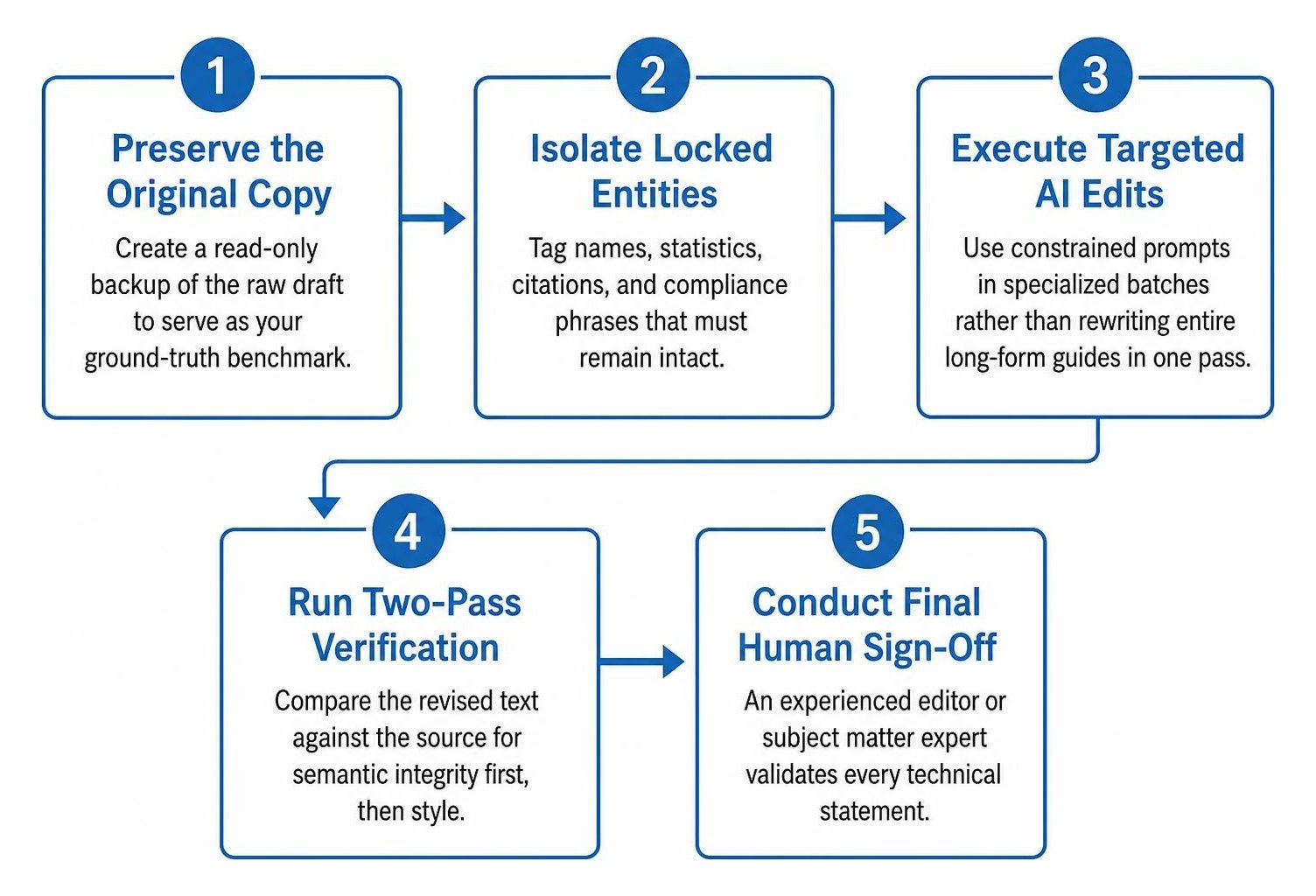
- Preserve the Original Copy: Create a read-only backup of the raw draft to serve as your ground-truth benchmark.
- Isolate Locked Entities: Tag names, statistics, citations, and compliance phrases that must remain intact.
- Execute Targeted AI Edits: Use constrained prompts in specialized batches rather than rewriting entire long-form guides in one pass. Applying structured AI SEO content optimization keeps edits focused on readability.
- Run Two-Pass Verification: Compare the revised text against the source for semantic integrity first, then style.
- Conduct Final Human Sign-Off: An experienced editor or subject matter expert validates every technical statement.
Academic research on professional copyediting with artificial intelligence shows that combining structured prompts with human-in-the-loop validation captures surface-level gains while eliminating hallucination risks.
How Can You Check That Meaning Stayed the Same in Two Passes?
A single review pass is insufficient because human editors naturally get distracted by smooth prose, missing subtle factual shifts. A structured two-pass comparison separates factual validation from stylistic polish.
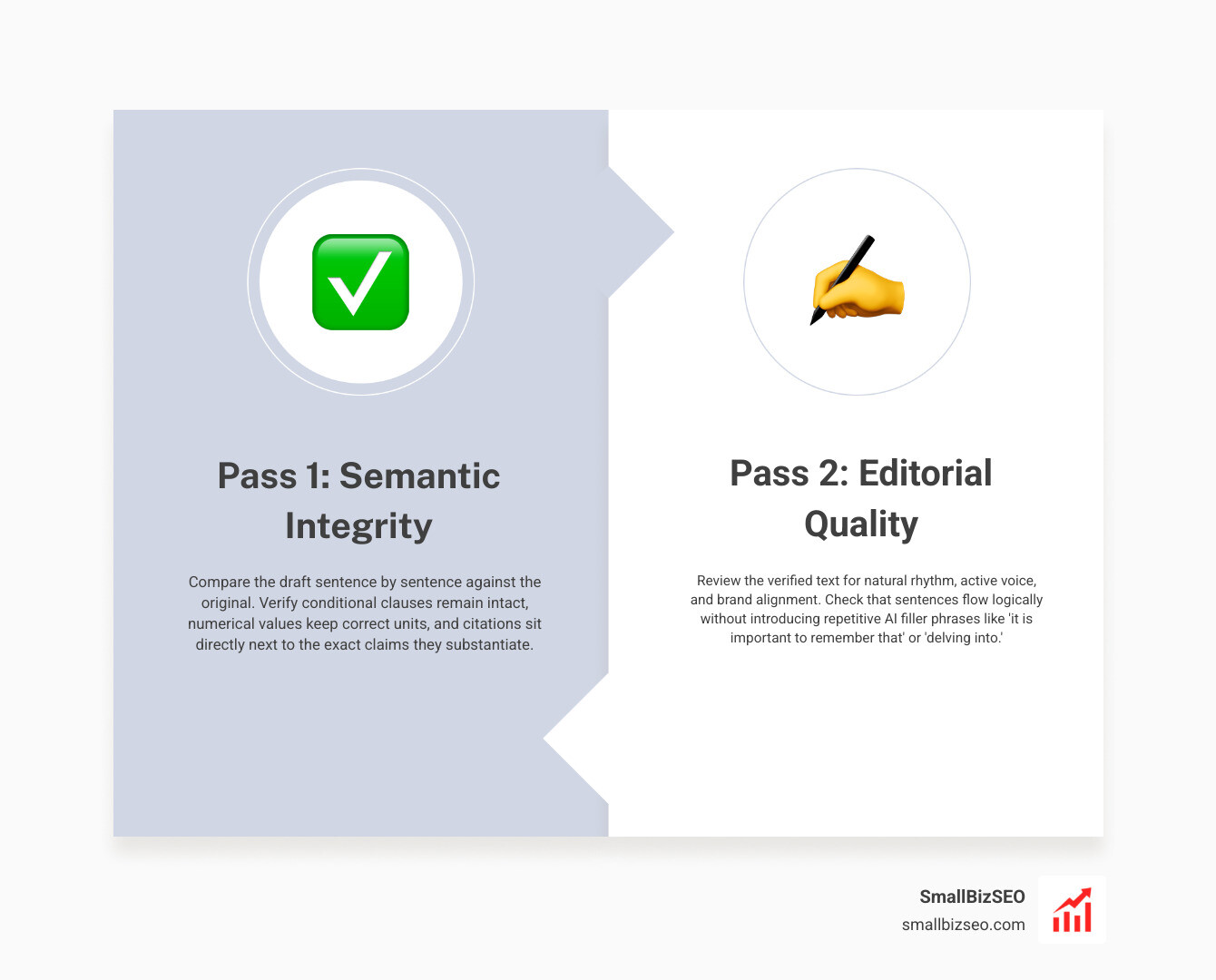
- Pass 1: Semantic Integrity (Fidelity Check) Compare the draft sentence by sentence against the original source. Verify that every conditional clause ("if," "unless," "provided that") remains intact. Confirm that every numerical value retains its correct unit of measurement and that citations sit directly next to the exact claims they substantiate.
- Pass 2: Editorial Quality (Style and Flow) Review the verified text for natural rhythm, active voice, and brand alignment. Check that sentences flow logically without introducing repetitive AI filler phrases like "it is important to remember that" or "delving into."
What Prompting Strategies Help AI Edit Without Changing Expert Meaning?
Clear prompting establishes the operational boundaries of the AI model. Instruct the system explicitly on what it is forbidden to modify, and direct it to flag confusing sentences rather than guessing their meaning.
When integrating AI-assisted editing into your publishing pipeline, use modular instructions:
- Define the Role and Scope: Direct the AI to act strictly as a copyeditor focusing on readability, grammar, and conciseness.
- State Negative Constraints: Explicitly forbid the AI from adding new facts, creating examples, removing qualifiers, or altering technical definitions.
- Demand Edit Transparency: Require the model to list every major structural change it makes alongside a brief rationale.
- Batch by Section: Process long-form copy subsection by subsection to prevent context window degradation and dropped paragraphs.
When Should an Editor Reject an AI Rewrite Entirely?
An editor should reject an AI rewrite whenever repairing the output requires more time and cognitive effort than editing the original text manually.

Discard an AI-generated revision immediately if it exhibits any of these critical issues:
- Invented Supporting Material: The rewrite introduces outside examples, statistics, or analogies not present in the source draft.
- Collapsed Technical Distinction: The AI combines two distinct industry concepts into a single oversimplified statement.
- Distorted Tone of Authority: The draft turns cautious, data-backed analysis into generic marketing hype or unsupported guarantees.
- High Repair Cost: The editor must cross-reference more than two external sources to verify whether the AI's rephrasing altered the author's technical point.
Securing Expert Authority in AI-Driven Publishing
Maintaining editorial integrity is essential for sustainable search visibility and reader trust. When teams rely on automated shortcuts without strict verification frameworks, content quality rapidly degrades into generic, untrustworthy text.
By defining immutable data blocks, enforcing multi-pass verification, and keeping human subject matter experts in control of final approvals, businesses can harness automated speed without sacrificing expert depth. If your team wants to scale content production while protecting your search rankings and brand credibility, discover how our professional AI-assisted editing services ensure your content meets the highest standards of accuracy and performance.