AI Answer Optimization: A Practical Content and Evidence Audit
What Is AI Answer Optimization?
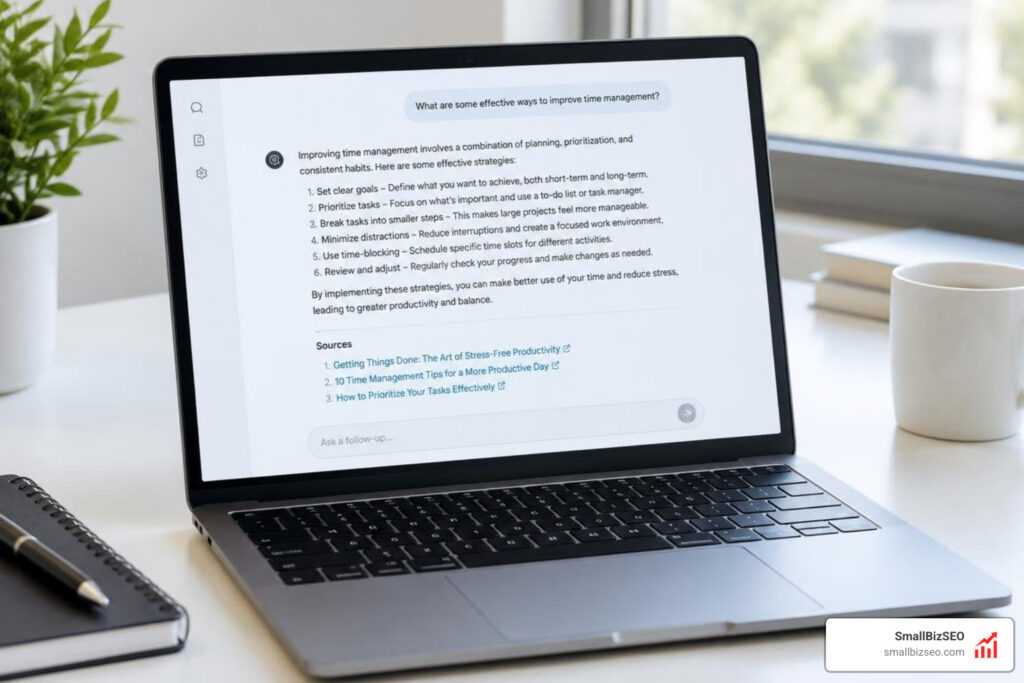
AI answer optimization, often called AEO, and generative engine optimization, often called GEO, are industry terms for making useful information easier to discover and assess in AI-assisted search. They do not give a business control over an answer, guarantee a citation, or promise visibility in any particular product.
Some AI systems retrieve and cite web sources for a response, while other responses may rely on a model's existing knowledge or use sources differently. Google describes retrieval-augmented generation and query fan-out in its generative-search guidance, but that description should not be treated as a universal or identical pipeline for every AI product.
What Should a Business Audit Before Trying to Improve AI Search Visibility?
Start with the customer decisions that need a clear, supportable answer. Review the page that currently answers each question, who owns the source material, what evidence is missing, and which gaps matter most.
The table below is an illustrative audit example, not a statement about SmallBizSEO's operating process. Replace it with the reader's verified records.
| Customer question | Current answer | Source owner | Evidence gap | Priority |
|---|---|---|---|---|
| What is included in the service? | A general overview | Service owner | Current scope and exclusions are not documented | High |
| What does the process require from the customer? | Scattered instructions | Operations owner | No single verified workflow page | High |
| How is a claim supported? | Marketing language | Content owner | Primary source or documented method is missing | Medium |
This is an evidence audit, not a platform-ranking exercise. It avoids claims about how a named AI product retrieves content unless the business has directly verified them.
What Does Google's Guidance Actually Say?
Google's guidance for generative AI features in Search says SEO fundamentals remain relevant. Pages must be indexed and eligible to appear as a snippet, and a site must be included in Search's generative AI features through Search Console to be eligible. Google does not promise that eligible content will be served in a generative response, require llms.txt, require special schema, or prescribe an ideal content chunk size. Use the Google controls documentation to distinguish inclusion in Search's generative AI features from training-related settings. Those controls do not require a blanket instruction to allow bots or a change to privacy choices.
A clear FAQ can help readers when it answers genuine questions; special FAQ schema is not required for Google's generative AI features. Likewise, off-site signals should come from accurate, authentic sources rather than spam forums, manufactured reviews, or artificial mentions.
How Can You Audit Content for Accurate AI Answers?
A useful page answers one clear customer question with a direct, accurate response, then states the necessary conditions and limitations. Support the response with a first-hand demonstration or documented method, a dated primary source when one exists, and an author or reviewer role only when that role can be verified. Assign an upkeep owner so outdated details have someone responsible for correcting them.
What Does a Grounded Small-Business FAQ Look Like?
The example below is hypothetical wording, not a SmallBizSEO service policy or a customer result.
Vague: “Our process guarantees fast results.”
Grounded: “After receiving your brief, we confirm scope, missing inputs and an estimated schedule before work begins; completion depends on agreed deliverables and feedback.”
The grounded version explains the process without turning an estimate into a promise. Legitimate uncertainty belongs in the answer when timing, availability, or outcomes depend on conditions outside the page owner's control. A useful starting point is to identify pre-purchase questions and document the evidence needed to answer them.
How Does a Claim Ledger Improve Content Review?
A simple claim ledger connects each important statement to its evidence, review date, limits, and owner. The table below is an illustrative example, not a statement about SmallBizSEO's operating process. Replace it with the reader's verified records.
| Claim | Evidence | Date | Limits | Owner |
|---|---|---|---|---|
| A customer receives a written scope confirmation before work begins. | Current operating procedure or approved template | Record the review date | Applies only when the documented process is in use | Operations owner |
| Hypothetical example: a service page states an estimated schedule. | Illustrative wording only | Not applicable | This is not a performance result or service promise | Content owner |
Use tables when they clarify decisions or evidence. Do not add them merely as a formatting tactic.
Do Semantic HTML and Accessibility Guarantee Citations?
No. Semantic HTML, descriptive alt text, accessible tables, and clear headings help people navigate and understand a page. They also make the page structure easier to interpret, but there is no proven direct citation boost that applies across AI systems. The goal is clarity and usefulness, not a mechanical formula.
Answer engine optimization implementation and entity SEO can be useful framing resources when they help a business describe real people, products, processes, and supporting evidence accurately. They should not replace primary documentation or inflate claims.
How Should a Small Business Measure and Correct AI Visibility?
Measure what can be observed, separate it from what cannot, and correct inaccurate source material with documentation. This is a small-business measurement and correction workflow, not enterprise legal advice or a universal framework for every platform.
Which Signals Should You Track Separately?
As of November 2026, Google's documentation says the Generative AI performance report in Search includes impressions for AI Overviews and AI Mode, with global availability beginning August 31, 2026. The report may not show data when impressions are insufficient. It covers Google's reported Search surfaces, not every AI platform, and impressions do not prove sales or qualified demand.
Keep separate records for:
- Native impressions: Platform-reported visibility where that reporting is available. Limits: not a measure of every AI surface or business outcome.
- Sampled citations or mentions: Manual observations from selected prompts. Limits: repeated observations are still a sample, not population market share or a stable Google position.
- Referral visits: Visits that arrive from identifiable sources. Limits: attribution can be incomplete and does not show every assisted interaction.
- Qualified inquiries: Leads reviewed against the business's own criteria. Limits: correlation with an AI mention does not establish causation.
There is no universally comparable citation rate across AI products. Zero-click behavior can reduce some visits, but it does not remove the value of analytics or make referral measurement impossible.
What Belongs in a Manual Observation Log?
For each observation, record the platform and surface, date, exact prompt, location and language context, source URLs shown, whether the brand was mentioned or cited, and whether the answer was accurate. Include the source-page owner and the next review step when a response contains an error. AI citation measurement can be useful only when its method and limitations are stated clearly.
How Should You Correct Inaccurate Information?
First, correct the business's own source page and retain proof of the update. When an independent third-party page is inaccurate, request a correction honestly and provide the supporting documentation. Keep a dated record of the request, evidence, and outcome. No business can guarantee that an AI response will update immediately after a page changes. For regulated claims, obtain review from an appropriately qualified professional rather than treating a content workflow as a legal-compliance promise.
Build a More Reliable Answer Source
Choose one important customer question and one weak source page to improve first. Document the original answer, the evidence added or corrected, the baseline observation, and the next review date. This creates a practical record of what changed without claiming that a single edit will control how AI systems respond.
For scoped help with the audit, explore SmallBizSEO's AEO services or book a consultation.