Beginner’s Guide to Compare AI Content Services

Beginner's Guide to Compare AI Content Services
Understanding the Role of AI Content Services
Modern ai content services combine generative AI models, natural language processing (NLP), and structured data connections to streamline information workflows. Rather than treating artificial intelligence as a simple text generator, sophisticated content platforms function as operational engines that turn raw company knowledge into multi-channel marketing assets. By synthesizing complex information into cohesive narratives, these platforms help businesses establish scalable production workflows while preserving overall editorial integrity.
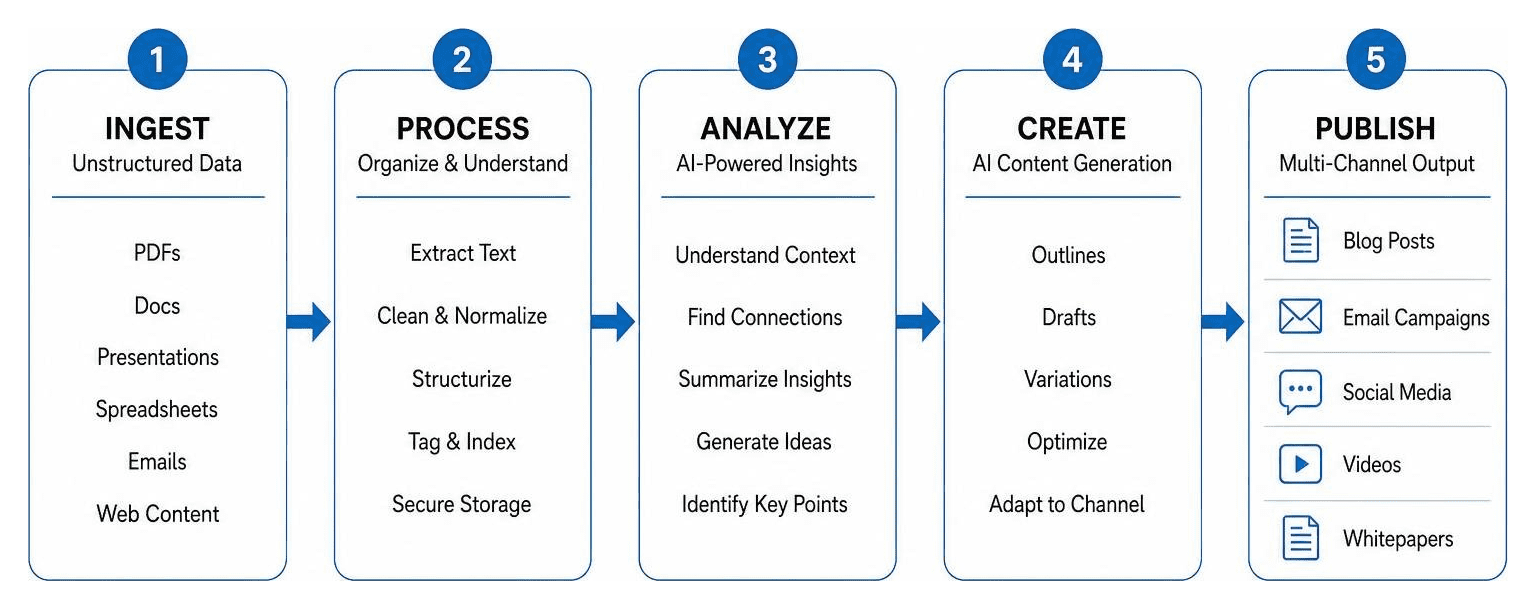
Many employees report losing critical business opportunities simply because they cannot access information quickly, with a majority spending two or more hours every single day searching for internal files and context. Enterprise-grade AI content systems eliminate this friction by pulling unstructured data—such as PDFs, research decks, customer reports, and internal documentation—into secure, context-aware workspaces.
Traditional Creation vs AI Content Services
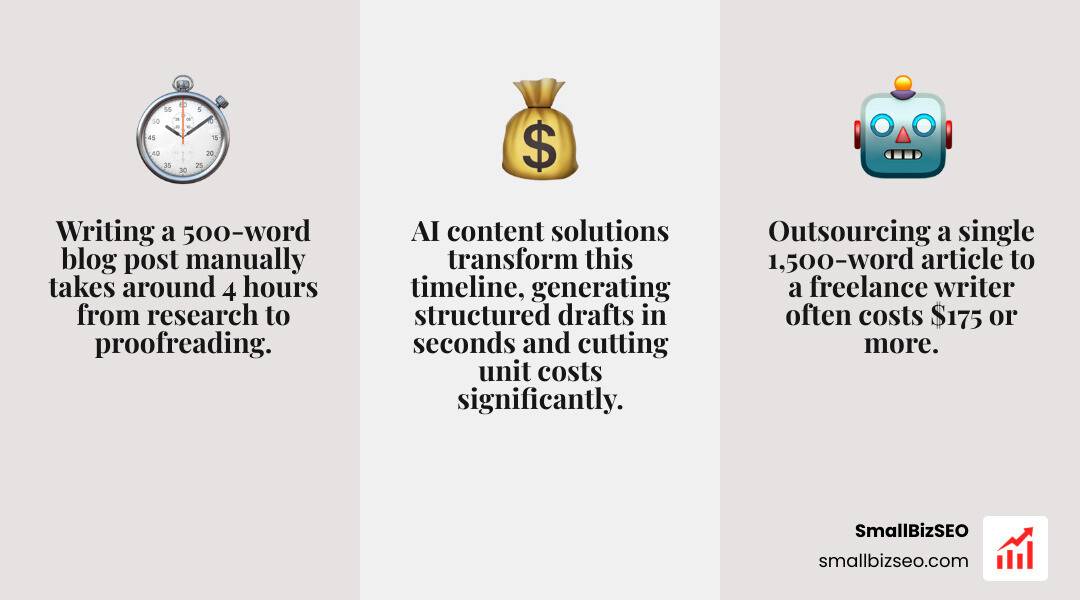
Writing a standard 500-word blog post manually takes around 4 hours from initial topic research to final proofreading. Furthermore, outsourcing a single 1,500-word article to a freelance writer often costs $175 or more. When scaling a business across multiple digital channels, these resource limits create severe bottlenecks that hinder market reach and content velocity.
AI content solutions transform this production timeline. Instead of starting from a blank page, teams leverage machine learning models to synthesize research, develop structured outlines, and draft complete first iterations in seconds. This allows businesses to scale their output significantly while cutting unit costs. However, AI does not eliminate human writers. Instead, it shifts human creative effort away from tedious baseline drafting toward high-level strategy, deep industry storytelling, and specialized SEO Content Services.
Core Capabilities Across Media Formats
The modern content landscape demands continuous updates across multiple communication channels. Leading platforms go well beyond basic text generation to deliver multi-modal production capabilities:
- Long-Form Articles & Blogs: Automated generation of comprehensive guides, news updates, and industry breakdowns.
- Social & Ad Copy: Rapid creation of channel-specific post variations, compelling ad headlines, and high-converting call-to-action scripts.
- Video & Audio Intelligence: Scriptwriting, automated text-to-speech generation in hundreds of natural voices, and localized video avatar creation.
- Technical & Product Documentation: Rapid drafting of specialized product descriptions, compliance summaries, and user manuals.
Organizations operating in competitive digital environments frequently partner with specialized agency networks to integrate multi-modal AI systems into custom growth workflows and automated enterprise pipelines.
Key Benefits, Quality Control, and SEO Strategy

Over 75% of digital marketers report incorporating AI tools into their workflows, but speed alone does not guarantee business growth. The true value of ai content services relies on balancing automated volume with rigorous quality control, factual accuracy, and strategic search engine placement. Implementing structured governance protocols ensures that accelerated production maintains optimal performance and trust.
Human-in-the-Loop Workflows and Brand Governance
Unrefined AI output can suffer from robotic sentence structure, vague generalities, or factual inaccuracies known as hallucinations. Maintaining brand credibility requires a structured "Human-in-the-Loop" (HITL) review process to verify facts and fine-tune editorial messaging.
Effective brand governance relies on dual-agent frameworks and automated style enforcement. By uploading company style guides, brand bibles, and forbidden terminology lists directly into the software intelligence layer, every generated draft is pre-scored for brand voice consistency. From there, human editors polish the text, adjust cultural nuances, verify cited facts, and ensure the tone aligns with the company's core values. This approach makes Scaling AI Content: Balancing Massive Output with Human Quality achievable for small teams without risking brand reputation. Selecting proper software tools is essential, as detailed in our guide on What Are AI SEO Tools?.
Generative Engine Optimization and Search Rankings
Search engine discovery is evolving beyond traditional keyword matching. Modern audience search behavior includes interaction with AI answer engines that summarize information and cite direct source materials.
To capture visibility across both environments, businesses must implement Generative Engine Optimization (GEO) alongside standard search practices. GEO focuses on structuring content so that generative answer engines easily extract, validate, and cite your brand as an authoritative source. Grounding drafts in verified evidence and earning search engine trust helps secure high organic rankings while driving AI citation rates. Learn more about maximizing search visibility in our deep-dive, Beyond the Hype: Unlocking the True AI SEO Advantage.
Platform Comparison and Tool Selection
Choosing the right platform requires evaluating software capabilities, workflow flexibilities, and underlying delivery models. Below is an overview comparing popular tool categories for businesses reviewing ai content services:
| Service Platform | Key Strengths | Output Focus | Pricing Architecture |
|---|---|---|---|
| Jasper | Enterprise agent workflows, GEO diagnostics, brand context hubs | Multi-channel campaigns, blog posts, performance copy | Monthly per-seat subscription |
| Writesonic | Dual-agent editing, removal of generic AI tells, smart voice routing | Blog posts, whitepapers, social threads, sales emails | Free trial, tiered monthly options |
| ContentBot | Trigger-and-action automation flows, bulk CSV processing | Scheduled blog posts, automated imports, multi-lingual copy | Pay-as-you-go credit model or monthly plan |
| Copy.ai | GTM workflow automation, sales enablement, short-form copy | Social media posts, email sequences, ad variations | Tiered monthly per-user plans |
| Viali Content Studio | Evidence-based citation matching, dual-scoring for SEO & GEO | Research-backed articles, structured website copy | Monthly team license |
To better understand how these service models differ, explore The Definitive Guide to Comparing AI SEO Services.
Beyond feature lists, teams should score each option against real production requirements: approval steps, brand risk tolerance, content volume, SEO goals, and the amount of internal expertise available for review. A lightweight tool may be enough for short-form copy, while a more governed workflow is usually better for businesses publishing research-heavy articles or conversion-focused landing pages.
Comparing Enterprise AI Content Services
Different platforms solve distinct operational challenges. For instance, Jasper excels at agentic marketing workflows, allowing enterprise teams to automate multi-asset campaign execution while enforcing strict visual and textual brand rules across all marketing channels.
Conversely, platforms like ContentBot focus heavily on event-driven automation triggers and bulk file processing, allowing e-commerce businesses to generate thousands of unique product descriptions simultaneously. For businesses prioritizing brand refinement, the AI Content Agent from Writesonic provides a second-agent review step that deliberately strips out repetitive AI writing patterns, em-dashes, and mechanical transitions. Finally, tools like Viali Content Studio focus on citation-backed drafting, building briefs directly from search engine evidence gaps.
Technical Integration and Security Controls
Deploying AI software safely requires evaluating enterprise compliance standards, permission hierarchies, and CMS software connectivity.
Leading AI platforms offer direct API connections to content management systems like WordPress, Webflow, and Shopify. Crucially, enterprise systems include permission-aware access controls to protect sensitive corporate data. By applying active data leak protection (DLP) protocols and confining generative AI models to approved data environments, businesses ensure proprietary information is never leaked or used to train external public models. Organizations looking for custom enterprise architecture often consult with specialists providing custom software integration and AI development services.
Frequently Asked Questions
Can AI content rank high on search engines without penalties?
Yes. Major search engines evaluate content based on overall quality, helpfulness, accuracy, and user experience rather than how the text was produced. Content created with the assistance of AI can rank at the top of search results provided it satisfies search intent, avoids unedited duplicate syntax, and demonstrates first-hand expertise, authoritativeness, and trustworthiness (E-E-A-T). For a neutral reference point, review Google Search Central guidance on creating helpful content, which emphasizes usefulness and reliability. Adding human strategic editing ensures high search engine performance, as covered in our overview on SEO Content Marketing.
How do AI content solutions protect sensitive enterprise data?
Enterprise-grade AI content systems protect sensitive corporate information by enforcing strict data encryption, permission-based access limits, and private cloud or sovereign data center deployments. User inputs, internal brand documents, and customer data uploaded to governed business workspaces are kept isolated and are not exposed to public model training sets. Enterprise administrative controls also offer role-based access management to prevent unauthorized internal data sharing.
What is the role of human editors in AI-assisted workflows?
Human editors serve as essential quality controllers in AI workflows. While AI tools excel at high-speed research compression, outlining, and initial draft generation, human editors step in to polish the brand voice, verify factual statements, introduce unique creative insights, and ensure the finished piece resonates naturally with real human readers.
Strategic Content Execution for Business Growth

Scaling organic visibility requires finding the right balance between automated creation speed and human strategic guidance. Adopting modern ai content services allows your business to eliminate production bottlenecks, expand into multi-channel asset creation, and maintain a consistent presence across search engine results and AI answer platforms.
At SmallBizSEO, our proprietary data-driven "Velocity" framework delivers rapid search engine rankings and E-E-A-T-compliant business growth. By combining automated research intelligence with expert editorial oversight and transparent reporting, we help small businesses build sustainable organic growth without sacrificing brand authenticity or voice continuity.
Ready to accelerate your search presence and scale high-quality content output? Discover how our team can transform your growth trajectory by exploring our tailored AI SEO Services today.