Competitor Keyword Gap Analysis: When Winning the Wrong Search Terms Hurts Growth

When Are Competitors' Ranking Keywords Wrong for Your Business?
To spot when competitors' ranking keywords are wrong for your business, check three things: Does the searcher need what you sell? Does the search result match a page you can create? Can you realistically compete for a top spot? If the answer is no, set the keyword aside, even if it has high search volume. Focus on searches that can bring qualified inquiries, not just more visits.
I'm Clayton Johnson, founder of SmallBizSEO. My work in SEO and content strategy helps small businesses recognize when competitor ranking keywords are wrong for your business and choose terms that better fit their customers.
How Can You Identify When Competitor Ranking Keywords Are Wrong for Your Business?
A competitor's keyword is wrong for your business when it fails to attract prospective buyers, targets queries outside your commercial scope, or requires authority signals you cannot currently match.
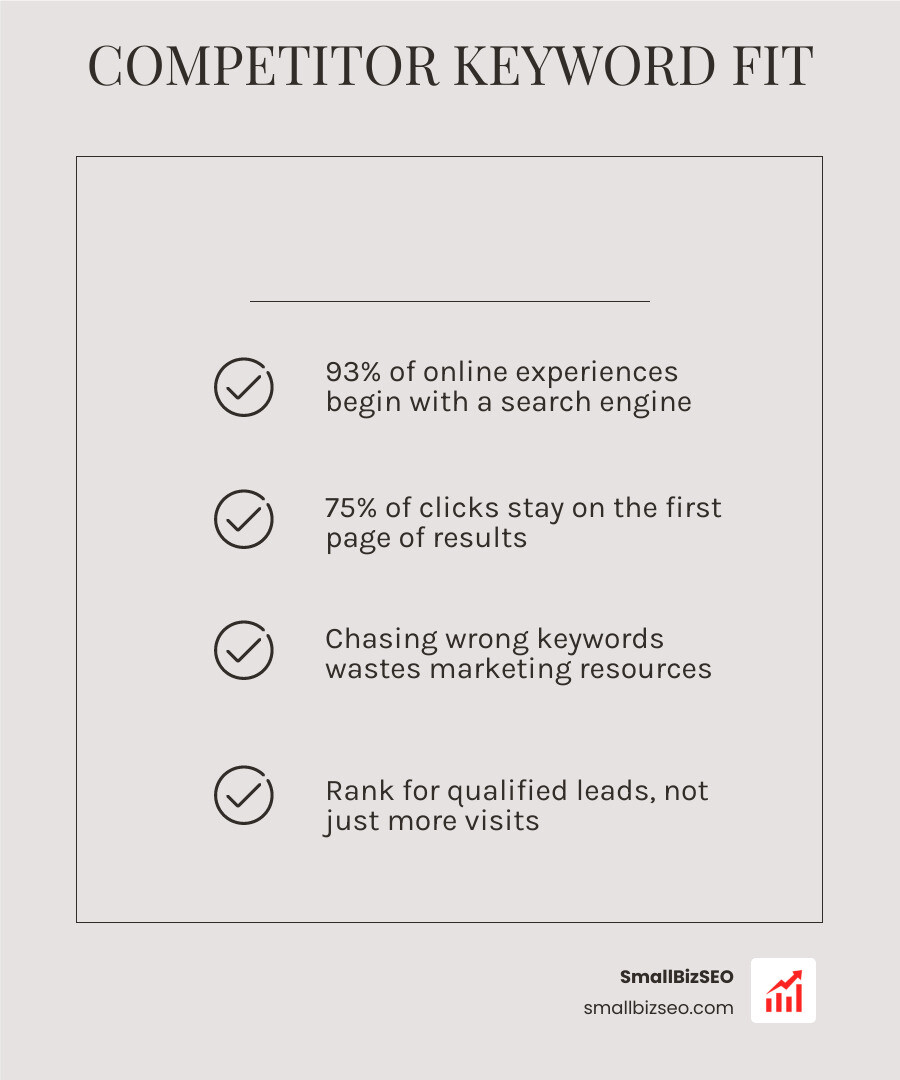
While about 93% of all online experiences begin with a search engine and 75% of clicks stay on the first page of search results, ranking for terms that do not generate leads wastes valuable marketing resources. To avoid chasing empty metrics, we must evaluate traffic qualification, commercial viability, and competitive feasibility before adding any term to our editorial calendar.
How Does Search Intent Reveal When Competitor Ranking Keywords Are Wrong for Your Business?
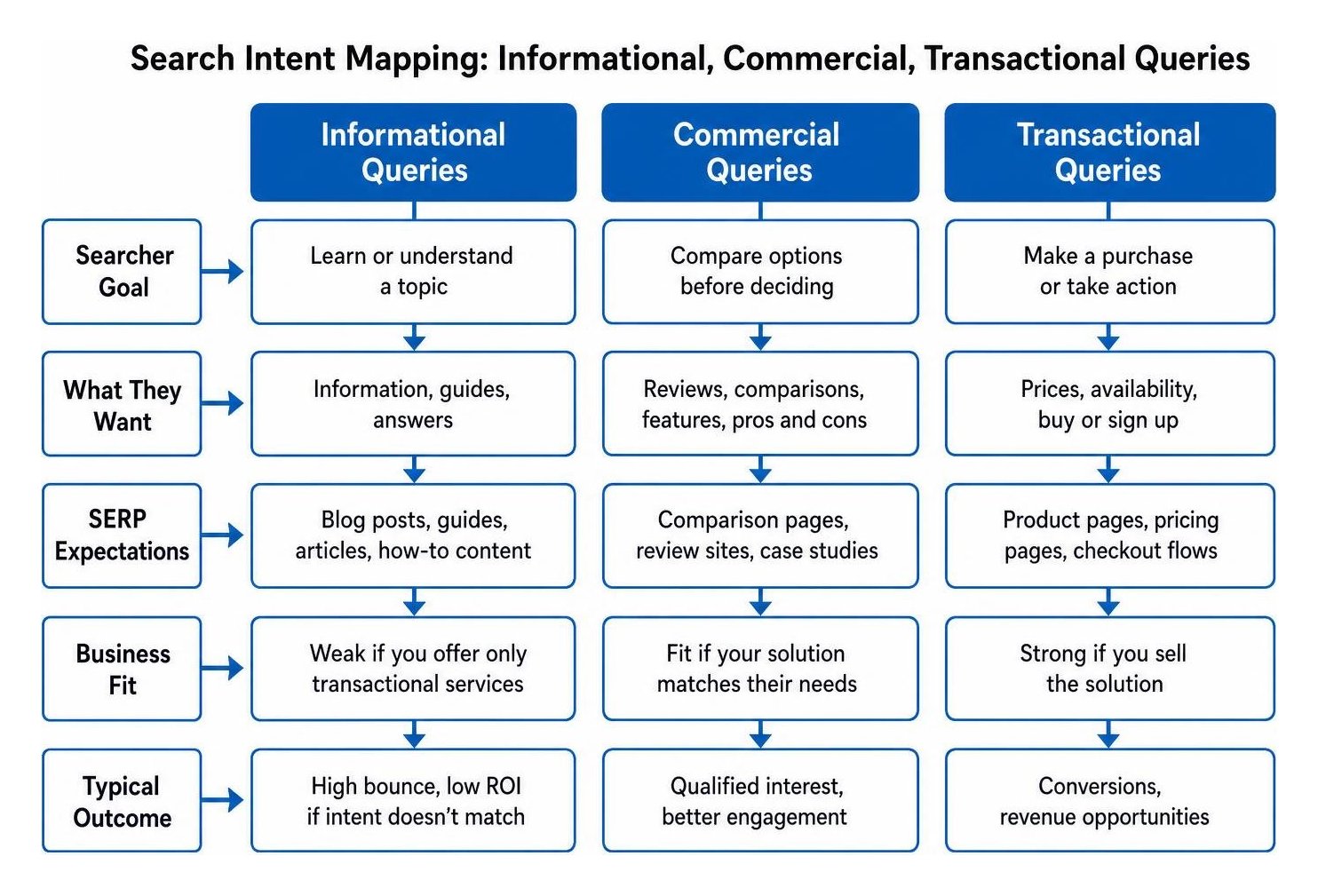
Search intent reveals poor keyword fit when the primary goal of the searcher does not align with your business model or the page format required by Google.
Evaluating search intent ensures that you understand whether a user wants information, a comparison, or an immediate purchase. If a competitor ranks for a broad term using an e-commerce catalog or an exhaustive free tool, but your website only provides custom consulting services, creating a standard blog post will rarely win top placement or convert visitors.
Understanding how to analyze user intent behind search queries allows you to examine the live search engine results page (SERP). If the top 10 positions are dominated by broad educational guides and you only offer transactional services, the intent gap will lead to high bounce rates and poor ROI.
How Can You Recognize an Audience Mismatch in Competitors' Ranking Keywords?
An audience mismatch occurs when a search term attracts an entirely different customer segment, buyer persona, or budget tier than what your business serves.
Even when you and a rival offer similar core solutions, differences in product-market fit can make a competitor keyword completely irrelevant. For instance, an enterprise provider might target search terms containing "enterprise-scale" or "global deployment," while your business specializes in agile implementations for small teams. Targeting enterprise-focused phrases brings visitors who will quickly leave when they realize your pricing or service scope does not fit their requirements.
| Query Type | Example Competitor Term | High-Intent Alternative | Why It Matters |
|---|---|---|---|
| Broad Head Term | "Accounting software" | "Contractor accounting software setup" | Lowers competition and targets specific operational needs. |
| Enterprise Query | "Enterprise project management tools" | "Small business workflow templates" | Filters out buyers seeking multi-tier enterprise support. |
| DIY / Free Query | "Free legal contract templates" | "Custom commercial contract drafting" | Disqualifies non-paying searchers who will never purchase services. |
| Informational Head | "What is web design" | "Custom B2B website redesign services" | Captures prospects ready to hire rather than students researching. |
When Do High Keyword Difficulty and Authority Gaps Waste Resources?
Targeting keywords with extreme difficulty scores wastes time and budget when established legacy competitors dominate search results with massive backlink profiles and high domain authority.
In SEO, a high keyword difficulty score indicates that the top results have hundreds of referring domains, deep topical authority, and years of brand recognition. A broad head term with 100,000 monthly searches provides zero value if your domain cannot break onto page one. Knowing how to analyze keywords helps you identify realistic ranking targets instead of burning resources chasing terms held by national aggregators and major publications.

How Can You Spot Flawed Metrics in Competitor SEO Reports?
You can spot misleading competitive SEO metrics by looking for branded keyword inflation, inaccurate clickstream traffic models, and disconnected revenue figures.
Third-party SEO dashboards estimate search traffic by multiplying average search volume by generic positional click-through rates. These models often compound errors significantly. Furthermore, competitors often receive substantial organic traffic from searches for their own brand names, offline advertising campaigns, or viral top-of-funnel listicles that never produce a single paying customer. Analyzing traffic estimates without verifying commercial intent gives a false sense of what is actually driving business growth.
How Can You Filter Competitor Keywords for Profitable Growth?
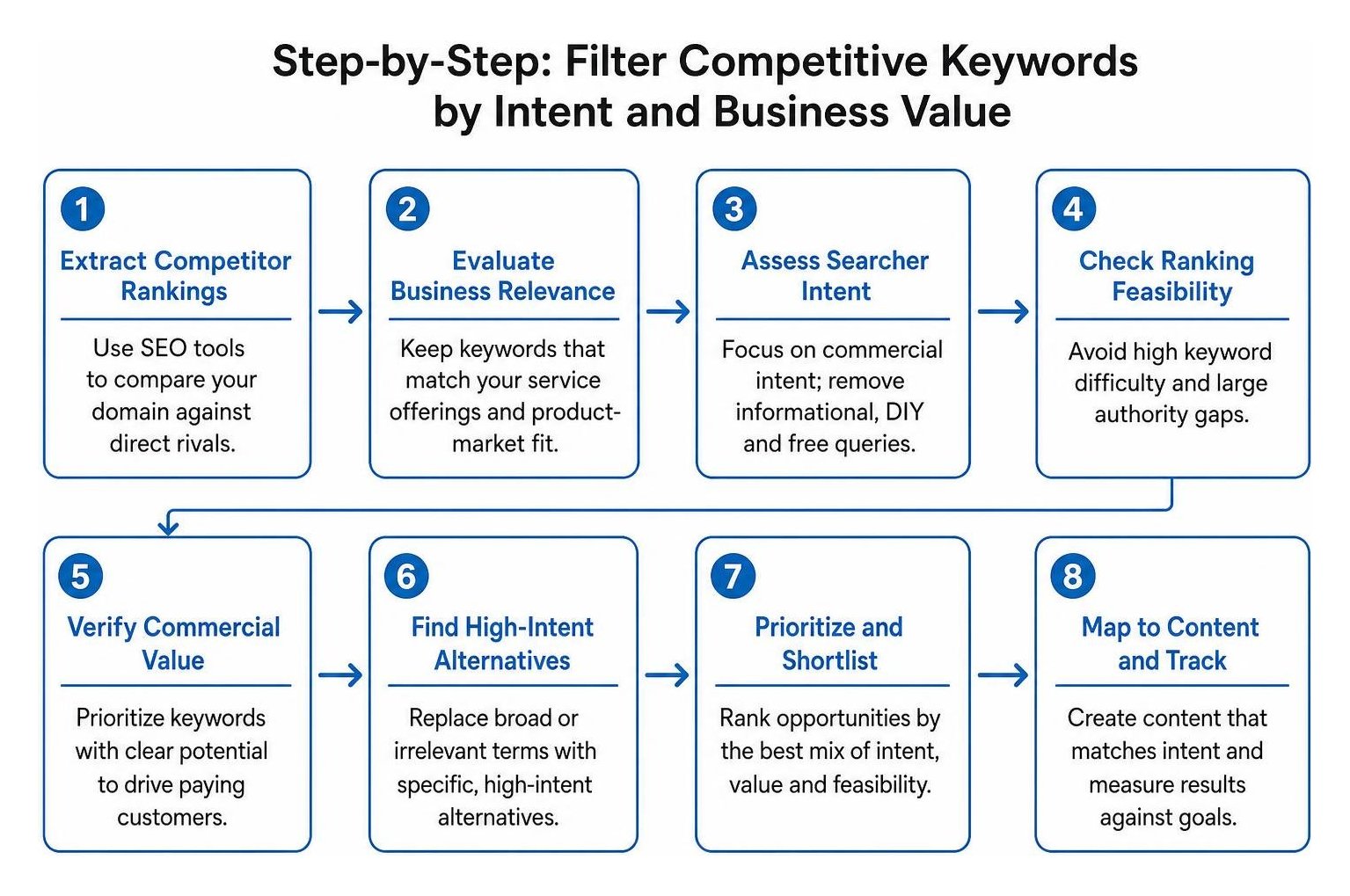
Filter competitor keywords by evaluating business relevance, searcher buying stage, ranking feasibility, and direct commercial value before creating any content.
According to foundational research in Forbes on the long-tail keyword strategy, highly specific search terms frequently deliver higher conversion rates and lower competition than broad head terms. Instead of blindly replicating a competitor's keyword inventory, use a disciplined vetting framework that isolates profitable search queries.
How Do You Run a Revenue-Focused Keyword Gap Analysis?
Run a revenue-focused keyword gap analysis by extracting competitor rankings, removing non-commercial queries, and prioritizing phrases that directly match your service offerings.
- Perform a Competitive Gap Audit: Use SEO tools to compare your root domain against direct rivals to identify missing terms.
- Apply a Commercial Value Score: Assign a simple score (0 to 3) to each keyword based on how closely it ties to your core revenue services.
- Establish a Focused Keyword Research Strategy: Prioritize high-intent phrases that target specific customer pain points over high-volume vanity terms.
- Target High-Intent Terms: Focus on finding the most profitable search terms and keywords for your business that demonstrate immediate purchase or inquiry intent.
- Complete Systematic Keyword Mapping: Assign each vetted keyword cluster to a dedicated, purpose-built page on your website to ensure search engines understand your topical focus.
How Can You Turn High-Intent Keyword Opportunities into Content Assets?
Turn vetted keyword opportunities into revenue-generating assets by creating comprehensive pages that resolve user queries and seamlessly guide visitors toward taking action.
Take time to explore key types of SEO keywords and how they work to select the right content format—such as service pages, comparison matrices, or detailed implementation guides. Structure your content around tightly organized topical clusters, while reviewing the keyword cannibalization definition to make sure new pages do not compete with your existing URLs for the same search queries.
At SmallBizSEO, we implement our data-driven Velocity framework to execute strategic competitor keyword optimization that drives tangible leads rather than empty traffic spikes.
Build a Higher-Converting Search Strategy
Winning in organic search is not about copying every keyword your competitors rank for—it is about capturing the specific queries that generate real business revenue. By filtering out vanity metrics, aligning content with genuine search intent, and targeting achievable search terms, you build a sustainable foundation for long-term customer acquisition. Focus on commercial relevance, target the right audience, and let your search strategy drive measurable growth.