Types of SEO Keywords: Intent, Dimensions, and Mapping

Types of SEO Keywords: The Short Answer
SEO keywords can be described along several dimensions, not as one fixed list. Search intent explains the task behind a query: learning, finding a known destination, comparing options, or taking action. Other dimensions describe whether a query mentions a brand, includes a geographic signal, has relatively broad or narrow demand, or belongs with a particular page type.
The practical question is not simply how many searches a phrase receives. It is what the searcher needs, what the live results suggest they expect, and whether an existing or planned page can meet that need better than the alternatives.
This guide explains the most useful keyword dimensions, shows how they overlap, and provides a practical worksheet for mapping related queries to pages without relying on rigid word-count rules or conversion promises.
Related resources for learning more about types of SEO keywords:
Keyword Types Are Dimensions, Not a Single List
A query can have more than one useful label. For example, a search can be commercial in intent, non-branded, geographically modified, and relatively low in demand at the same time. Treating these traits as overlapping dimensions makes keyword research more accurate and helps avoid choosing a page format from a label alone.
Start by identifying the words and phrases an audience uses, then use available search and customer evidence to decide which pages deserve attention. An evidence-led approach keeps keyword research focused on useful page improvements rather than chasing rankings.
| Dimension | What it describes | Example label | How to use it |
|---|---|---|---|
| Intent | The task a searcher is trying to complete | Informational, navigational, commercial, transactional | Compare the live results before choosing a page format. |
| Brand | Whether a brand name is present | Branded or non-branded | Decide whether the page should serve existing demand or introduce the business. |
| Geography | Whether the query contains a geographic signal or proximity need | Geographic modifier or “near me” language | Consider whether the page needs local proof, service details, or a location-specific experience. |
| Popularity | Relative search demand and specificity | Broad head term or lower-frequency long-tail query | Use demand as one input, not a prediction of difficulty or value. |
| Page role | The job the page performs on the site | Guide, service page, comparison, category, or tool | Group related queries when they need the same core answer and page type. |
What Is Search Intent, and Why Can It Be Mixed?
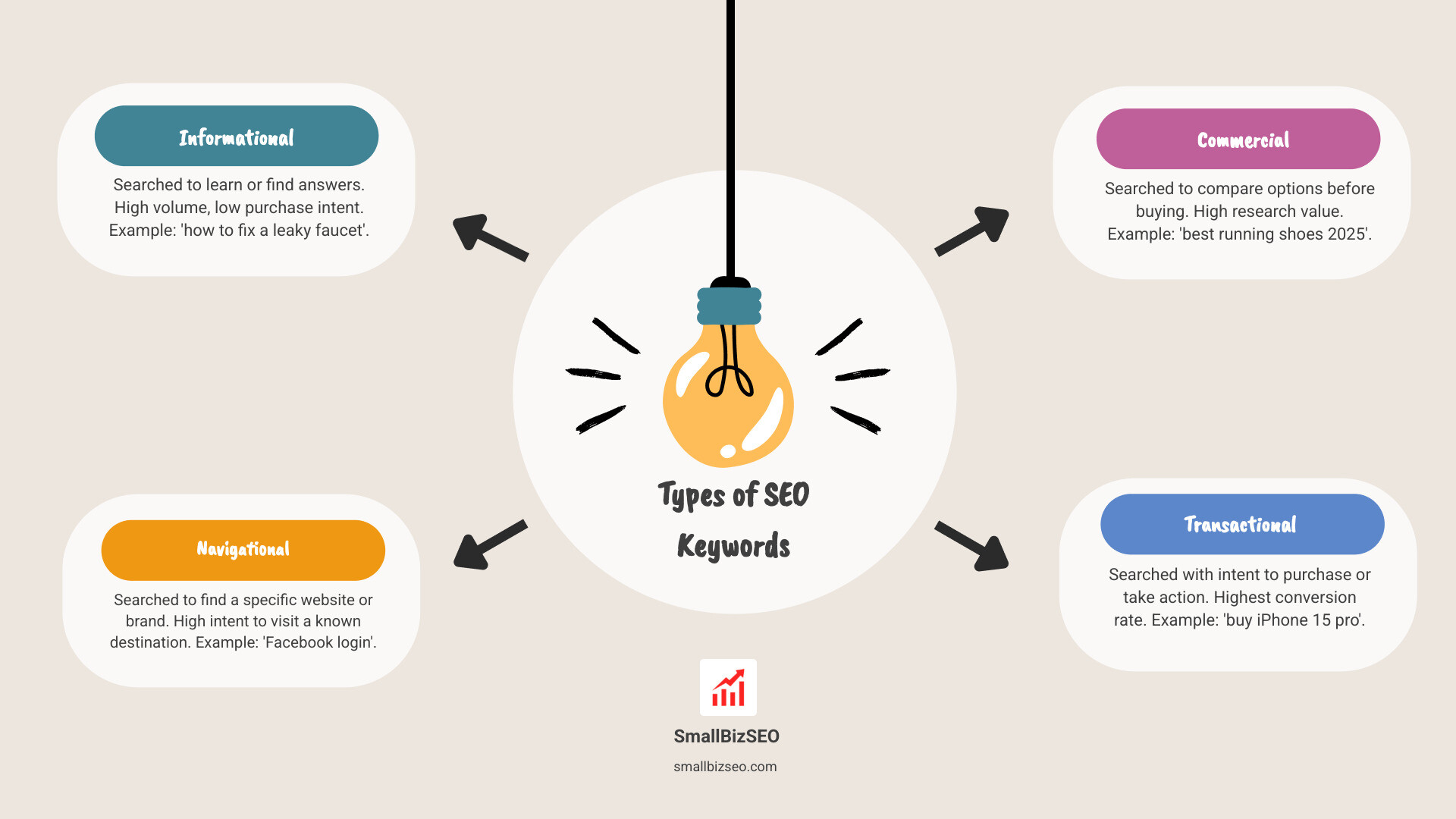
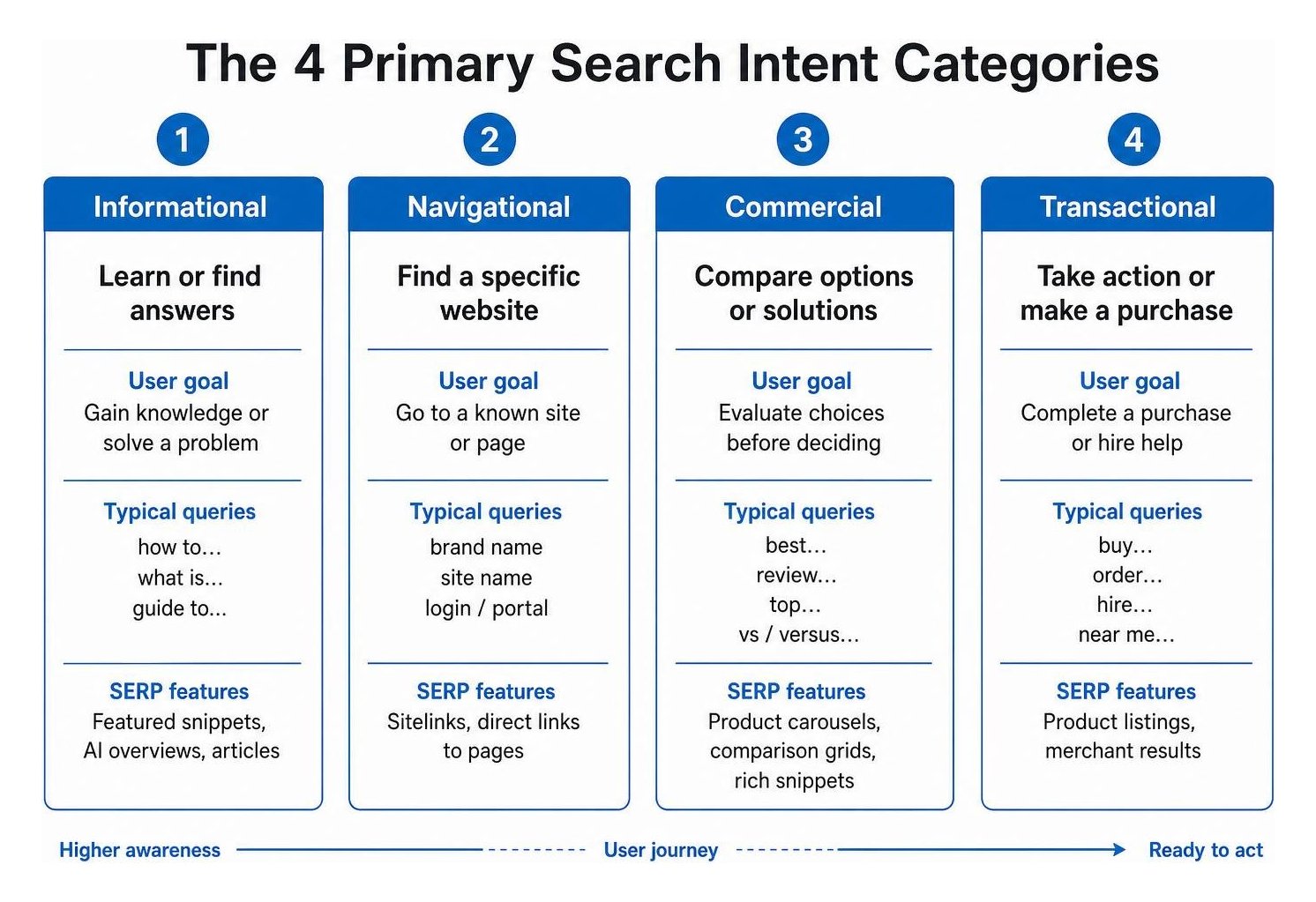
Search intent is the goal behind a query. Informational searches seek an explanation, navigational searches seek a known destination, commercial searches compare options, and transactional searches signal a next step. These labels are useful starting points, but a query can carry mixed intent. A person comparing repair options, for example, may also be ready to contact a provider.
Use the live search results as evidence, not as an infallible rule. Look for the formats that recur, the questions they answer, and whether guides, service pages, comparison pages, or other formats dominate. That review helps test whether a proposed page can satisfy the query.
- Informational: The searcher wants an explanation, process, or definition. A guide, glossary entry, or tutorial may be a fit when the results reward educational content. Fundamentals from keywords to content optimization can help shape an educational page around the reader’s need.
- Navigational: The searcher is trying to reach a known website, brand, or feature. These queries are often best served by the destination itself rather than a new educational article.
- Commercial: The searcher is evaluating approaches, providers, or products. Useful pages often explain decision criteria, alternatives, and trade-offs without pretending a single format will win every result. How to analyze keywords can help test the comparison intent.
- Transactional: The searcher appears ready to begin a purchase, booking, contact, or other action. A focused service or product page can be appropriate when it provides the details needed to act.
For each label, confirm the page type against the results before building content. The goal is a useful match, not a formula based on a few trigger words.
What Do Short-Tail and Long-Tail Really Mean?
Short-tail and long-tail describe the distribution of search demand, not a fixed number of words. Broad terms often sit near the high-demand head of the curve, while the many more specific, lower-frequency queries form the long tail. A long query is not automatically easy to rank for or more likely to convert, and a short query is not automatically broad.
Word count, a third-party difficulty score, and apparent specificity can be helpful research signals, but none proves that a query is easy, valuable, or conversion-ready. Review the results, the strength of the competing pages, the business fit, and the evidence available to create a better answer.
Use long-tail research to uncover specific needs and language customers use, then evaluate whether the topic belongs on an existing page or deserves a new one. Google’s guidance on keyword research and this guide to Google Keyword Planner explain ways to expand ideas.
How Do Brand, Geography, Popularity, and Page Role Fit?
Seed terms are starting concepts for research. Brand, geography, popularity, and page role are separate lenses that help determine what the page should do. They do not replace intent, and none by itself proves that a query will produce a business result.
Use these dimensions together when deciding whether to create, improve, combine, or separate pages:
- Seed terms: Broad concepts used to discover language, questions, and related services. They are research inputs, not automatic page titles.
- Branded and non-branded queries: Branded searches include a business or product name; non-branded searches describe a need without naming a provider. Both can be important, but they serve different audiences. Checking competitor keywords can provide additional non-branded topic ideas to assess, not copy blindly.
- Geographic signals: A query may include a place name, a proximity phrase, or an implied local need. Treat this as a modifier that can coexist with any intent. Generative AI SEO and local discovery offers related context for discovery-oriented searches.
- Popularity and specificity: Search demand can help prioritize research, but it should be weighed with business value, relevance, effort, and the quality of the current results.
- Page role: A guide, service page, category, comparison, or tool should be chosen because it meets the need shown in the results, not because a keyword label dictates it.
How Should Related Keywords Support a Page?
Related queries can help a page cover the questions, terminology, and decisions that matter to the reader. The aim is not to insert a predetermined list of terms, but to build a complete, accurate resource that addresses closely connected needs.
A page can legitimately serve multiple related queries when those searches need the same central answer and page type. Likewise, similar wording does not always belong on one page if the results show clearly different needs. Use query overlap, search-result patterns, and the page’s purpose to make that decision. Focus on accurate coverage, clear language, and genuinely helpful supporting details rather than outdated keyword-labeling theories.
Organize related topics where they improve clarity for readers, then check that headings, examples, and links genuinely support the page’s purpose. Google’s SEO Starter Guide advises against repetitive keyword use; clear, people-first coverage is a stronger goal than mechanical keyword repetition. For implementation detail, see these on-page SEO techniques for measurable growth.
Map Queries to Helpful Pages
Keyword mapping is the process of deciding which related queries a page should answer and which need a different page. Prioritize opportunities with a practical balance of business fit, evidence from the results and your own data, reader relevance, and the effort required to create or improve the page.
Use this worksheet for each potential page. It is a decision aid, not a promise of rankings or revenue:
| Small-business scenario | Intent signal | Sample query | Best page role to test | Query overlap decision |
|---|---|---|---|---|
| Plumbing company helping homeowners with water-heater problems | Informational with possible commercial intent | “why is my water heater leaking” | Troubleshooting guide with clear next steps | Combine with closely related diagnostic questions if the results and answer are substantially the same. |
| Same business, reader comparing options | Commercial | “water heater repair or replacement” | Comparison guide or service decision page | Keep separate from a basic troubleshooting guide when the searcher needs cost, trade-offs, and decision support. |
| Same business, reader ready to act | Transactional | “schedule water heater repair” | Service or contact page | Keep separate when the results favor action-oriented pages and the user needs booking details. |
How Should a Small Business Prioritize Keyword Opportunities?
Prioritize a keyword opportunity by asking four questions: Does it fit the business? Is there evidence of demand or existing visibility? Is the topic relevant to a real customer need? Can the site create or improve a page with a credible answer without disproportionate effort? Difficulty estimates may inform that conversation, but they should not make the decision alone.
A practical prioritization pass can look like this:
- Business fit: Does the query connect to a service, product, audience need, or meaningful next step?
- Evidence: What do Search Console, Google Trends, the live results, customer questions, and the current page reveal? A keyword gap analysis can provide additional evidence to review.
- Reader relevance: Can the page answer the question clearly and accurately, including the likely follow-up?
- Effort: What content, proof, technical work, or internal linking would be needed to make the page genuinely useful? Use this guide to increase organic keywords across your site as an implementation reference.
When the evidence is mixed, frame the choice as a testable hypothesis and review the page’s query data after changes rather than promising a particular result.
When Should Multiple Queries Share a Page?
Multiple queries can share a page when they express the same underlying need and the search results point to the same kind of answer. There is no universal one-page-per-keyword rule. Start with one clear page purpose, then use related queries to shape the sections, examples, and internal links.
Separate pages when the evidence shows different intent, audience, or page format. Consolidate or clarify pages when they compete to answer the same need without offering distinct value. This guide to keyword cannibalization can help identify overlaps, but the decision should be based on the pages and queries involved rather than a blanket rule.
A well-maintained keyword map makes content decisions easier to explain and review. Businesses that need coordinated keyword research, content planning, technical SEO, and link building can explore SmallBizSEO’s SEO services for a tailored strategy.
Build a Repeatable Monthly Keyword and Content Workflow
Keyword mapping works best as an ongoing operating rhythm, not a one-time setup task. Each month, review query patterns, customer questions, and page performance to decide what deserves an update, a new page, stronger internal links, or outreach support.
What Should a Monthly Keyword and Content Workflow Include?
- Review query patterns and customer questions. Use Search Console, sales conversations, support questions, and on-site behavior to identify changing language, unanswered questions, and pages that attract the wrong audience.
- Refresh existing pages first when they can better meet the need. Improve accuracy, examples, page structure, internal links, and calls to action when a page already has the right purpose but needs a stronger answer.
- Commission useful original guides and service content. Create new content only when the topic needs a distinct page and the business can provide a credible, helpful answer. SmallBizSEO’s SEO content services can support research, planning, and production for that work.
- Strengthen internal links. Link related guides, service pages, and decision-stage resources where the connection helps readers continue their research or take an appropriate next step.
- Earn relevant editorial links through outreach. Useful content can give outreach a stronger destination, while link-building services can help pursue relevant editorial opportunities. Earned outreach is ongoing relationship and editorial work, not a checklist item or an assurance of any particular ranking result.
- Measure qualified inquiries and iterate. Track whether the work is attracting relevant leads, not merely visits or impressions. Use those findings to refresh, expand, combine, or retire content decisions in the next cycle.
Content improvement and earned outreach reinforce each other over time, but neither guarantees rankings or a fixed volume of inquiries. The goal is to keep improving the usefulness, discoverability, and business fit of the pages a site publishes.
Keep Your Keyword Map Grounded in Evidence
Keyword labels are useful when they clarify a searcher’s need, not when they substitute for evidence. Start with the query, inspect the live results, compare related searches, and decide whether an existing page can provide the answer or a distinct page is warranted.
Use the worksheet to document the business fit, evidence, relevance, effort, intended page role, and overlap decision for each topic. Then improve the page with the strongest case, measure the resulting query data, and revise the hypothesis when the evidence changes. For coordinated ongoing SEO work, explore SmallBizSEO’s SEO services or book a consultation.