Field-Testing AI Service Recommendations: A Framework for Operational Accuracy

How can you test whether AI recommendations fit real service areas and needs?
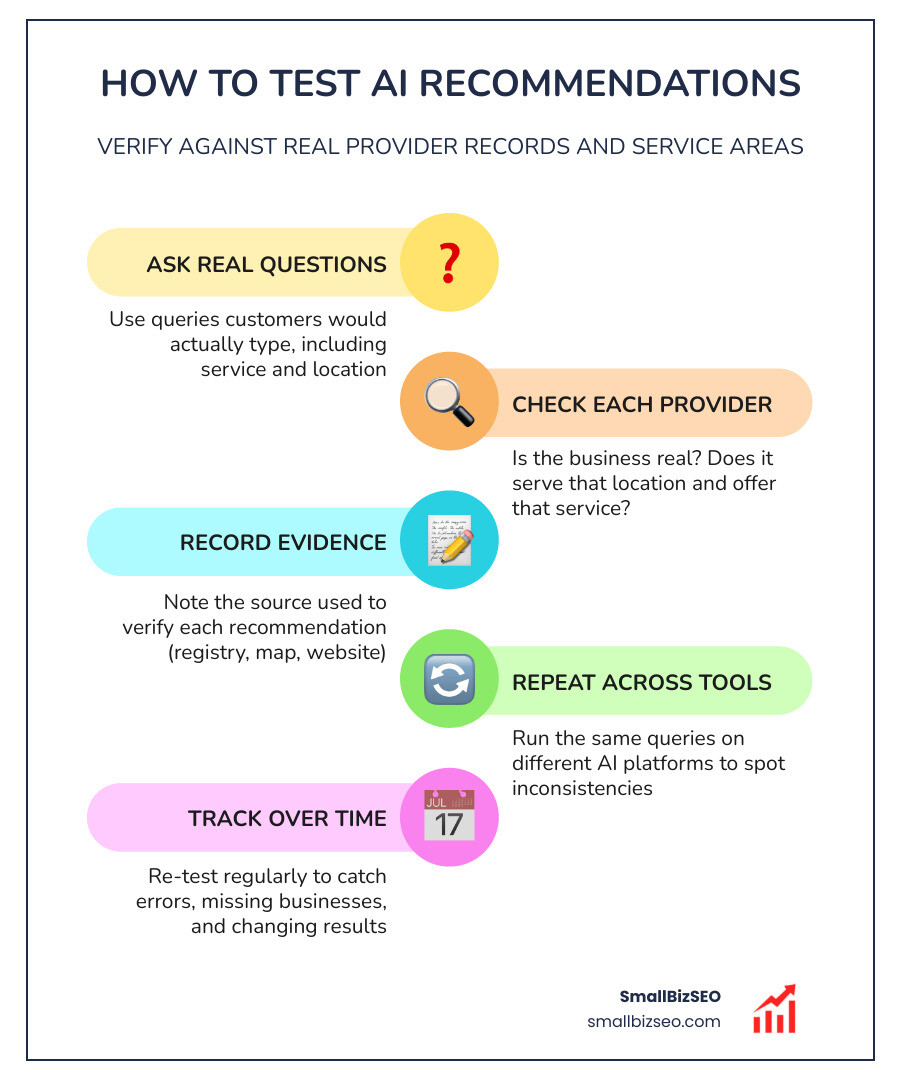
Start testing whether AI recommendations fit real service areas and needs with a few questions your customers would actually ask. Include the service and location in each question. Then check every suggested provider: Is it a real business? Does it serve that location? Does it offer the service the customer needs? Record the answer and the source you used to verify it.
A provider can be real but still be the wrong referral. Repeat the same questions across AI tools and over time to spot errors, missing businesses, and changing results.
I'm Clayton Johnson, founder of SmallBizSEO, where I work on SEO, content, and AI-driven discovery for small businesses. My approach to testing whether AI recommendations fit real service areas and needs starts with clear customer questions and verifiable business information.
Introduction: How Can AI Decision Support Match Real-World Service Demands?
AI decision support matches real-world service demands only when recommendation models are actively verified against live operational registries, verified service territories, and the exact intent behind user searches.
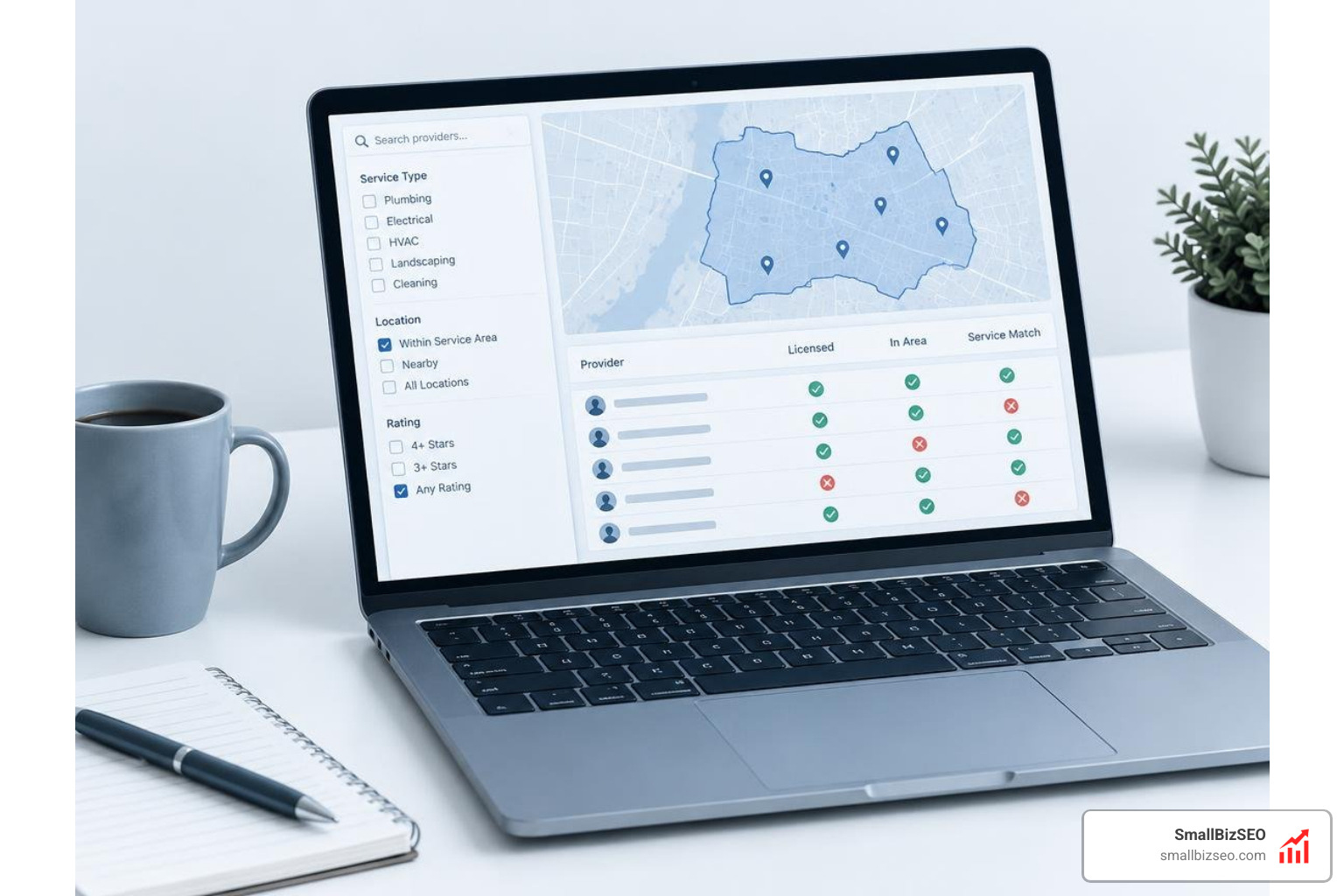
When consumers ask generative AI engines for local trades, medical specialists, or legal counsel, they expect reliable referrals. However, general-purpose large language models (LLMs) operate probabilistically. Without strict retrieval mechanisms, these models often produce convincing names that fail to correspond to licensed, practicing professionals within the requested geographic boundary.
Establishing baseline accuracy requires measuring how well an AI assistant identifies valid entities, confirms physical service boundaries, and interprets complex constraints. High-performing systems bridge the gap between user intent and real-world execution by combining retrieval-augmented generation (RAG) with live directory verification. Evaluating these mechanics protects consumer trust and ensures businesses maintain authentic visibility in modern AI-driven discovery channels.
Protocol: How Can You Test Whether AI Recommendations Fit Real Service Areas and Needs?
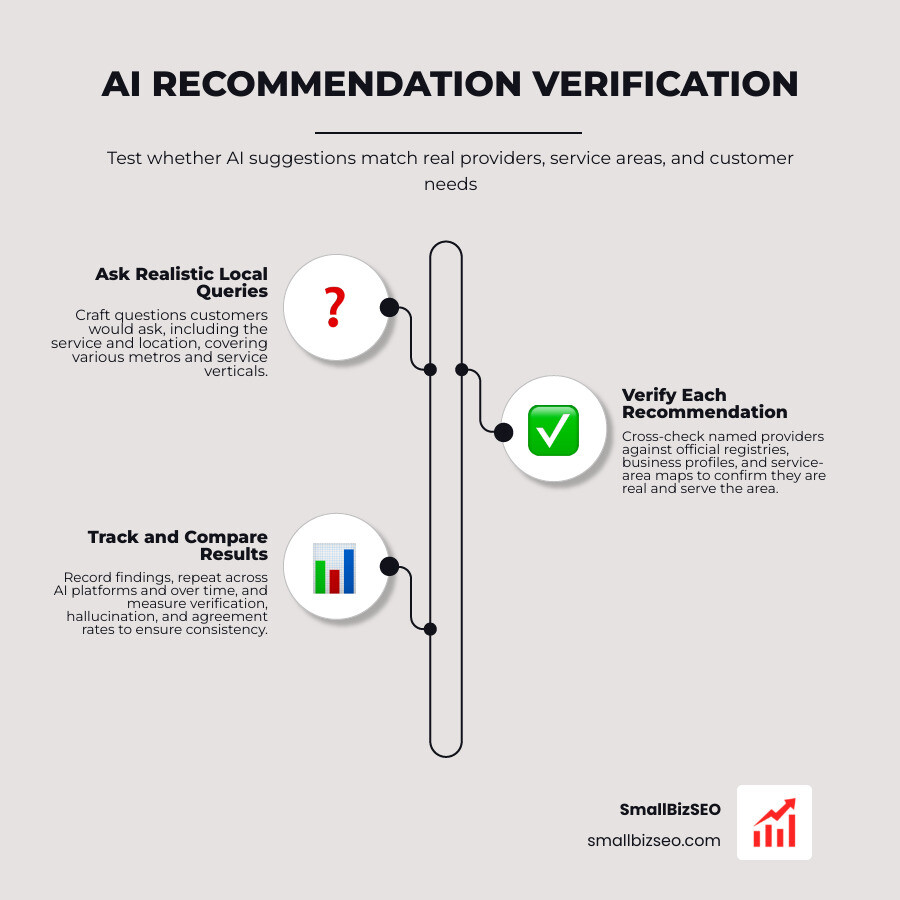
To test whether AI recommendations fit real service areas and needs, query multiple AI platforms using a standardized set of realistic customer prompts, then evaluate each named provider against authoritative public registries, business profiles, and service-boundary maps.

A reliable testing protocol avoids vague, conversational queries such as "find a plumber near me." Instead, it uses structured, golden-set testing prompts that explicitly specify the needed service, urgency, and target municipality.
As highlighted in scientific research on AI provider recommendations in local service markets, relying purely on model parametric memory causes massive referral failures. Testing protocols must evaluate assistants with live web retrieval enabled versus disabled to understand how dynamic indexing affects referral quality. Every generated provider must be cross-referenced against authoritative sources, such as state licensing boards, official corporate registries, and primary digital assets, to ensure the provider actually covers the requested territory.
Core Verification Metrics: Which Measures Show Whether AI Recommendations Fit Real Service Areas and Needs?
Track verification rates, hallucination frequencies, cross-platform agreement rates, and regulatory compliance flags to determine if recommendations match actual operational capabilities.
- Verification Rate: The percentage of recommended entities that represent active, verifiable businesses operating within the target area. In rigorous testing, dental queries often reach a 77.0% verification rate due to dense public registries, whereas specialized trade categories like HVAC can drop to 35.8%.
- Hallucination Rate: The share of generated business names, phone numbers, or physical addresses that do not exist or represent fabricated entities.
- Agreement Rate: The consistency with which different AI engines recommend the same provider for an identical query, which typically ranges between 6.6% and 20.9% across competitive service verticals.
- Regulatory Disclosures: The frequency with which an AI surfaces providers with disciplinary actions. In financial advisory audits, unaugmented models selected firms carrying regulatory misconduct disclosures at 3.6 times the baseline registry rate, whereas search-enabled models dropped significantly below the baseline.
Understanding these metrics is vital for mitigating unchecked AI errors in enterprise workflows to prevent compliance and operational risks.
| Service Domain | Verification Metric Focus | Baseline Model Accuracy (Search Off) | Search-Enabled Accuracy (Search On) |
|---|---|---|---|
| Primary Care Physicians | Clinical Registry Match | 4.0% – 11.0% | 64.0% – 71.0% |
| Financial Advisory | Disciplinary Record Filter | 3.6x Base Misconduct Rate | Below Base Misconduct Rate |
| Skilled Trades (Boise/Omaha) | Operational Business Existence | 82.0% | 97.6% – 98.3% |
| Local Legal Services | Bar Verification & Active Practice | 28.4% | 49.3% |
| Health Insurance Plans | Near-Optimal Cost/Benefit Plan | 36.0% | 57.0% – 73.0% |
Retrieval and Hallucinations: How Does Accuracy Vary Across Geographic Metros?
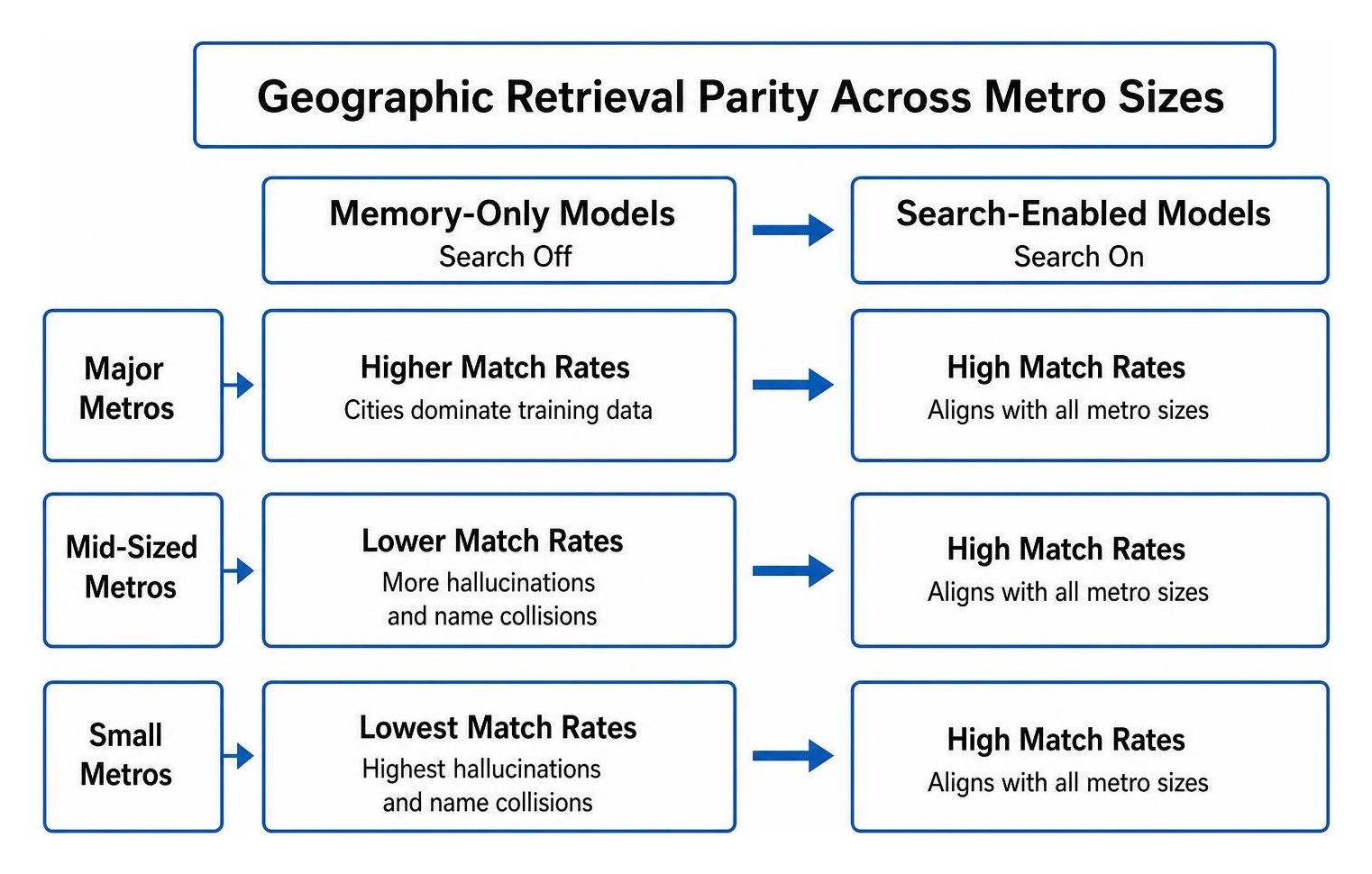
Without live web search retrieval, AI recommendation accuracy drops dramatically outside top-tier metropolitan areas, but search-augmented retrieval restores geographic parity across smaller markets.
When models rely solely on static training memory, they exhibit severe geographic bias. Prompts targeting densely populated urban centers surface real businesses more frequently because large cities dominate online training corpora. In contrast, smaller cities suffer from high hallucination rates and "name collisions"—instances where an AI recommends a real professional who practices in an entirely different state.
Auditing generative engines across diverse markets reveals that enabling live web retrieval eliminates this metro-size penalty. With retrieval active, match rates across small and medium-sized markets align closely with major metropolitan centers. Systematically auditing generative search results across different user locations and evaluating geo-targeted query relevance ensures that recommendations remain accurate regardless of population density.
Step-by-Step Workflow: How Do You Test Whether AI Recommendations Fit Real Service Areas and Needs?
Execute a structured, six-stage auditing workflow that pairs fixed customer prompts with multi-point record verification.

- Construct Standardized Question Sets: Develop 5 to 10 realistic customer prompts per service vertical. Structure queries using clear context, objective, and explicit city constraints (for example: "Emergency commercial pipe repair provider in Boise with 24/7 service").
- Execute Across Controlled Sessions: Query target AI platforms using clean sessions without prior conversation history to avoid personalization bias.
- Capture Complete Output Records: Log the exact response, timestamp, named entities, listed contact details, and source citations, following standard methods for tracking generative AI citation rates and accuracy.
- Cross-Check Primary Business Data: Verify that the named business exists on primary mapping platforms and state business registries. Check that phone numbers and website URLs resolve directly to the named entity rather than third-party aggregators or dead domains.
- Confirm Service Area Coverage: Review provider websites or registry filings to confirm they actively service the requested municipality.
- Classify and Score Outcomes: Label each result as Discovered (mentioned in context), Cited (used as a reference source), or Recommended (explicitly suggested as the preferred solution).
Multi-Model Consistency: How Can You Compare AI Recommendations and Reduce Operational Risks?
Compare recommendations by querying multiple independent AI engines simultaneously to identify platform-specific biases, hallucination patterns, and algorithmic drift.

Testing identical service prompts across distinct generative engines—such as ChatGPT, Claude, Gemini, and Perplexity—reveals significant variance. In field tests across home-service categories, competing AI assistants rarely select the same business as their top recommendation, matching first-choice picks in only 6 out of 72 comparisons.
Because each platform weighs directory signals, review depth, and web citations differently, businesses cannot assume that visibility on one assistant guarantees presence on another. Tracking these variations helps organizations evaluate why generative search engines keep changing their top brand picks and build resilient digital discovery strategies.
Model Discrepancies: How Do AI Recommendations Compare With Google Map Pack Results?
AI recommendation lists diverge sharply from traditional map rankings, with less than a quarter of AI picks appearing in Google's top three local map results.
In empirical audits of local business recommendations, only 22.8% of AI-recommended providers appeared within Google's top three map pack positions. While ChatGPT exhibited the highest alignment at 31.0%, Claude demonstrated lower overlap at 18.5%.
This disparity occurs because AI assistants evaluate a broader set of unstructured web citations, brand mentions, and third-party review platforms rather than relying strictly on proximity and traditional local search signals. Businesses must examine these differences when analyzing generative AI brand recommendation gaps while adhering to emerging frameworks in scientific research on international AI evaluation standards.
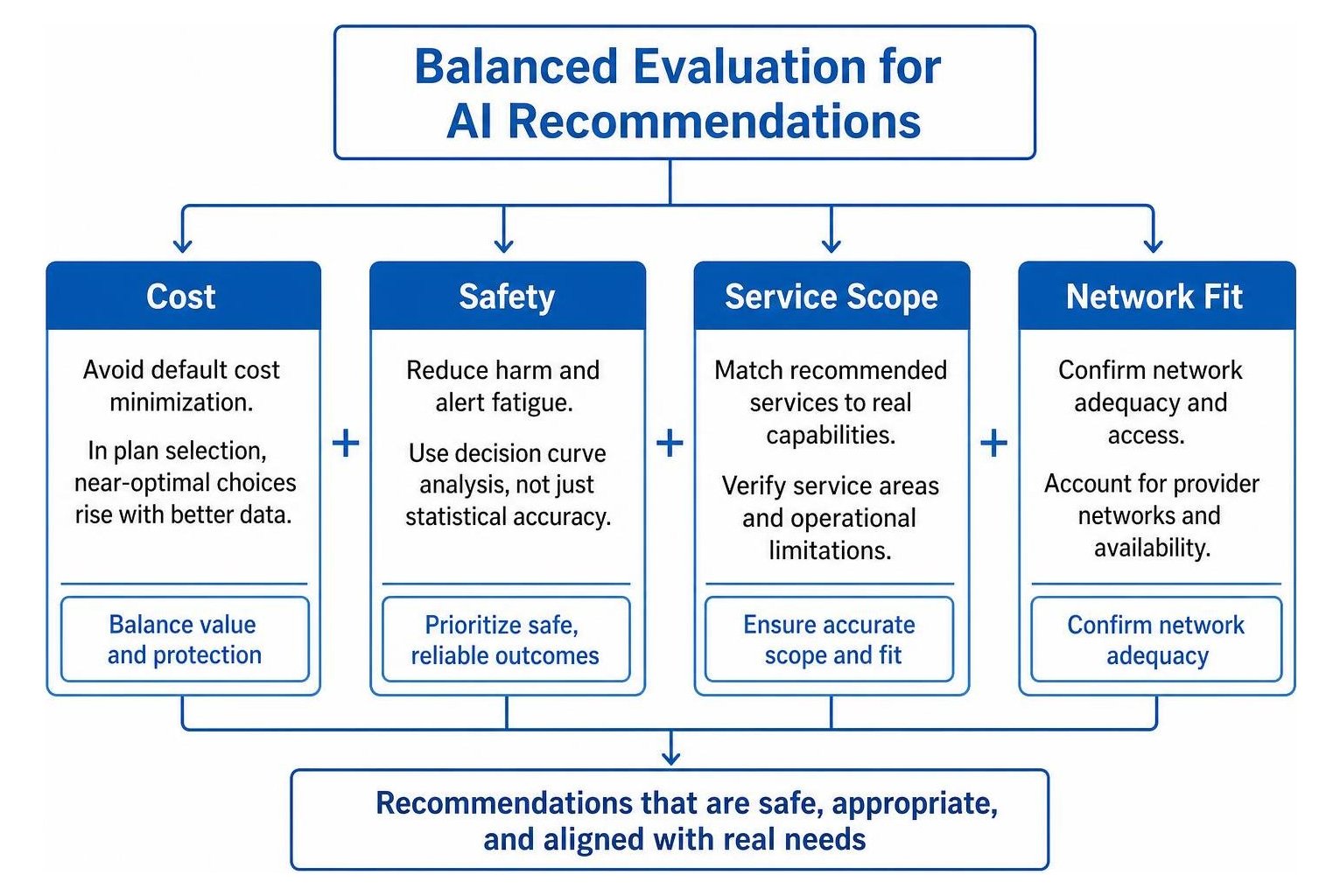
User Needs, Cost, and Safety: How Should Testing Balance These Factors?
Testing must balance cost minimization against safety, operational capabilities, network adequacy, and clinical utility.
When evaluating complex services like healthcare or insurance, AI models often default to simple cost minimization. In health plan selection benchmarks, standard models select near-optimal plans only 57% of the time, often underestimating risk protection needs or doctor network limitations. However, when models receive structured clinical context and market pricing data, optimal selection rates rise to 73% and 90% respectively.
Clinical AI evaluation demonstrates similar dynamics. In hospital sepsis prediction, traditional statistical accuracy fails to measure real-world utility if high false-alarm rates cause alert fatigue (Scott et al., 2026). Decision curve analysis provides a better testing standard by balancing predictive effectiveness against workflow capacity.
At SmallBizSEO, we incorporate these multi-factor evaluation principles into our data-driven Velocity framework. By systematically auditing discovery signals, our technical SEO and content strategy help businesses build verified, authoritative digital footprints that AI assistants can accurately parse, cite, and recommend. To ensure your business surfaces correctly across AI platforms, explore optimizing brand visibility for generative search recommendations.
Systematic Auditing for Reliable AI Discovery
Testing AI recommendations requires rigorous verification against live business data, service territories, and complex customer constraints. As generative discovery engines increasingly guide consumer purchasing decisions, businesses and developers must implement structured benchmarking protocols to identify hallucinations, correct inaccurate citations, and maintain operational alignment. Regular, multi-model evaluation ensures that AI-driven recommendations deliver safe, accurate, and genuinely local service options to consumers.
Medical References
Scott IA, van der Vegt AH, Campbell V, Lane PJ, Rice M, Venkatesh B. "How Can Clinicians Decide if AI-Enabled Risk Prediction Models Are Fit for Purpose for Real World Use?." Journal of evaluation in clinical practice, 2026. PMCID PMC13456610.