How Generative Tech Is Taking Over: 30 Revealing AI Statistics

What Do AI Statistics Tell Us About Business Growth?
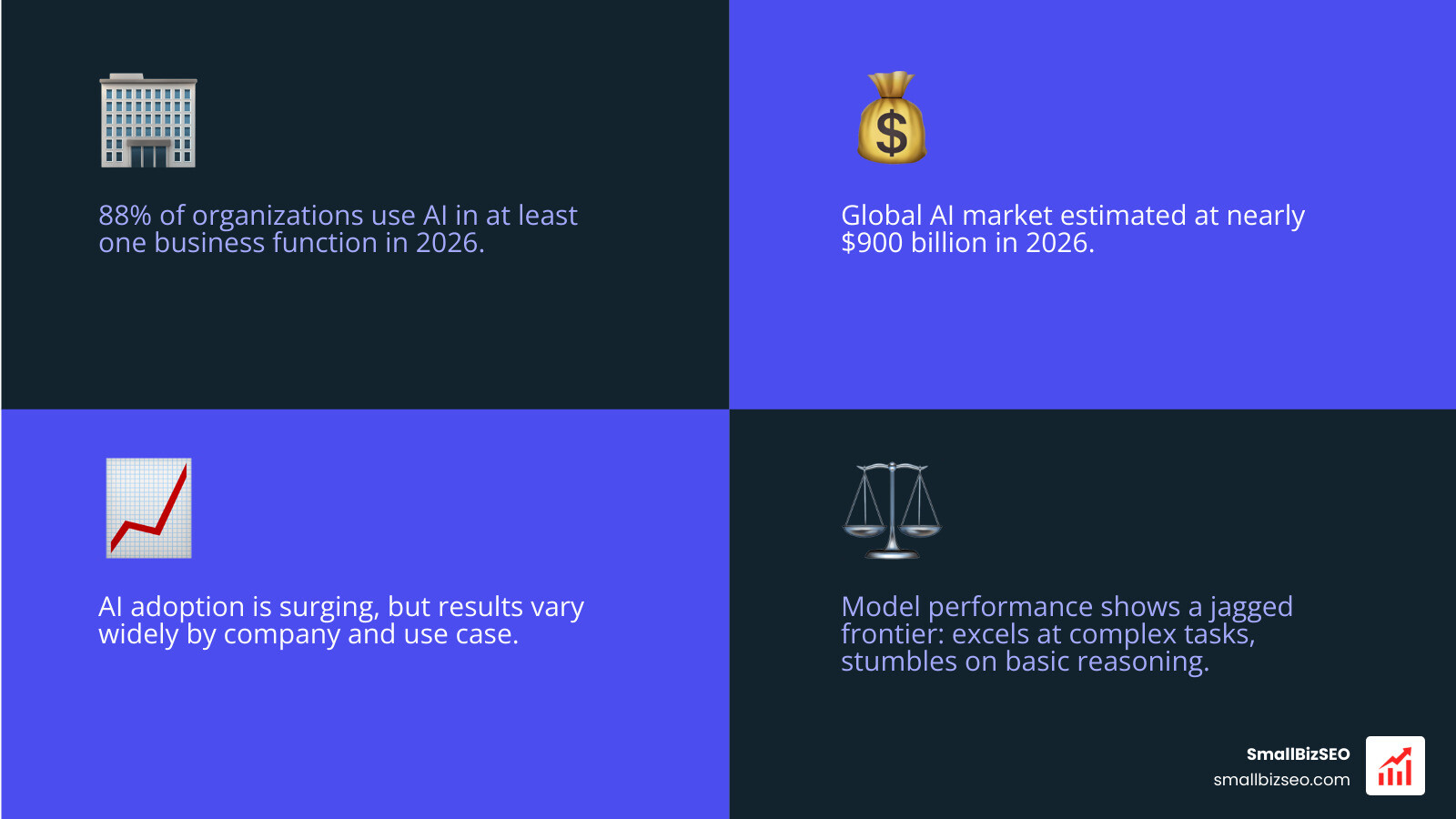
AI Statistics show fast growth, but not uniform results. An estimated 88% of organizations use AI in at least one business function, while one market estimate puts the global AI market near $900 billion. Those numbers show how widely AI has spread. They do not tell us whether every company is saving money or getting better results.
This article looks at 30 statistics on adoption, jobs, model performance, public trust, and AI agents. It also separates measured outcomes from forecasts, so the big numbers are easier to put in context.
I'm Clayton Johnson, founder of SmallBizSEO, where I help small businesses turn research into clearer content and stronger search visibility. My work with AI Statistics focuses on finding evidence owners can use to make better SEO decisions.
What Do AI Statistics Reveal About Market Growth, Enterprise Adoption, and Performance?
AI data highlights a rapid expansion across infrastructure, specialized industry deployments, autonomous systems, and digital workforces. While total adoption is surging, model performance reflects a jagged frontier where software excels at advanced technical challenges while occasionally stumbling over basic reasoning tasks.

What Do Current AI Statistics Reveal About Global Market Valuation and Infrastructure?
The global artificial intelligence market has reached an estimated valuation of $900 billion, driven by massive enterprise investments in compute power and foundational model training. Macroeconomic projections indicate that AI technologies could contribute up to $15.7 trillion to the global economy by the start of the next decade, transforming core business operations and software delivery.
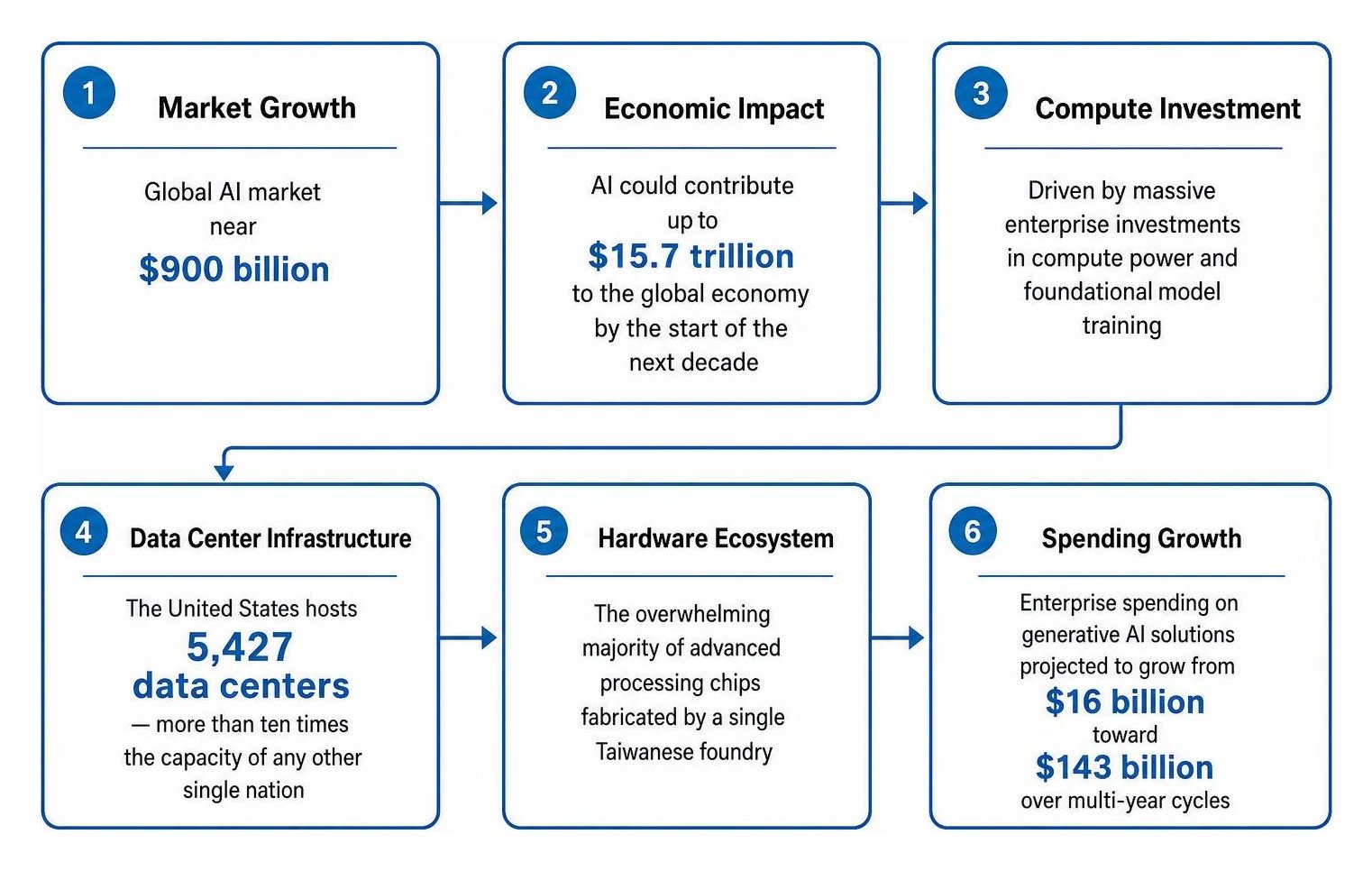
This commercial growth relies on an intensive physical footprint. The United States hosts 5,427 data centers—more than ten times the capacity of any other single nation. However, the hardware ecosystem remains concentrated, with the overwhelming majority of advanced processing chips fabricated by a single Taiwanese foundry.
Organizations seeking to capitalize on this expansion can review verified global AI investment and adoption statistics to benchmark their technical budgets. Furthermore, tracking enterprise spending on generative AI solutions demonstrates that annual software allocations are projected to grow from early baselines of $16 billion toward $143 billion over multi-year cycles. Practitioners can examine detailed cross-platform capability and model comparison data to assess raw compute efficiency against token operating costs.
| Metric | Measured Scale | Long-Term Projection | Primary Driver |
|---|---|---|---|
| Global Market Value | $900 Billion | $15.7 Trillion GDP Impact | Enterprise LLM Integration |
| Data Center Infrastructure | 5,427 U.S. Facilities | 945 TWh Energy Consumption | Frontier Model Training |
| Organizational Adoption | 88% of Enterprises | 63% Expanding Multi-Departmentally | Workflow Automation |
| Generative Software Spend | Accelerating Enterprise Capex | $143 Billion Solution Market | Agentic Pipeline Deployments |
What Are the Key AI Statistics for Healthcare, Finance, and Autonomous Systems?
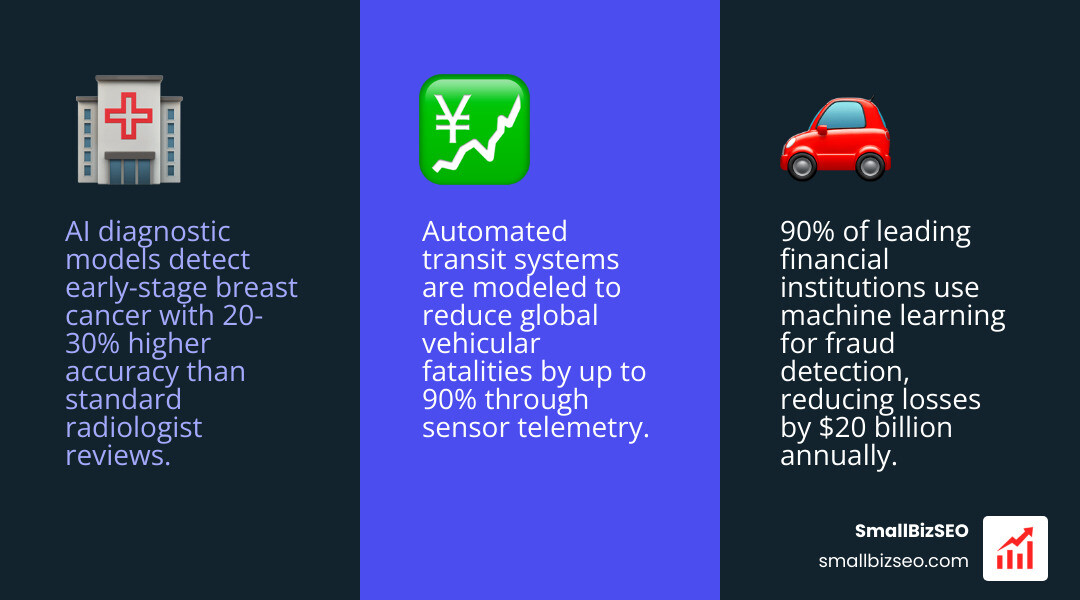
Specialized AI models are delivering high-precision outcomes across data-dense industries, significantly outperforming human baselines in pattern identification and real-time processing. In finance, 90% of leading financial institutions actively use machine learning systems for fraud detection, reducing industry-wide operational losses by an estimated $20 billion annually. Simultaneously, automated algorithms execute 70% of daily stock market transactions.
Clinical medicine and transportation show similar quantitative leaps:
- Oncology Diagnostics: Specialized diagnostic models detect early-stage breast cancer with 20% to 30% higher accuracy than standard radiologist reviews.
- Biochemical Research: Predictive drug discovery platforms compress traditional ten-year research timelines down to one or two years.
- Autonomous Mobility: Comprehensive automated transit systems are modeled to reduce global vehicular fatalities by up to 90% through instantaneous sensor telemetry.
To see how these capabilities translate into commercial returns, explore verified sector-specific productivity and cost savings data. Small business leaders can also review how AI integration in digital commerce and retail is reshaping modern storefront transactions, supported by broader verified industry impact benchmarks.
How Are Autonomous AI Agents Transforming Enterprise Workflows?
Autonomous AI agents differ fundamentally from standard conversational chatbots by planning, executing, and self-correcting multi-step tasks across external APIs and software environments without human prompting at every stage. The global market for autonomous agents is projected to expand from $5.4 billion to $26.8 billion, reflecting a massive shift toward programmatic task execution.

Among enterprise organizations generating over $1 billion in annual revenue, 42% report deploying active AI agent workflows. These systems handle complex coding refactoring, dynamic customer triage, and data analysis. Benchmark evaluations on OSWorld highlight that autonomous agents have advanced task completion success rates from 12% to roughly 66%.
This automation wave is directly affecting operational funnels. Marketers can assess these shifts through marketing workflow automation metrics, while examining ChatGPT and LLM demographic reach provides valuable perspective on consumer adoption curves.
How Is AI Changing Jobs, Skills, and Worker Productivity?
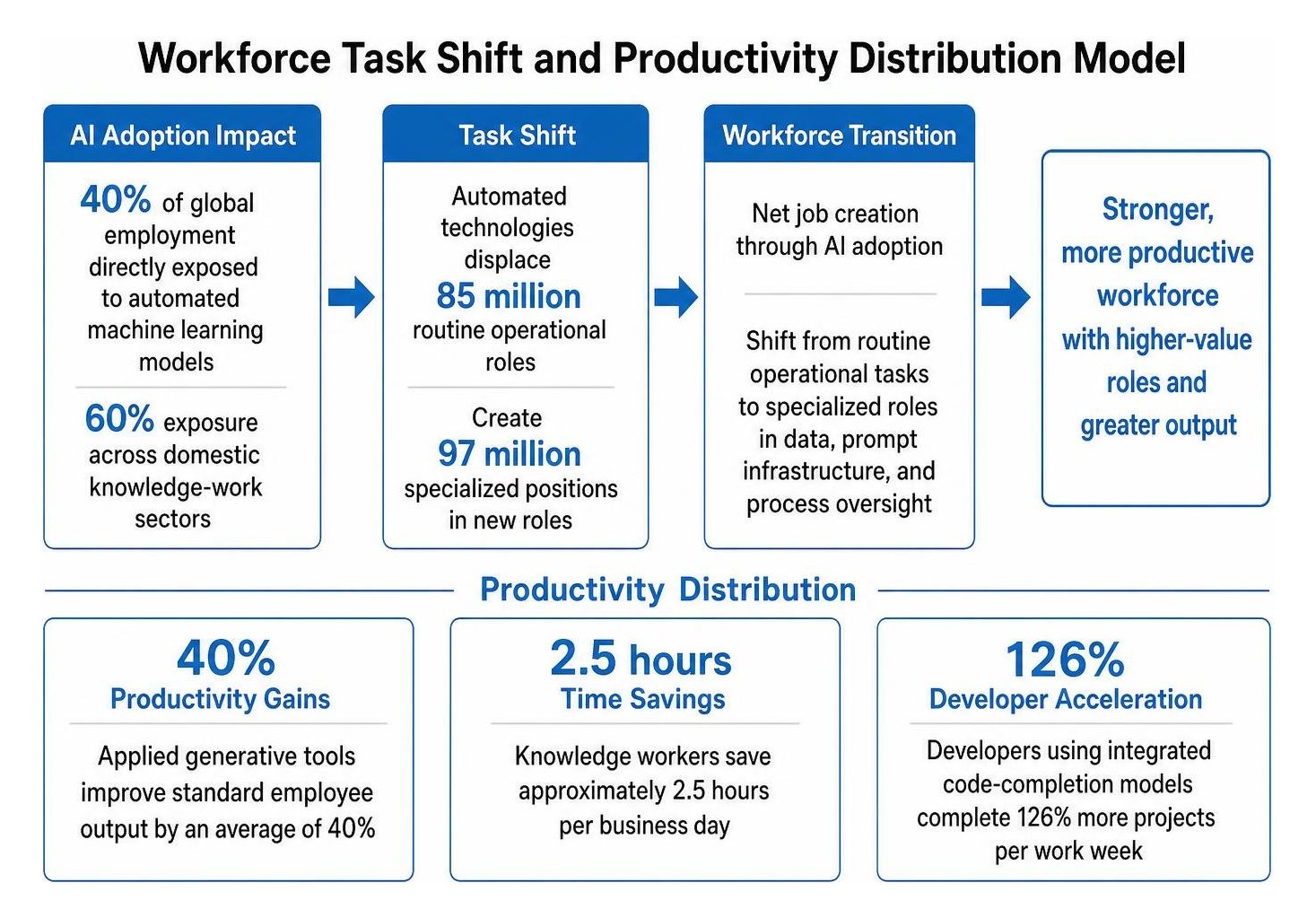
AI adoption is reshaping the workforce by automating repetitive administrative tasks, resulting in net job creation alongside widespread occupational disruption. Global labor estimates suggest automated technologies could displace 85 million routine operational roles while creating 97 million specialized positions focused on data architecture, prompt infrastructure, and process oversight.
Key employment metrics include:
- Macro Exposure: Approximately 40% of global employment is directly exposed to automated machine learning models, with domestic exposure reaching 60% across knowledge-work sectors.
- Productivity Gains: Applied generative tools improve standard employee output by an average of 40%, saving knowledge workers roughly 2.5 hours per business day.
- Developer Acceleration: Programmers utilizing integrated code-completion models complete 126% more projects per work week.
- Customer Service Throughput: Support specialists resolve 13.8% more inquiries per hour when assisted by predictive response engines.
To understand how individual tasks are evolving, business leaders can analyze macro labor productivity impacts across tasks alongside generative content proliferation trends across digital channels.
What Do AI Statistics Show About Public Trust, Safety, and Regulation?
Public sentiment toward artificial intelligence is characterized by heightened caution regarding personal privacy, systemic bias, and institutional governance. Approximately 70% of adults believe machine learning applications present significant risks to data privacy, while 60% express serious concern regarding corporate data misuse.

Furthermore, real-world deployments continue to reveal algorithmic vulnerabilities:
- Algorithmic Bias: Automated hiring algorithms have been shown to reject qualified female candidates at a 15% higher rate and minority applicants at a 10% higher rate when trained on historically skewed resumes.
- Incident Volatility: Documented safety and security incidents climbed past 360 events in a single year, highlighting the gap between model deployment speed and safety testing.
- National Policy Support: 85% of citizens advocate for national regulatory frameworks to ensure technological safety and model transparency.
Understanding the statistical foundations of AI safety and evaluation helps teams implement robust testing methodologies. Organizations can review consumer trust metrics and sentiment data to align their operational deployments with emerging consumer expectations.
How Can Businesses Future-Proof Growth with AI?
Businesses can build sustainable search visibility and commercial growth by combining automated workflows with strict editorial oversight, statistical validation, and E-E-A-T search compliance. Rather than publishing unverified automated copy at scale, sustainable strategies focus on factual depth, original data, and clear direct answers.

At SmallBizSEO, we help small businesses turn statistical research into authoritative, high-ranking search assets. Our proprietary Velocity framework pairs technical SEO architecture with data-backed content creation, ensuring your brand builds organic authority while staying fully aligned with evolving search engine quality standards.
To elevate your digital presence and outrank the competition:
- Explore our high-impact AI-driven search optimization strategies designed to maximize search visibility and qualified lead acquisition.
- Read our comprehensive actionable generative AI guide for businesses to refine your operational strategy.
- Request a custom technical search visibility audit from our team to uncover immediate growth opportunities across your digital ecosystem.