Key AI Marketing Statistics That Prove Automation Is Winning

Key AI Marketing Statistics That Prove Automation Is Winning
Global AI Marketing Adoption: How Fast Is Automation Growing?
Artificial intelligence is expanding rapidly from experimental pilot programs into standard marketing operations across every major sector.
Industry studies tracking AI adoption and business impact demonstrate that modern growth teams no longer view smart tools as novelties. Global data from Statista marketing research reveals that marketing-specific automation revenue has surged toward multi-billion-dollar milestones worldwide as platforms integrate native machine-learning capabilities.
What Percentage of Businesses Currently Use AI in Their Marketing Workflows?
Current data indicates that 67% of small and medium-sized businesses use AI in their marketing workflows.
Across broader industry assessments, roughly 88% of marketing professionals report integrating automated software into their day-to-day responsibilities. Furthermore, 74% of small-business leaders express active interest in applying machine learning to commercial challenges, with more than half reporting that their focus on modern tools has accelerated significantly.
How Daily AI Usage Rose Among Professional Marketers
Daily utilization of automation tools jumped from 37% to 60% of marketers, marking a permanent shift in how campaigns are built and executed.
Instead of reserving smart software for occasional brainstorming sessions, professionals now use machine-learning systems constantly to:
- Conduct rapid competitive analysis and research
- Draft baseline copy for email and web pages
- Analyze campaign analytics across fragmented channels
- Build audience segments based on intent signals
How Is AI Helping Businesses Attract Customers?
AI helps businesses attract customers by identifying high-intent audiences, predicting consumer demand, and tailoring outreach messages automatically.
Rather than relying on generic broadcasts, modern teams leverage machine learning to personalize interactions at the individual level.
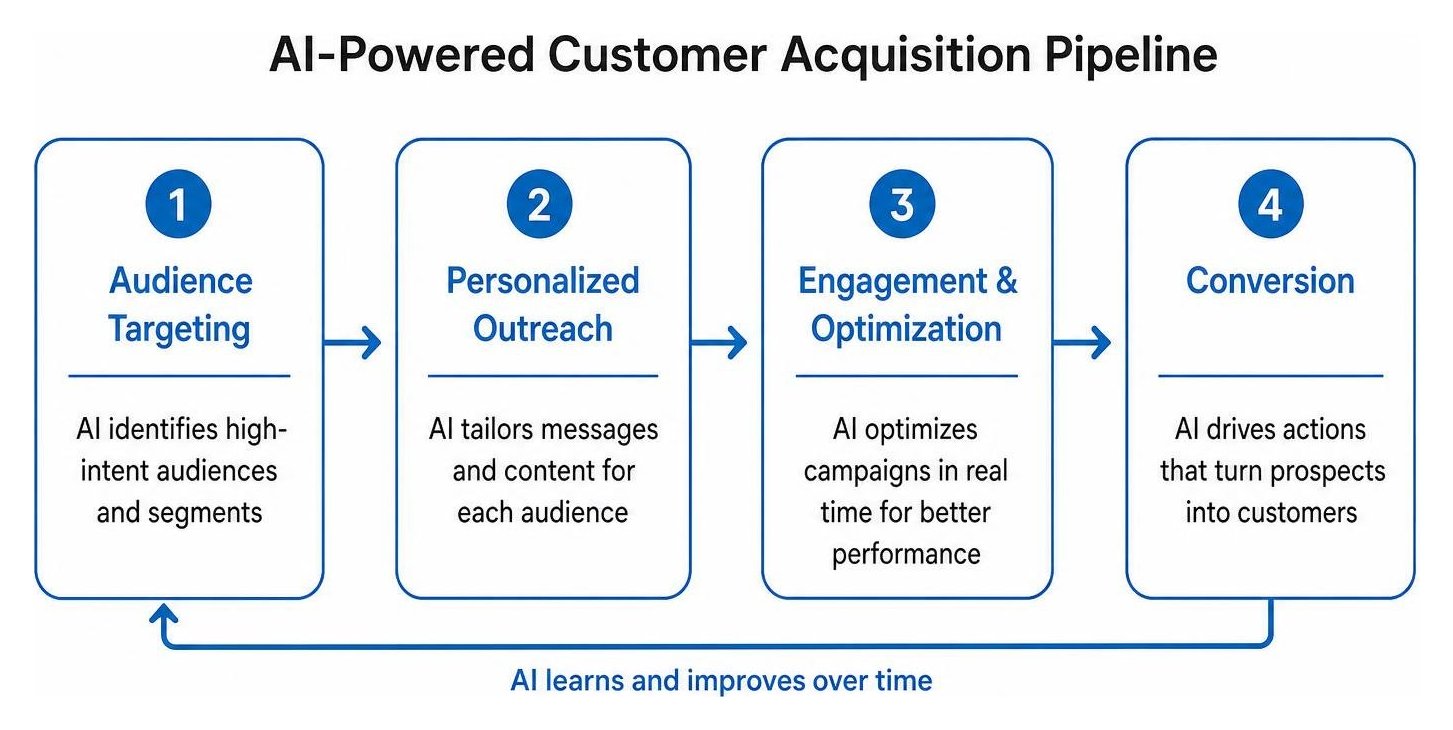
What Core AI Marketing Statistics Show How Businesses Attract Customers
Attracting new customers remains the primary operational hurdle for 60% of small businesses. Data shows automation delivers tangible relief:
- Ad Campaign Improvements: 95% of small business owners believe intelligent platforms enhance their digital advertising campaigns.
- Higher Satisfaction: 91% of small businesses using smart marketing software state that it has contributed directly to their commercial success.
- Widespread Interest: 55% of business owners report their enthusiasm for machine-assisted marketing grew substantially over recent operating cycles.
How Can AI Help Businesses Attract Customers at Scale?
Automation platforms allow lean marketing departments to run multi-channel acquisition funnels that previously required large agency teams.
Modern systems analyze live user behavior to trigger personalized offers precisely when prospects are ready to convert. Consumer behavioral data highlighted by the IAB shopping study confirms that buyers increasingly rely on automated engines and personalized discovery feeds to guide their purchase decisions.
What Measurable Impact Does AI Have on ROI, Productivity, and Costs?
Sourced industry evidence shows that AI substantially lowers acquisition costs while driving productivity gains of over 40% across creative and administrative operations.
Real-world deployments demonstrate that automation directly protects operating margins by eliminating manual campaign waste.
| Campaign Dimension | Traditional Manual Marketing | AI-Automated Marketing |
|---|---|---|
| Weekly Administrative Time | 10 to 15 hours spent on manual reporting and data sorting | Reclaims up to 13 hours per week through automated workflows |
| PPC Bid Optimization | Manual schedule updates and static keyword bidding | Real-time predictive bidding reduces wasted ad spend by ~37% |
| Content Drafting Speed | 4 to 8 hours per long-form asset | 30% to 40% reduction in initial content creation time |
| Paid Ad Returns | Baseline historical return on ad spend (ROAS) | Up to 50% increase in advertising campaign ROI |
| Organic Search Uplift | Incremental manual technical checks | 65% of businesses report an uplift in SEO performance |
Examining verified productivity and business savings statistics underscores that operational efficiency directly enhances bottom-line profitability.
How Much Time and Money Does Marketing Automation Actually Save?
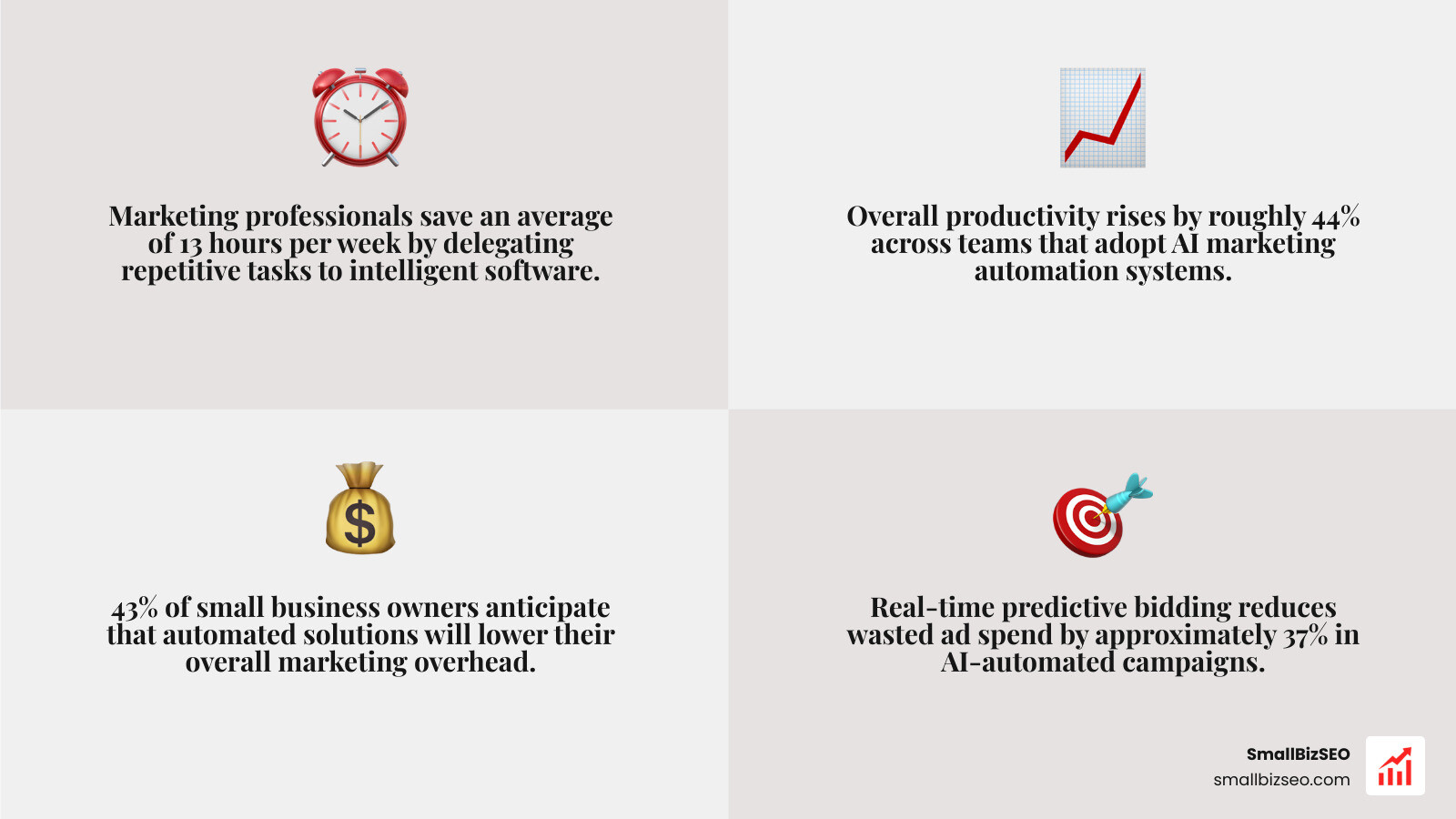
Marketing professionals report saving an average of 13 hours per week by delegating repetitive tasks to intelligent software.
Overall productivity rises by roughly 44% across teams that adopt these systems. Furthermore, 43% of small business owners anticipate that automated solutions will lower their overall marketing overhead, with 45% expecting meaningful budget reductions in creative production expenses alone.
What ROI Improvements Are Companies Experiencing from Automated Campaigns?
Automated platforms deliver substantial revenue improvements across customer acquisition channels:
- Content Marketing Returns: 68% of commercial organizations report higher content marketing ROI after implementing smart production and optimization tools.
- Organic Search Performance: 65% of businesses experience measurable organic search uplifts after adopting automated discovery platforms.
- Paid Media Efficiency: Predictive bidding engines routinely decrease wasted ad spend by 37% while elevating aggregate campaign ROI by roughly 50%.
How Do Brands Use AI Across Advertising, Content, SEO, and Personalization?
Modern brands deploy artificial intelligence as an integrated layer across every primary customer acquisition touchpoint.
How Does AI Support Digital Advertising and PPC Bid Management?
Machine learning optimizes digital advertising by adjusting pay-per-click (PPC) bids in real time based on millions of contextual user signals.
Rather than relying on static keyword bids, algorithms forecast individual conversion probabilities. These tools dynamically allocate budget toward high-performing demographic segments while excluding negative search terms, safeguarding ad spend against unqualified clicks.
How Does AI Support Content Generation and Search Engine Optimization?
Roughly 50% of marketing teams use machine intelligence to assist in drafting content, while 51% utilize intelligent tools to optimize web pages and email campaigns.
Applying content optimization software accelerates drafting timelines by 30% to 40% without sacrificing topical thoroughness. When combined with search architecture best practices, these tools help websites structure data cleanly so that modern search crawlers index and surface key commercial pages effectively.
How Does AI Enable Real-Time Personalization and Dynamic Customer Journeys?
Personalization is a primary driver of modern conversion gains, with 73% of marketers confirming that AI plays a direct role in shaping tailored customer experiences.
- 67% of brands expect automation to power curated retail recommendations.
- Tailored personalization engines deliver conversion rate improvements of up to 30%.
- Forward-thinking growth teams implement generative engine optimization methods to ensure brand messaging surfaces clearly within conversational search interfaces.
What Holds Businesses Back from Scaling AI?
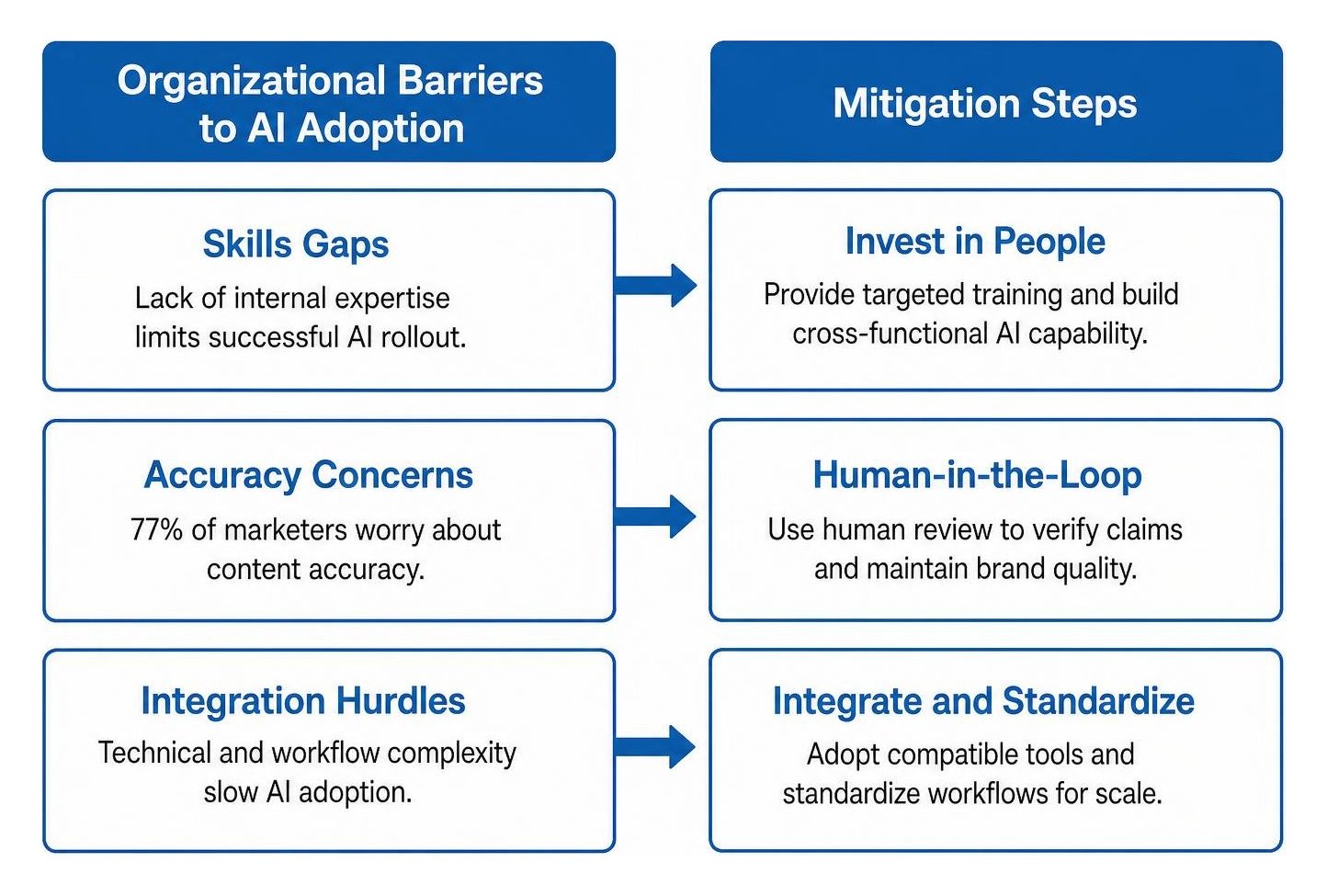
Businesses struggle to scale AI primarily due to internal skills gaps, concerns over factual accuracy, and technical integration hurdles.
While interest in automation remains exceptionally high, successful organizational rollout requires overcoming clear operational bottlenecks.
How Can Businesses Manage Data Privacy, Accuracy, and Brand Safety Concerns?
Factual reliability remains a chief concern, with 77% of marketing practitioners citing content accuracy as a significant operational worry. Additionally, 68% cite data privacy concerns and 65% worry about intellectual property compliance.
To safeguard brand equity, companies must implement strict human-in-the-loop editorial standards. Automated systems should handle data aggregation, outlines, and initial drafts, while experienced human specialists verify claims, maintain proprietary brand tone, and protect sensitive customer records.
How Can Businesses Address Training Gaps and Integration Complexity?
A significant barrier to enterprise-wide adoption is workforce readiness: 70% of marketers state that their employers do not offer structured training on generative tools.
Furthermore, only 31% of marketing executives report complete satisfaction with their ability to unify disjointed customer data sources. Overcoming these barriers requires investing in structured internal education and selecting software that integrates natively with existing customer relationship management systems.
Frequently Asked Questions About AI Marketing Statistics
What is the most common use of AI in marketing today?
The most common applications are written content drafting (used by roughly 90% of adopting marketers), content optimization (51%), visual asset creation (50%), and automated audience segmentation (43%).
How does AI reduce wasted digital ad spend?
AI reduces wasted ad spend by constantly analyzing user intent signals, managing real-time bids, and shifting budgets away from underperforming placements. This automated bid management cuts ad spend waste by an average of 37%.
Can small businesses compete with enterprise brands using AI marketing tools?
Yes. Automated software serves as a major equalizer by giving small businesses access to enterprise-grade analytics, dynamic creative testing, and automated audience targeting at accessible subscription costs.
Winning the Future of Search and Customer Acquisition
The statistical evidence is unambiguous: marketing automation has transitioned from a speculative experiment into an operational necessity. Organizations leveraging machine intelligence save valuable labor hours every week, cut advertising waste, and build responsive, personalized acquisition funnels that convert prospects reliably.
At SmallBizSEO, we help businesses capitalize on this momentum through our data-driven "Velocity" framework. By combining advanced technical SEO, high-authority link acquisition, and E-E-A-T-compliant content development with automated reporting, we help brands secure sustainable search visibility. Explore our comprehensive collection of generative AI business statistics to discover how modern automation can elevate your growth strategy today.