Outrank Industry Leaders Using Actionable Competitive SEO Analysis Tactics

Outrank Industry Leaders Using Actionable Competitive SEO Analysis Tactics
Step-by-Step Blueprint for Auditing Your Organic Competitors
A competitive SEO analysis is the structured process of reverse-engineering the search performance, content depth, backlink authority, and technical setup of sites that outrank you on Google. Instead of creating content blindly, benchmarking against market leaders helps you understand the search intent driving customer demand and claim your fair share of organic market share.
The data proves why this matters: roughly 90% of web pages receive zero organic search traffic from Google, and two-thirds of all clicks concentrate on the top five organic search results. Gaining visibility requires understanding why top pages win. Following the step-by-step guide to SEO analysis for competitors ensures you target realistic traffic potential while systematically unlocking long-tail query capture, which represents 70% of all searches across the web.
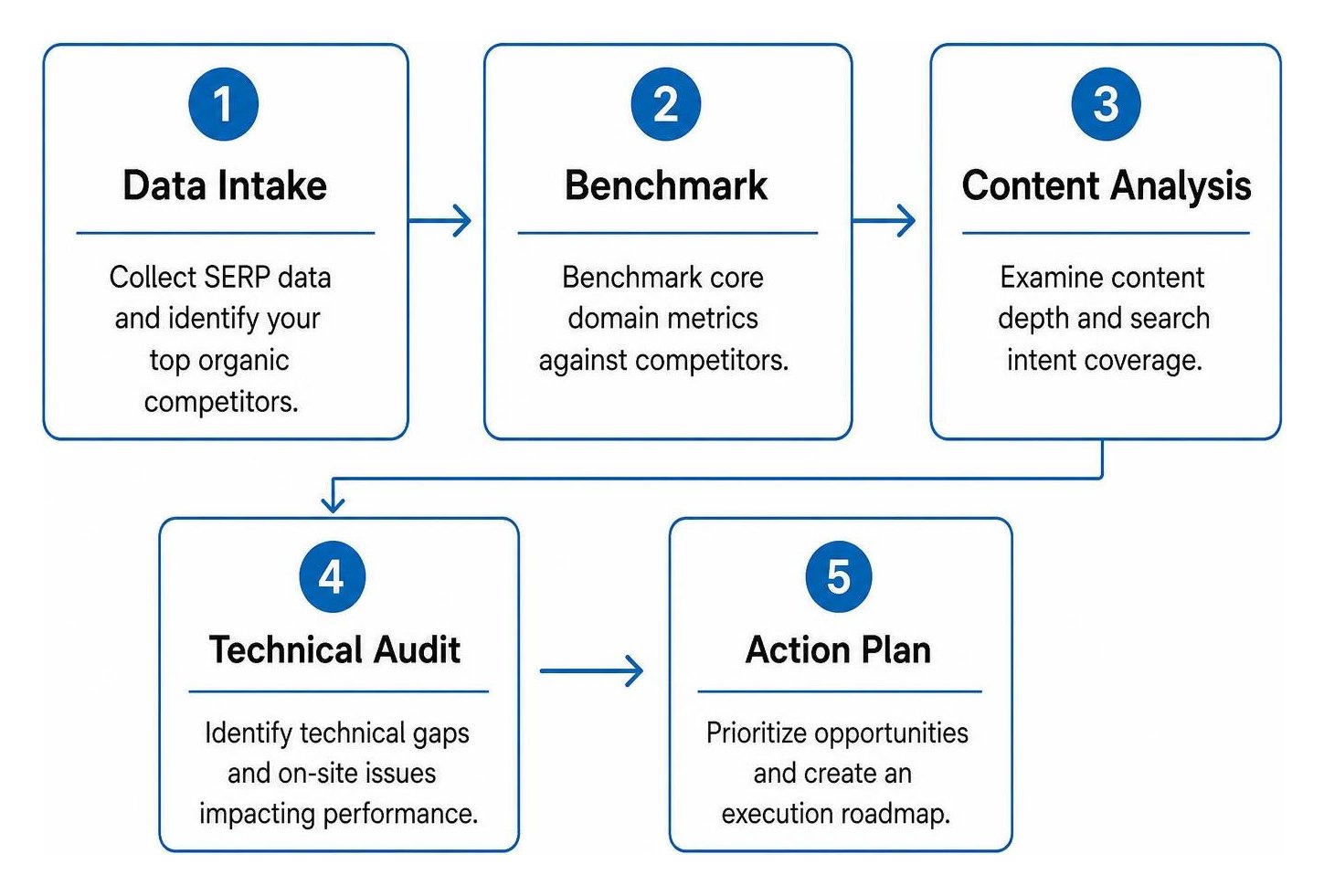
A reliable audit follows a clear, repeatable process. We collect SERP data, benchmark core domain metrics, examine content depth, and pinpoint technical gaps before creating a final action plan.
To help you choose the right platform for tracking SERP volatility and gathering data, here is how popular competitive intelligence approaches compare:
| Tool / Method | Best For | Core Advantage | AI & LLM Tracking |
|---|---|---|---|
| SE Ranking | All-in-one SMB tracking | Broad global index (1.1B+ domains) | Generative Engine tracking |
| SpyFu | Historical search & PPC analysis | 18+ years historical data; 7.2T SERPs | SERP snapshot analysis |
| Mr.Chief / Apify | Budget-conscious custom audits | Low cost per audit ($2.40 vs SaaS plans) | Custom LLM prompt synthesis |
| Ahrefs / Semrush | Enterprise backlink & gap audits | Deepest backlink graphs and keyword databases | SERP feature monitoring |
How Do You Identify True Search Rivals and Run a Competitive SEO Analysis?
Your true SEO competitors are websites ranking for your target keywords on Google, not just your local storefront or direct business rivals. You might compete offline with a neighborhood shop, but online, your organic search competitors could include regional service directories, industry publishers, or national aggregators.
To classify your competitors accurately, look at both SERP overlap analysis and audience overlap across your primary money terms:
- Direct Search Competitors: Websites offering the same core services and ranking for high-intent, bottom-of-funnel queries.
- Topical Content Leaders: Industry blogs, media platforms, and educational sites that capture top-of-funnel informational searches.
- Aggregators & Directories: Broad listing portals that dominate local or category terms.
- Fast-Rising Challengers: Newer domains displaying rapid link velocity and fresh content clusters.
We recommend tracking three to five rivals. Selecting too many creates unnecessary noise, while three to five covers nearly 90% of all actionable industry signals. You can download this free SEO competitor analysis template to organize your domain ratings, top-ranking URL extractions, and core competitor classifications in one place.
How to Find Keyword Gaps and High-Yield Content Opportunities
A keyword gap represents valuable customer search queries that your rivals rank for, but your website completely misses. Discovering these queries allows you to build targeted content that captures missed demand.
To execute a clean audit, use our guide on keyword gap analysis. Segment keywords by search intent:
- Bottom-of-Funnel (BOFU) Keywords: Terms used by searchers ready to hire or purchase (e.g., "emergency commercial roof repair").
- Middle-of-Funnel (MOFU) Topic Clusters: Comparison and evaluation queries (e.g., "metal roof vs shingle cost for warehouses").
- Top-of-Funnel (TOFU) Educational Queries: Informational problem-solving topics that build topical authority.
When evaluating winning content, look at search intent and structure rather than just word count. While page-one Google results average 1,447 words, success comes from content depth, clear answer formatting, and logical topic coverage. If a competitor dominates a high-volume query with outdated information, use the Skyscraper technique: build a more comprehensive, better-organized resource with actionable steps, original data, and clear visual summaries.
How to Evaluate Competitor Backlink Profiles and Authority Gaps
Search engines rely on backlinks to verify website authority, trust, and relevance. Because 66% of all web pages have zero backlinks, building a focused link profile gives you an immediate market advantage.
A thorough external link analysis evaluates:
- Referring Domain Quality: The number of unique, relevant websites pointing to your rivals.
- Link Velocity: How quickly competitors acquire new links each month.
- Anchor Text Distribution: The ratio between branded, exact-match, and natural URL anchor texts.
- Replicable Link Opportunities: Niche resource pages, supplier directories, industry associations, and local press features where your brand can also earn inclusion.
Look for high-quality unlinked brand mentions and active digital PR campaigns. If a rival regularly earns links from local business journals or niche podcasts, pitch your own founders and case studies to those same media outlets.
How to Audit Technical Health and User Experience Metrics
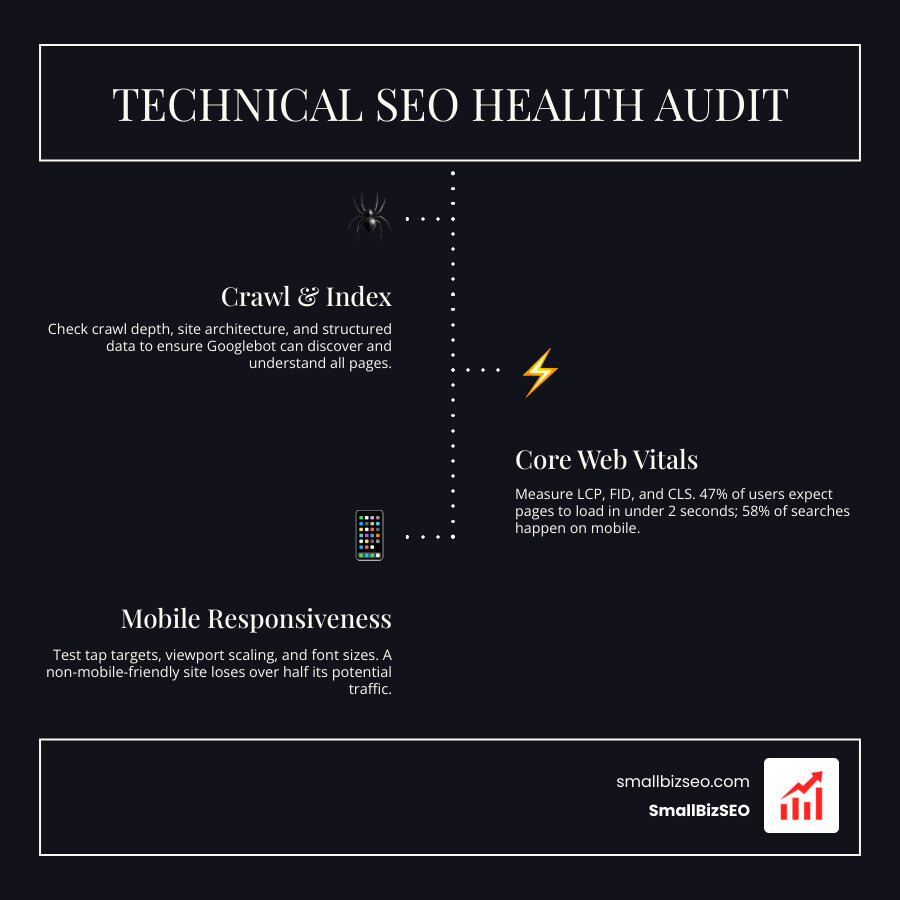
A well-written article cannot rank if technical issues prevent search engines from crawling it or frustrate human visitors. Nearly 47% of web users expect pages to load in under two seconds, and 58% of all searches happen on mobile devices.
Audit your competitors' technical baselines against these critical factors:
- Core Web Vitals: Measure Largest Contentful Paint (LCP), Interaction to Next Paint (INP), and Cumulative Layout Shift (CLS).
- Crawl Depth & Site Architecture: Ensure core service pages sit within three clicks of the homepage.
- Mobile Usability & Responsive Layouts: Verify that tap targets, fonts, and menus display seamlessly across smartphones.
- Structured Data: Inspect schema markup (LocalBusiness, FAQPage, Service, and Product schema) that helps search engines parse page context.
Fixing underlying site architecture prevents the common crawling breakdowns detailed in the guide to SEO audit errors, keeping your domain healthy and fully indexable.

How to Turn Competitor Insights into an Actionable SEO Strategy
Collecting raw metrics only helps if you translate them into everyday publishing and optimization tasks.
How Can You Track AI Search Visibility and LLM Citations in Competitive SEO Analysis?
Modern search engines and answer engines (like Google AI Overviews, ChatGPT Search, and Perplexity) generate conversational responses by referencing authoritative entities. Tracking brand citations across language models is now just as critical as tracking traditional SERP positions.
To monitor your presence:
- Test High-Intent Prompts: Enter key industry questions into AI platforms to see which competitors get cited as recommended solutions.
- Track Entity Citations: Follow the framework in the AI SEO audit guide to ensure your brand's digital footprint contains structured, verifiable facts.
- Automate Data Extraction: Use an open-source tool like this Python competitor ranking script to pull head-to-head SERP positions for your core keyword targets.
Establishing clear topical authority and earning coverage on trusted trade websites ensures your business gets cited when AI engines summarize your industry.
How to Build a 90-Day Execution Plan and Avoid Common Mistakes
Avoid the common mistake of copying a competitor page-for-page. Replicating their outdated content or toxic backlinks will only slow your progress. Instead, capitalize on their weaknesses.
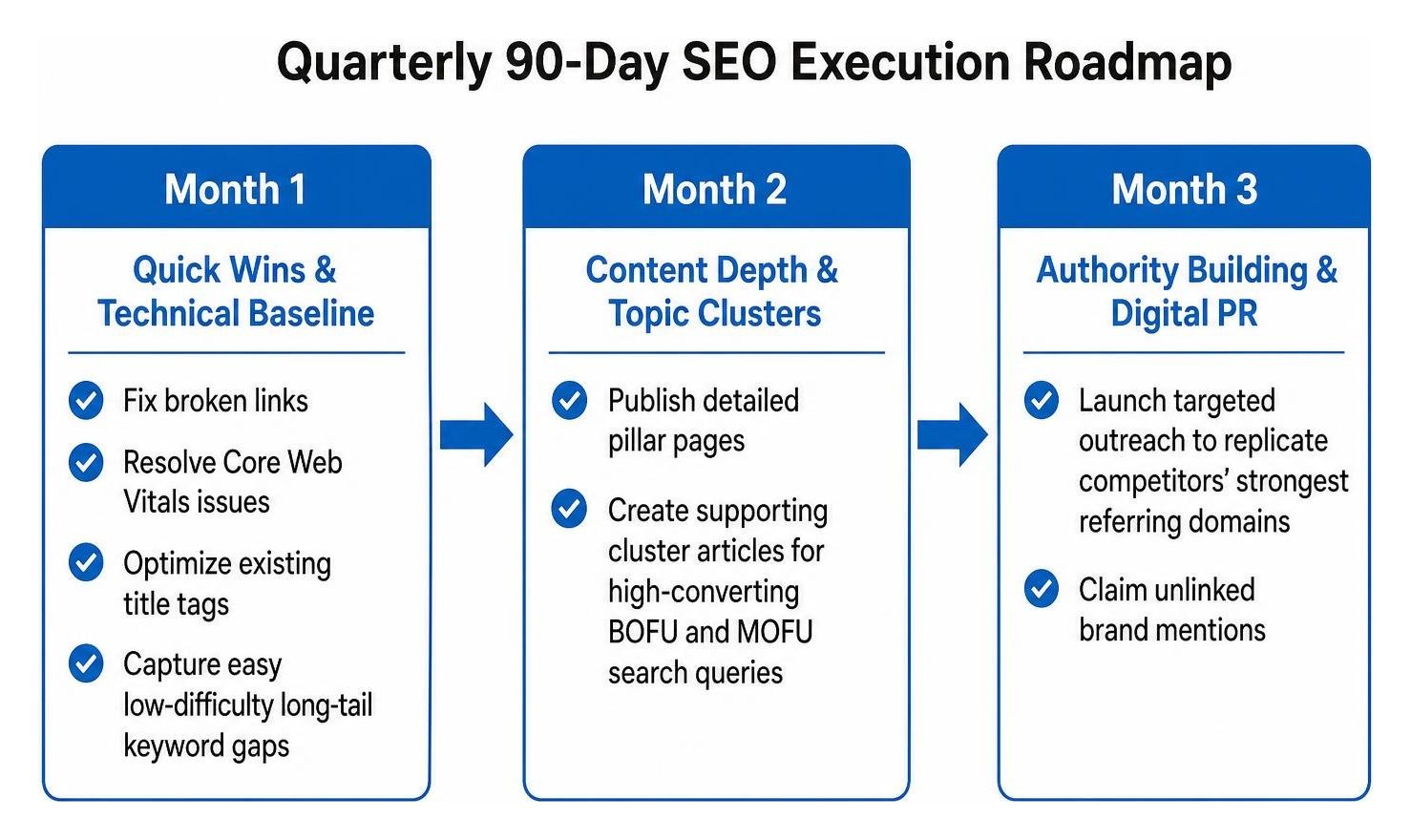
Structure your priorities into a manageable 90-day plan:
- Month 1 (Quick Wins & Technical Baseline): Fix broken links, resolve Core Web Vitals issues, optimize existing title tags, and capture easy low-difficulty long-tail keyword gaps.
- Month 2 (Content Depth & Topic Clusters): Publish detailed pillar pages and supporting cluster articles for high-converting BOFU and MOFU search queries.
- Month 3 (Authority Building & Digital PR): Launch targeted outreach to replicate your competitors' strongest referring domains and claim unlinked brand mentions.
Maintain this momentum by checking primary keyword movements weekly, reviewing new competitor content monthly, and conducting a full strategic refresh once a year.
Accelerate Your Organic Growth with Smarter Competitive Insights
Conducting a thorough competitor analysis provides the exact roadmap needed to capture untapped search demand. At SmallBizSEO, we use our data-driven "Velocity" framework to help small businesses identify high-impact keyword opportunities, resolve technical bottlenecks, and earn lasting topical authority. If you are ready to stop guessing and start outranking your organic rivals, get started today with a comprehensive SEO visibility audit.