How Predictive Product Recommendations Boost Average Order Value

How Predictive Product Recommendations Boost Average Order Value
How Is AI Changing the Way People Shop?
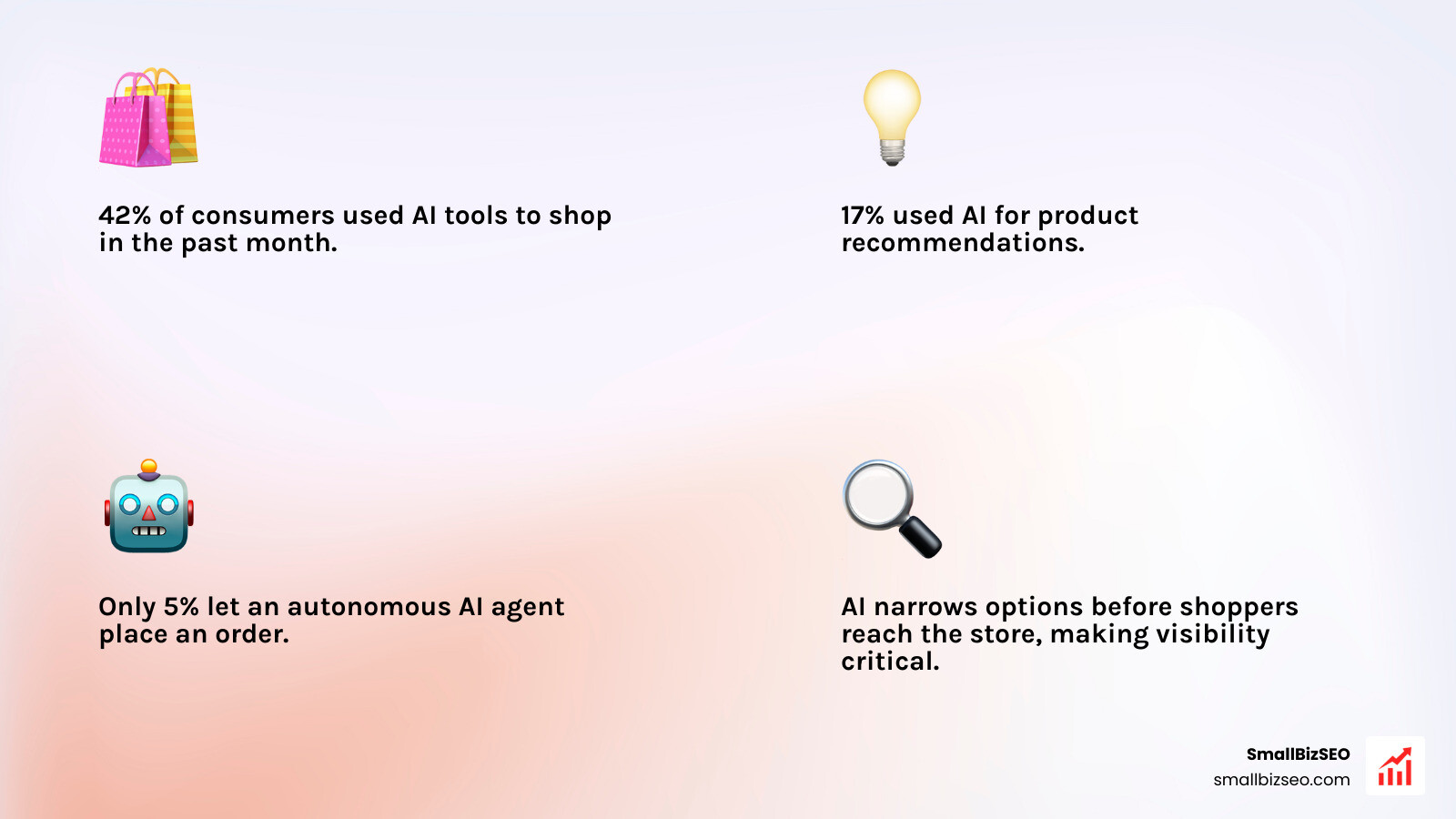
AI is becoming a common way to research products, but most shoppers still make the final choice themselves. In a recent U.S. survey, NielsenIQ found that 42% of consumers had used an AI tool to shop in the past month. Seventeen percent used AI for product recommendations, while just 5% had let an autonomous AI agent place an order.
That gap matters. AI can narrow a shopper's options before they reach a store, making it harder for a brand to win attention if its products never appear in the answer. The statistics below show where AI is changing discovery, recommendations, and purchases - and where shoppers still want control.
I'm Clayton Johnson, founder of SmallBizSEO and a digital marketing strategist focused on search visibility. My work on AI Shopping Statistics: Product Discovery, Recommendations, and Purchasing Behavior draws on my focus on SEO, answer engine optimization, and how brands appear in AI-generated answers.
Easy AI Shopping Statistics: Product Discovery, Recommendations, and Purchasing Behavior glossary:
- AI-Generated Content Statistics: How Much of the Internet Is Created by AI?
- AI Brand Recommendation Statistics: How Often Do Small Businesses Appear Alongside Major Brands?
- AI Marketing Statistics: How Businesses Are Using Artificial Intelligence to Attract Customers
How Is Artificial Intelligence Reshaping E-Commerce?
Artificial intelligence is transforming e-commerce from a passive directory of product links into an active, conversational buying assistant that predicts intent, compares items across platforms, and guides shoppers directly to checkout.
The days of typing rigid keywords like "waterproof running shoes size 10" and manually filtering through dozens of tabs are quickly fading. Shoppers now expect intuitive search bars that understand nuanced, real-world prompts, such as "lightweight trail runners for rainy mountain trails under $150."

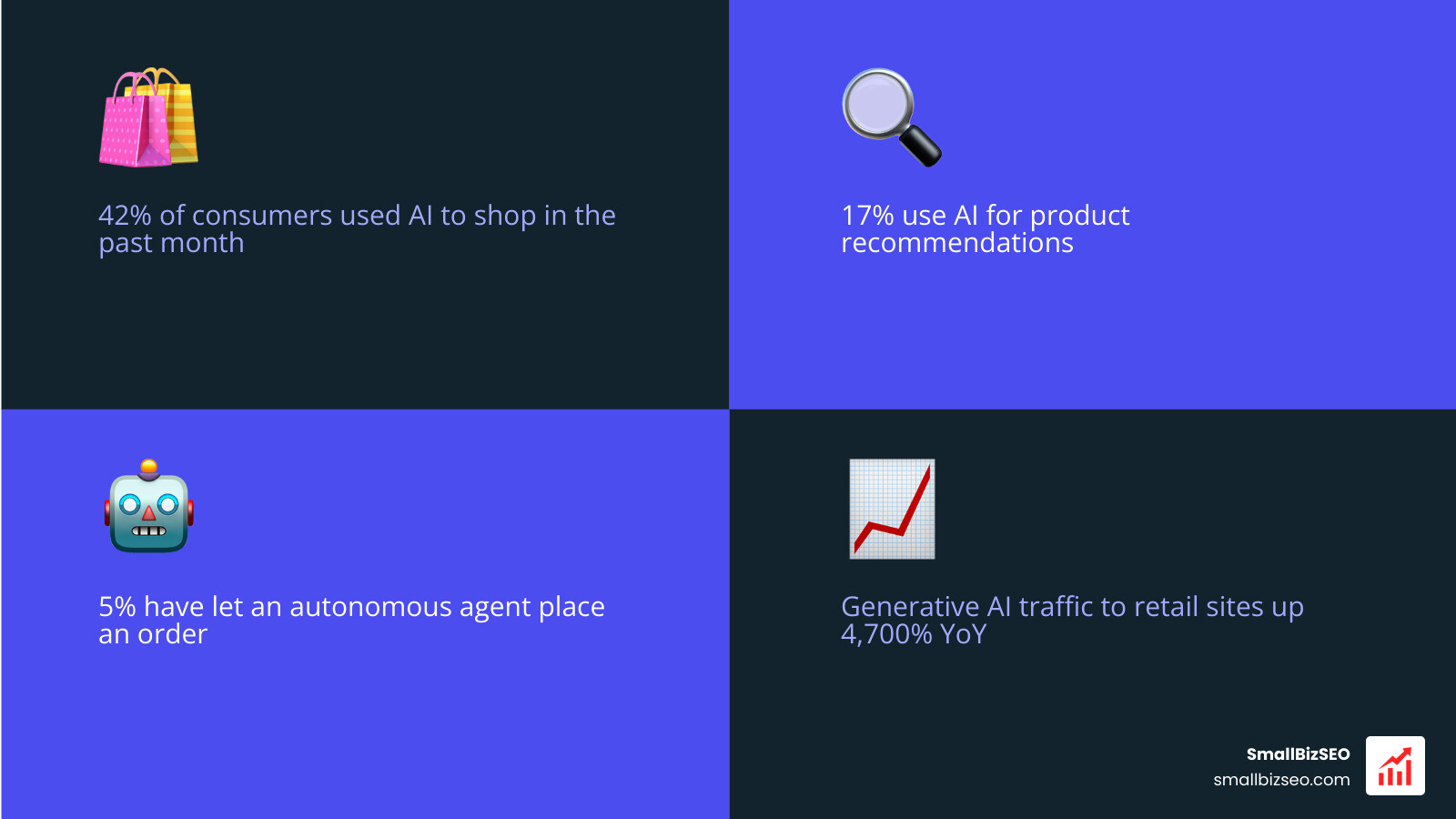
Retailers are feeling this shift directly in their traffic logs. Generative AI traffic to retail websites has surged by 4,700% year over year, with AI-driven referrals expanding over 100% in recent cycles. Consumers no longer browse blindly; they rely on smart models to synthesize reviews, evaluate pricing trends, and provide direct product matches.
This evolution is forcing online merchants to rethink their entire catalog architecture. If an AI engine cannot instantly interpret a product's dimensions, materials, use cases, and compatibility, that product remains invisible during the initial discovery phase.
What Do AI Shopping Statistics Reveal About Product Discovery, Recommendations, and Purchases?
The latest data reveals that AI has fundamentally compressed the customer purchase journey, creating high-intent visitors who convert at substantially higher rates while demanding total accuracy and transparency from brands.
Shoppers using conversational tools spend more time reviewing tailored results and bounce less often than traditional web visitors. Retailers embracing deep personalization and smart search are capturing a disproportionate share of high-margin sales.
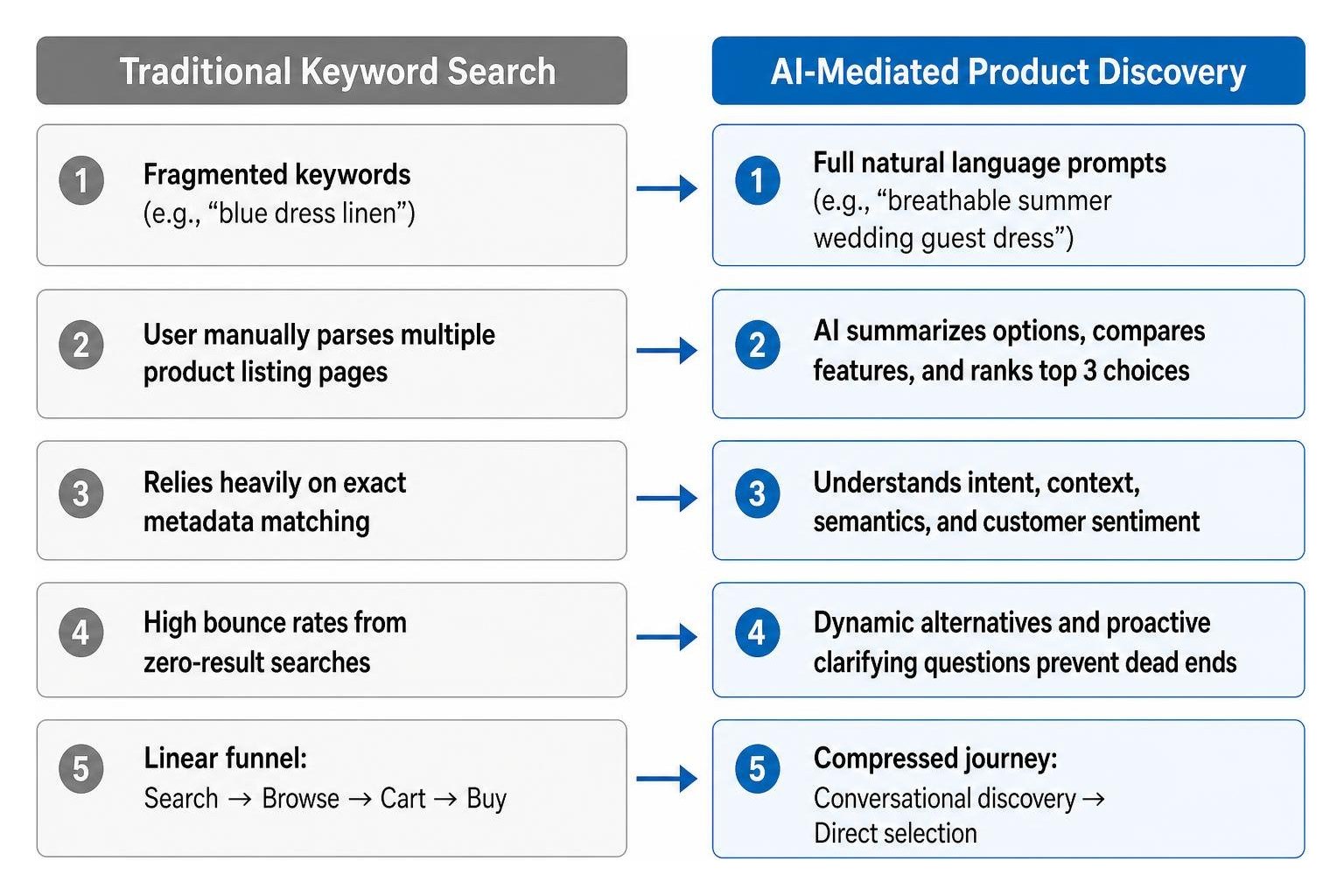
| Traditional Keyword Search | AI-Mediated Product Discovery |
|---|---|
| Fragmented keywords (e.g., "blue dress linen") | Full natural language prompts (e.g., "breathable summer wedding guest dress") |
| User manually parses multiple product listing pages | AI summarizes options, compares features, and ranks top 3 choices |
| Relies heavily on exact metadata matching | Understands intent, context, semantics, and customer sentiment |
| High bounce rates from zero-result searches | Dynamic alternatives and proactive clarifying questions prevent dead ends |
| Linear funnel: Search to Browse to Cart to Buy | Compressed journey: Conversational discovery to Direct selection |
How Are AI Tools Changing the Way Consumers Discover Products?
Consumers are rapidly replacing standard search engines with conversational assistants because dialogue-driven search eliminates browsing fatigue and finds better deals faster.
Industry research shows that 74% of shoppers now use AI for some form of product discovery, while 68% interact with generative tools monthly. According to recent NIQ research on consumer AI shopping trends, 64% of buyers specifically turn to AI to discover or research products before visiting a merchant site.
To understand how widespread this shift has become across every digital sector, exploring these 50 generative AI statistics every business owner should know provides a clear picture of the macro environment. Shoppers want multi-brand aggregation in a single window: 84% prefer AI platforms that compare products across multiple stores simultaneously, and 63% state that AI helps them uncover better prices and promotional discounts.
How Does AI Affect E-Commerce Conversions and Revenue?
AI-driven interactions dramatically boost revenue by delivering relevant recommendations at the exact moment of purchase intent, eliminating the friction that causes cart abandonment.
When visitors arrive at an e-commerce store via AI referrals, they convert 42% higher than non-AI traffic, demonstrating 32% longer site visits and 27% lower bounce rates. Implementing on-site conversational chat delivers a 4X higher conversion rate (12.3% compared to just 3.1% for standard browsing).
Furthermore, proactive automated chat interventions successfully recover 35% of abandoned carts by answering sizing, shipping, and compatibility questions in real time. As highlighted in our breakdown of AI marketing statistics proving automation impact, companies that deploy advanced personalization generate 40% more revenue than those relying on static product pages. Tailored recommendation engines can lift overall e-commerce sales by up to 300% and average order value by 50%.
How Much Do Consumers Trust AI to Shop on Their Behalf?
While shoppers enthusiastically trust AI to analyze features and compare prices, the vast majority still insist on verifying recommendations before granting permission to complete financial transactions.
A striking 46% of consumers admit they trust AI to provide more honest, unbiased advice than their own friends. However, trust declines sharply when moving from advice to automated execution. As detailed in a McKinsey analysis on agentic commerce adoption, European and American shoppers embrace cognitive delegation—such as building comparative shortlists—but maintain strong boundaries around autonomous purchasing.
Currently, 54% of shoppers who use generative AI for buying decisions double-check all product information on the merchant's direct website, and 66% visit the brand directly to verify claims. Only 5% of consumers have authorized autonomous AI agents to execute purchases on their behalf, while 51% express general comfort with agentic assistance for routine tasks like gift research.
How Can Brands Avoid Becoming Invisible in AI Shopping Results?
Brands face a severe risk of complete digital invisibility if their products are not structured to be indexed, interpreted, and cited by large language models and intelligent search assistants.
Traditional SEO focused on winning the top positions on search engine results pages. In contrast, AI shopping assistants provide a synthesized answer containing only two or three top recommendations. If an algorithm cannot parse your catalog, your brand is excluded entirely from the shopper's consideration set.
Recent AI brand recommendation data reveals that smaller, agile brands frequently outrank legacy competitors in AI answers simply by maintaining cleaner product data and stronger community sentiment. Winning in this space requires dominating two new performance metrics:
- Share of Conversation: The frequency with which an AI model discusses your brand when users explore your product category.
- Share of Recommendation: The percentage of times an assistant explicitly recommends your specific SKU over competing alternatives.
How Can E-Commerce Brands Prepare for Agentic Commerce and AI Search?
Preparing for agentic commerce requires moving beyond basic keyword optimization to build a unified data infrastructure that large language models can effortlessly ingest, verify, and prioritize.
At SmallBizSEO, we help businesses master this transition through our proprietary Velocity framework. By focusing on deep machine readability, entity authority, and transparent data pipelines, we ensure your store captures high-converting generative referrals.
Adapting to conversational discovery requires mastering modern AI SEO best practices, which prioritize verifiable E-E-A-T signals (Experience, Expertise, Authoritativeness, and Trustworthiness). If you want your store to thrive in an algorithmic marketplace, our team delivers tailored AI SEO services for digital retail that optimize your entire catalog for AI engines.
What Product Content and Data Should Brands Prepare for AI Shopping?
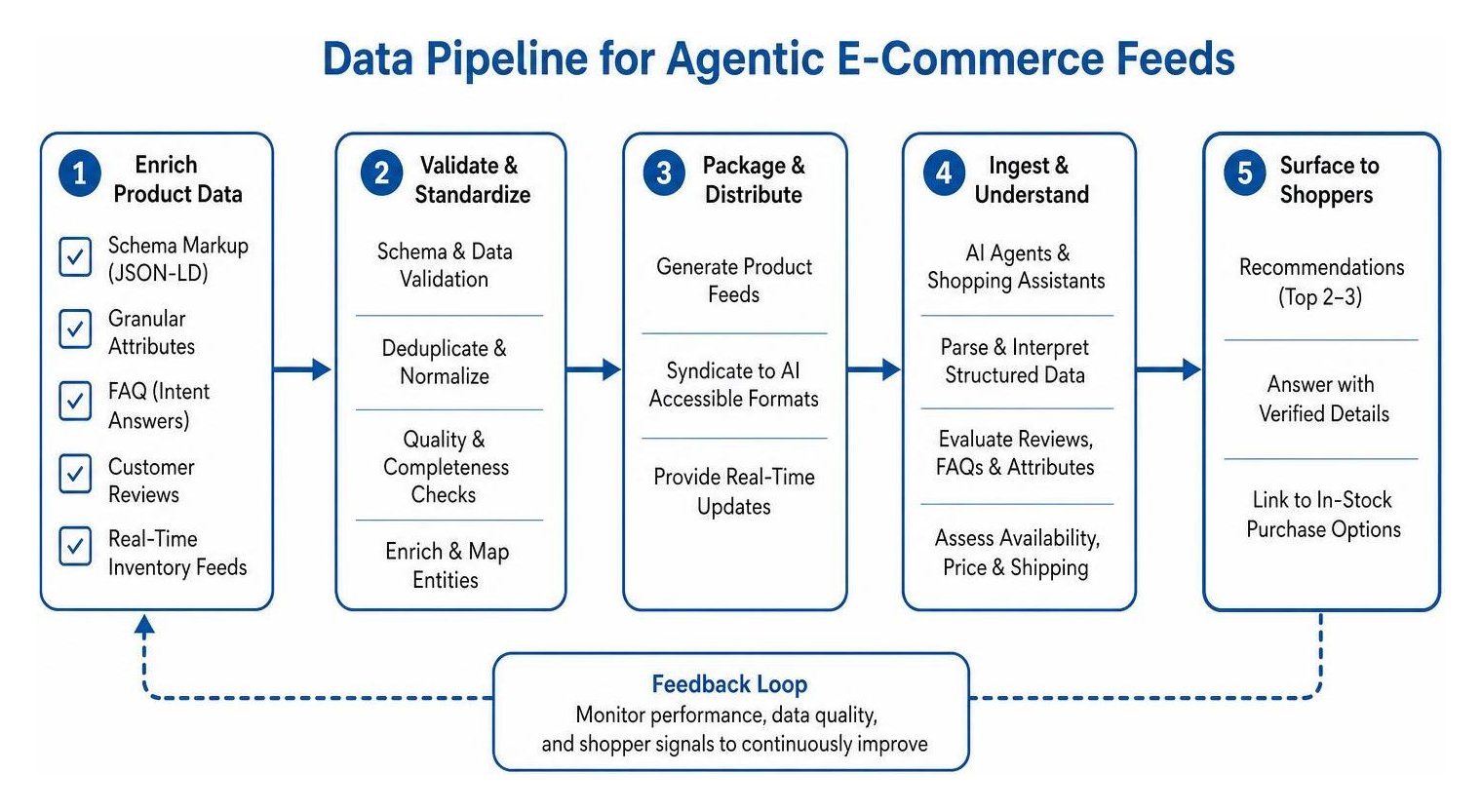
To guarantee complete visibility across conversational agents and smart platforms, brands must enrich their product pages with structured technical markup, real-time inventory signals, and detailed answers to practical consumer questions.
A thorough LLM signal tracking through an AI SEO audit can pinpoint technical gaps in your schema markup before they harm your sales pipeline.
To maximize machine readability across third-party tools, your product feeds should incorporate:
- Comprehensive Schema Markup: Integrate deep JSON-LD structured data including Product, AggregateRating, Offer, and FAQPage schemas.
- Granular Attribute Depth: Detail precise dimensions, materials, care instructions, compatibility specs, and sustainability credentials.
- Intent-Driven Natural Language FAQs: Directly answer real-world usage queries (e.g., "Is this jacket warm enough for sub-zero hiking?").
- Verified Customer Review Syndication: Structure authentic customer feedback to allow AI scrapers to assess sentiment and validate product durability.
- Real-Time Omnichannel Inventory Feeds: Connect dynamic pricing, stock levels, and regional shipping timelines to prevent recommending out-of-stock items.
Mastering the Next Era of Retail Search
The transition from keyword-based search to conversational AI shopping is not a distant prediction—it is actively reshaping how consumers discover products, evaluate alternatives, and make purchases.
Shoppers are rewarding brands that provide instant, honest, and hyper-personalized discovery experiences while punishing sites with slow, rigid navigation. By auditing your product feeds, syndicating authentic customer proof, and structuring your digital catalog for answer engines, you can secure your position on the algorithmic shelf and capture the next wave of high-intent buyers.