Trillion-Dollar Market Forecasts Show Accelerating Global AI Investment

How Fast Is Global AI Spending Expected to Grow?
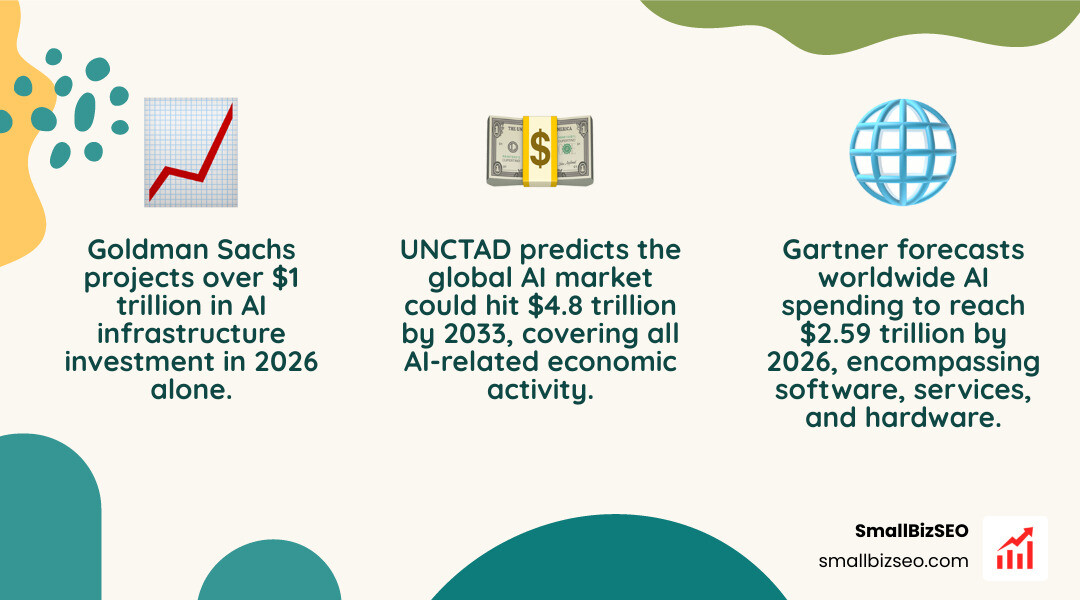
Global AI spending is set to keep rising, but the forecasts measure different things. Goldman Sachs projects more than $1 trillion in AI-related investment within the next few years, while Gartner forecasts $2.59 trillion in worldwide AI spending over a comparable period. Looking further ahead, Grand View Research projects a $3.5 trillion AI market, and UNCTAD puts it at $4.8 trillion. These figures are not interchangeable: investment, total spending, and market revenue each count different activity.
For businesses, the practical question is not how big the forecast gets. It is which AI investments produce useful results as spending shifts from infrastructure toward everyday work. Understanding the future of AI spending, including market growth, investment forecasts, and industry projections, helps business owners separate durable trends from headline numbers.
I'm Clayton Johnson, founder of SmallBizSEO. My work in SEO, content strategy, and AI-driven discovery shapes how I explain The Future of AI Spending: Market Growth, Investment Forecasts, and Industry Projections for business owners.
Basic The Future of AI Spending: Market Growth, Investment Forecasts, and Industry Projections vocab:
- AI Tools Market Share: The Most Popular Artificial Intelligence Platforms for Businesses
- The Economics of AI Content Creation: Costs, Output, and Marketing Productivity
- AI Workforce Statistics: Jobs Created, Tasks Automated, and Productivity Gains
Key Forecasts on The Future of AI Spending: Market Growth, Investment Forecasts, and Industry Projections

Direct forecasts show that artificial intelligence is transitioning from experimental enterprise budgets into a massive multi-year capital supercycle. Major institutions agree that global spending will expand significantly, driven by data center development, specialized silicon, and software automation.
What Do Major Institutions Predict for the Future of AI Spending: Market Growth, Investment Forecasts, and Industry Projections?
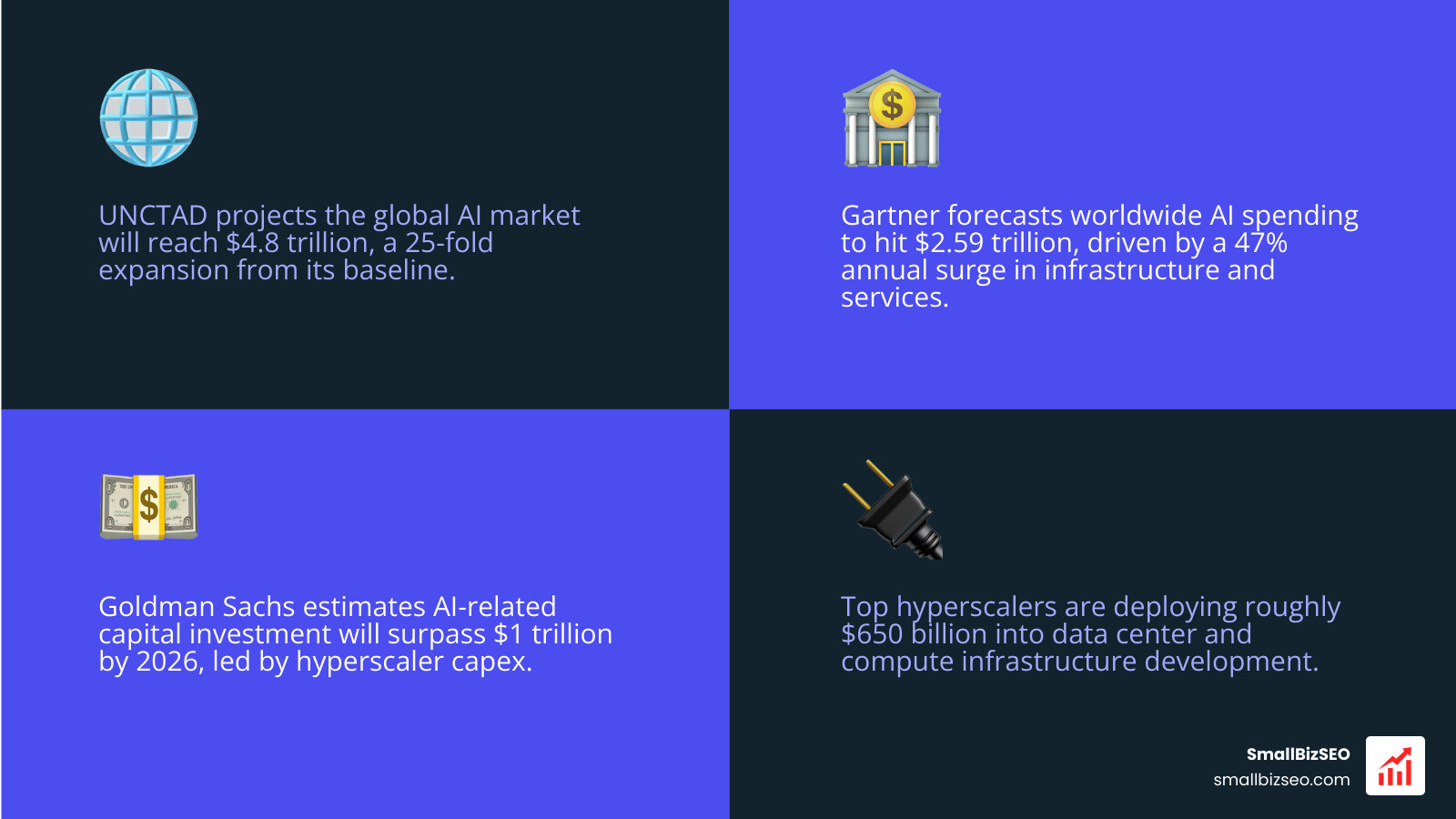
Global market sizing varies depending on whether analysts evaluate pure capital expenditures, end-user software, or total market revenue. UNCTAD projects the global AI market to reach $4.8 trillion, representing a dramatic 25-fold expansion from its baseline and capturing nearly 29% of the entire frontier technology sector. In parallel, Gartner AI spending forecasts project worldwide spending to hit $2.59 trillion, marking a rapid 47% annual surge.
For organizational leaders evaluating business spending on AI investment, understanding these varying research methodologies clarifies realistic expectations:
| Research Institution | Market Metric Analyzed | Projected Valuation | Key Economic Focus |
|---|---|---|---|
| UNCTAD | Global Market Opportunity | $4.8 Trillion | Frontier technology share, global equity, and trade policy |
| Grand View Research | Total AI Market Size | $3.5 Trillion | 30.6% compound annual growth rate across enterprise software |
| Gartner | Worldwide Annual Spending | $2.59 Trillion | Massive growth in specialized infrastructure, IaaS, and servers |
| Goldman Sachs | AI-Related Capital Investment | $1.0 Trillion+ | Hyperscaler capex, GDP share expansion, and private investment |
Which Geographic Regions and Infrastructure Segments Lead Global AI Capital Allocation?
North America remains the undisputed capital anchor for modern machine learning infrastructure. According to Goldman Sachs research on global AI investment, private capital allocation in the United States reached $285.9 billion, outpacing China's $12.4 billion in private funding by more than 23 times. The United States also operates 5,427 enterprise data facilities, outnumbering every other nation by a factor of ten.
Despite this funding gap, Chinese engineering teams have closed the model performance deficit on leading coding and reasoning benchmarks. Simultaneously, global chip fabrication remains highly concentrated, with a single semiconductor foundry in Taiwan producing the overwhelming majority of top-tier accelerators. Navigating enterprise AI software pricing and benchmarks requires recognizing how this tight supply chain directly dictates software subscription tiers and operational costs.
How Does the $650 Billion Infrastructure Wave Impact the Future of AI Spending, Market Growth, Investment Forecasts, and Industry Projections?
Physical compute and data center expansion represent the core engine of near-term capital deployment. Detailed breakdowns in the AI infrastructure spending thesis indicate that top hyperscalers are deploying roughly $650 billion into infrastructure development.
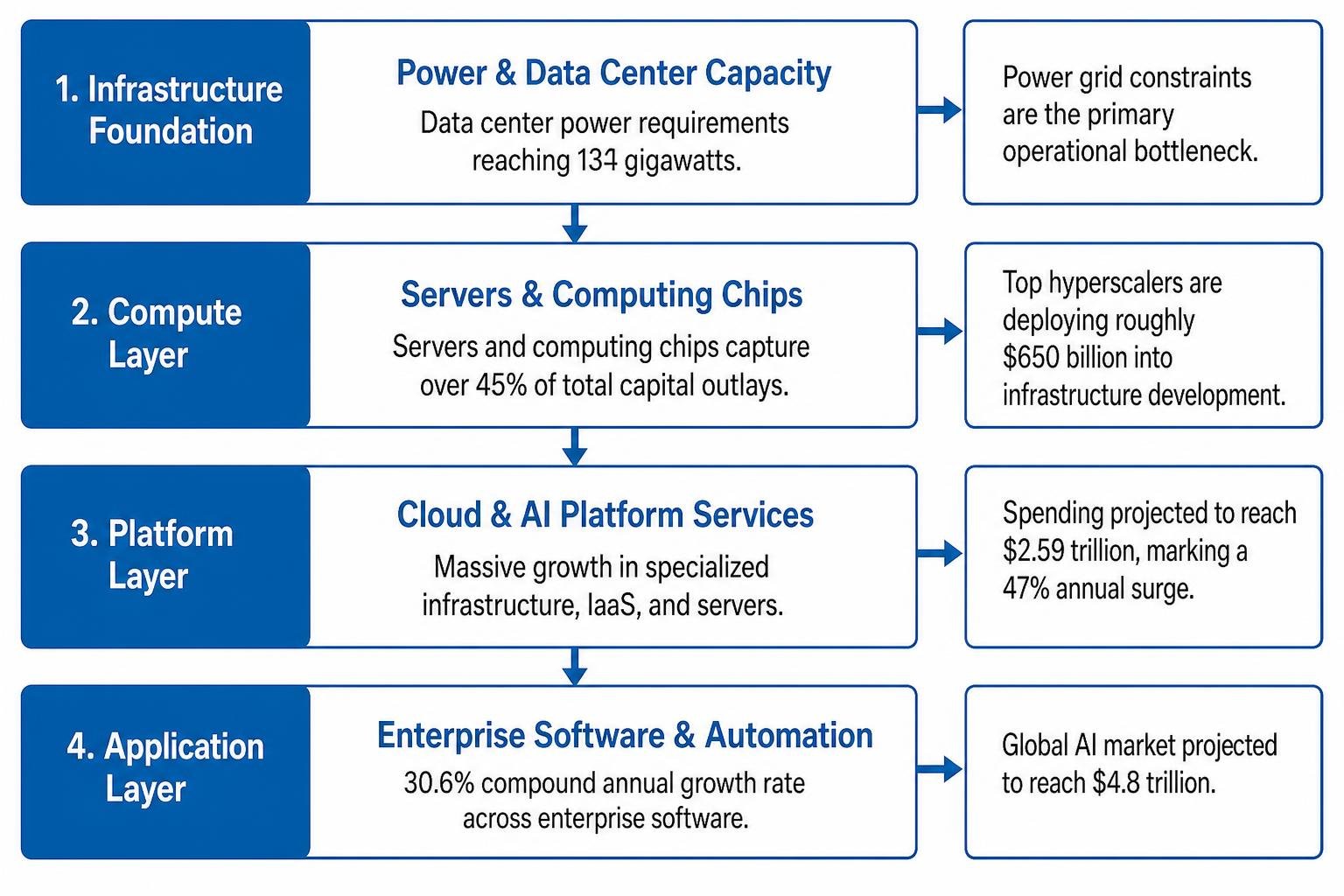
Servers and computing chips capture over 45% of total capital outlays, but power grid constraints have emerged as the primary operational bottleneck. Projections show data center power requirements reaching 134 gigawatts, forcing tech operators to strike direct power purchase agreements with utility and nuclear providers. As tracked in our research on adoption spending benchmarks, hardware costs account for the vast majority of technical budgets before software layers ever touch end users.
Enterprise Realities, Workplace Transformation, and Strategic Implementation

While hardware providers report historic quarterly earnings, everyday commercial users face a challenging monetization gap. Turning computing capacity into sustainable bottom-line efficiency requires structured adoption rather than blind tool purchasing.
Why Are Enterprise AI Profits Lagging Behind Record Hardware and Model Spending?
Enterprise profitability has trailed infrastructure outlays because most companies remain stuck in early, tactical experimentation. As outlined in corporate AI investment and profit analysis, only 11% of S&P 500 organizations have quantified specific productivity improvements, and just 2% tie direct revenue gains to automated tools.
The underlying challenge stems from budget reallocation. Two-thirds of businesses fund automation by trimming conventional software and labor allocations rather than generating net-new revenue streams. Evaluating how AI impacts business productivity and ROI confirms that measurable value appears only when teams optimize specific, repeatable workflows instead of launching broad, unfocused pilot programs.
How Will Generative AI Deployment Reshape Global Labor Productivity and Workforce Skills?
Widespread automation directly impacts up to 40% of global employment, with knowledge workers in advanced economies experiencing the greatest day-to-day transformation. According to an Oxford Economics analysis on enterprise AI budgets, intelligent software will climb from a modest baseline to represent nearly 23% of total enterprise technology budgets over the next decade.
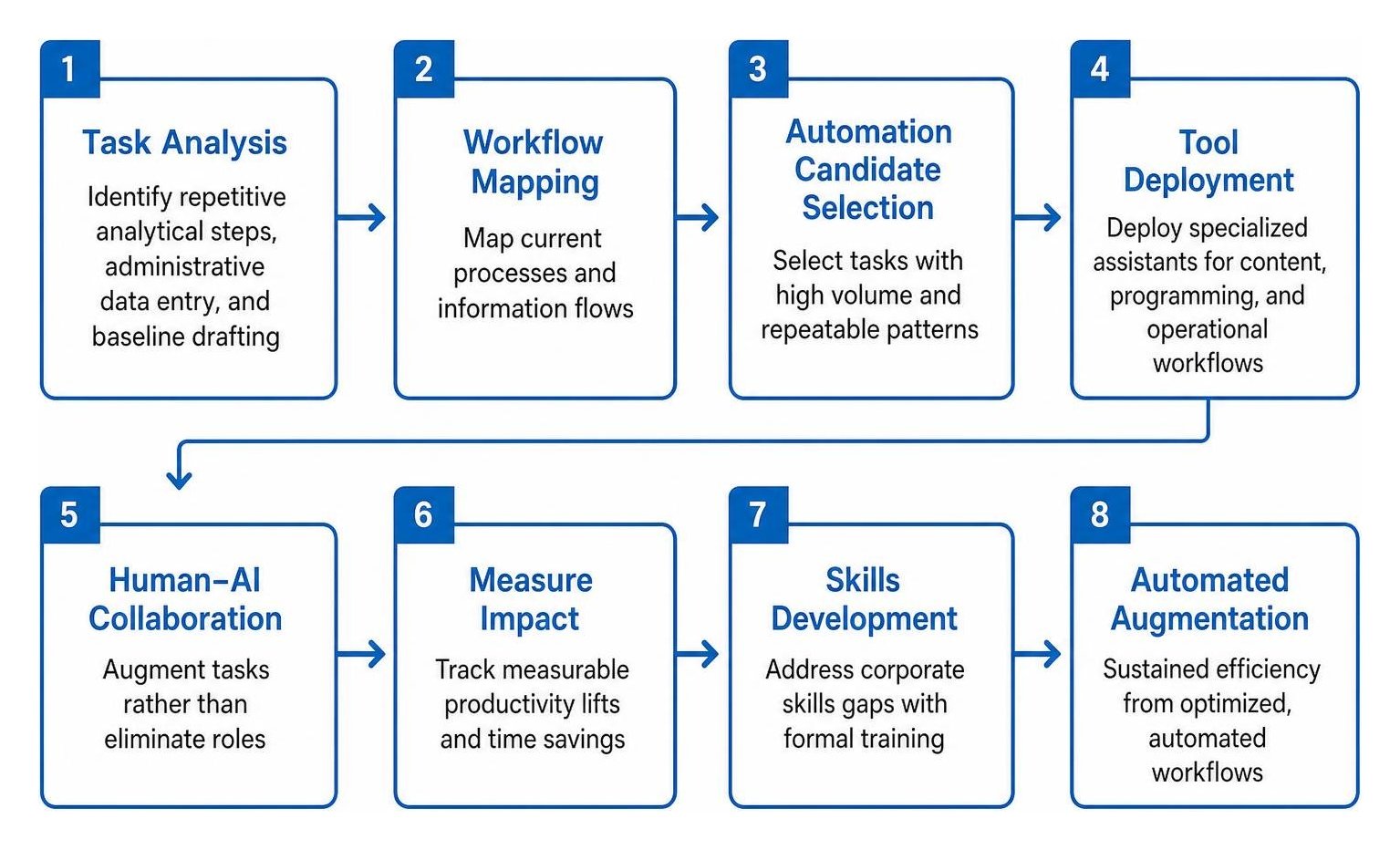
Key labor market transformations driven by modern software adoption include:
- Task-Level Augmentation: Rather than eliminating entire roles, automation absorbs repetitive analytical steps, administrative data entry, and baseline drafting.
- Measurable Productivity Lifts: Independent labor statistics on AI worker productivity show significant time savings when deploying specialized assistants for high-volume content, programming, and operational workflows.
- Widening Corporate Skills Gaps: Recent corporate AI training and skills gap metrics reveal that formal corporate training programs lag behind the rapid pace of tooling updates.
- Explosive Consumer Adoption: Generative software reached over 53% population adoption within three years, delivering an estimated $172 billion in annual consumer utility.
What Governance and Infrastructure Strategies Ensure Sustainable ROI on Artificial Intelligence?
Achieving sustainable returns requires balancing ambitious implementation with reliable governance, risk management, and search visibility. Documented operational safety incidents rose from 233 to 362 within a single reporting period, illustrating that technical capabilities continue to develop faster than internal compliance controls.
At SmallBizSEO, we help modern businesses navigate automated search discovery using our data-driven "Velocity" framework. We provide technical SEO, content strategy, and link-building services designed to capture real consumer demand as search engines integrate large language models. Reviewing essential generative AI statistics every business owner should know provides the practical foundation needed to build high-converting organic search channels.
Turning Market Forecasts Into Practical Business Growth
The transition toward multi-trillion-dollar automated infrastructure is permanently reshaping commercial discovery, operational workflows, and enterprise software budgets. Navigating this shift does not require outspending industry giants on proprietary server clusters. It requires deploying structured, high-value workflows that drive sustainable revenue, build long-term brand authority, and turn automated technology into measurable business growth.