All About Creating AI Content Briefs

What Are AI Content Briefs?
AI content briefs are plans for a single piece of content, built with help from AI. They bring the audience, search intent, key questions, sources, brand voice, and suggested structure into one place. To make one useful, start with the reader's question and your goal, then check the AI's suggestions before handing the brief to a writer.
I'm Clayton Johnson, a digital marketing and SEO strategist whose work connects search strategy, content, and digital PR. That experience shapes how I think about AI content briefs: they should save time without replacing the research and judgment that make content worth reading.
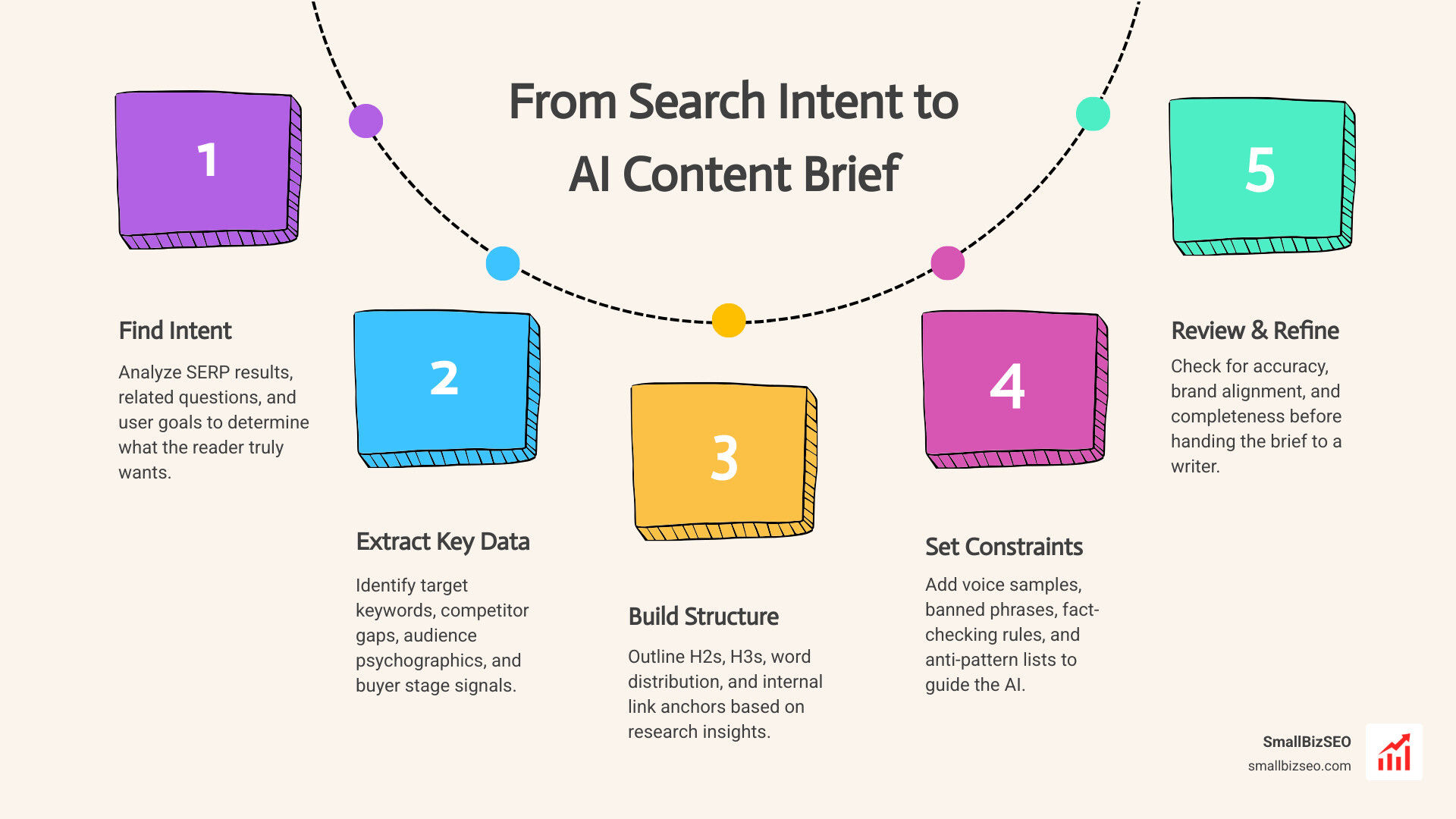
Must-know AI content briefs terms:
What Are AI Content Briefs, and Why Do They Matter?
An AI content brief is an automated, data-backed document that maps out everything needed to produce a high-performing article. Instead of spending hours manually reviewing competitor pages, an AI brief analyzes top-ranking search results, uncovers audience questions, and organizes target subtopics in seconds. When built correctly, it serves as a reliable bridge between your high-level strategy and the final draft.
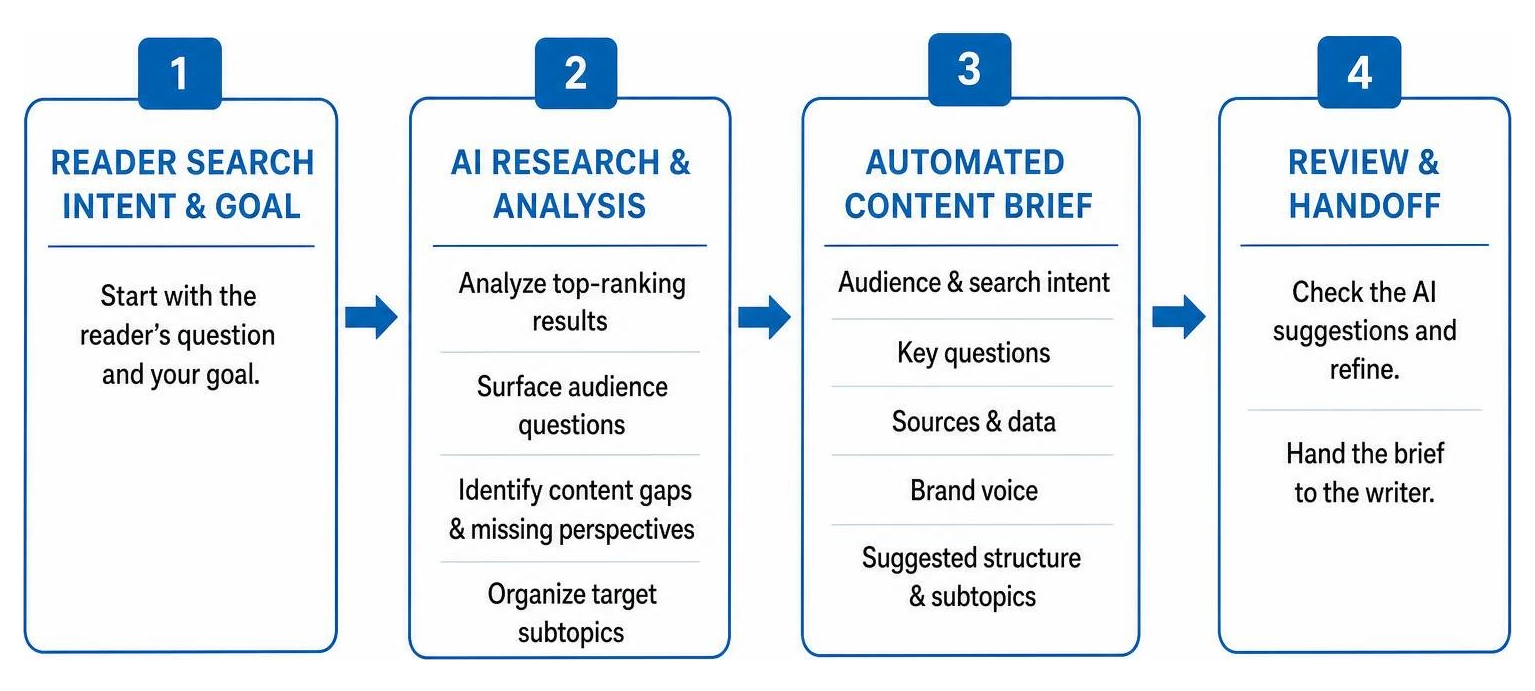
Modern search engines reward original value through information gain models. If your article merely repeats what ten competitors already wrote, it provides no new information. By using advanced large language model (LLM) prompt engineering, an AI brief identifies specific content gaps, user intent signals, and missing perspectives across the search landscape.
For example, if you input a complex query like "commercial property insurance costs," an automated generator evaluates top results, pulls forum discussions, extracts pricing variables, and structures a complete blueprint. Learning the principles of mastering the art of the SEO content brief helps your team turn raw data into actionable instructions for either human writers or AI engines.
How Do Traditional Briefs Differ from Generative Workflows?
Traditional briefs rely on manual data collection. A strategist examines five competitor articles, copies their main subheadings, lists a target keyword with search volume, and pastes everything into a document. This static approach takes 30 to 60 minutes per article and often misses deeper semantic relationships.
Generative workflows extract micro-intent signals and semantic topic clusters across hundreds of search results, forums, and Q&A boards in under a minute. Instead of an unorganized list of headings, generative workflows produce structured machine-readable context. They categorize user intent by sales funnel stage, flag specific entities required for comprehensive coverage, and pinpoint exact angles competitors failed to address.
Why Can AI Content Briefs Improve First-Draft Acceptance Rates?
A major source of friction between editors and writers is mismatched expectations. When a writer receives vague directions, the resulting draft often requires extensive structural revisions and multiple rounds of rewrites.
Standardized data inputs give writers explicit guidance on tone, section depth, and audience needs. In their Think with Google analysis of AI briefs, researchers highlight how clear upfront parameters prevent creative drift and keep messaging tightly aligned with strategic goals. Teams using detailed briefs often see first-draft acceptance rates increase from under 40% to over 60%, cutting post-draft editing time from over an hour down to roughly 25 minutes per piece.
What Should an Effective Content Brief Include?
An effective content brief must provide clear context, technical SEO parameters, and direct instructions. A minimum viable brief requires eight foundational fields: target search intent, audience profile, competitor gap analysis, heading structure, word count distribution, internal link targets, semantic entities, and calls to action.
| Brief Field | Purpose | Prompt & Output Impact |
|---|---|---|
| Search Intent | Defines user goal (informational, commercial, transactional) | Keeps the draft focused on answering the primary query directly |
| Psychographic Persona | Identifies specific pain points and background knowledge | Prevents over-explaining basic concepts to experienced readers |
| Competitor Gap Analysis | Highlights missing points across current search results | Forces the draft to supply unique information gain |
| Section Word Distribution | Allocates target length across individual headings | Stops the writer or model from creating thin, unbalanced sections |
| Constraint List | Defines banned words, cliches, and tone anti-patterns | Eliminates generic phrasing and repetitive filler |
| Internal Link Targets | Supplies target URLs and conceptual anchor text | Embeds natural contextual pathways during the initial draft |
Providing this structured data makes it easier to understand how to optimize your content for E-E-A-T and build real search trust by making sure first-hand experience, data sources, and expert proof points are planned out before writing begins.
How Should You Define the Audience and Search Intent?
Vague audience labels like "marketers" or "homeowners" produce generic writing. Effective briefs define psychographic personas by detailing what the reader already knows, their everyday problems, and their primary goal for reading.
Search intent must go beyond labeling a keyword as "informational." Specify the exact customer stage and their core problem. For instance, an informational query from a beginner looking for a broad definition requires a simple breakdown with basic examples. Conversely, an informational query from an enterprise director evaluating software migration requires high-level architecture breakdowns, cost models, and risk mitigation strategies.
How Can Voice Samples and Negative Constraints Guide the Draft?
Voice calibration is the single highest-leverage field in any brief. Rather than relying on subjective descriptors like "friendly yet professional," include a short reference sample of three to four sentences from an existing, high-performing article. Language models and freelance writers can emulate this real syntax, sentence rhythm, and vocabulary much more reliably.
Negative constraints (what not to do) are equally vital. Use an explicit constraint list to eliminate fluff, such as:
- Never open an introductory paragraph with "In today's digital world."
- Do not use overused transition words like "delve," "unlock," "revolutionize," or "testament."
- Avoid vague claims; every assertion must be supported by an operational example or a cited data point.
Standardizing these parameters using a proven framework for AI content brief templates ensures that every contributor adheres to your brand's unique editorial voice.
How Should You Set Content Length, Headings, and Internal Links?
A total word count number is rarely enough. A target of 2,000 words without section boundaries often leads to inflated introductions and thin practical advice. Instead, allocate word counts per heading—such as 150 words for the introduction, 350 words per core H2 section, and 100 words for the conclusion.
When mapping headings, pair each section with specific internal linking targets and anchor concepts. Practicing AI SEO content optimization made easy means embedding exact destination URLs into your outline so writers integrate related resources naturally as they draft.
How Can You Keep Generated Content Consistent with Your Brand Voice?
Maintaining brand voice across high-volume production requires clear style governance. When multiple team members or automated workflows draft content simultaneously, subtle variations in tone can dilute your brand identity. Establishing unified guidelines protects quality across all published work.
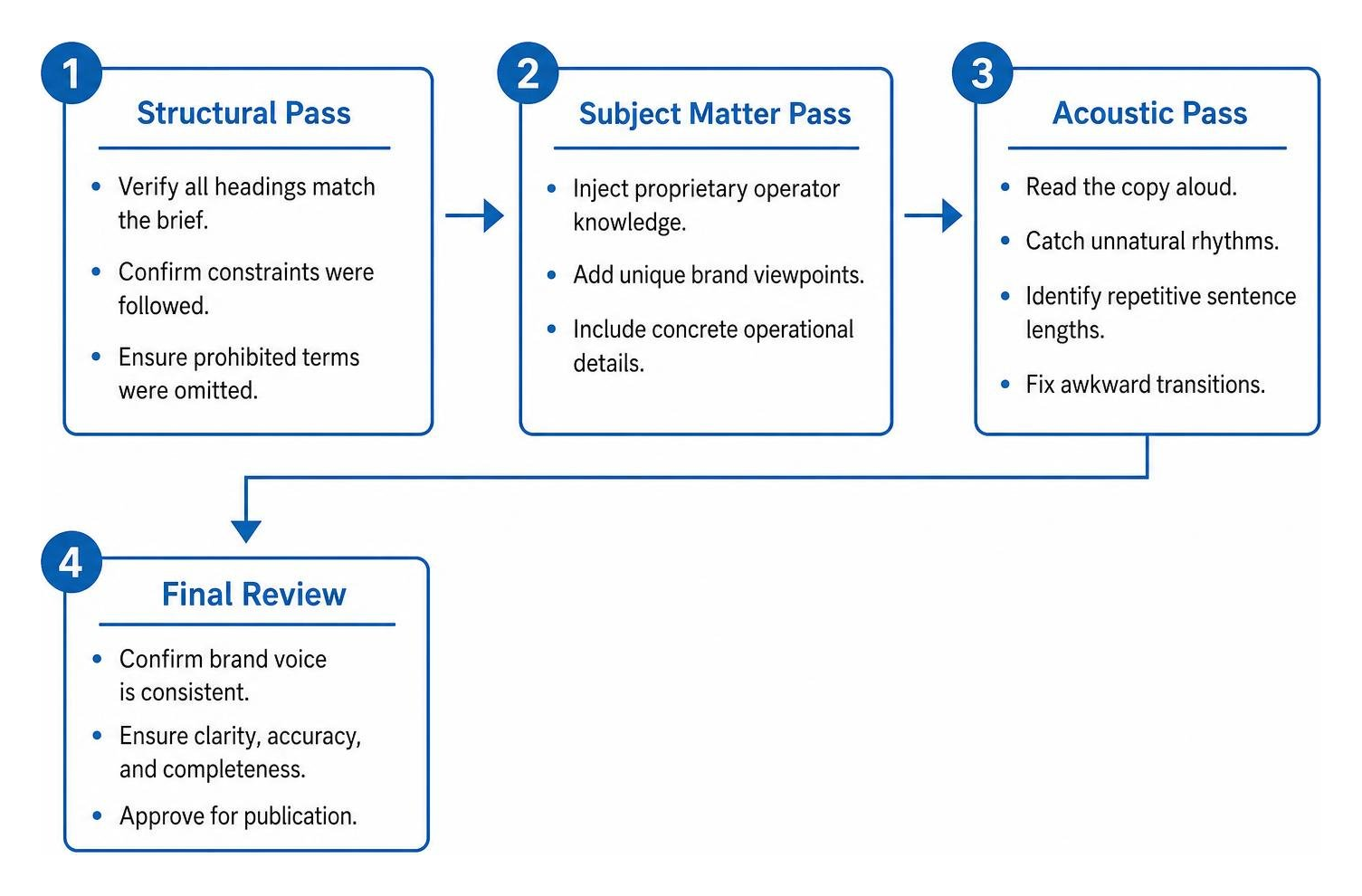
Maintaining high editorial standards is central to scaling AI content balancing massive output with human quality. To ensure consistent quality across every draft, implement a three-pass review process:
- Structural Pass: Verify that all headings match the brief, clear constraints were followed, and prohibited terms were omitted.
- Subject Matter Pass: Inject proprietary operator knowledge, unique brand viewpoints, and concrete operational details.
- Acoustic Pass: Read the copy aloud to catch unnatural rhythms, repetitive sentence lengths, or awkward transitions.
How Should You Provide Style Reference Pieces?
Few-shot prompting provides an AI system with clear input-output pairs to illustrate expected behavior before generating new text. Supplying two distinct 300-word reference samples in your brief shows the model your preferred balance of active verbs, paragraph lengths, and conversational elements. This gives the generator concrete boundaries for syntax and tone, minimizing generic phrasing.
What Anti-Pattern Rules Help Reduce Fluff and Hallucinations?
Language models generate plausible-sounding text based on statistical patterns, which can sometimes introduce unverified facts or fake citations. Anti-pattern rules provide guardrails against these issues.
Explicitly require all statistical data points to use an evidence-based format: claim, data point, and source context. Instruct the model or writer to flag any unsourced data with a placeholder rather than generating an approximate number. This practice prevents factual errors and ensures every claim is verified before publication.
What Common AI Content Brief Mistakes Should You Avoid?

Even advanced automated systems fail if fed poor inputs. Common briefing errors that damage draft quality include:
- Targeting Multiple Unrelated Keywords: Forcing distinct primary keywords with different user intents into one brief confuses the structure. Create one dedicated brief per primary intent.
- Providing Static, Unchecked Outlines: Accepting raw AI-generated headings without human review often leads to redundant sections. Always refine the outline to guarantee unique information gain.
- Skipping Negative Constraints: Leaving out banned phrases and structural restrictions allows repetitive filler to creep back into the copy.
- Relying on Outdated Competitor Research: Generating outlines based solely on current search listings without checking for recent market changes leads to outdated articles.
- Treating Briefs as Rigid Specifications: A brief is an operational guide. If a writer uncovers a valuable angle during research, allow room to adapt while keeping search intent intact.
Which Tools and Platforms Can Help Generate Content Briefs?
Selecting the right brief generation platform depends on your team's size, publishing volume, and technical stack. Key evaluation criteria include SERP scraping accuracy, integration with existing CMS platforms, and API access for programmatic workflows.
Understanding these tools is part of exploring beyond keywords a guide to generative AI SEO services and GEO, where modern visibility relies on topical completeness rather than basic keyword placement.
| Platform Type | Core Data Sources | Customization Capabilities | Primary Strengths | Generation Speed |
|---|---|---|---|---|
| Enterprise SEO Platforms | Live Google SERPs, backlink graphs, search databases | High; custom templates, team workspaces, scoring rules | Deep keyword metrics, competitive difficulty scoring | 2 to 5 minutes |
| Dedicated Content Studio Tools | Top 20 SERP results, People Also Ask, forum threads | Moderate; drag-and-drop heading builders, token trackers | Rapid outline creation, built-in text editors | Under 30 seconds |
| Custom LLM Agents | User-supplied context, uploaded style guides, web search | Full; prompt-level field control, custom API logic | Tailored voice matching, custom workflow integration | 10 to 20 seconds |
How Can You Measure the ROI of Brief Automation?
To measure the return on investment of automating your content briefs, compare your operational costs and publishing speed against your historical baseline.
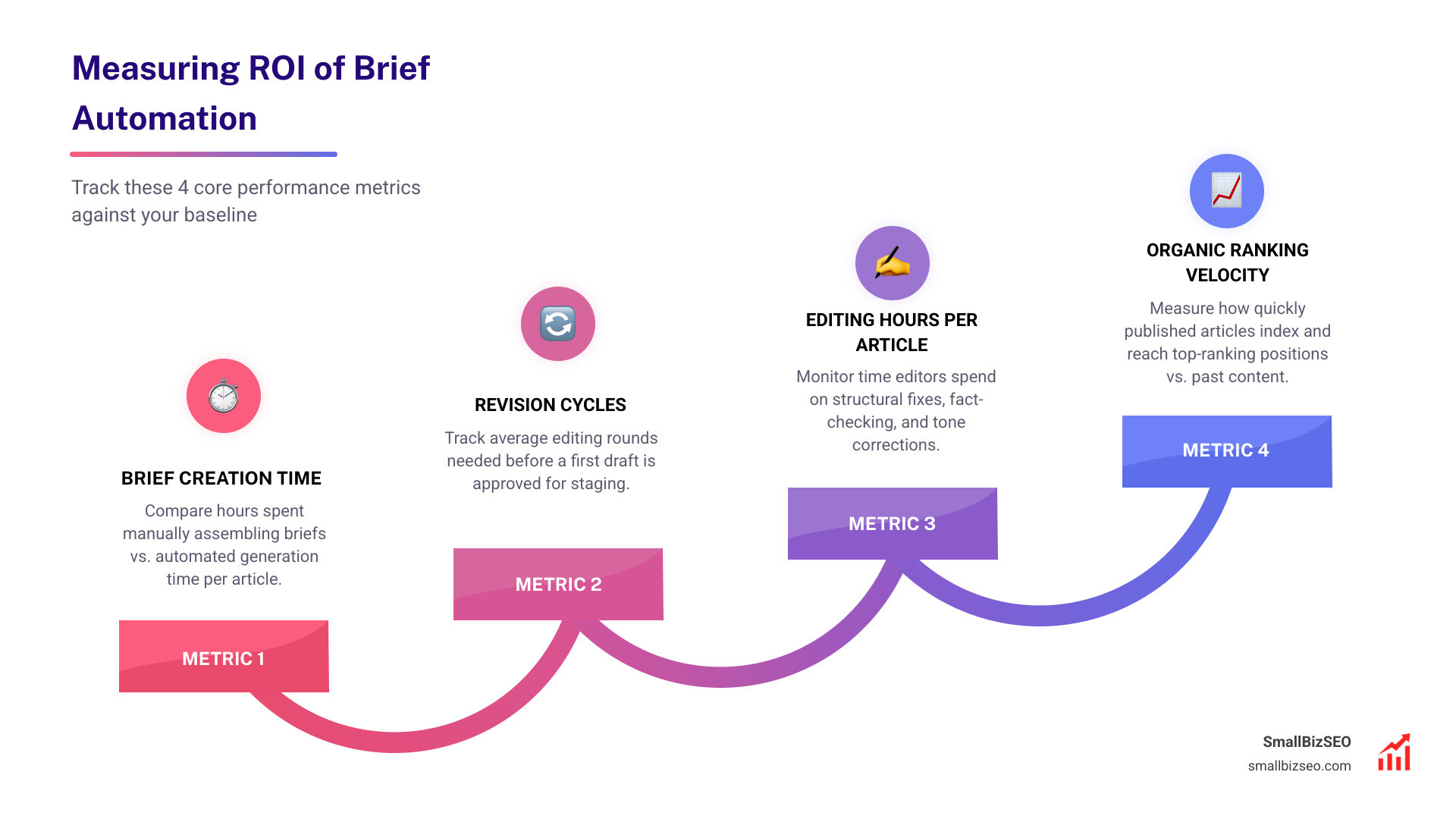
Track these four core performance metrics:
- Brief Creation Time: Measure the hours spent assembling briefs manually compared to automated generation.
- Revision Cycles: Track the average number of editing rounds required before a first draft is approved for staging.
- Editing Hours per Article: Monitor the time editors spend refining structure, checking facts, and correcting tone.
- Organic Ranking Velocity: Track how quickly published articles indexed and achieved top-ranking positions compared to past content.
Documenting these performance markers supports clear tracking, as outlined in the ultimate guide to SEO reporting for beginners, showing leadership how operational efficiency directly impacts growth.
What Should You Know About AI Content Briefs?
How Long Should It Take to Create a Complete AI Content Brief?
An AI platform generates the foundational data—including keywords, competitive subtopics, and common questions—in under 20 seconds. A human strategist should spend another three to five minutes reviewing the outline, adding proprietary brand notes, and confirming internal linking targets. A complete, ready-to-write brief takes about five minutes.
Can an Automated Brief Guarantee First-Page Search Rankings?
No. While a comprehensive brief ensures your content matches search intent and answers critical user questions, search rankings also depend on domain authority, technical site health, backlink quality, and user engagement signals. A brief provides an optimized blueprint, but ranking requires consistent site-wide execution.
What Is the Highest-Leverage Field in an AI Brief?
The voice sample field combined with explicit negative constraints has the highest leverage on final draft quality. While SEO keyword lists provide topical coverage, concrete style samples and banned-phrase lists eliminate generic phrasing, cutting down editing time more than any other field.
Building Sustainable Search Visibility
Automated content planning helps modern teams move from slow manual research to streamlined, data-driven execution. Standardizing your audience research, search intent mapping, and brand guidelines across every brief creates clear blueprints that save time and keep content quality high.
If your business is ready to streamline content planning, improve editorial workflows, and drive consistent search visibility, explore SmallBizSEO’s data-driven AI SEO services to scale your organic performance today.