Close Content Gaps to Help Restore Traffic After Algorithm Updates
How can you find a content gap after a core update?
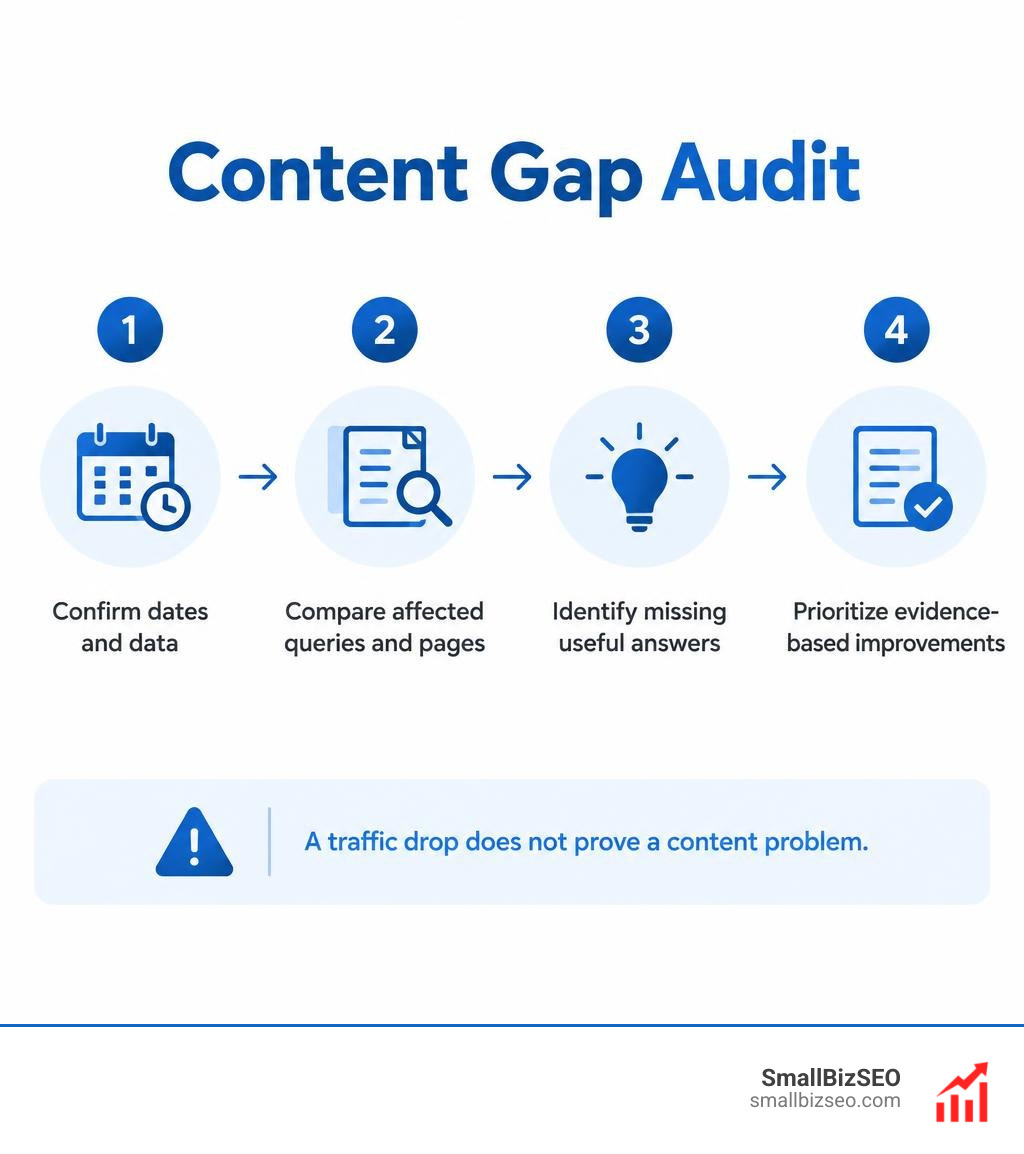
To find a core update content gap, first make sure the traffic loss is real. Wait until the update ends, then allow at least one full week before comparing Search Console data. Check for reporting errors and seasonal changes. Next, look at the pages and search queries that lost ground, compare them with pages now ranking above yours, and note where your content lacks a useful answer, first-hand proof, or a clear match for what the searcher needs.
Avoid rewriting pages over a small ranking dip. A large, lasting drop calls for a closer review, but it does not prove that a core update caused it. The dashboard and diagrams below are illustrative, not a client recovery case study.
I’m Clayton Johnson, founder of SmallBizSEO. My work in SEO and content strategy helps small businesses turn a core update content gap into a practical plan for clearer answers, stronger evidence, and qualified leads.
Core update content gap terminology:
- analyzing traffic after a google core update finishes
- core update google
- core update recovery strategy
How to Identify and Audit Every Core Update Content Gap
Review affected pages alongside the wider site, but do not assume Google assigns a visible domain-wide quality tier or that one weak article necessarily suppresses every strong page. Compare changed queries and landing pages, content usefulness, technical accessibility and demand. A content gap is a reader need you can document, not simply a topic a competitor has published.
Official guidance in Google Search's Core Updates confirms that these rollouts do not target individual URLs or hand out penalties. Instead, they reassess the open web to spotlight pages that best fulfill search intent. Successfully understanding core algorithm shifts means identifying topical voids where competing resources provide deeper clarity, original insights, or better user utility.
What Is a Core Update Content Gap Versus a Technical Data Bug?
A sustained visibility loss can have several causes, including ranking changes, demand shifts, indexing problems or site changes. A reporting anomaly can distort the apparent trend. Neither impressions nor clicks alone reliably distinguishes these causes; treat patterns as hypotheses to investigate.
Before diagnosing content quality problems, verify that your traffic drop is not an illusion. Review the Google Search Status Dashboard to confirm whether ranking updates are still actively deploying or if known platform bugs have disrupted data collection. Logging errors can cause sudden dips in impression reporting while total clicks remain stable.
| Observation | Possible explanations | Next check |
|---|---|---|
| Clicks and impressions fall | Demand, ranking, indexing or reporting changes | Segment queries, pages, devices and dates; review site changes |
| Impressions fall while clicks stay stable | Query mix, result presentation or a reporting issue | Inspect affected segments and official notices; do not assume a bug |
| Drop overlaps an update | Possible correlation, not established causation | Compare suitable periods after rollout and rule out technical causes |
| Competitors appear above your page | Changed relevance, intent or result composition | Review multiple representative searches and the pages’ usefulness |
How Do You Uncover an AI Visibility and Information Gain Gap?
An AI visibility gap is an observed absence from a defined set of sampled answers, not proof of a core-update problem. Record the prompts, platform, date and sources shown before drawing conclusions. Original evidence can make content useful and citable, but there is no public universal information-gain score or guaranteed citation uplift.
We uncover these gaps by sifting through competitor keyword gap data alongside query fan-out analysis. Ask what follow-up questions users explore after an initial search, and inspect whether your pages answer those conversational inquiries. Bridging these voids requires fixing search intent mismatches so your content delivers fast, direct answers that answer engines can easily extract and cite.
Actionable Steps to Close Content Gaps and Recover Rankings
Closing content gaps requires transforming thin, generic articles into authoritative, structured resources that serve both human readers and search crawlers.
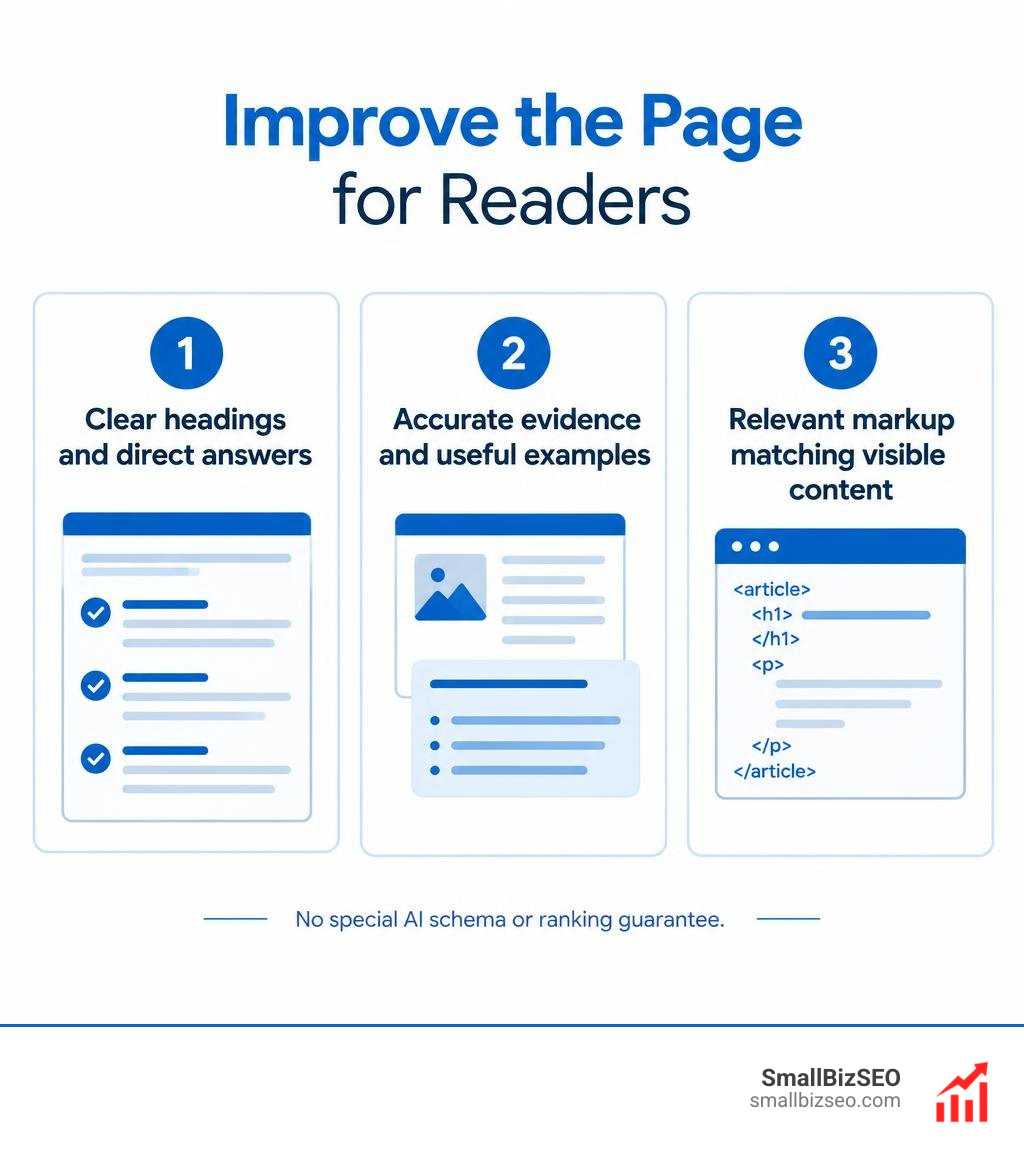
Use a reader-focused improvement checklist:
- Clear structure: Organize answers with meaningful headings, then supply the detail needed to complete the task.
- Appropriate markup: Use only relevant structured data that matches visible content. Follow Google’s current feature guidelines; adding every schema type does not restore rankings or guarantee rich results.
- Intent and evidence: Improve the specific answer, examples, sources and practical steps that are missing. Preserve separate pages when they address different queries or user tasks.
How to Fix a Core Update Content Gap with First-Hand Experience
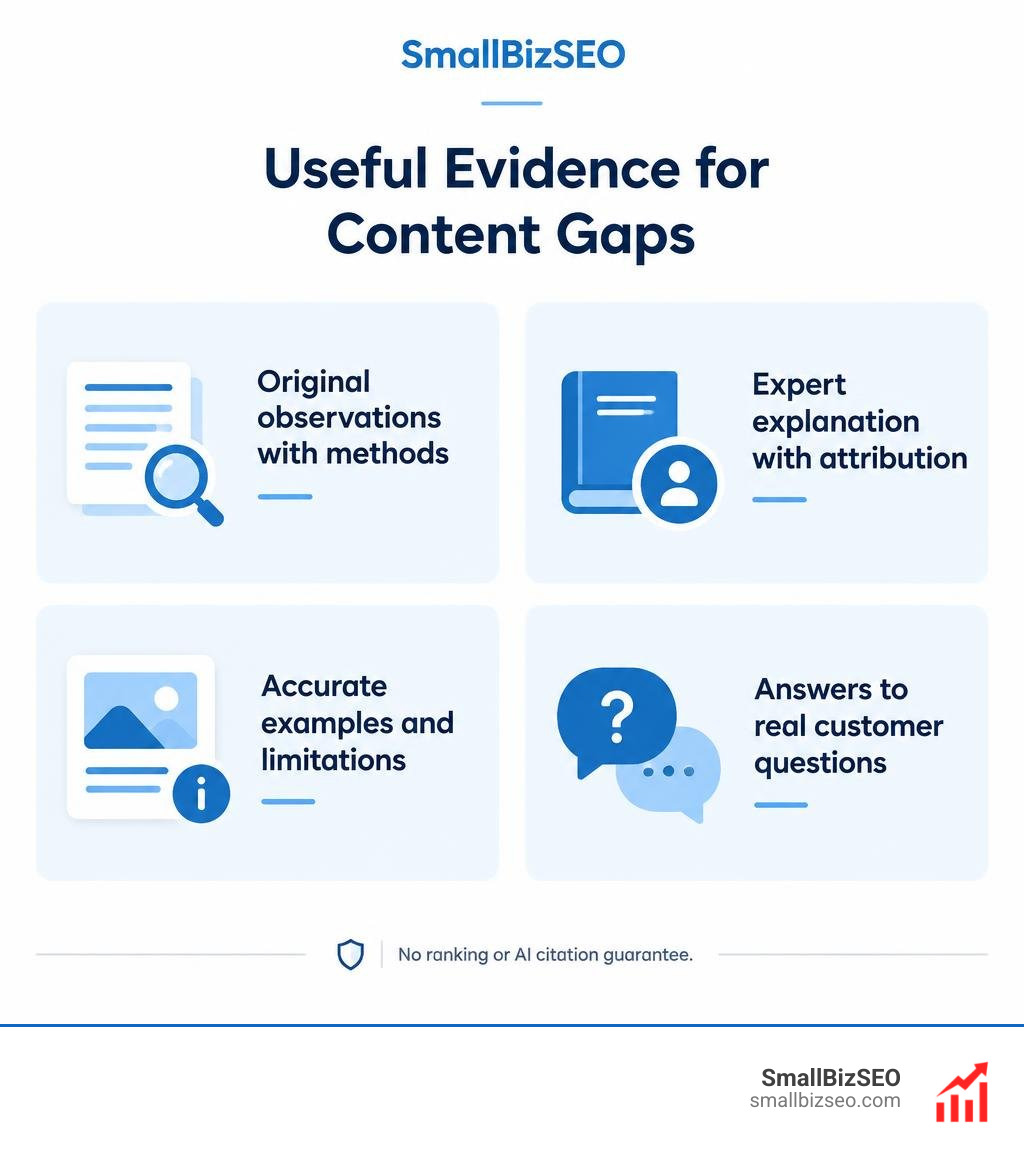
First-hand experience is valuable when it genuinely helps answer the reader’s question. Show what was done, how it was checked and where its limitations lie. Google’s helpful-content guidance emphasizes reliable, useful content and explains that E-E-A-T is not itself a specific ranking factor. Do not invent experience or promise a percentage gain from adding it.
Build evidence proportionate to the question:
- Interview practitioners: Ask focused questions, verify the answers and obtain permission for attributed quotes.
- Report real observations: Include methods, dates, sample limits and appropriate permission before sharing internal or customer data. Use primary external sources where they are the right evidence.
- Use meaningful visuals: Keep good existing images and add authentic screenshots or photographs where useful. Replace inaccurate or poor images, and label illustrative graphics instead of presenting them as proof of actual results.
- Explain limitations: Describe where a method works and where it does not, rather than adding contrarian claims for novelty.
- Show truthful authorship: Link accurate bylines to relevant experience and credentials without invented identities or expertise.
Which Pages Should You Prioritize, Consolidate, or Prune First?
Prioritize by business relevance, the severity of the reader problem, evidence of lost opportunity and effort required. A useful supporting article can matter even if it is not a direct sales page. Treat prioritization as a reasoned work order, not a prediction of the fastest return.
Begin by auditing your archive to update high-impact posts using a disciplined triage framework:
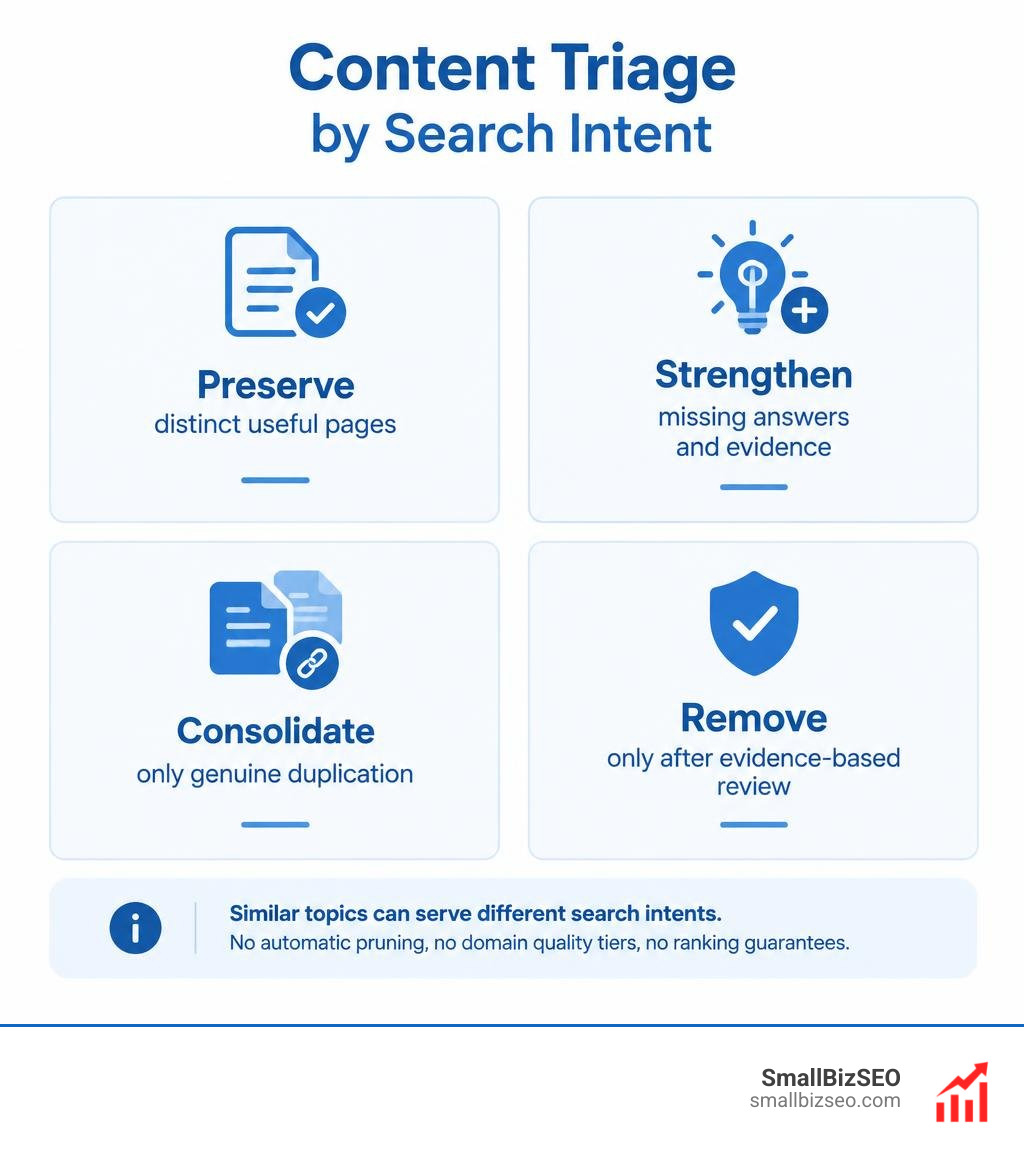
- Preserve: Keep useful pages that serve distinct search phrases or reader tasks. Similar titles or topics do not establish duplication.
- Strengthen: Correct inaccuracies, fill evidenced gaps and improve examples, navigation and visual support. Keep good images; replace poor ones rather than simply deleting them.
- Consolidate selectively: Consider merging only when pages genuinely serve the same intent and the combined resource is better. Review queries, links and user needs before planning any redirect.
- Remove only as a last resort: Document why a page cannot be improved and review its value before deletion. Low traffic alone is not enough, and deleting content is not a shortcut to a supposed site-quality tier.
How Do You Measure Traffic Recovery in an Answer Engine Environment?
Measure relevant search visibility, visits and qualified outcomes together. Keep sampled AI mentions separate from website traffic and sales attribution. There is no reliable universal metric called algorithmic consensus, and a brand mention should not be counted as a visit or conversion.
Use consistent definitions for the following measures:
- Search trends: Compare relevant pages and queries over suitable periods and annotate site changes, update dates and confirmed reporting incidents.
- Qualified outcomes: Track inquiries and sales where attribution is available. Disclose missing data and do not treat attributed revenue as proof of incremental profit.
- Sampled AI visibility: Record a fixed prompt set, platform, date and cited URLs. Results vary, and a sample is not the full population of answers.
Google reports AI-feature traffic within Search Console’s Web search data, not as a complete separate citation inventory. Its guidance does not require special AI schema.
Use a documented review process: record the issue, supporting evidence, change made and measurement date. Our core update resources can help organize the investigation. No framework can guarantee recovery or immunity from later ranking changes.
Moving Forward with a Resilient Content Strategy
A useful recovery plan starts with a diagnosis, not mass rewriting or deletion. Preserve distinct search intent, correct verifiable problems and improve the evidence and experience readers receive. Review results over time while accounting for demand and other changes. Improvements may help, but traffic recovery and protection from future updates are not guaranteed.