Mastering Post-Rebrand Search Transitions for a Flawless Online Identity

How do you make search results consistent after a rebrand?
The first step to improving brand serp consistency after a rebrand is to make the connection between the old and new names clear. Update your website and business profiles, publish a page that says you were formerly known by the old name, and use page-to-page redirects if your URLs changed. Then check searches for both names and fix outdated results.
Search engines may update at different speeds, so a consistent story across your site and other trusted sources matters more than a launch-day change alone.
I'm Clayton Johnson, founder of SmallBizSEO. My work in SEO, content strategy, and digital PR informs this guide to improving brand serp consistency after a rebrand.
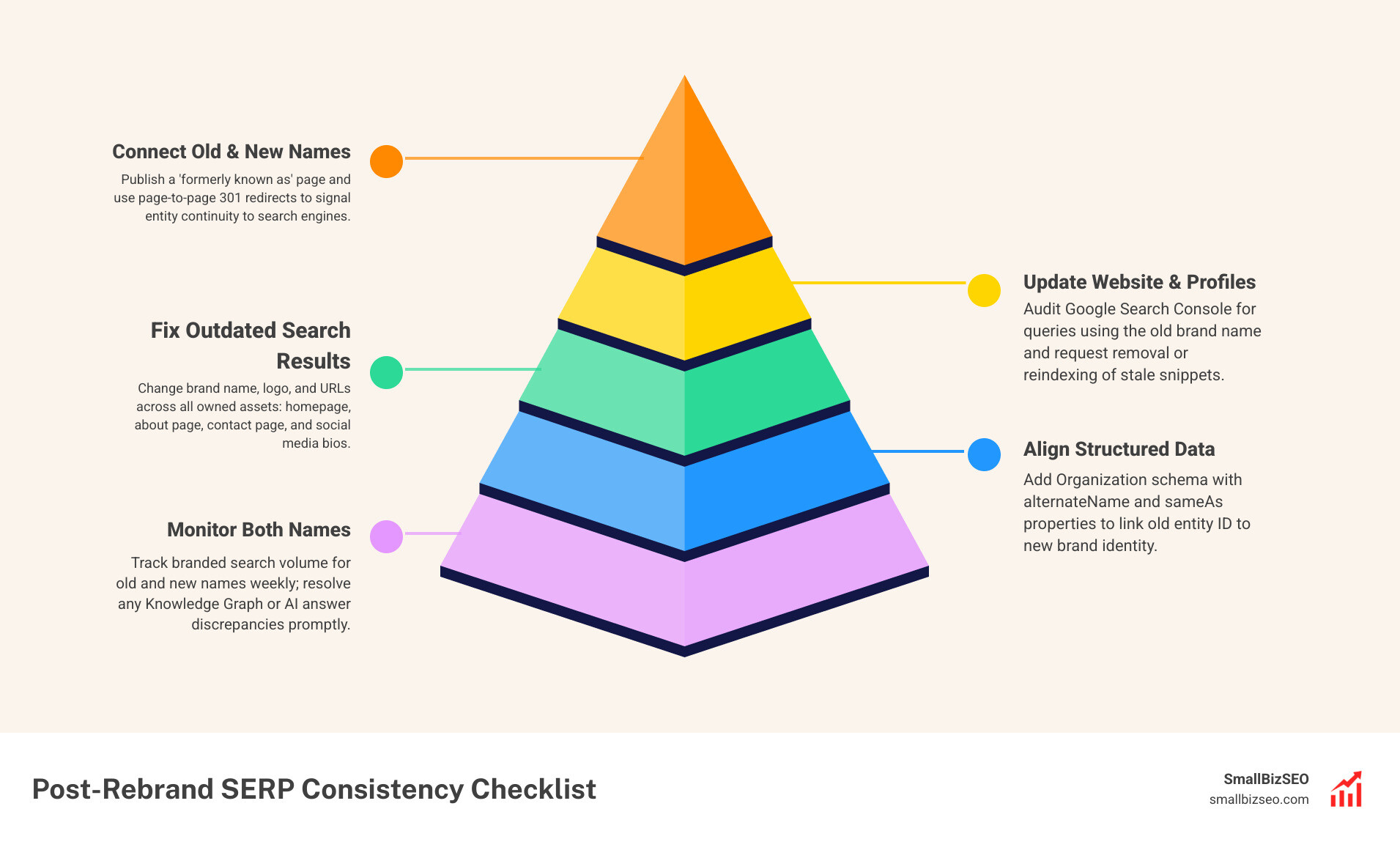
Strategic Framework for Improving Brand SERP Consistency After a Rebrand
Search engines understand companies as interconnected entities, not just collections of isolated web pages. When a business renames itself, search algorithms must verify whether the new identity represents an existing organization or an entirely separate enterprise.
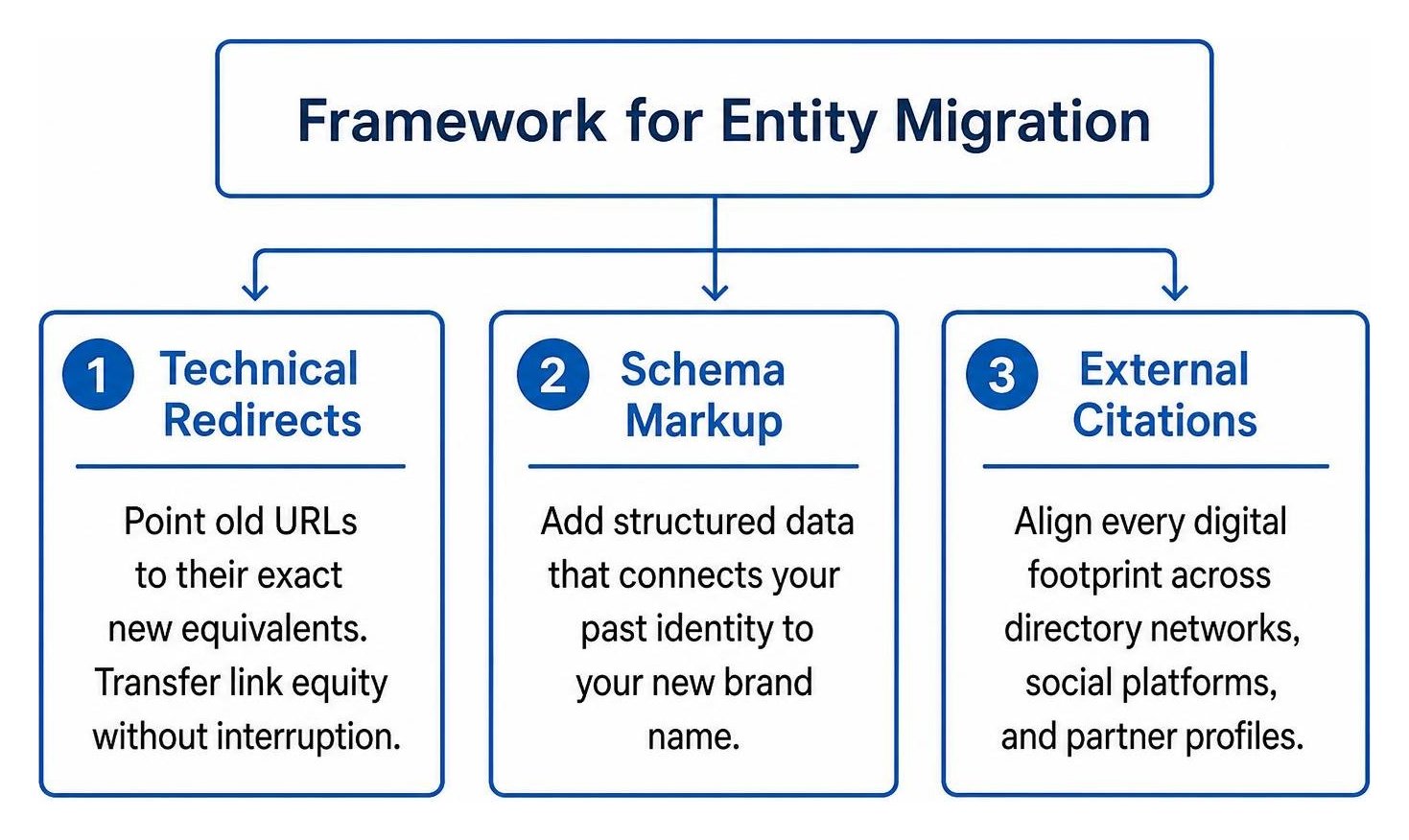
Achieving full search consistency requires a multi-layered approach:
- Direct technical mapping: Pointing old URLs directly to their exact new equivalents so crawlers transfer link equity without interruption.
- Explicit machine-readable context: Embedding structured data on your site that explicitly connects your past identity to your new brand name.
- Cross-web profile synchronization: Aligning every digital footprint across directory networks, social platforms, and partner profiles.
- Knowledge Graph updates: Providing corroborated, authoritative evidence across third-party sources to update search engine knowledge panels.
What Causes Search Discrepancies and Traffic Loss Following a Name Change?
Search discrepancies and lost traffic happen when search engines encounter conflicting signals about your company name, broken redirect paths, or contradictory third-party references.
When legacy signals remain untouched across the web, search engine algorithms struggle to establish confidence in your primary identity. Understanding why auditing search results for your business name stops traffic leaks helps prevent customer confusion and keeps visibility intact. The most destructive technical mistake during a name change is dumping all legacy URLs onto the new homepage via bulk redirects.
| Migration Tactic | Impact on Search Bots | User Experience | Long-Term Entity Impact |
|---|---|---|---|
| Single-Hop 1:1 301 Redirects | Passes PageRank cleanly to relevant target pages | Users reach identical or equivalent content immediately | Preserves historical relevance and prevents ranking drops |
| Homepage Bulk Redirects | Google treats non-equivalent redirects as soft 404 errors | Users land on an unfamiliar homepage, increasing bounce rates | Erases page-level topical authority and collapses brand SERPs |
Always configure strict, one-to-one redirects that map every historical page directly to its substantive equivalent on your new domain.
How Does Structured Data Support Improving Brand SERP Consistency After a Rebrand?
Structured data provides direct, machine-readable instructions that tell search engines your old and new names represent the same underlying organization.
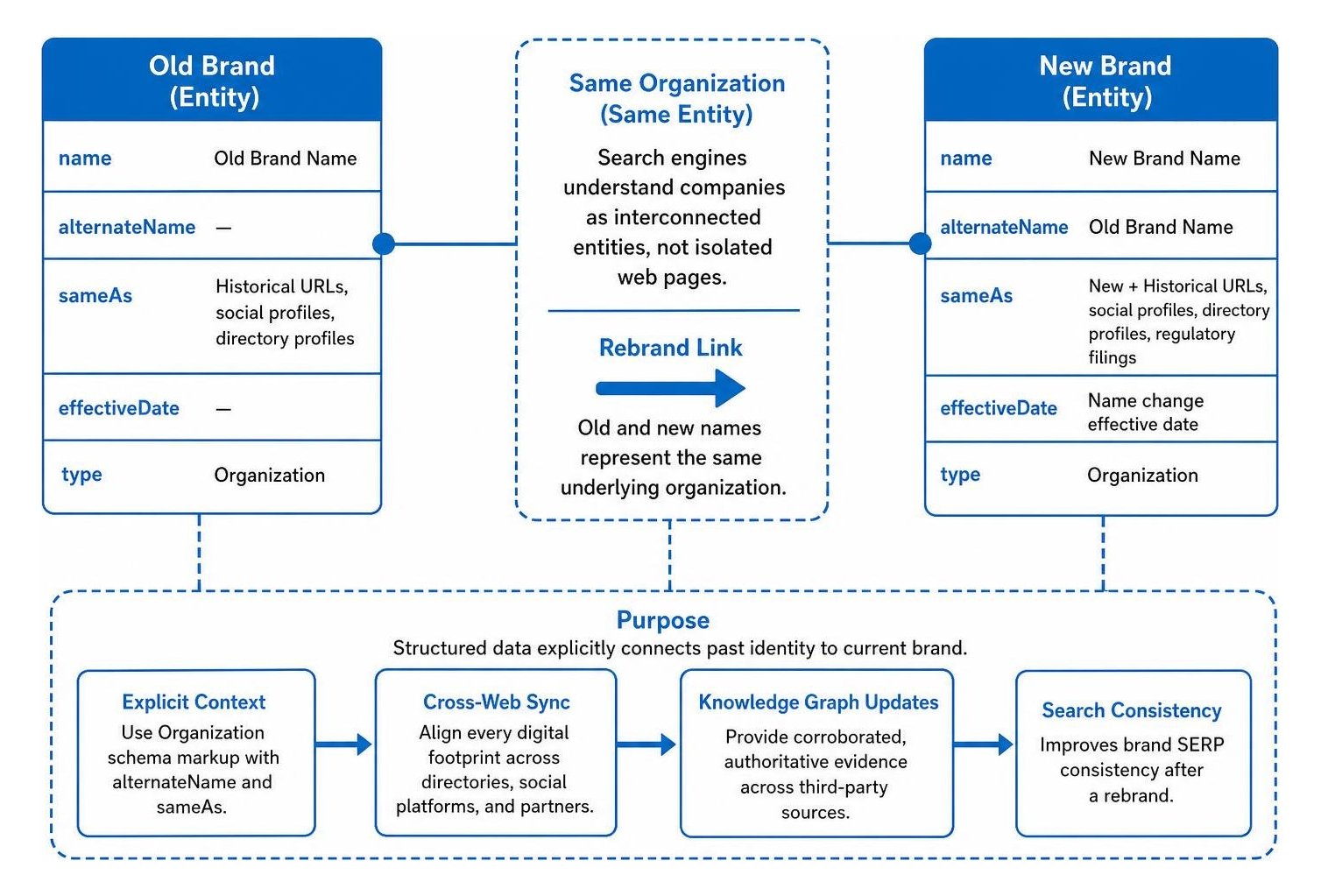
To maintain search visibility, update your Organization schema markup across your primary digital assets. Use the alternateName property to hold your former company name, while designating your current label in the name field. Add your historical and new social media profiles, regulatory filings, and directory profiles inside the sameAs array. This explicit brand entity mapping accelerates Knowledge Graph reconciliation, which is explored in depth in Ask An SEO: How Do We Shift Google From Our Old Brand Name to Our New One? by industry experts.
Maintaining strong entity salience also requires a dedicated canonical transition page. Publish an announcement page detailing the name change, its effective date, and key leadership details. Use clear "formerly known as" phrasing within your page titles, meta descriptions, and footer text to preserve historical context without diluting your primary branding.
What Technical and Citation Updates Drive Improving Brand SERP Consistency After a Rebrand?
External business citations and verified directory profiles validate your identity change across local and organic search indexes.

It is critical that you keep your business citations clean and organized while changing names. Search engines cross-reference directory data against your website to confirm physical existence and operational legitimacy. Having proper NAP consistency explained across platforms ensures algorithms do not split your reviews or divide your rankings between two separate entities.
Prioritize updates in distinct tiers:
- Primary profiles: Claim and refresh your Google Business Profile, Apple Business Connect, and Bing Places listings.
- Tier-one directories: Correct every core business citation across authoritative aggregator networks and industry-specific portals to reinforce your local relevance.
- Author and executive bios: Update executive profiles, guest contributor author bios, and speaker pages to eliminate conflicting mentions.
- Social channels: Update handles, vanity URLs, and bio descriptions on LinkedIn, X, YouTube, and Facebook.
How Do Traditional SEO and AI Search Optimization Differ During a Brand Transition?
Traditional SEO centers on URL redirects and technical signals, whereas AI search engines rely on semantic consensus gathered across multiple external sources.
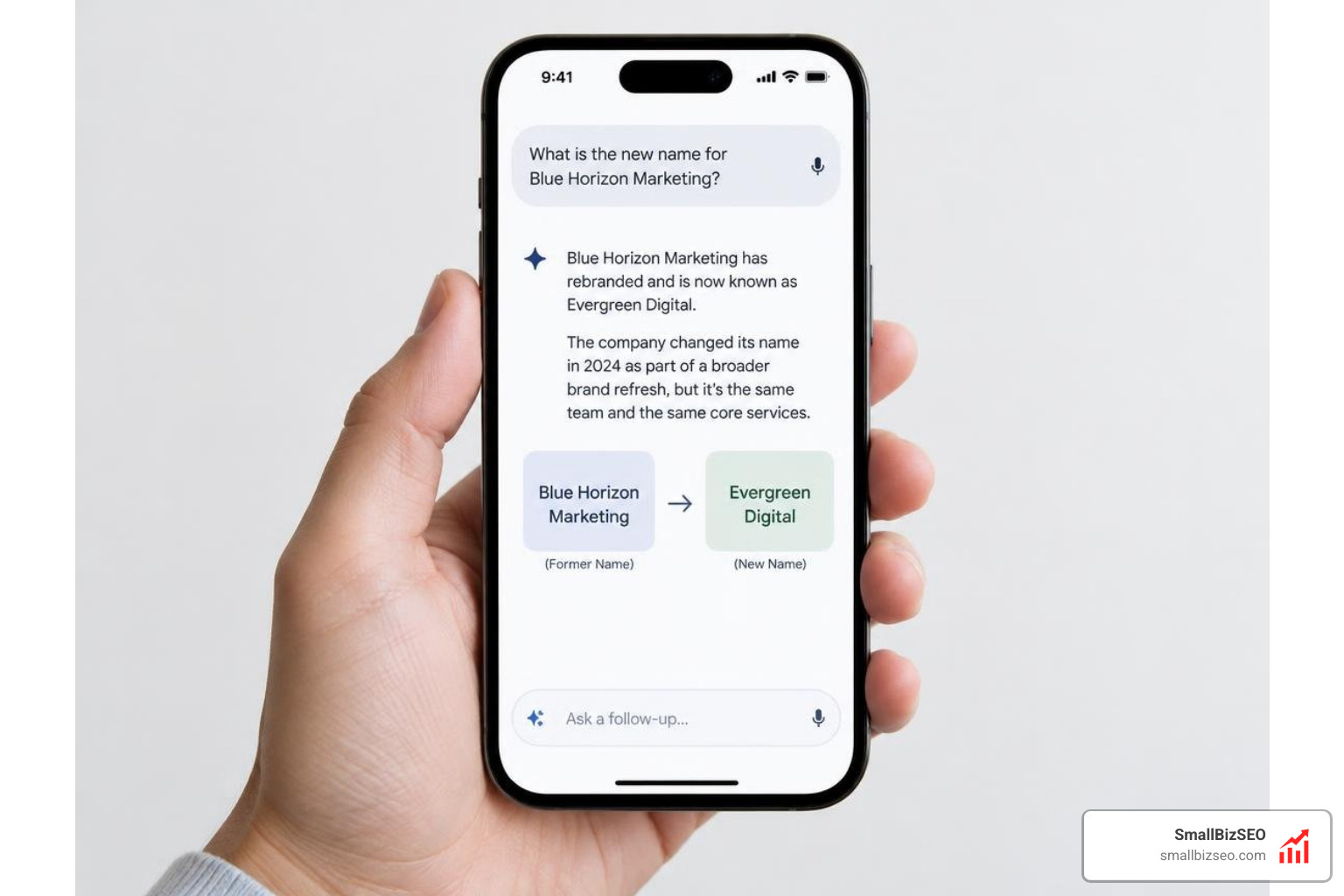
Large language models and AI Overviews build answers from training data, live web crawls, and third-party mentions. As highlighted in Rebranding And AI Search: What Happens After A Rebrand?, artificial intelligence engines often suffer from latency, repeatedly citing outdated company names unless they encounter overwhelming cross-web consensus.
When an external platform includes an outdated brand mention, it dilutes the AI model's certainty. Execute targeted digital PR to update listicles, partner websites, and industry news coverage. Maintain a contradiction ledger to log every instance where an AI tool returns inaccurate legacy information, identify the outdated source powering that answer, and reach out directly to secure an editorial correction.
Measuring Post-Rebrand Search Performance and Maintaining Entity Authority
A successful transition requires ongoing performance tracking across conventional search engines and generative answer platforms alike.
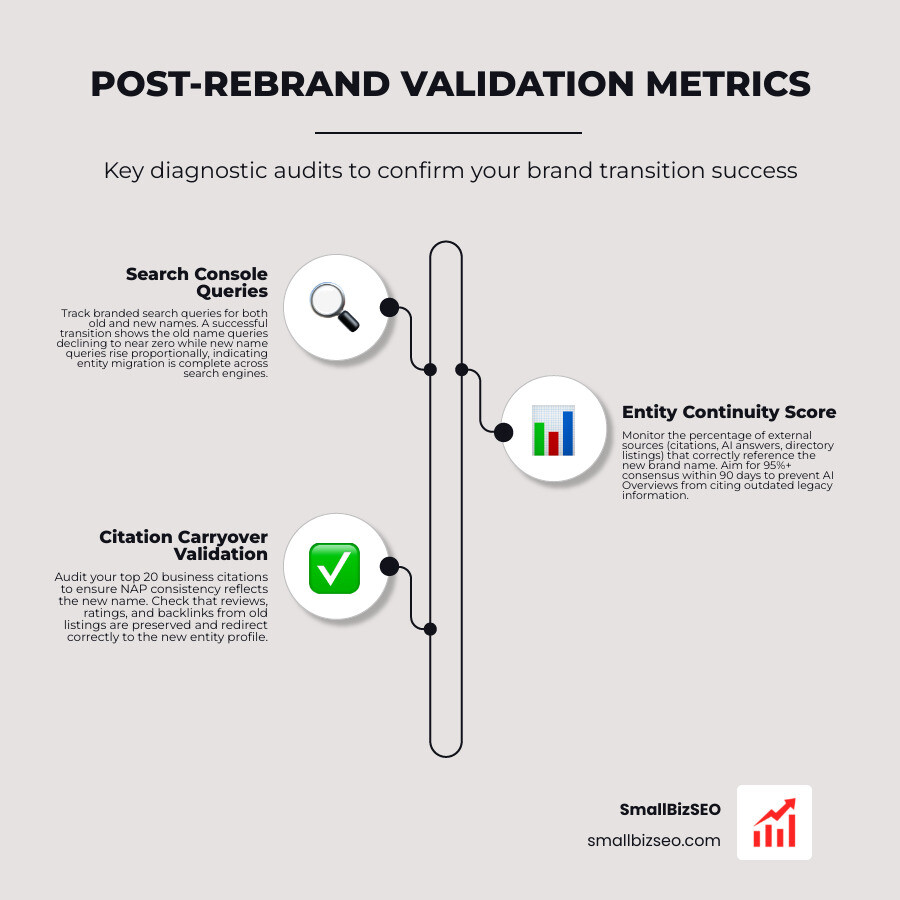
At SmallBizSEO, we implement long-term monitoring across both organic indexes and generative search interfaces to ensure complete identity alignment. If you want dedicated support for your migration, explore our comprehensive brand SERP optimization solutions to protect your digital footprint.
Which Tracking Metrics and Diagnostic Audits Validate a Successful Transition?
Track these vital performance metrics and diagnostic audits to verify that your rebrand has taken hold:
- Google Search Console query tracking: Monitor impressions and clicks for both old and new brand name variants. The legacy name should steadily decrease as your new identity captures the search volume.
- Knowledge Panel accuracy: Confirm that Google's Knowledge Panel displays your new name, updated logo, current executive leadership, and accurate social links.
- AI answer accuracy rate: Regularly test prompt matrices across generative engines to confirm that queries regarding your services cite the new entity name without attribution errors.
- Citation carryover audits: Audit external directories to prevent profile duplication, drawing on techniques for spotting and fixing business discrepancies following a suspension to remove fragmented listings.
- Conversion stability: Ensure organic conversion paths, lead forms, and referral channels operate without drops in user engagement.
Building Lasting Search Authority for Your New Identity
A smooth post-rebrand transition requires treating your company name change as an entity migration rather than a simple cosmetic update. By aligning your technical redirects, deploying explicit schema markup, updating high-authority citations, and securing third-party mentions, you provide search engines and AI models with the clear consensus they need. Consistent digital references protect your hard-earned authority and ensure your customers always find the right brand.