AI-Generated Content Examples: Documented Cases and Fictional Walkthroughs

What Are Real Examples of AI-Generated Content in Digital Marketing?
AI generated content examples include product descriptions drafted from catalog details, email copy adapted from a campaign brief, and images made for ad concepts. A documented historical example is the Associated Press automated corporate earnings reports, which used structured data and pre-defined editorial templates. That was rule-based automation, not a modern large language model writing from a conversational prompt.
For a small business, the practical question is not just what generative tools can draft, but what human review must verify before publishing: product specifications, factual claims, visual accuracy, and whether the text directly answers real search intent. AI-assisted drafting can support content production across multiple channels when paired with disciplined human editorial review.
Core concepts for managing AI-assisted production:
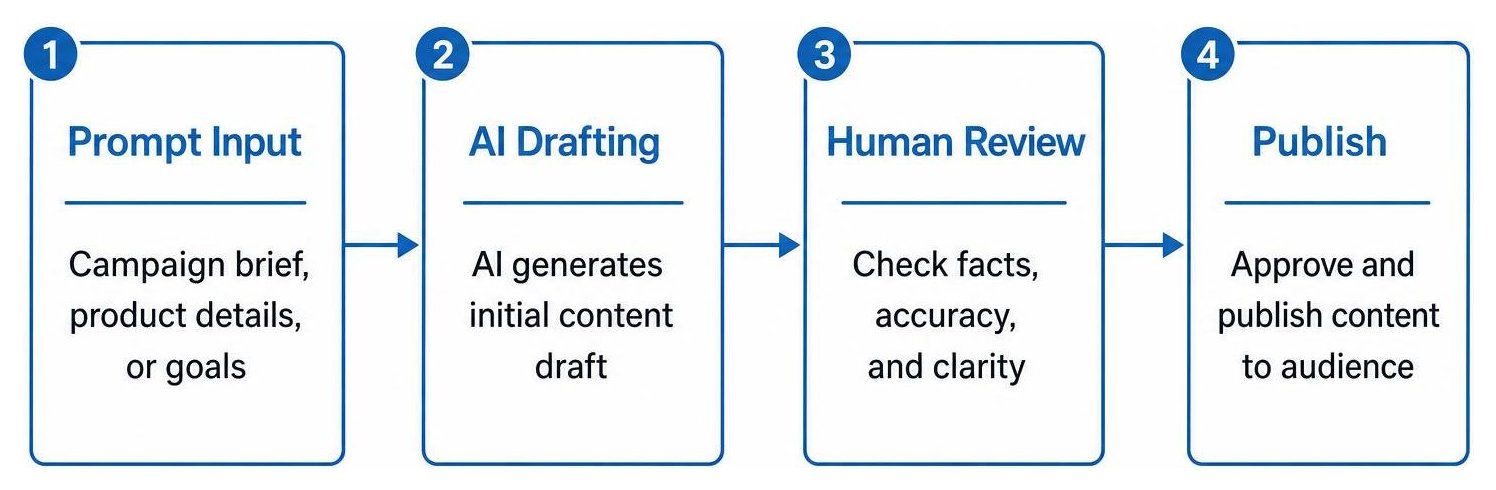
Real-World AI Generated Content Examples Across Marketing Channels
AI-assisted drafting can produce initial text in several formats, but the examples below distinguish documented capabilities from fictional walkthroughs. Generated drafts still require human review because the system does not independently verify the underlying facts.
What Are Documented Examples of AI-Generated Content in E-Commerce and Copywriting?
A documented historical example is the Associated Press’s automated corporate earnings coverage, which combined source data with an automated reporting workflow rather than open-ended LLM writing. Shopify’s official documentation describes product-description generation from provided product details and directs merchants to review generated text for accuracy before publishing. Shopify’s product description documentation.
When teams create useful business documents and marketing copy, unedited drafts can introduce false claims or invent technical specifications.
To see why editing is essential, consider this fictional small-business worked example:
- Product Input: "Ceramic travel mug, double-wall insulation, splash-proof silicone lid, holds 12 ounces, hand wash recommended."
- Unedited AI Draft: "Experience lifetime thermal perfection with our indestructible mug! Keeps beverages piping hot for 48 hours straight. Completely dishwasher safe and guaranteed leak-proof under all conditions."
- Human-Corrected Output: "A 12-ounce ceramic travel mug with double-wall insulation and a splash-proof silicone lid. Hand wash recommended."
The raw draft hallucinated an unverified thermal duration, falsely claimed dishwasher compatibility, and promised absolute leak-proof performance. Rigorous fact-checking of AI-generated articles helps editors identify unsupported claims before publication.
Which AI Generated Content Examples Illustrate Email Campaigns and Customer FAQs?
Email marketing and support operations use text generators to convert bulleted notes into conversational paragraphs and structured FAQ entries.
In an illustrative email transformation, a business supplies a short brief:
- Email Brief Input: "Announce restock for artisan olive oil. Offer free standard shipping on orders over fifty dollars. Mention supplies are limited."
- AI Working Draft: "Our artisan olive oil is back in stock! Order early while bottles last. Standard shipping is free on all orders over $50."
- Review Verification: The editor verifies shipping thresholds, confirms stock availability, checks promotional timelines, and ensures brand consistency.
For customer support, consider this illustrative FAQ transformation:
- FAQ Brief Input: "Draft an FAQ answer on changing shipping addresses after order placement. Allow address modifications within one hour of purchase through the customer account. Clarify that orders already in fulfillment cannot be rerouted."
- Raw AI Draft: "You can change your delivery address anytime for free before arrival! Contact support and we will redirect your package to any location immediately."
- Human-Corrected Output: "Shipping addresses can be modified within one hour of order placement directly through your account dashboard. Once an order enters fulfillment, delivery addresses cannot be changed."
AI outputs alone do not establish verified answers. Generative tools may hallucinate citations, invent non-existent policies, or quote obsolete pricing when left ungrounded. Teams must provide explicit reference documents by creating structured content briefs that restrict generation to verified company information.
How Are Brands Using AI Concept Imagery and Multi-Channel Formats?
Generative-image tools can be used to create fictional concept renderings, mood boards, and storyboards during early planning. Coverage of Madison Avenue advertising technology discusses agency experimentation with AI, but this remains an illustrative use case rather than a general claim about adoption or results.
Teams must distinguish between digital concept renderings and authentic photography. Using synthetic imagery to represent real product results, real personnel, or fictional customer testimonials can mislead consumers. When managing multi-channel synthetic assets:
- Likeness and Permissions: Secure explicit written permission before using synthetic voice models or digital personas, and avoid creating fake endorsements or unverified persona claims.
- Visual Accuracy: Reserve synthetic renderings for conceptual mockups, mood boards, and illustrative graphics, using genuine photography for tangible products and customer case studies.
- Technical Testing: When generating structured data markup or technical snippets, test all generated code thoroughly before implementation.
How Do Content Formats Compare in Inputs, Outputs, and Review Checks?
Every content format requires distinct input parameters, validation checks, and operational boundaries.
| Content Format | Typical Input Source | Generated Draft Output | Mandatory Human Review Check | Operational Limitation |
|---|---|---|---|---|
| Product Listings | Raw catalog specs and material details | Formatted product titles and descriptive bullet points | Verify technical specifications, dimensions, and care instructions | Cannot verify physical product quality or real-world performance |
| Email Campaigns | Campaign terms, discount codes, offer constraints | Promotional email subject lines and body copy | Confirm offer terms, discount validity, and regulatory disclosures | Cannot assume current stock or pricing without verified data |
| Support FAQs | Approved policy manuals and verified support tickets | Concise Question-and-Answer knowledge articles | Fact-check answers against official company documentation | Can hallucinate non-existent service policies or inaccurate terms |
| Visual Concepts | Descriptive text prompts and compositional mood boards | Digital concept art and advertising mockups | Inspect visual consistency, brand standards, and visual artifacts | Cannot replace genuine product photographs or verified case documentation |
| Technical Schema | Actual visible page facts and approved business details | Structured FAQ or Organization JSON-LD markup code | Validate syntax, eligibility, and accuracy against applicable structured-data guidance | Code outputs can include deprecated attributes or syntax errors |
To safeguard privacy and rights, teams should use only data and assets they are authorized to use, minimize the information included in prompts, and redact sensitive personal information, internal financial numbers, and proprietary material before using external tools.
Strategic Guidelines and Review Workflows for AI Content Deployment
Deploying automated content requires adherence to search engine webmaster guidelines, intellectual property caution, and structured editorial operations.
How Do Search Engine Policies and Legal Considerations Impact AI Content?
Google’s guidance on generative AI content emphasizes content quality, accuracy, relevance, and value for readers rather than whether text was produced with AI assistance or manual writing. However, generating large volumes of unhelpful, unoriginal, or manipulative pages can fall under scaled content abuse policies regardless of the production method used.
Legal and intellectual property considerations also require careful oversight:
- Rights and Contracts: Ownership, copyright eligibility, and data usage terms vary significantly across jurisdictions and commercial contracts.
- Scanner Limitations: Automated AI scanners do not prove ownership or originality.
- Legal Review: Organizations operating in regulated fields or navigating complex client obligations should obtain qualified legal review regarding disclosure requirements, synthetic likenesses, and intellectual property compliance.
Maintaining search visibility while scaling content with human quality requires that published assets provide clear sourcing, substantive depth, and accurate answers.
What Multi-Step Review Process Supports AI Content Publishing?
A structured review workflow helps maintain editorial consistency and support content quality across publishing workflows:
- Source Grounding: Supply the generation tool with authorized data, official internal briefs, and verified product specifications.
- Editorial Verification: Have a human editor review outputs, remove unsupported claims, adjust tone, check outbound links, and correct factual inaccuracies.
- Subject-Matter Enhancement: Add proprietary data, verified business case studies, practical experience, and industry insights that automated tools cannot create.
- Ongoing Maintenance: Conduct ongoing research, perform regular content refreshes, strengthen internal linking networks, and earn editorial outreach links over time.
Building Reliable AI-Assisted Content
AI tools can provide helpful initial drafts, while authentic expertise, verified accuracy, and disciplined editorial execution remain essential for reliable published content. We support businesses with strategic SEO audits and professional SEO content services. Schedule an SEO consultation with SmallBizSEO to discuss an Answer-Ready content strategy tailored to your needs.