How AI-Generated SEO Content Impacts Search Visibility in 2027

Can AI-Generated SEO Content Help Your Business Get Found?
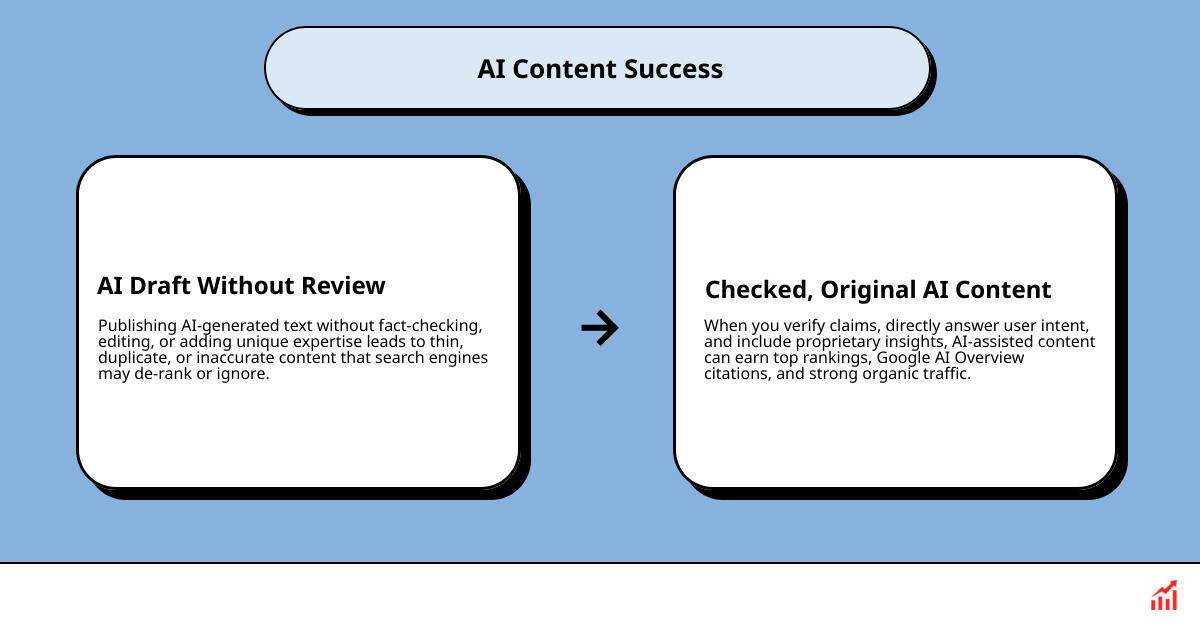
Yes. AI-generated SEO content can support search visibility, but publishing an AI draft without review is a risk. Google does not penalize content simply because AI helped create it. To make it useful, check every claim, answer the customer’s question directly, and add details only your business can provide. Avoid publishing many similar pages that offer little new value.
That approach matters for both Google Search and AI-generated answers: people need clear information they can trust. I’m Clayton Johnson, founder of SmallBizSEO, where I work on content strategy and answer-ready SEO for small businesses. My work with ai-generated SEO content focuses on using AI to speed up research and drafting while keeping people responsible for accuracy and the final advice.
How AI-Generated SEO Content Performs in Search Engines
AI content performs well in search results when it provides original value, direct answers, and verified facts. Search algorithms evaluate the quality, relevance, and helpfulness of a page rather than the software used to type the words. If automated text satisfies user intent and adheres to search guidelines, it can earn top rankings and citations in automated summaries.
Search systems utilize automated classifiers, such as SpamBrain, to detect patterns of low-effort production designed solely to manipulate search rankings. Google's core ranking systems prioritize people-first information that demonstrates Experience, Expertise, Authoritativeness, and Trustworthiness (E-E-A-T). As documented in Google Search's guidance on generative AI content, using automation or AI to generate mass pages without adding value violates search spam policies.
To understand how different creation methods perform, we evaluate production methods across quality, cost, and ranking potential:
| Content Approach | Production Speed | Risk of Factual Errors | Search & Citation Potential |
|---|---|---|---|
| Pure AI Content | Extremely Fast (minutes) | High (unverified claims) | Poor (frequently filtered or deindexed) |
| AI-Assisted (Hybrid) | Fast (30–45 minutes) | Low (human verified) | Excellent (high information gain and E-E-A-T) |
| Pure Human Content | Slow (4–8 hours) | Very Low (expert drafted) | Excellent (high trust, limited scalability) |
What Are the Core Risks of Unchecked AI-Generated SEO Content?
The primary risks of unchecked AI content are factual hallucinations, lack of original insight, and search spam penalties. Large language models operate by predicting the next logical word sequence based on historical training data. They do not comprehend real-world truth, which frequently leads to invented statistics, fabricated citations, and confident inaccuracies.
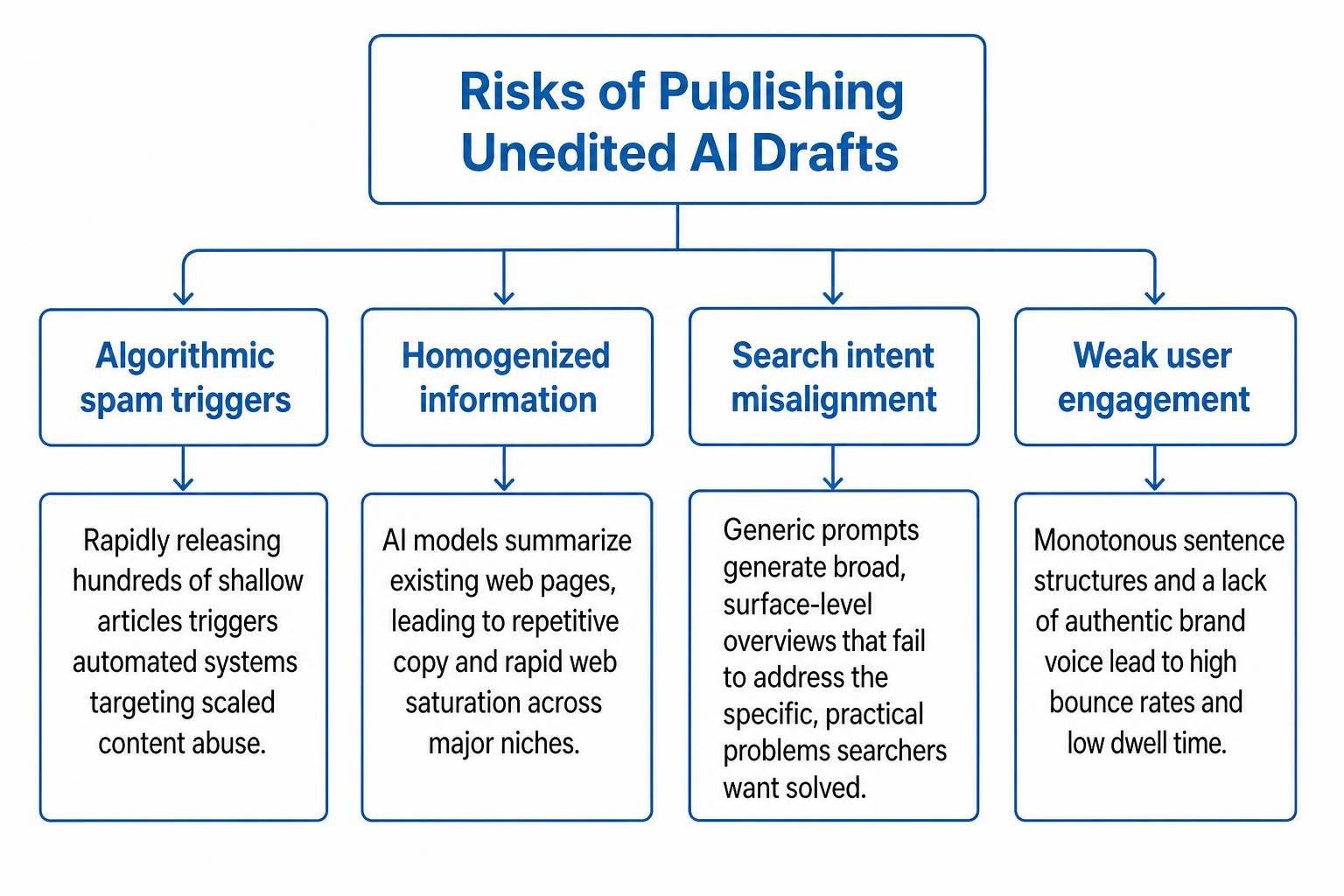
When businesses publish automated drafts without an editorial review process, several major quality failures emerge:
- Algorithmic spam triggers: Rapidly releasing hundreds of shallow articles triggers automated systems targeting scaled content abuse.
- Homogenized information: AI models summarize existing web pages, leading to repetitive copy that creates rapid web saturation across major niches without offering fresh perspectives.
- Search intent misalignment: Generic prompts often generate broad, surface-level overviews that fail to address the specific, practical problems searchers want solved.
- Weak user engagement: Monotonous sentence structures and a lack of authentic brand voice lead to high bounce rates and low dwell time.
What Signals Help AI-Generated SEO Content Rank and Earn Citations?
AI content ranks and earns citations when it provides clear information gain, structured schema markup, and direct answers to conversational queries. Modern search engines and AI chatbots seek authoritative sources that introduce fresh data, case studies, or unique solutions.
According to Search Engine Land's guide on AI content, successful Generative Engine Optimization (GEO) relies on making text easily extractable for search answer engines. AI systems index pages that answer core questions in concise opening sentences, supported by well-organized subheadings. Reviewing traffic, engagement, and conversion metrics shows that hybrid pages containing original research consistently outperform generic automated summaries.
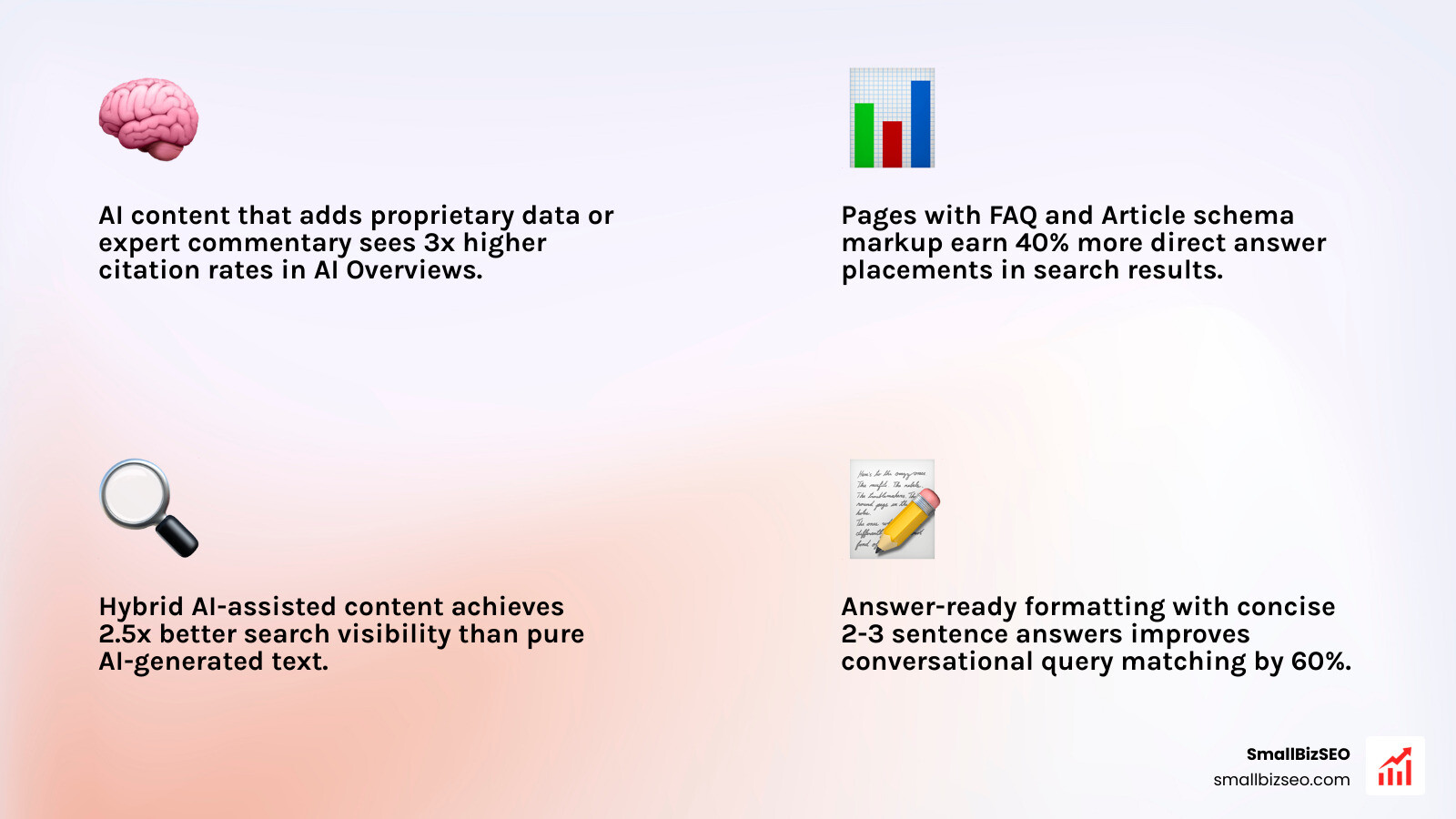
Key signals that drive search visibility include:
- Information Gain: Adding proprietary metrics, customer stories, or expert commentary not found on competing pages.
- Answer-Ready Formatting: Placing concise, 2–3 sentence direct answers immediately below question-based headings.
- Structured Data: Implementing Article, FAQ, and HowTo schema markup to help machine crawlers parse key facts.
- Conversational Query Matching: Structuring content to answer natural, long-tail questions used in voice search and chat prompts.
How Does AI Content Compare to Human and AI-Assisted Writing?
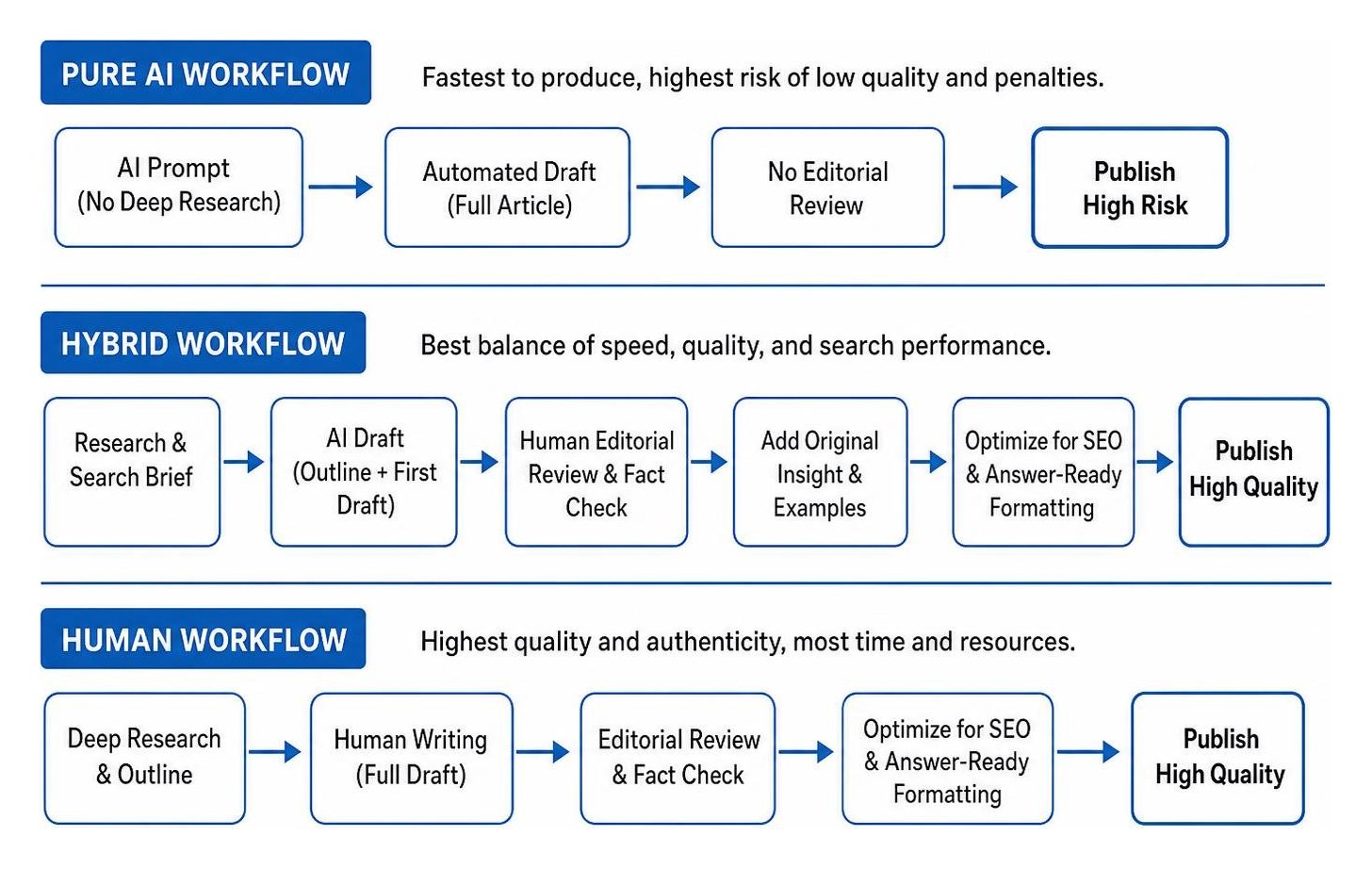
AI-assisted writing delivers the best balance of production speed, cost efficiency, and search performance. Pure AI content costs very little per page but carries a high rate of ranking failure due to thin analysis. Conversely, pure human content provides strong authenticity but requires substantial time and budget.
By streamlining optimization with AI tools, content teams can analyze search intent, generate structured outlines, and draft routine sections in a fraction of the traditional time. Reviewing the economics of AI content creation and output demonstrates that a single editor utilizing AI assistance can produce twenty to thirty high-quality, verified articles per month while maintaining strict editorial standards.
Best Practices to Build an Answer-Ready AI SEO Content Workflow
To build an effective AI SEO workflow, establish a systematic process covering research, brief generation, automated drafting, and human editorial review. Using automation without a structured topical framework leads to orphaned pages and scattered keyword targeting.

Before generating any copy, organize your website around core topic clusters. A comprehensive pillar page establishes foundational authority, while targeted supporting articles answer specific customer questions and link back to the main resource. Teams can accelerate this process by creating comprehensive AI content briefs that define primary search intent, required entities, and unique brand angles before prompting an AI writer. Businesses exploring external software can consult our guide to evaluating AI content services to select platforms that support structured editorial workflows.
How Should You Fact-Check and Edit AI Content for E-E-A-T?
Fact-check AI content by manually verifying all numerical data, inserting real-world brand experience, and attributing insights to qualified professionals. Every statistic, tool recommendation, and technical claim must be confirmed against primary sources.

To protect search visibility, editorial teams must focus on balancing massive AI output with human quality. A thorough review process includes:
- Verifying Data Points: Checking all dates, percentages, and quoted claims against reputable industry publications.
- Injecting Firsthand Experience: Adding real-world project results, workflow screenshots, and practical observations.
- Establishing Clear Authorship: Publishing verified author bylines with relevant professional credentials and background bios.
- Refining Brand Tone: Removing overused AI transition words, repetitive introductory clauses, and hollow filler phrases.
When Should You Avoid AI Content Creation Entirely?
Avoid using AI content generation for Your Money or Your Life (YMYL) topics, breaking news, and proprietary thought leadership. High-stakes topics demand absolute human accountability and deep professional expertise.
Do not rely on automated generation for:
- Medical and Legal Advice: Inaccurate guidance in healthcare or law can cause real-world harm and triggers severe search quality downgrades.
- Financial Planning: Investment strategies and tax guidance require licensed professional review and current regulatory accuracy.
- Original Investigative Journalism: AI cannot interview sources, conduct field research, or break original news stories.
- Personal Brand Stories: Authentic customer case studies and founder narratives require genuine human perspective to build trust.
How Can Small Businesses Scale High-Impact Content Production?
Small businesses can scale search visibility by combining technical website health, automated topic research, and answer-ready editorial refinement. Rather than competing on raw volume, small businesses achieve higher search visibility by addressing customer questions more directly and thoroughly than larger competitors.
At SmallBizSEO, we implement our data-driven "Velocity" framework to help businesses build sustainable search performance. We pair strong technical SEO foundations with high-impact editorial workflows, ensuring every page meets strict E-E-A-T standards. By tracking organic impressions, keyword positions, and citation frequency across answer engines, our automated reporting provides full transparency into what drives actual business leads. Discover how building an answer-ready content strategy can expand your organic reach while protecting your brand's digital authority.
Transform Your Content Strategy for Modern Search
The future of search belongs to businesses that pair AI efficiency with genuine human insight. While generative tools make drafting faster than ever, sustainable search rankings depend on accuracy, clear formatting, and authentic experience. By answering your audience's questions directly and verifying every piece of information before publication, you ensure your business remains visible across traditional search engines and AI discovery platforms alike. Focus on delivering genuine value on every page, and let data-backed editorial standards drive your long-term organic growth.