A Practical Field Guide to AI Search Intent Analysis

How Do You Analyze Search Intent in AI Search?
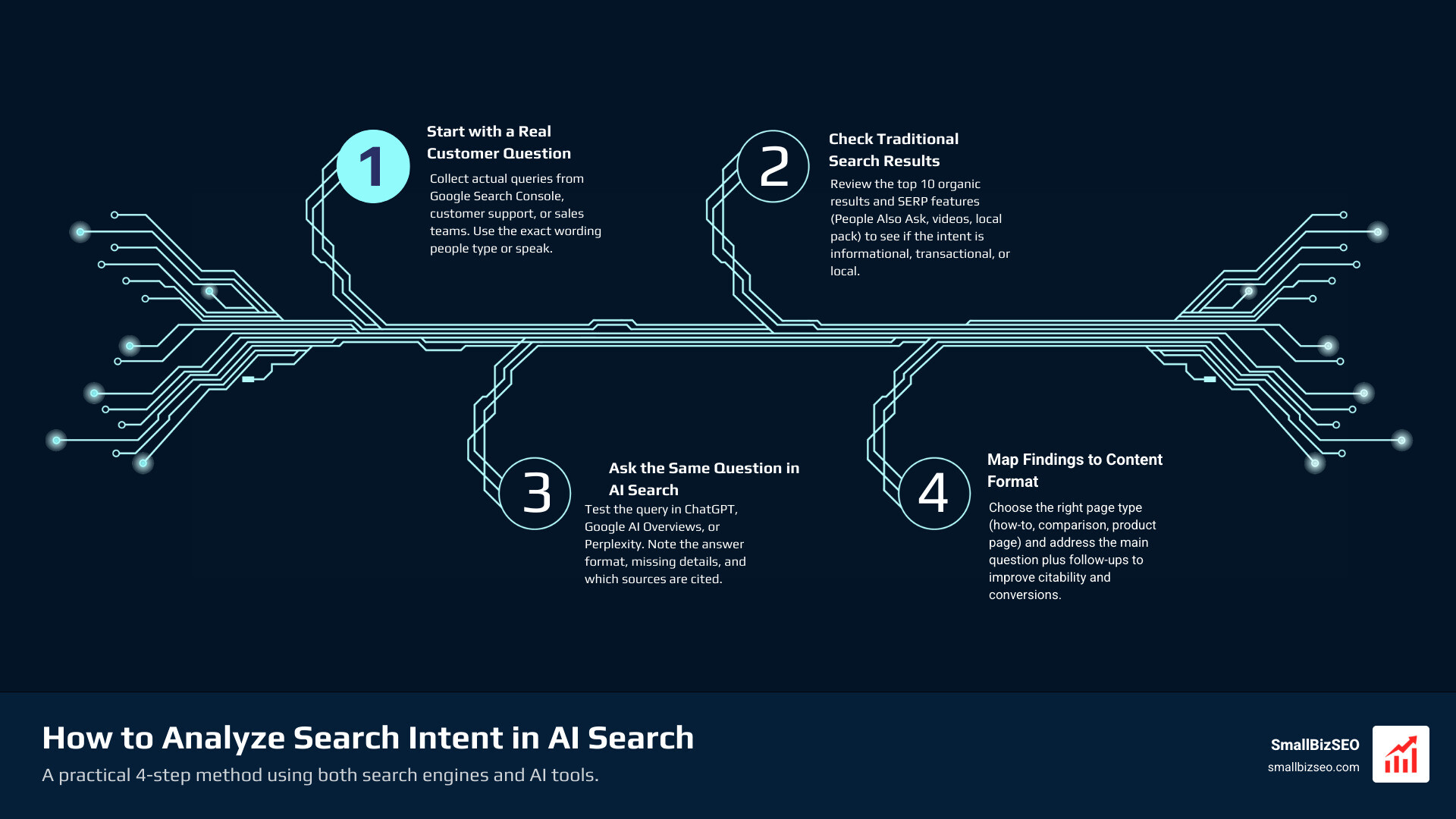
AI search intent analysis means finding out what someone wants to do, not just what words they typed. Start with a real customer question. Check the search results to see whether people need an explanation, a comparison, a place to visit, or a way to buy. Then ask the same question in an AI search tool and note what it answers, what it leaves out, and which sources it cites. Use those findings to choose the right page format and answer the main question clearly.
This matters because a short search query and a detailed AI prompt can express the same need in different ways. Both may reveal follow-up questions your content should address.
I’m Clayton Johnson, founder of SmallBizSEO. My work in AI search intent analysis builds on my experience connecting SEO, content strategy, and customer questions so small businesses can create clearer, more useful answers.
Explore more about AI search intent analysis:
What Is AI Search Intent Analysis Across Modern Engines?
AI search intent analysis is the process of evaluating the true goal, context, and expected outcome behind a user's prompt or search query using natural language processing and live search data. Instead of matching literal keywords, modern systems evaluate why a person is asking a question and what format best resolves their problem.
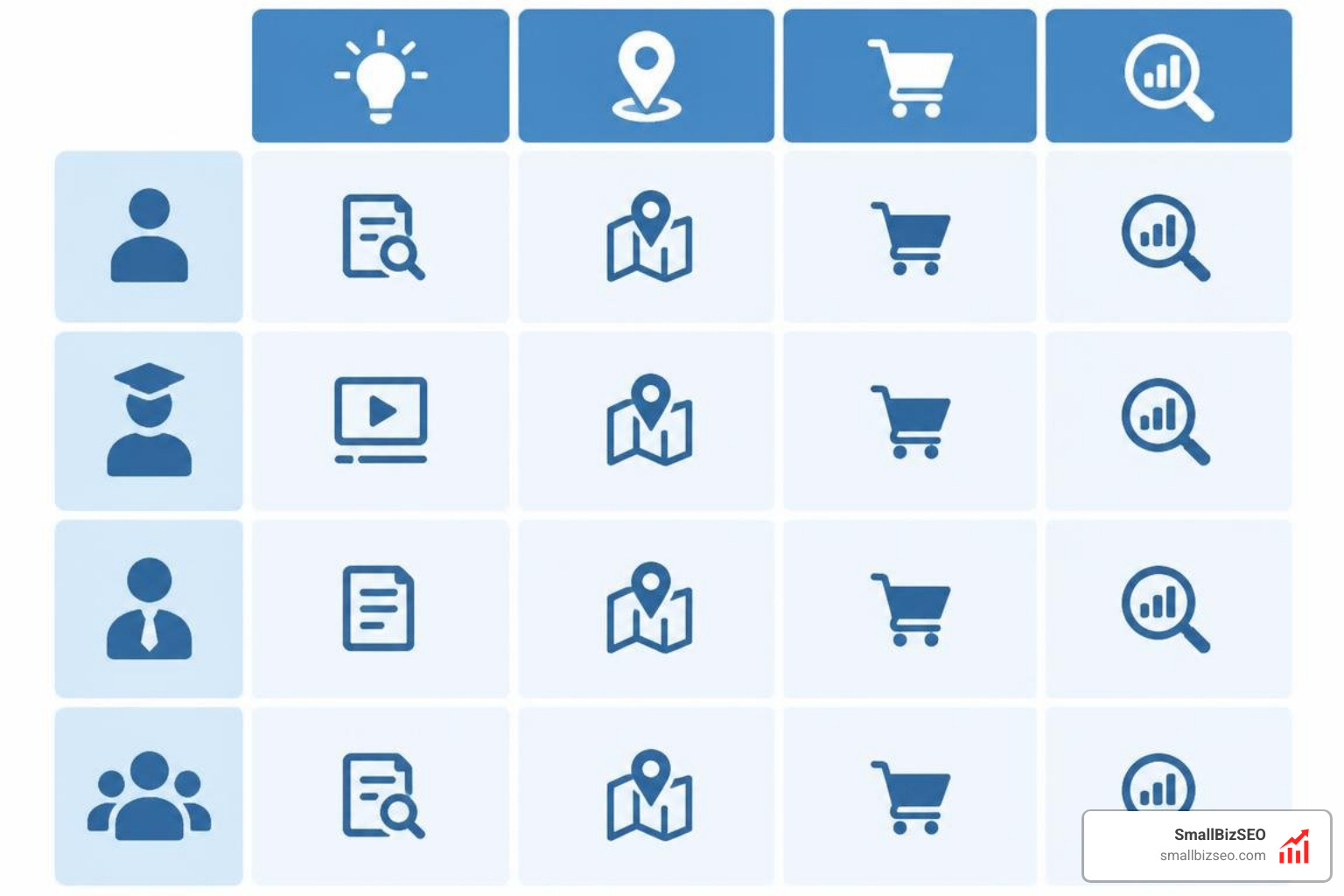
The concept of search intent began with Andrei Broder's foundational research, which divided web queries into informational, navigational, and transactional buckets. In modern AI Search, that framework has evolved. Search engines no longer rely solely on "reflected intent"—the literal words someone types. Instead, they use large language models to uncover "intrinsic intent"—the deeper motivation, unspoken constraints, and multi-step tasks implied by a prompt.
Understanding this distinction allows us to map content directly to where prospects sit in their buying journey, whether they need high-level education or bottom-funnel validation.
What Are the Six Core Types of Search Intent in LLMs?
Modern search experiences process user goals through six distinct intent categories:
- Informational Intent: The searcher wants to learn a concept, understand a process, or answer a question.
- Navigational Intent: The searcher is looking for a specific brand, portal, or website destination.
- Commercial Intent: The searcher is comparing options, reading reviews, or evaluating solutions before making a purchase.
- Transactional Intent: The searcher is prepared to buy, request a quote, or complete an immediate action.
- Local Intent: The searcher wants a service, store, or resource within a specific geographic area.
- Generative Search Intent: The searcher asks an AI engine to draft, calculate, debug, summarize, or create a custom asset directly inside the chat interface.
| Intent Type | User Goal | Query & Prompt Examples | Primary AI Output / Citation Format |
|---|---|---|---|
| Informational | Learn or understand | "How does cloud backup work?" | Direct summary definitions, step lists |
| Navigational | Reach a destination | "QuickBooks login" | Direct links, portal buttons, brand FAQs |
| Commercial | Compare solutions | "Best CRM software for contractors" | Comparison tables, feature breakdowns |
| Transactional | Purchase or sign up | "Buy burr coffee grinder online" | Product specs, pricing tables, purchase paths |
| Local | Find nearby services | "HVAC repair near me" | Map packs, localized business directories |
| Generative | Execute a task or build | "Draft a cold email template for SaaS" | Generated copy, formulas, step-by-step code |
Generative search intent represents a fundamental transformation in user behavior. Users no longer just request a reading list; they expect actionable task execution directly from the interface.
Why Do Traditional SEO Tools Fail at AI Search Intent Analysis?
Legacy SEO tools rely heavily on rigid keyword pattern matching and simple n-grams (such as labeling any query containing "buy" as transactional). This approach creates blind spots because human intent is rarely static.
Research into how to identify user search intent using AI and machine learning shows that converting words into semantic vectors captures true meaning far better than counting keyword frequency. Academic research on BloomIntent demonstrates that automated evaluations align over 72% with human expert evaluations when search queries are broken down into granular, sentence-level intent goals.
Traditional tools often miss multi-intent queries where a searcher seeks both an informational guide and a pricing breakdown on a single page. Manual evaluation of live search engine result pages (SERPs) remains essential to verify the exact formats ranking today.
How Are Google AI Overviews and ChatGPT Reshaping User Queries?
Query expression differs significantly between traditional search engines and conversational engines:
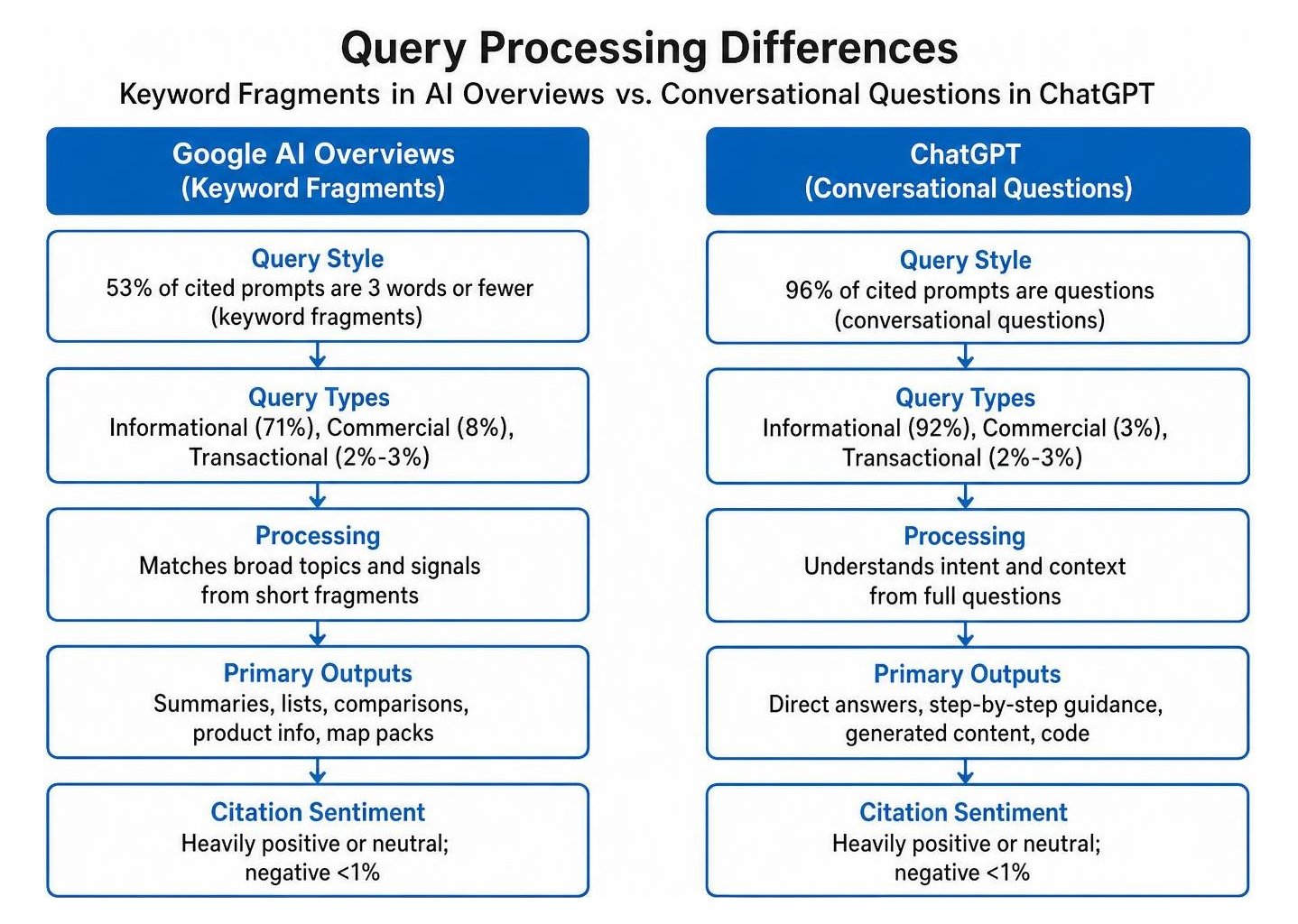
- Informational dominance: Informational intent accounts for 71% of cited volume on AI Overviews and 92% on ChatGPT.
- Query syntax: 53% of cited prompts on Google AI Overviews consist of three words or fewer (keyword fragments), whereas question-format prompts account for 96% of cited prompt volume on ChatGPT compared to just 21% on Google AI Overviews.
- Commercial and transactional volume: Commercial intent represents 8% of cited volume on Google AI Overviews and 3% on ChatGPT. Transactional queries represent only 2% to 3% across both environments.
- Sentiment framing: Citations on conversational platforms lean heavily positive or neutral; negative brand sentiment accounts for less than 1% of citations on both engines.
Conversational engines functionally re-categorize major platforms. For instance, video platforms are indexed primarily as how-to utilities, ecommerce sites function as factual product reference databases, and community forums are cited for consumer reviews. Reviewing real user prompt data makes it clear that conversational searchers ask complete questions expecting definitive answers.
How Can You Execute AI Search Intent Analysis for Business Content?
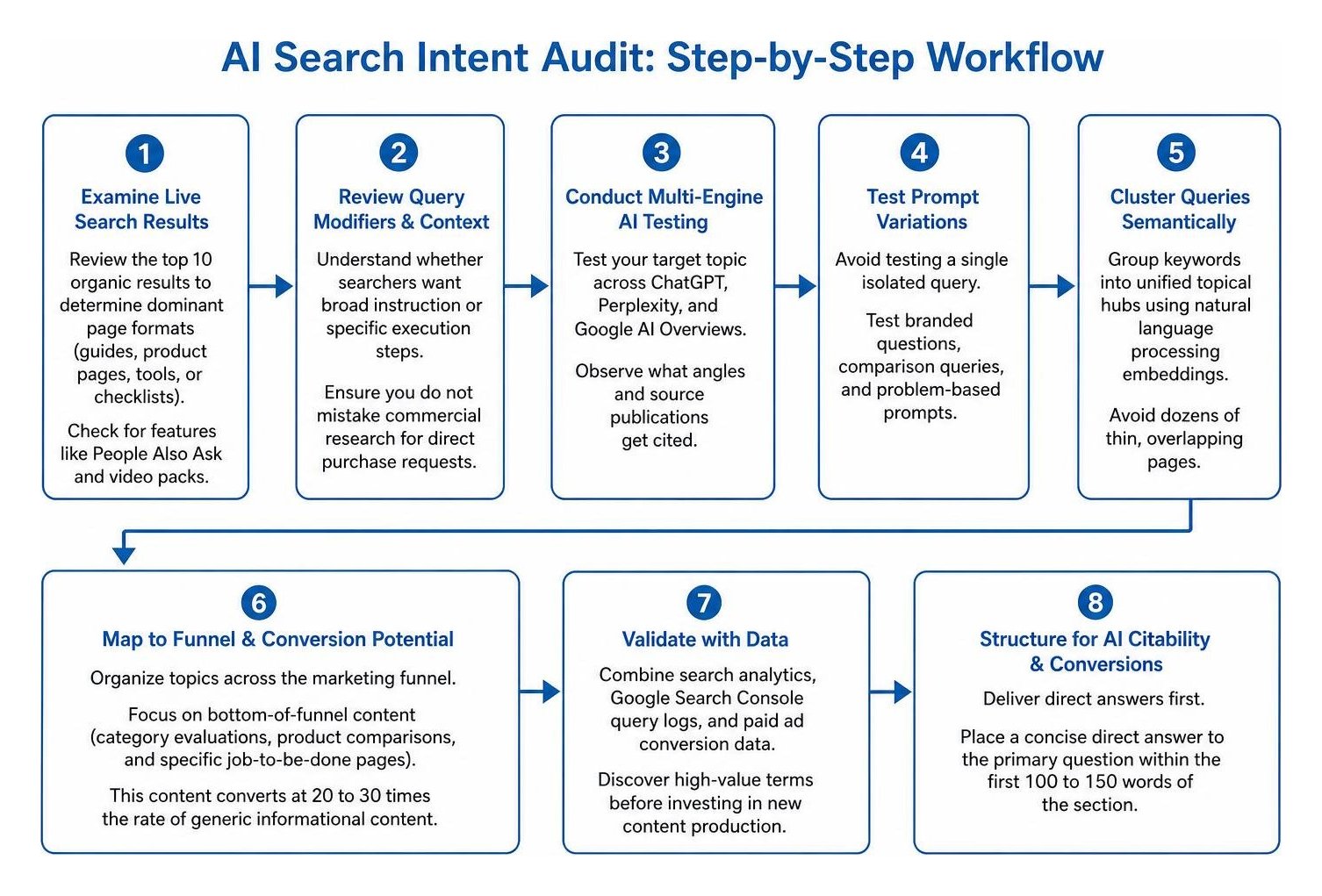
To execute AI search intent analysis effectively, start by auditing your target audience's questions, validate those topics against live search engine results and AI outputs, and organize your content assets around conversion potential.
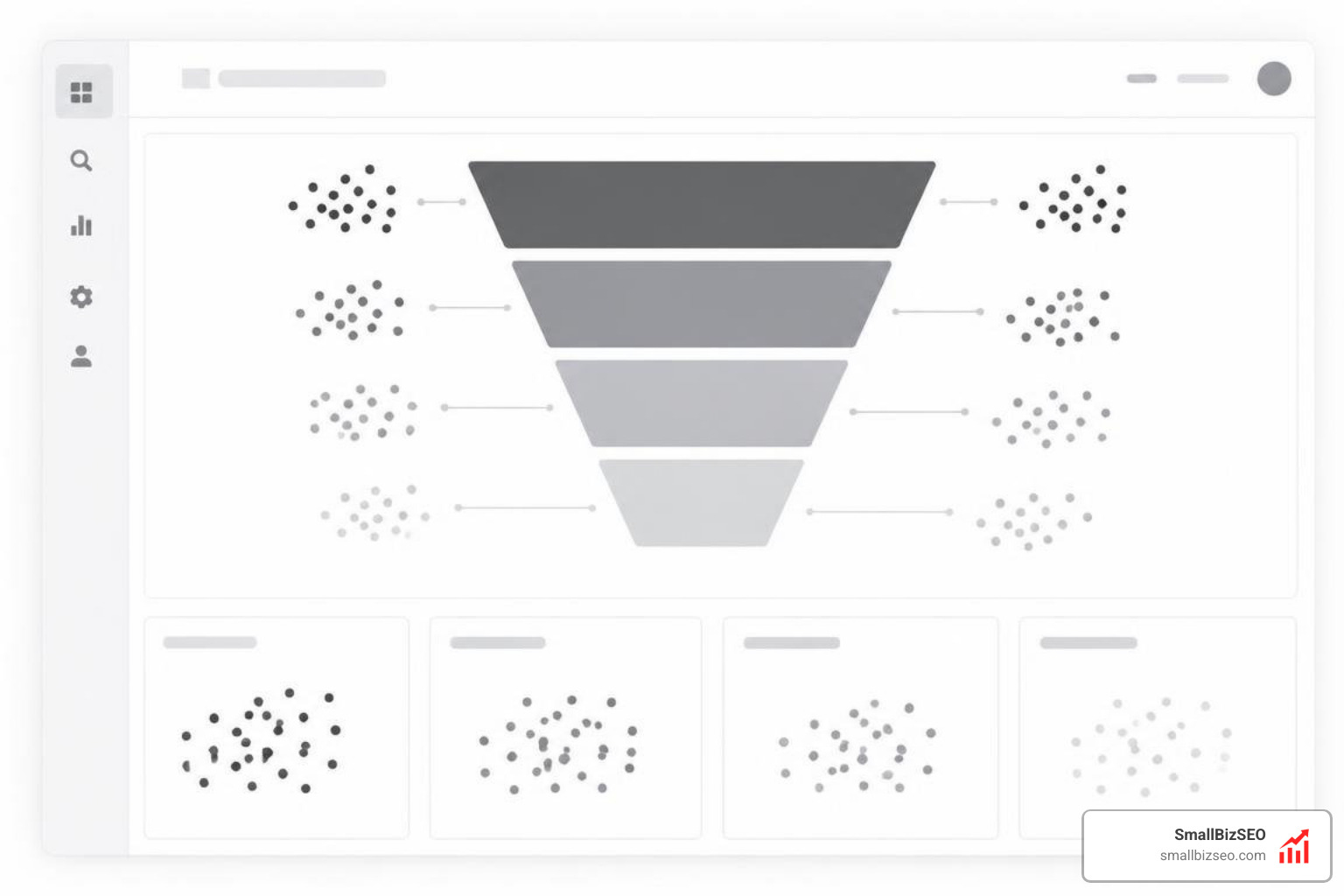
A successful strategy connects Search Intent Match principles with direct revenue generation. While top-of-funnel informational queries drive broad brand awareness, bottom-of-funnel content (such as category evaluations, product comparisons, and specific job-to-be-done pages) consistently converts at 20 to 30 times the rate of generic informational content.
Combining search analytics, Google Search Console query logs, and paid ad conversion data allows us to discover high-value terms before investing in new content production.
How Do You Analyze Search Intent Step by Step for Content Optimization?
We use a repeatable, structured framework to identify search intent before writing:
- Examine Live Search Engine Results: Review the top 10 organic results to determine dominant page formats (guides, product pages, tools, or checklists). Check for features like People Also Ask and video packs.
- Review Query Modifiers and Context: Understand whether searchers want broad instruction or specific execution steps. Learning how to analyze user intent behind search queries ensures you do not mistake commercial research for direct purchase requests.
- Conduct Multi-Engine AI Testing: Test your target topic across ChatGPT, Perplexity, and Google AI Overviews. Follow a practical guide to multi-step AI comparison research to observe what angles and source publications get cited.
- Test Prompt Variations: Avoid testing a single isolated query; remember that testing a single prompt warps your AI visibility data. Test branded questions, comparison queries, and problem-based prompts.
- Cluster Queries Semantically: Group keywords into unified topical hubs using natural language processing embeddings rather than building dozens of thin, overlapping pages.
How Should You Structure Content for AI Citability and Conversions?
To win visibility in AI summaries while maximizing on-page conversions, content must be formatted for both human readers and machine parsing:
- Deliver Direct Answers First: Place a concise direct answer to the primary question within the first 100 to 150 words of the section.
- Use Clear Heading Architecture: Use descriptive H2 and H3 subheadings that reflect the exact phrasing real customers use.
- Incorporate Extractable Data Elements: Structure key comparisons using clean Markdown tables, bulleted takeaways, and numbered walkthroughs.
- Track Technical and Citability Signals: Conduct an AI SEO audit to ensure your technical markup, structured data schema, and crawl efficiency are fully optimized for LLM scrapers.
At SmallBizSEO, we provide technical SEO, content strategy, and link-building services designed to help small businesses capture sustainable organic visibility. Our data-driven Velocity framework pairs deep intent mapping with transparent performance reporting to turn search interest into real pipeline.
Turn AI Intent Insights into Measurable Growth
Mastering AI search intent analysis means moving beyond simple keyword counts to understand the core problem your customer is solving. By diagnosing user goals across both traditional search engines and conversational AI platforms, you can craft clear, structured content that earns citations and guides prospects toward a buying decision.
Align your content strategy with real customer intent today by scheduling an assessment with our team through our SEO Visibility Audit or exploring our dedicated AI SEO Services. Reach out directly via our Contact Page to discover how our Velocity framework can accelerate your organic search performance.