Why Early-Stage Technical SEO Debt Costs Startups Millions in Lost Growth

Why Early-Stage Technical SEO Debt Costs Startups Millions in Lost Growth
How do you audit startup technical SEO before it costs you growth?
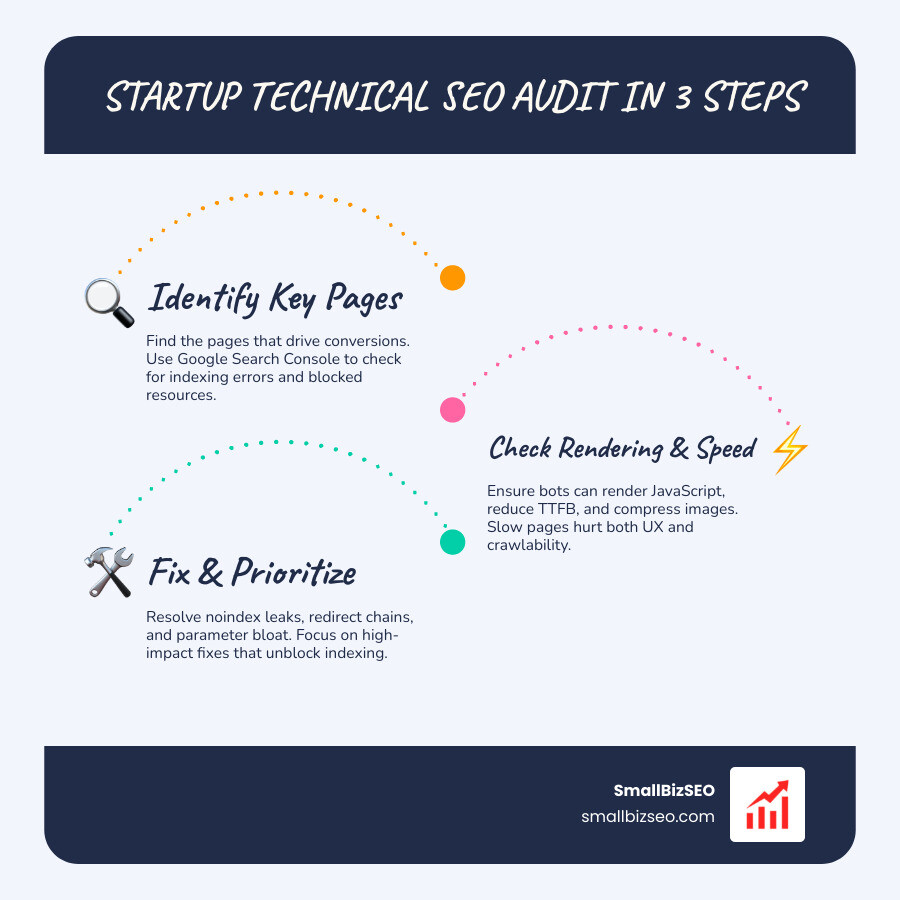
Start with the pages that could bring in customers. Check whether search engines can reach and index them, then inspect their mobile content, internal links, and load speed. Use Google Search Console to spot blocked pages and indexing errors. Fix those issues before spending time on smaller improvements.
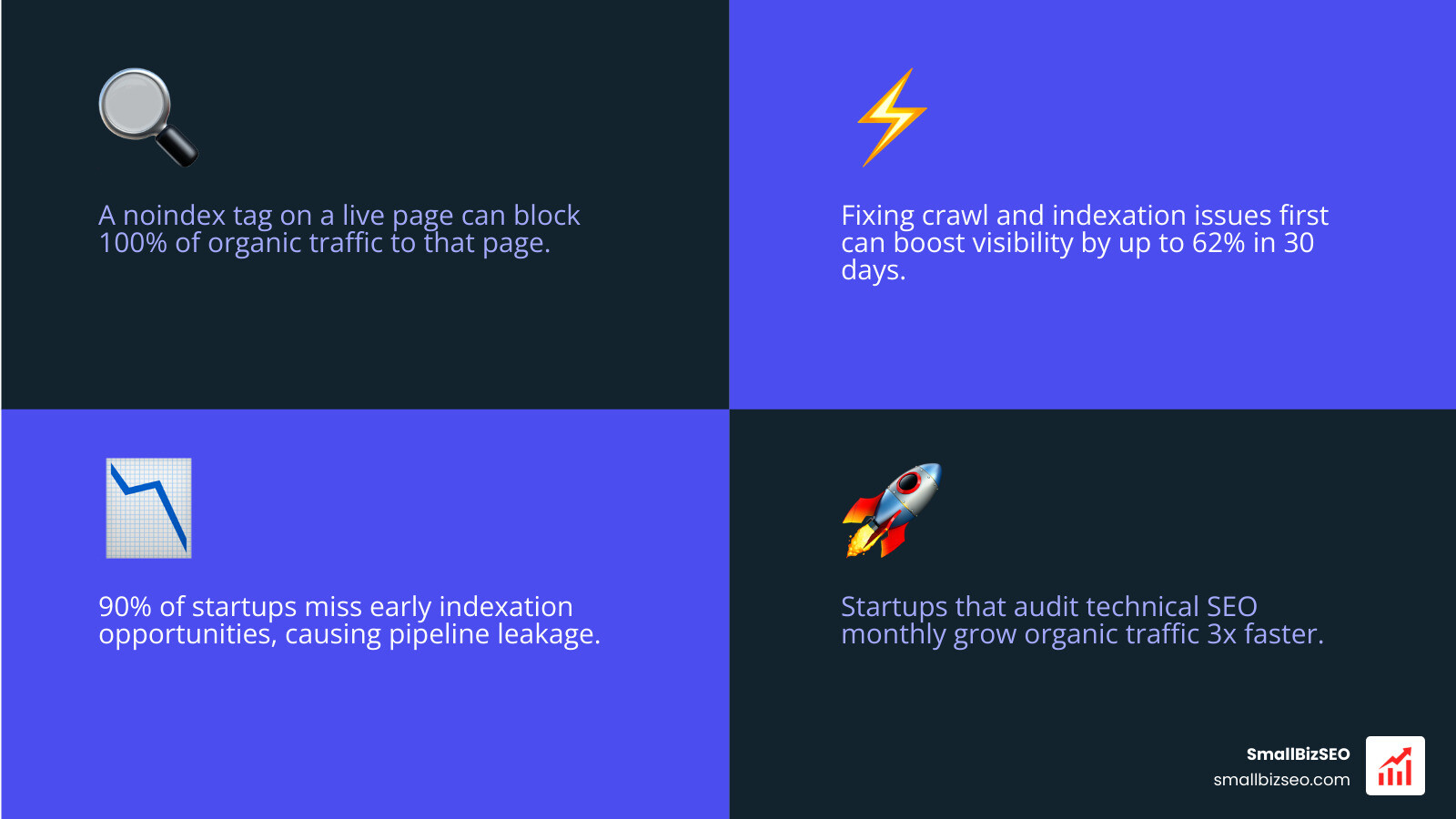
Technical SEO debt builds quietly. A noindex tag left on a live site or a key page hidden behind JavaScript can keep useful content out of search. For a startup with limited time, the cost is not just a slower website. It is missed chances to reach buyers as the business grows.
I’m Clayton Johnson, founder of SmallBizSEO. My work connects technical SEO, content, and clear reporting for small businesses, and I bring that practical approach to startup technical SEO.
Basic startup technical SEO glossary:
Nearly 90% of startups fail, often because of marketing bottlenecks and an inability to build scalable customer acquisition channels. For B2B SaaS organizations, organic search can deliver a 702% three-year return on investment with an average break-even timeline of roughly seven months. Yet, early indexation barriers and crawl budget waste quietly siphon off revenue. When developer bandwidth is constrained, technical debt compounds, turning what should be an efficient inbound engine into an expensive pipeline leak.
How to Execute a Complete Startup Technical SEO Audit
Conducting an audit requires systematically verifying that search engine bots can discover, render, understand, and index your primary conversion assets without friction.
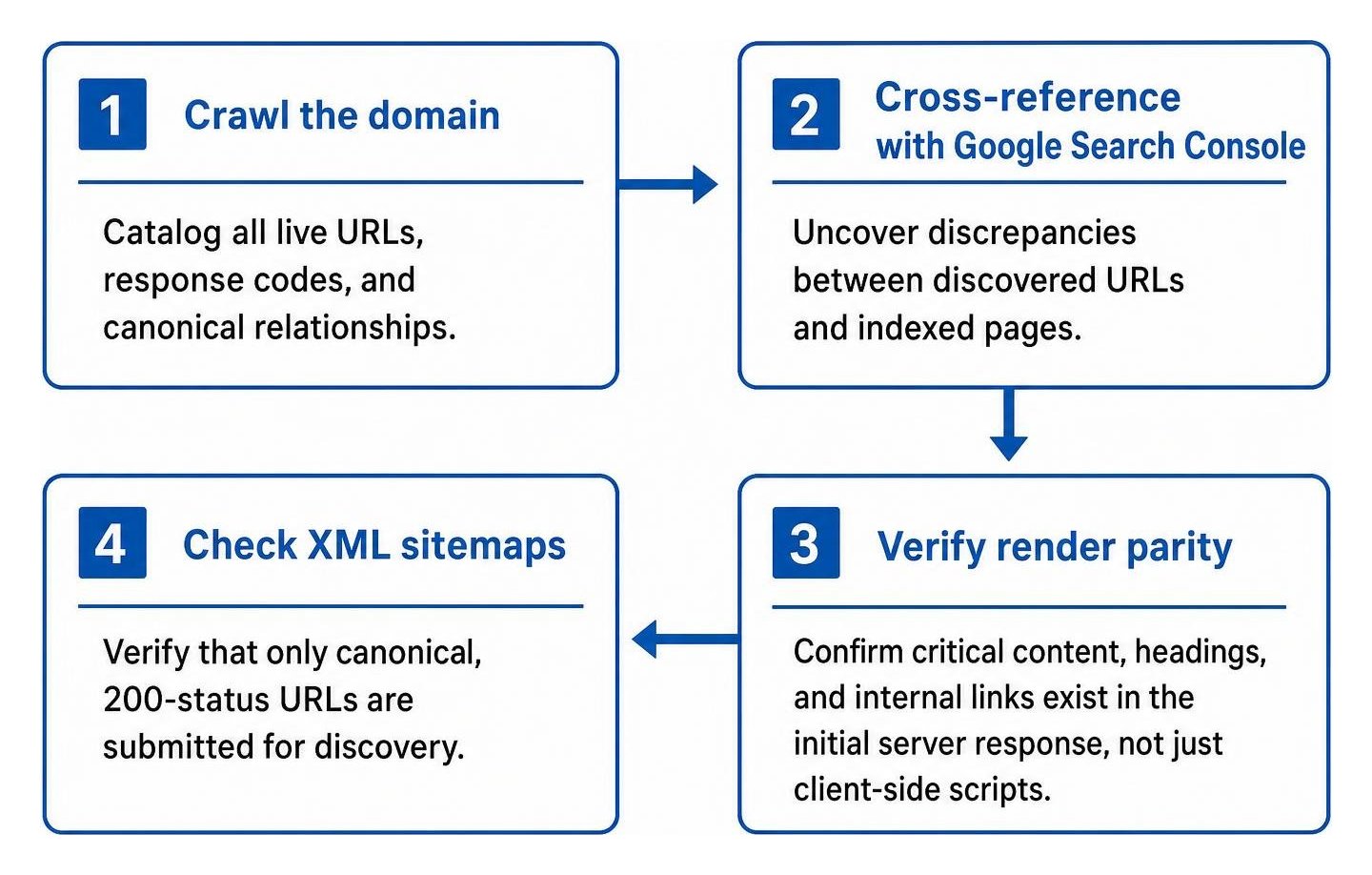
To execute an audit efficiently:
- Crawl the entire domain using standard diagnostic crawlers to catalog all live URLs, response codes, and canonical relationships.
- Cross-reference internal crawl data against Google Search Console to uncover discrepancies between discovered URLs and indexed pages.
- Verify render parity by confirming that critical content, headings, and internal links exist within the initial server response rather than relying purely on client-side script execution.
- Check XML sitemaps to verify that only canonical, 200-status URLs are submitted for discovery.
Following the core recommendations in Google's official Search Engine Optimization SEO Starter Guide ensures your audit targets baseline requirements without chasing low-impact vanity metrics.
What Are the Core Foundations of Startup Technical SEO from Day One?
The primary foundation of startup technical SEO is a clean, logical site architecture built upon clear directory hierarchies and uniform URL naming conventions. Every indexable page must contain a self-referential canonical tag to consolidate link equity and prevent duplicate parameter variations from fragmenting search signals.
A startup must implement site-wide HTTPS encryption to prevent security warnings and maintain trust. Your robots.txt file must be configured carefully to keep search engines from wasting resources on staging environments or internal search queries while keeping public product paths open.
To establish authority, deploy JSON-LD structured data directly into page templates. Implementing Organization and SoftwareApplication schema helps automated crawlers classify your product category, pricing models, and core capabilities accurately. Founders looking to align their technical stack with modern search landscapes can study our technical SEO guide to establish structured entity signals early.
How Does JavaScript Rendering and Site Speed Impact Startup Technical SEO?
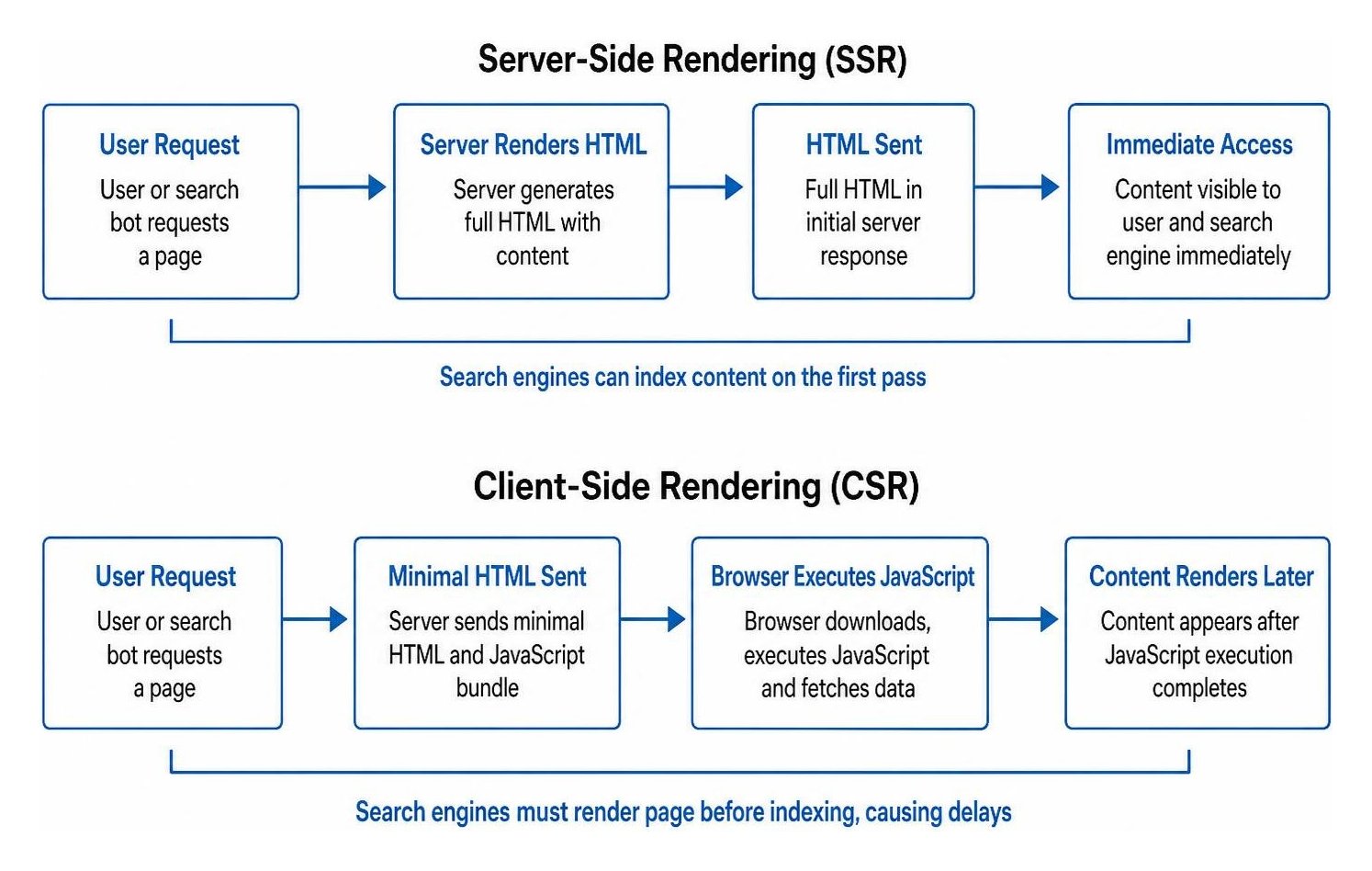
Modern JavaScript frameworks like Next.js, React, and Vue can create severe discoverability issues if they rely exclusively on client-side rendering. While search engine bots can render JavaScript, the two-phase indexing process means client-side content often sits in a rendering queue, delaying indexation of critical conversion pages. Implementing server-side rendering or static generation guarantees that search bots receive full HTML content on the first pass.
Site speed directly dictates whether an early-stage site can capture organic interest. Improving page speed without dedicated engineers requires focusing on server response times and asset compression:
- Configure edge caching on a content delivery network to lower Time to First Byte to under 100 milliseconds.
- Convert all images to lightweight modern formats like WebP or AVIF, which reduce payload size by 25% to 50% without visual degradation.
- Optimize your First Contentful Paint score by preloading primary brand fonts using
font-display: swapand hosting font files locally. - Minimize third-party tracking pixels; loading non-essential scripts via defer or async attributes prevents them from blocking the browser's main thread.
Startups that solve these rendering and infrastructure hurdles early can unlock extraordinary visibility across organic search channels.
How Do You Detect and Fix Crawlability and Indexation Traps?
The most destructive technical traps for startups stem from forgotten development settings, broken redirect chains, and URL parameter sprawl. Staging site noindex directives accidentally deployed into production can instantly wipe out hard-won organic rankings. Similarly, unmanaged faceted navigation filters generate endless thin URLs that exhaust search bot crawl allocations.
Startups needing to resolve indexing roadblocks can review strategies for deep indexing and crawling issue remediation and explore our comprehensive guide to critical SEO audit errors to diagnose infrastructure failures quickly.
| Indexation Trap | Root Cause | Diagnostic Method | Rapid Resolution |
|---|---|---|---|
| Accidental Production Noindex | Staging environment meta tags pushed live | Search Console Coverage "Excluded by 'noindex' tag" | Remove a robots meta tag set to noindex header |
| Crawl Budget Exhaustion | Faceted search generating millions of dynamic URLs | Log file analysis showing repetitive query parameter crawling | Add canonicals to parent categories; disallow parameters in robots.txt |
| Orphaned High-Intent Pages | Navigation redesign removing links to legacy feature pages | Screaming Frog crawl vs XML sitemap URL comparison | Add contextual internal links from parent category pages |
| Redirect Chains & Loops | Multiple platform migrations without 1-to-1 redirect mapping | HTTP status code crawler flagging multi-hop 301 paths | Update internal links and point legacy URLs directly to the final 200-status URL |
Prioritizing and Resolving Technical Debt to Scale Pipeline
Resolving technical debt requires organizing fixes into an engineering-ready framework that developers can immediately execute during standard sprint cycles.

Rather than delivering an ambiguous list of suggestions, technical issues must be converted into clear tickets that include:
- The exact URL path affected.
- The specific business impact of the technical roadblock.
- The proposed technical fix with code samples or configuration parameters.
- Acceptance criteria for QA validation prior to production deployment.
What Role Do Core Web Vitals and Page Experience Play in AI-Era Search?
Core Web Vitals—specifically Largest Contentful Paint, Cumulative Layout Shift, and Interaction to Next Paint—serve as direct ranking signals under modern search quality standards. Sites that fail basic performance metrics suffer higher user bounce rates, which suppresses conversion momentum across organic channels.
Because mobile performance underpins modern discovery, adhering to mobile-first indexing compliance is mandatory. In modern search landscapes, artificial intelligence engines synthesize direct answers from indexed pages. AI Overviews trigger on roughly 25% of search queries, with content that addresses specific sub-queries proving 161% more likely to be cited in generative summaries.
Structured HTML data, clear entity headings, and fast page response times ensure your content can be parsed and extracted by automated search systems before competitors establish category dominance.
How Should Startups Prioritize Fixes with Limited Engineering Resources?
When developer resources are tight, startups must prioritize technical tasks using an impact-versus-effort matrix.
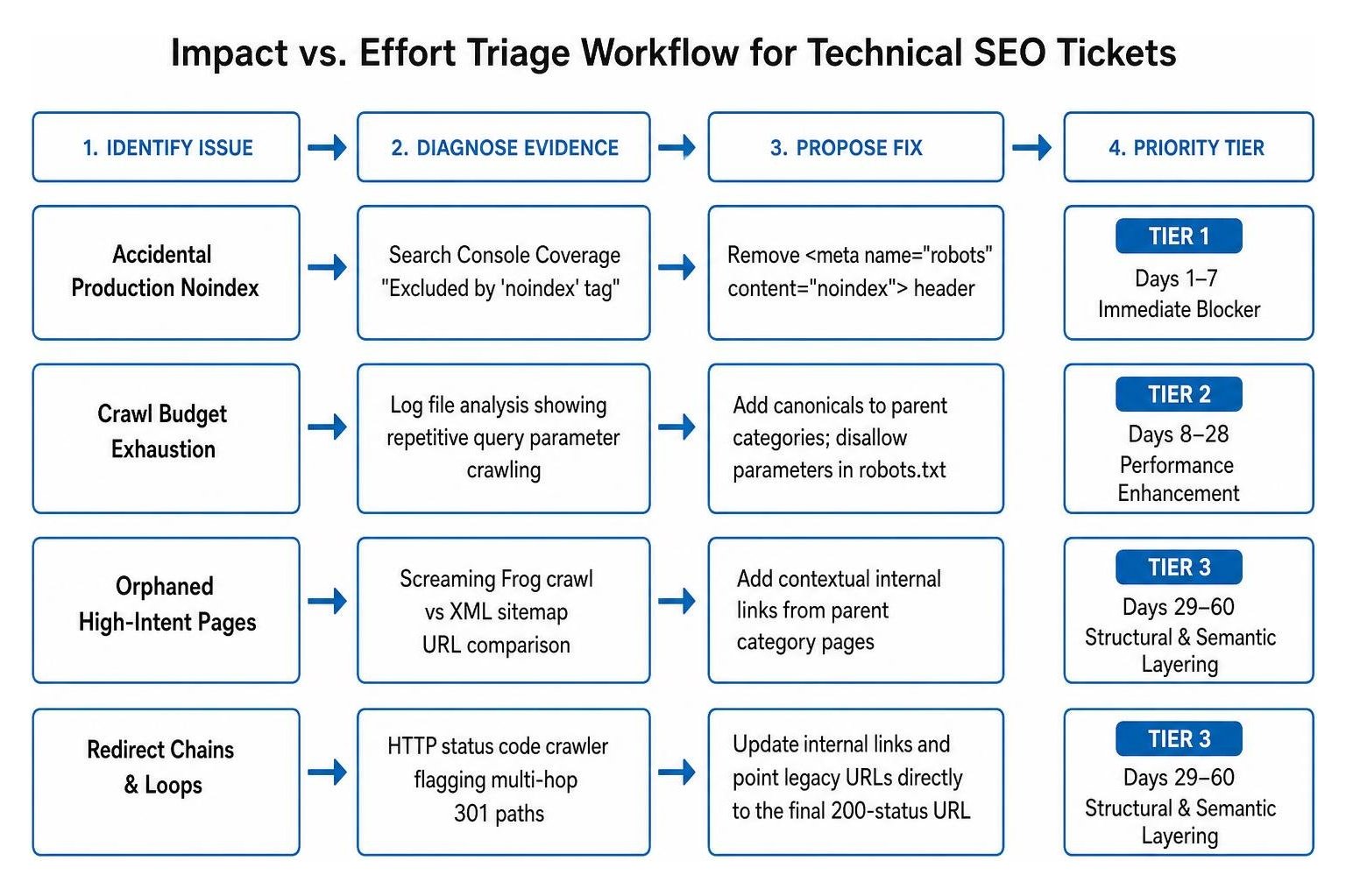
- Immediate Tier-1 Blockers (Days 1–7): Resolve
noindexleaks, server 500-level errors, broken canonical tags, and robots.txt misconfigurations that stop search engines from reading conversion pages. - Tier-2 Performance Enhancements (Days 8–28): Implement CDN edge caching, convert media assets to modern WebP formats, and streamline heavy JavaScript bundles to pass Core Web Vitals thresholds.
- Tier-3 Structural and Semantic Layering (Days 29–60): Deploy advanced JSON-LD structured data, eliminate redirect chains, and optimize internal linking architecture across related topic clusters.
Before major software overhauls or site updates, founders should review our website redesign SEO checklist to prevent ranking drops. At SmallBizSEO, our data-driven Velocity framework isolates high-impact technical adjustments, giving resource-constrained teams transparent, automated reporting and rapid pipeline results.
Building a Search Foundation That Scales
Technical SEO is not a one-time maintenance chore—it is the structural foundation of your company's organic acquisition engine. By eliminating rendering roadblocks, resolving crawl traps, and optimizing core page assets from day one, early-stage businesses protect their engineering runway and ensure that every piece of content published drives compounding organic pipeline.
If you are ready to remove technical bottlenecks and accelerate your organic visibility, you can schedule an expert SEO visibility audit with our team to unlock sustainable search growth.