Beginner’s Guide to ChatGPT Brand Monitoring Methods
What Is ChatGPT Brand Monitoring?
Chatgpt Brand Monitoring means regularly checking whether ChatGPT mentions your business, how it describes you, and which sources it cites. To start, test a few questions your customers might ask, save the answers, and repeat the checks each month. Compare results across prompts because ChatGPT's answers can change with the wording and whether it uses web search.
This guide shows you what to track, how to spot wrong information, and where to focus your efforts when your business is missing from an answer.
I'm Clayton Johnson, founder of SmallBizSEO, where I help small businesses connect SEO, content, and digital PR with stronger search visibility. I apply that same Answer-Ready SEO approach to Chatgpt Brand Monitoring: ask useful customer questions, check the answers, and make your business information clear and consistent.
Quick Chatgpt Brand Monitoring definitions:
- Meaningful brand mentions vs. passing references
- Monitoring incorrect business details in AI brand mentions
Why ChatGPT Brand Monitoring Matters for Modern Businesses
ChatGPT brand monitoring matters because conversational engines directly generate a shortlist of top brands for buyers before they ever visit a website. ChatGPT processes 2.5 billion queries per day and serves more than 900 million weekly active users, making it a primary discovery tool for products and services.
When prospective buyers research solutions, ChatGPT narrows multi-product categories down to two or three options in its conversational text. Research shows that 87.4% of all AI referral traffic comes from ChatGPT. Furthermore, B2B visitors referred from ChatGPT convert at an average rate of 15.9%, compared to just 1.76% from traditional Google organic search.
As detailed in discussions on workplace AI adoption, generative tools are embedded inside professional research workflows. To capture this high-intent demand, businesses must embrace answer engine optimization rather than relying solely on traditional search engine results pages.
However, brand risk is substantial: 56% of users encounter incorrect AI responses about brands, and 42% trust that information without questioning it. If ChatGPT shares outdated pricing, describes deprecated features, or omits your company entirely, you lose customers silently.
How Does ChatGPT Brand Monitoring Differ from Traditional SEO?
Traditional SEO tracks numerical rankings on a public results page, whereas ChatGPT brand monitoring evaluates whether your business is included, recommended, and accurately represented inside an AI-synthesized answer.
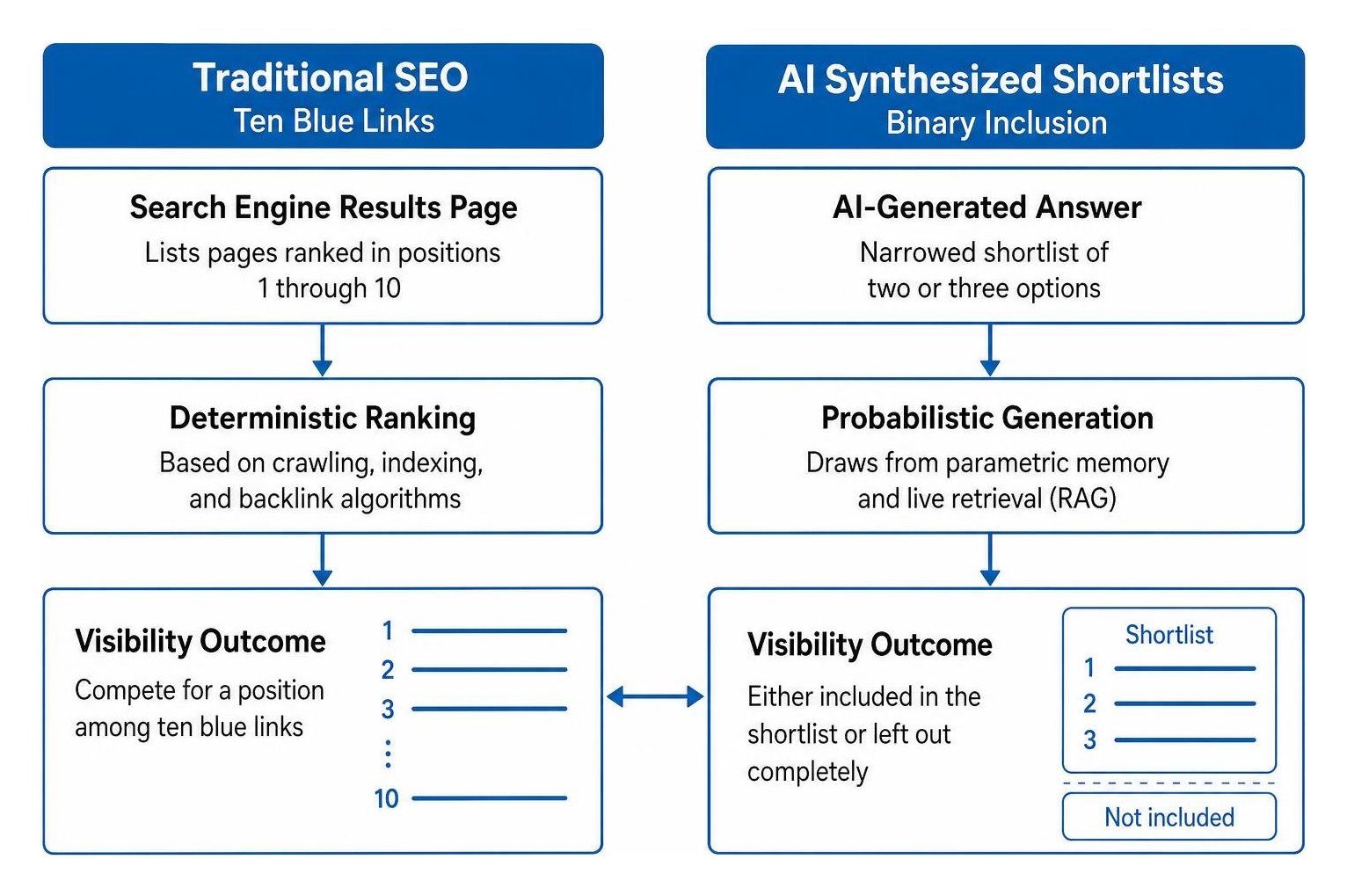
In standard search engine optimization, pages rank in positions 1 through 10 based on deterministic crawling, indexing, and backlink algorithms. In contrast, generative AI visibility is largely binary: your company is either synthesized into the generated recommendation or left out completely.
Understanding why generative search engines change recommendations requires recognizing that large language models generate probabilistic answers from two distinct systems:
- Parametric Memory: Static historical training data stored in the model weights. Around 65.5% of ChatGPT responses rely strictly on this training data without browsing the live web.
- Live Retrieval (RAG): Real-time search queries pulled via search engines to ground the conversation in fresh web data.
Unlike social listening tools that monitor public user-to-user comments on forums, ChatGPT conversations occur within private interfaces. Reviewing AI brand tracking fundamentals highlights that monitoring must evaluate synthesized model consensus rather than individual public social posts.
What Are the Core Metrics and Citations to Track in AI Responses?
To track your brand accurately in conversational AI, measure brand mentions, share of voice, sentiment, recommendation position, cited source URLs, and competitor co-occurrence.
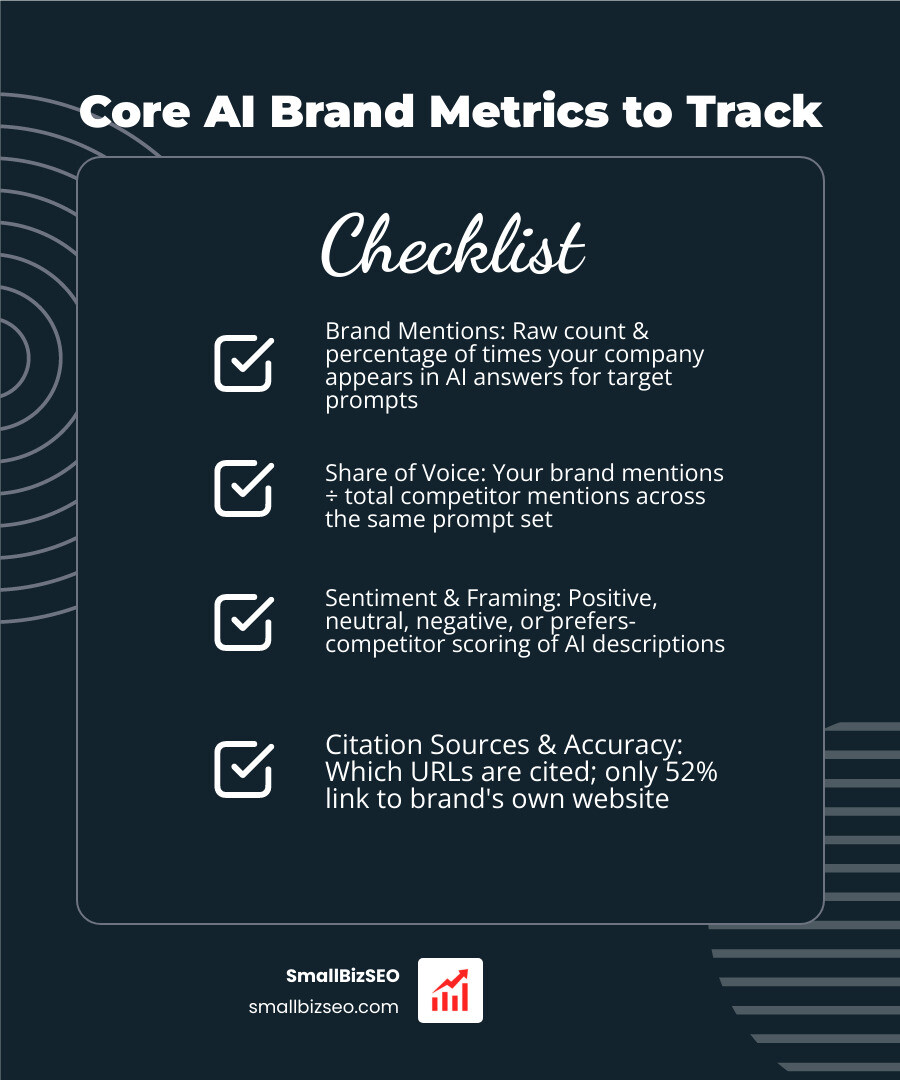
- Brand Mentions: The raw count and percentage of times your company name appears in generated answers for target category prompts.
- Share of Voice: Your total brand appearances divided by the total mentions of all competing brands across the same prompt set. A deeper review of understanding brand visibility metrics helps you benchmark these proportions over time.
- Sentiment and Framing: An evaluation (positive, neutral, negative, or prefers-competitor) scoring how favorably the model describes your products.
- Mention Positioning: Where your brand appears in the response body. Early placement drives primary buyer consideration, while later mentions often serve as decorative secondary examples.
- Citation Sources and Accuracy: The specific third-party URLs linked in the response. Studying understanding AI citation rate impact reveals that when ChatGPT names an audited brand, it links to the brand's own website only 52% of the time, often citing third-party review directories instead. In 15% of answers with web search active, it cites no sources at all.
- Competitor Co-occurrence: The specific market rivals generated alongside your brand, which you can evaluate by benchmarking competitors in AI search.
How Can Businesses Monitor and Improve Their ChatGPT Brand Visibility?
Businesses can monitor and improve their AI presence by querying target customer prompts, recording text outputs and citation sources, establishing an audit cadence, and updating authoritative reference sites.
Because generative AI is being adopted across strict sectors, such as financial AI workflows, tracking must be structured, repeatable, and compliant with internal data privacy rules. At SmallBizSEO, we implement structured tracking protocols to ensure small businesses maintain accurate data across modern search models using our dedicated brand mention monitoring strategy.
What Are the Essential Steps to Set Up Your ChatGPT Brand Monitoring Workflow?
To establish a functional ChatGPT monitoring system, select your prompt set, choose a manual or automated tracking method, and audit outputs on a 30-day schedule.
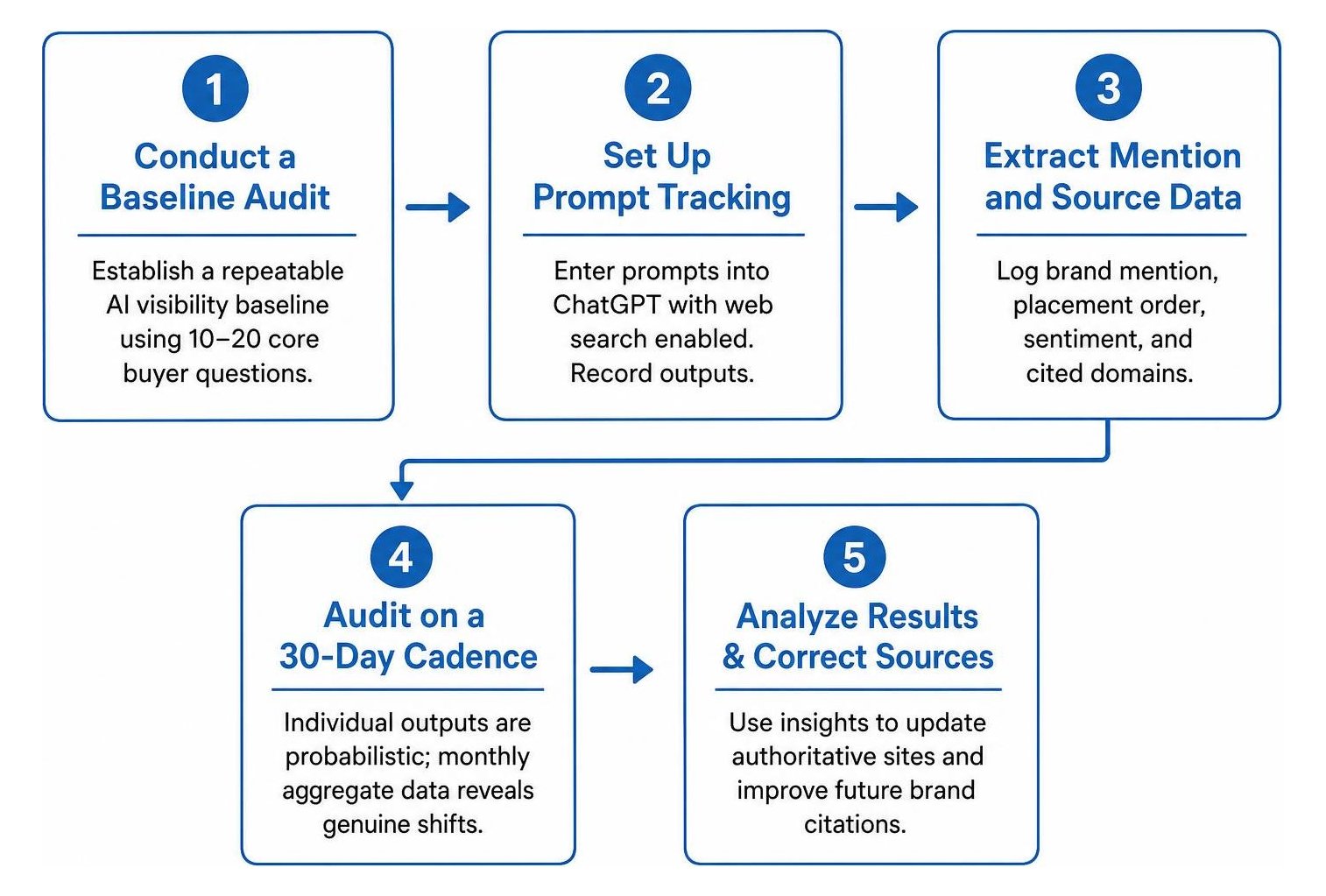
- Step 1: Conduct a Baseline Audit: Start by establishing a repeatable AI visibility baseline using 10 to 20 core buyer questions.
- Step 2: Set Up Prompt Tracking: Enter prompts into ChatGPT with web search enabled to verify what ChatGPT Search says about your business. Record outputs in a structured spreadsheet or an automated monitoring tool.
- Step 3: Extract Mention and Source Data: Log whether your brand was named, your placement order, the sentiment, and any cited external domains.
- Step 4: Audit on a 30-Day Cadence: Individual prompt outputs are probabilistic, but monthly aggregate data reveals genuine shifts in underlying model memory and retrieval consensus.
Which Prompts Should You Test to Uncover AI Recommendations?
Test natural language buyer prompts that reflect how real consumers seek recommendations, comparisons, and problem solutions.
Analyzing real user prompt data indicates that conversational searches average 348 words per session—nearly 70 times longer than classic keyword queries. Focus your testing on these core prompt variations:
- Category Discovery Prompts: "What are the best [product/service category] platforms for small businesses?"
- Competitor Comparison Prompts: "Compare [Your Brand] vs [Competitor] for ease of use and pricing."
- Alternative and Switcher Prompts: "What are the top alternatives to [Leading Competitor]?"
- Problem-Solving Prompts: "How do I solve [specific operational pain point], and what tools help?"
- Direct Branded Prompts: "What is [Your Brand], what does it cost, and what are its main drawbacks?"
- Persona and Criteria Queries: "Recommend the top 3 [category] tools for a remote team of 15 with a limited budget."
Which Tools and Software Track Brand Mentions in AI Search?
You can track ChatGPT brand mentions through manual spreadsheet testing or dedicated AI search tracking platforms that log text mentions, sentiment, and cited domains automatically.
| Tool / Method | Primary Approach | Best Used For | Key Tracking Features |
|---|---|---|---|
| Manual Spreadsheets | Manual prompt entry + text search formulas | Small businesses tracking 5–10 core prompts | Zero software cost, custom qualitative review |
| Otterly.AI | Automated multi-engine prompt audits | Tracking visibility and sentiment across LLMs | Automated prompt testing, sentiment breakdown |
| Visualping | Web page action scraping (Type, Click, Wait) | Monitoring exact live ChatGPT user interface | Change alerts on live chat answers without APIs |
| SE Ranking | Dedicated ChatGPT Visibility Tracker | Agency and enterprise rank tracking | Citation URL tracking, Model Context Protocol integration |
| Keyword.com | Automated SERP and LLM response scraping | SEO teams tracking AI share of voice | Verifiable response snapshots, competitor tracking |
| AuditAE | Pay-per-check API prompt auditing | Budget-conscious teams testing prompt batches | In-text mention extraction, citation gap analysis |
| Kairosy AI | Multi-model sentiment scoring | Auditing training data memory across models | 0–100 sentiment scoring, verbatim answer logs |
How Can You Fix Inaccurate Information and Improve AI Visibility?
To correct inaccurate AI outputs and earn recommendations, fix underlying source data across the web, publish structured schema, build third-party consensus, and implement an llms.txt file.
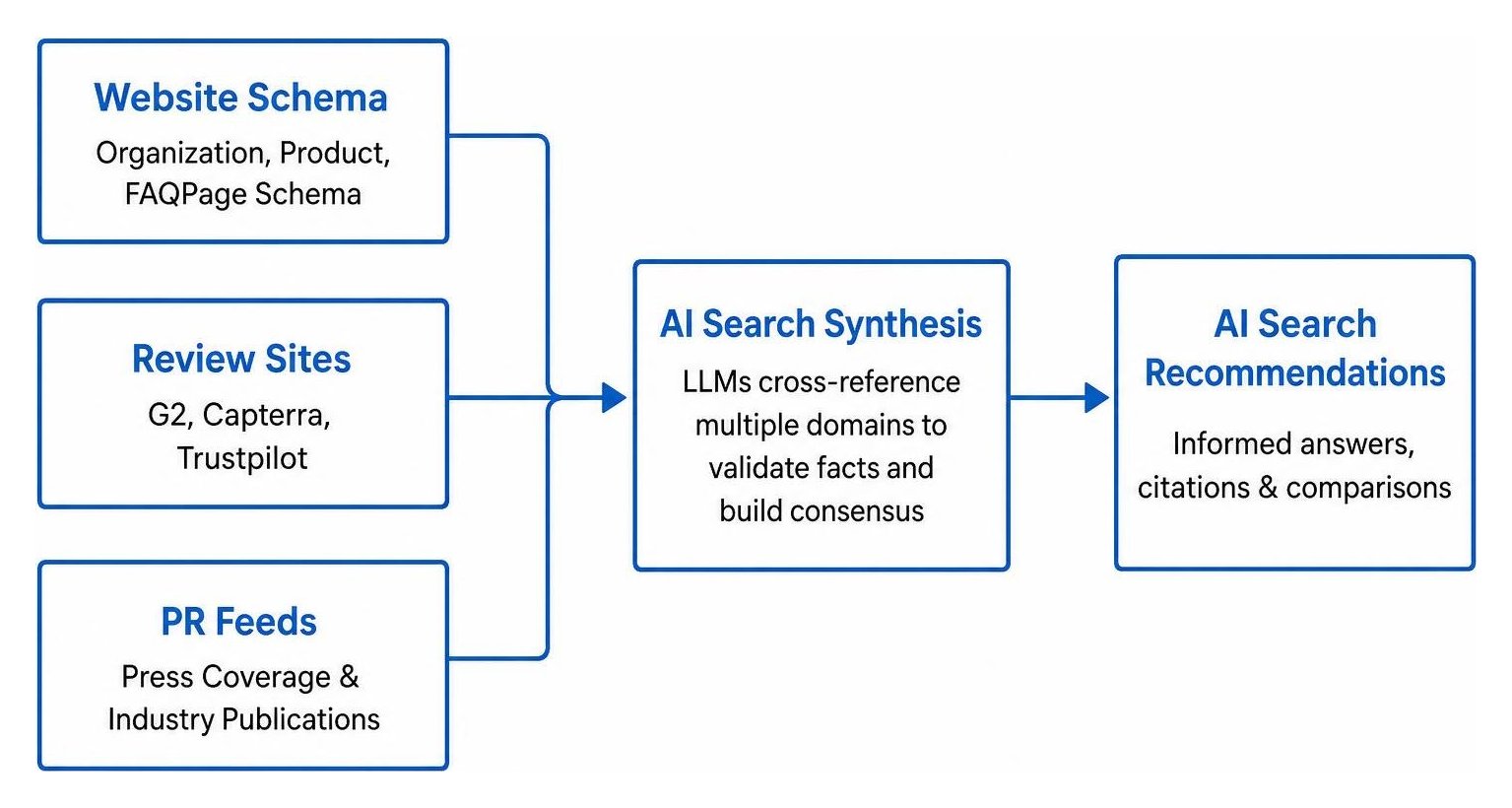
Taking proactive steps to improve your AI search brand visibility involves treating AI optimization as an authority and consensus challenge. When auditing your AI presence and inaccurate business details, apply these optimization tactics:
- Correct Citations at the Source: ChatGPT relies on high-authority industry platforms for retrieval. Update your company profiles, pricing, and feature sets on G2, Capterra, Trustpilot, and directory listings.
- Build Multi-Source Consensus: LLMs cross-reference multiple domains to validate facts. Secure press coverage and digital PR placements across industry publications to reinforce your core positioning.
- Implement Structured Schema Markup: Add Organization, Product, and FAQPage schema to your site to make your technical entity data easy for AI search crawlers to parse.
- Publish Clear Comparison Content: Create transparent "Brand vs. Competitor" pages on your website that directly answer common buyer evaluation questions.
- Deploy an llms.txt File: Place a clean markdown file at your domain root (yourwebsite.com/llms.txt) summarizing your company's core services, target audience, pricing tiers, and documentation for AI parsers.
Protecting Your Business Reputation in AI Search
Tracking your brand in ChatGPT is no longer optional for growing companies. With hundreds of millions of users relying on conversational models for purchase decisions, your business is either actively recommended on the AI shortlist or handed over to competitors.
By running monthly prompt audits, tracking in-text mentions and citation sources, and strengthening your web authority, we help you ensure that AI engines represent your business accurately and drive high-converting referral traffic.